Sales forecasting in e-commerce is the practice of predicting future sales based on historical performance, customer behavior, seasonality, and market trends. It helps online businesses estimate how much they are likely to sell over a specific period so they can plan inventory, marketing, and operations with more confidence.
For today’s e-commerce brands, sales forecasting is no longer optional. Demand shifts quickly due to changing customer preferences, flash sales, and seasonal spikes, while rising ad costs make it expensive to guess wrong. Without reliable forecasts, businesses risk overstocking slow-moving products or running out of high-demand items at critical moments.
Accurate sales forecasting gives e-commerce teams a clearer view of what’s coming next. It supports smarter inventory decisions, better cash flow planning, and more effective marketing strategies, helping brands stay competitive in an increasingly crowded online market.
Key Takeaways
- Sales forecasting helps e-commerce businesses predict future revenue using historical data, trends, and customer behavior.
- Accurate forecasts reduce the risk of overstocking and stockouts, protecting cash flow and customer trust.
- Rising advertising costs make sales forecasting essential for planning promotions and marketing spend more efficiently.
- E-commerce brands use sales forecasting to align inventory, marketing, and operations with real demand.
- Modern forecasting tools and AI improve accuracy by adjusting predictions based on real-time data.
- Consistent sales forecasting supports sustainable growth across multiple sales channels
What Is Sales Forecasting in E-Commerce
Sales forecasting in e-commerce is the process of estimating future sales by analyzing past performance and current business signals. It helps online retailers anticipate customer demand, plan inventory levels, and prepare marketing and operational strategies in advance. Instead of relying on assumptions, forecasting uses data to guide decision-making across the business.
In e-commerce, sales forecasting is especially important because demand can change quickly due to seasonality, promotions, pricing changes, and shifts in customer behavior. Accurate forecasts allow businesses to stay prepared for peak periods while avoiding excess stock during slower sales cycles. This makes forecasting a core part of running a profitable and scalable online store.
To create reliable sales forecasts, e-commerce businesses rely on multiple data inputs that reflect both demand and supply-side factors. These inputs help improve accuracy and ensure forecasts align with real market conditions.
Key inputs used in ecommerce sales forecasting include:
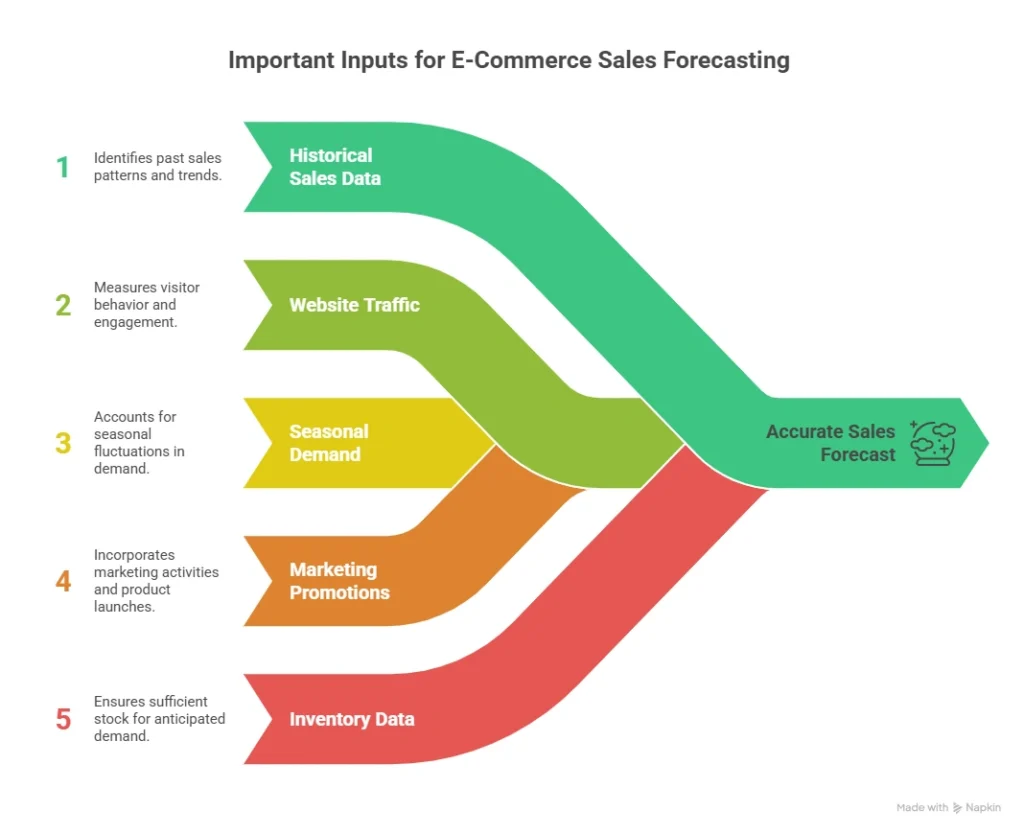
- Historical sales data to identify patterns, trends, and repeat demand over time.
- Website traffic and conversion rates to understand how visitor behavior impacts sales volume.
- Seasonal demand patterns such as holidays, sales events, and industry-specific peak periods.
- Marketing and promotion calendars to account for discounts, campaigns, and product launches.
- Inventory and supply chain data to align forecasts with stock availability and replenishment timelines.
When these inputs are analyzed together, sales forecasting becomes a practical tool that helps e-commerce teams plan with confidence rather than react to unexpected demand changes.
Why Sales Forecasting Is Critical for E-Commerce Businesses
Sales forecasting plays a critical role in helping e-commerce businesses operate with clarity and control. With demand constantly shifting due to seasonality, promotions, and changing customer behavior, relying on guesswork can quickly lead to costly mistakes.
Accurate forecasting gives decision-makers a data-backed view of future sales, helping them plan inventory, marketing, and finances more effectively.
Prevents Overstocking and Stockouts
Inaccurate sales forecasts often result in overstocking slow-moving products or running out of high-demand items at the wrong time. Overstocking ties up working capital, increases storage costs, and leads to heavy discounting, while stockouts cause missed sales opportunities and frustrate customers. Sales forecasting helps balance inventory levels by aligning supply with expected demand.
- Reduces excess inventory and warehousing costs
- Minimizes lost sales due to out-of-stock products
- Improves order fulfillment and customer satisfaction
- Protects brand reputation and repeat purchase rates
Improves Cash Flow Planning
Sales forecasting gives e-commerce businesses better visibility into cash flow and future revenue, making cash flow planning more predictable. When sales expectations are clear, teams can budget more accurately for advertising, operations, and supplier payments. This reduces financial stress and helps businesses avoid last-minute funding gaps.
- Supports realistic budgeting and financial planning
- Helps allocate ad spend based on expected returns
- Improves payment scheduling with suppliers and vendors
- Reduces the risk of cash shortages during low-demand periods
Supports Smarter Marketing Decisions
Marketing performance is closely tied to demand planning. Sales forecasting helps e-commerce teams time promotions, discounts, and ad campaigns around periods of high customer intent. Instead of over-promoting during slow demand or under-investing during peak seasons, forecasts help optimize marketing spend.
- Aligns promotions with expected demand spikes
- Prevents aggressive discounting when inventory is limited
- Improves ROI on paid ads and campaigns
- Helps marketing and inventory teams stay aligned
Enables Scalable Growth
As e-commerce businesses expand into new markets, sales channels, or product categories, forecasting becomes even more important. Growth without forecasting often leads to supply chain strain, inconsistent customer experiences, and operational bottlenecks. Sales forecasting provides the structure needed to scale with confidence.
- Supports expansion into new regions or marketplaces
- Helps plan inventory for new product launches
- Improves coordination across sales channels
- Reduces risk during rapid business growth
If your business is struggling with an inventory imbalance or unpredictable demand, exploring smarter forecasting tools can make a measurable difference. Learn how NetSuite Demand Planning helps e-commerce businesses align sales forecasts with inventory and financial planning for better control and scalability.
Key Benefits of Sales Forecasting in E-Commerce
Sales forecasting delivers measurable benefits that help e-commerce businesses operate more efficiently and plan with greater confidence. By using accurate demand predictions, teams can align inventory, finances, and operations with real customer needs instead of reacting to problems after they occur.
- Better inventory management
Sales forecasting helps businesses stock the right products in the right quantities. This reduces excess inventory while ensuring high-demand items are always available, especially during peak seasons.
- Reduced operational costs
Accurate forecasts minimize unnecessary storage, emergency replenishment, and last-minute shipping expenses. This leads to lower warehousing costs and more efficient use of operational resources.
- Higher customer satisfaction
When products are consistently in stock and delivered on time, customer trust improves. Sales forecasting supports smoother order fulfillment and fewer backorders, leading to better shopping experiences.
- More accurate revenue planning
Forecasting provides clearer revenue expectations, helping finance teams plan budgets, manage cash flow, and set realistic growth targets. This reduces financial uncertainty across the business.
- Stronger supplier and logistics coordination
With reliable forecasts, e-commerce businesses can communicate demand expectations to suppliers and logistics partners in advance. This improves replenishment planning and reduces supply chain disruptions.
These benefits make sales forecasting a foundational practice for e-commerce brands aiming to improve profitability and scale sustainably.
Types of Sales Forecasting Methods Used in E-Commerce
E-commerce businesses use different sales forecasting methods depending on their product mix, growth stage, and data availability. Choosing the right approach helps improve accuracy and ensures forecasts reflect actual market behavior rather than assumptions.
Historical Sales Forecasting
Historical sales forecasting relies on past sales data to predict future demand. It works best for e-commerce businesses with stable product lines and consistent purchasing patterns. By analyzing previous sales cycles, businesses can estimate future performance with reasonable accuracy.
- Uses past sales volumes as the primary input
- Best suited for products with steady demand
- Works well when seasonality patterns are consistent
- Less effective for new or rapidly changing products
Trend-Based Forecasting
Trend-based forecasting focuses on identifying upward or downward sales trends over time. This method is useful for growing e-commerce stores or businesses with seasonal demand fluctuations. It helps brands anticipate changes in demand rather than assuming sales will remain flat.
- Analyzes growth trends and demand shifts
- Useful for seasonal products and expanding catalogs
- Helps plan inventory for upcoming peak periods
- Requires frequent updates to stay accurate
AI and Predictive Analytics Forecasting
AI and predictive analytics forecasting use machine learning models to analyze large volumes of real-time and historical data. These systems continuously adjust forecasts based on customer behavior, market conditions, and external factors. This approach delivers higher accuracy for complex and fast-moving e-commerce environments.
- Uses machine learning to identify hidden demand patterns
- Processes real-time sales and customer data
- Adapts forecasts automatically as conditions change
- Ideal for large catalogs and multi-channel businesses
Each forecasting method has its place, but combining traditional approaches with AI-driven insights often delivers the most reliable results for modern e-commerce operations.
Read our blog on AI in ERP systems to understand how it will heelp in your eCommerce operations.
How Sales Forecasting Improves Inventory Management
Sales forecasting plays a direct role in strengthening inventory management by helping e-commerce businesses plan stock levels based on expected demand. Instead of reacting to shortages or excess inventory after problems arise, forecasting allows teams to take a proactive approach to inventory decisions. This leads to better stock control, lower carrying costs, and smoother order fulfillment.
At the core of effective inventory management, sales forecasting follows a simple, practical process that links demand data to supply planning.
- Analyzes past demand patterns to identify seasonality, repeat purchases, and product performance trends that influence inventory requirements.
- Predicts future product-level demand so inventory management teams know which SKUs will need faster replenishment and which may slow down.
- Aligns reorder points and safety stock levels with forecasted demand, helping maintain consistent stock availability without over-ordering.
- Reduces dead stock and rush replenishment by minimizing excess inventory and avoiding last-minute restocking at higher costs.
By integrating sales forecasting into inventory management workflows, e-commerce businesses gain better visibility, reduce operational risks, and maintain the right balance between product availability and cost efficiency.
Sales Forecasting vs Demand Planning in E-Commerce
Sales forecasting and demand planning are closely related but serve different purposes in e-commerce operations. While both rely on data to support decision-making, they answer different business questions. Sales forecasting focuses on estimating how much revenue a business expects to generate, while demand planning turns those forecasts into actionable inventory and supply plans.
In e-commerce, sales forecasting is typically the first step. It helps businesses understand expected demand based on historical sales, trends, and market signals. Demand planning builds on this insight by factoring in supply chain limitations, lead times, and inventory capacity to ensure products are available when customers want to buy.
| Aspect | Sales Forecasting | Demand Planning |
|---|---|---|
| Focus | Revenue prediction | Inventory execution |
| Time horizon | Short to mid-term | Mid to long-term |
| Data used | Sales data and demand trends | Sales data plus supply constraints |
| Outcome | Revenue estimates | Stock availability |
Forecasting provides visibility into future demand, while demand planning ensures inventory and supply chains are prepared to meet that demand without disruption.
How Modern Tools Improve Sales Forecasting Accuracy
Modern tools have transformed how e-commerce businesses approach sales forecasting. ERP systems, AI-powered platforms, and analytics tools provide faster, more accurate predictions by integrating multiple data sources, including sales history, inventory, and customer behavior. This allows businesses to make informed decisions and plan for demand fluctuations proactively.
- Automate forecasting – Tools can automatically generate forecasts across large product catalogs and multiple channels, saving time and reducing reliance on manual calculations.
- Reduce manual errors – Centralized data from websites, marketplaces, and ERP systems ensures consistency and minimizes mistakes caused by fragmented information.
- Adapt to real-time demand changes – Forecasts are updated automatically as new sales data, stock levels, or market shifts occur, helping teams respond to trends instantly.
By using these modern solutions, e-commerce businesses can improve inventory management, avoid costly stockouts or overstock, optimize marketing spend, and maintain smoother operational workflows. These tools turn sales forecasting into a proactive strategy rather than a reactive task, supporting growth and profitability.
Conclusion
Sales forecasting is an essential practice for e-commerce businesses that want to stay profitable, scalable, and competitive. By predicting future demand based on historical data, trends, and market signals, businesses can make informed decisions about inventory, marketing, and operations.
It also enables brands to plan for growth, expand into new markets, and manage multi-channel operations with confidence.
Take control of your e-commerce growth by integrating smart forecasting tools today. Explore how NetSuite Demand Planning can help your business optimize inventory, improve revenue planning, and scale efficiently across multiple channels.
FAQs
1. How often should e-commerce sales forecasts be updated?
Sales forecasts should be reviewed and updated regularly, ideally monthly or before major sales events like holidays or promotions. Frequent updates help businesses respond to sudden changes in demand, seasonal shifts, or market trends.
- Keeps inventory aligned with real-time demand
- Helps adjust marketing spend for peak periods
- Reduces the risk of stockouts or overstock
2. Is sales forecasting useful for small e-commerce businesses?
Yes, sales forecasting is valuable for small e-commerce businesses as it allows better planning and resource management. Even with limited products or a smaller team, forecasting helps avoid costly overstock, manage cash flow, and optimize marketing strategies.
- Supports smarter inventory management
- Helps allocate limited budgets efficiently
- Prepares the business for scalable growth
3. What data is most important for accurate sales forecasting?
Accurate forecasts rely on multiple data sources, including historical sales, website traffic, conversion rates, seasonal trends, and marketing campaigns. Integrating inventory and supply chain data ensures forecasts reflect both demand and fulfillment capabilities.
- Historical sales patterns and trends
- Customer behavior and website analytics
- Inventory and supplier data
- Marketing and promotion schedules
4. Can AI really improve e-commerce sales forecasting accuracy?
Absolutely. AI improves forecasting by analyzing large volumes of data in real time and detecting patterns humans might miss. Machine learning models adapt to trends, promotions, and unexpected market changes, producing more precise predictions for revenue and inventory planning.
- Identifies hidden demand patterns
- Adapts forecasts automatically to real-time changes
- Reduces manual errors and improves operational efficiency