Key Takeaways
- The North American ERP market for food businesses is growing fast, from $22.23B in 2025 to $35B by 2030. More companies are moving away from spreadsheets and legacy systems.
- Food ERP is not a generic ERP. It must handle lot traceability, recipes, FEFO inventory, allergen tracking, and compliance workflows.
- NetSuite, when configured correctly, is a strong cloud ERP option for mid-market food businesses. It brings production, inventory, financials, and compliance into one system.
- Your ERP implementation partner matters as much as the software. Industry experience directly impacts how well the system works from day one.
- The right ERP depends on your operation type. Batch manufacturers, distributors, and processors all need different setups.
- Traceability is critical in food operations. Weak systems slow down recalls and increase regulatory and financial risk.
A food manufacturer we spoke to last year had been running their beverage operation on a patchwork of tools. QuickBooks for accounting and a separate spreadsheet for batch records. Another tool for their warehouse. A third-party app manages customer orders.
A retailer raised a quality concern about a specific production batch. The manufacturer needed to pull the full trace on that batch within hours. Which ingredients came from which supplier? Which warehouse locations do they move through? Which customer orders received that batch?
It took their team 18 hours (time that could have been used somewhere else productively) and three people to piece it together. By then, the retailer had already made its decision.
That is the problem the right food industry ERP solves. It connects production, inventory, compliance, and distribution in one system so that when a question comes in, the answer is already there.
In this guide, we bring you the top ERP and software solutions for the food industry, what to look for before you choose, and how to match the right platform to your operation.
What Makes Food Industry ERP Different?
Food businesses face pressures that general manufacturing ERP is not designed to handle. Before you look at any platform, understand what sets food industry software apart.
The key differences:
| General ERP | Food Industry ERP |
|---|---|
| Standard inventory management | FEFO/FIFO controls for perishable stock |
| Basic BOM management | Recipe and formula management with batch scaling |
| General lot tracking | Forward and backward lot traceability from supplier to shelf |
| Standard compliance reporting | FSMA, SQF, HACCP, and BRC audit-ready documentation |
| Generic quality control | Allergen tracking and catch weight handling |
| Basic financials | Cost per batch with actual ingredient and labor allocation |
Food and beverage operations often involve recipe-based production, perishable inventory management, and rigid compliance demands. A system that handles standard manufacturing well may still fall short when you need to track an allergen through five processing stages or pull a recall report at 6 AM on a Friday.
At a Glance: Top ERP & Software for the Food Industry
| # | Platform | Best For | Deployment | Starting Price |
|---|---|---|---|---|
| 1 | NetSuite (via Folio3) | Mid-market food manufacturers, distributors, and multi-entity food businesses | Cloud | From ~$999/month + users |
| 2 | Aptean Food & Beverage ERP | Food and beverage manufacturers needing compliance-ready workflows | Cloud / On-premise | Custom pricing |
| 3 | Deacom (ECI Software) | Batch manufacturers wanting all-in-one ERP with WMS and MES included | Cloud / On-premise | Custom pricing |
| 4 | Infor M3 | Mid-to-large food processors with multi-site and multi-country operations | Cloud | Custom pricing |
| 5 | SAP S/4HANA | Large food enterprises with global supply chains and complex compliance needs | Cloud / On-premise | Enterprise pricing |
| 6 | Microsoft Dynamics 365 | Food businesses in the Microsoft ecosystem needing broad ERP with industry add-ons | Cloud | From $70/user/month |
| 7 | BatchMaster ERP | Small to mid-sized food manufacturers with complex formulations and batch records | Cloud / On-premise | Custom pricing |
| 8 | Sage X3 | Mid-market food businesses needing strong financials with process manufacturing support | Cloud / On-premise | Custom pricing |
| 9 | inecta Food ERP | Food distributors and processors needing a Microsoft-powered food-specific solution | Cloud | Custom pricing |
| 10 | MRPeasy | Small food manufacturers needing affordable production and inventory management | Cloud | From $49/user/month |
The 10 Best ERP and Software Solutions for the Food Industry
Below is the list of the top ERPs for the food industry that will help you optimize your business operations and scale them effortlessly.
1. Aptean Food & Beverage ERP – Best for Compliance-Ready Workflows
Aptean specializes in industry-specific solutions, and its Food and Beverage ERP is built to address the unique needs of the sector. It covers quality management, supply chain, and production with workflows pre-configured for food manufacturers.
Key strengths:
- Pre-configured food safety and compliance workflows
- Quality management with inspection plans and non-conformance tracking
- Good recipe and formula management for batch manufacturers
- Flexible cloud and on-premise deployment options
Best for: Food and beverage manufacturers needing a pre-configured, compliance-ready ERP without heavy customization.
What to know: Aptean’s financial management capabilities are less broad than platforms like NetSuite. For food businesses with complex multi-entity financials or significant e-commerce and distribution alongside manufacturing, additional tools may be needed.
2. NetSuite (via Folio3) – Best for Mid-Market Food Businesses
NetSuite is a cloud-native ERP that covers the full scope of a food business in one platform. Production, inventory, procurement, quality, financials, and distribution all connect without separate tools or manual data reconciliation.
What makes Folio3’s food and beverage ERP implementation different is its industry-specific configuration. We have configured NetSuite for food manufacturers, beverage producers, food distributors, and multi-entity food businesses. The system is built around how your operation actually runs, not a generic wholesale distribution template.
Key strengths for food industry businesses:
- Lot and batch traceability from raw material receipt through production to customer delivery, forward and backward
- Recipe and formula management with batch scaling, substitute ingredient handling, and version control
- FEFO inventory controls to manage perishable stock rotation and reduce waste
- Allergen tracking linked to recipes and production orders with automated alerts
- Batch cost calculation, allocating actual ingredient, labor, packaging, and overhead costs to each production run
- Integrated financials with accounts payable, receivable, and real-time gross margin visibility by product line
- Native integrations for Shopify, Amazon, Cropster, EDI, WMS platforms, and 3PL providers
Best for: Food manufacturers, beverage companies, food distributors, and multi-entity food businesses with 20 to 1,000500 employees with an annual revenue of $50 million or more.
What to know: NetSuite is a flexible platform, not a food-specific ERP. Its food industry capabilities come from configuration. Choosing a partner with genuine food manufacturing experience makes the difference between a system that works on paper and one that works on the production floor.
If you want to understand how NetSuite has been applied to real food and beverage business challenges, our blog on how NetSuite helps food and beverage companies covers the operational and financial outcomes clients have seen.
3. Deacom (ECI Software) – Best for All-in-One Batch Manufacturing
Deacom is a unified ERP platform designed for batch and process manufacturers, with a strong focus on food and beverage operations. It brings production, inventory, quality control, and financials into a single system, reducing the need for multiple integrations.
For food businesses, Deacom stands out for its built-in support for lot traceability, compliance, and strict process control. It is designed to handle industries like dairy, meat, beverages, and packaged goods where quality and regulatory requirements are critical.
Key strengths:
- Single unified platform covering production, WMS, MES, CRM, and financials
- Strong batch and process manufacturing capabilities
- Built-in lot traceability and quality control for compliance
- Designed for food and beverage industries, including dairy, meat, and CPG
- Reduces dependency on third-party integrations
Best for:
Food and batch manufacturers that want a tightly integrated system with strong traceability and compliance built in.
What to know:
Deacom works best for businesses that can align with its structured, all-in-one approach. If your processes require heavy customization or flexibility, the unified architecture may feel limiting.
4. Infor M3 – Best for Large Multi-Site Food Processors
Infor M3 is an enterprise-grade cloud ERP designed for process manufacturers, including food and beverage companies. It combines industry-specific functionality with AI and machine learning for complex food operations across multiple sites and countries.
Key strengths:
- Deep process manufacturing support for large food and beverage operations
- Strong multi-site and multi-currency capabilities
- Pre-built tools for traceability, compliance, and sustainability reporting
- Good for perishable goods management and multi-site distribution
Best for: Mid-to-large food processors and distributors with international operations and multi-site complexity.
What to know: Infor M3 is sized and priced for larger operations. For mid-market food manufacturers and distributors, the total cost of ownership is often higher than cloud-native alternatives without proportional return.
5. SAP S/4HANA – Best for Global Food Enterprises
SAP is the enterprise standard for large food companies with global supply chains. Its compliance tools, multi-country regulatory support, and supply chain traceability capabilities cover requirements that most other platforms cannot match at enterprise scale.
Key strengths:
- Deep supply chain traceability from raw material sourcing to the end consumer
- Strong regulatory compliance across multiple international markets
- Comprehensive financial management for complex corporate structures
- Extensive partner and integration ecosystem
Best for: Large food enterprises with global operations and heavy compliance requirements across multiple jurisdictions.
What to know: SAP implementation timelines run in years, and the total cost of ownership is significantly higher than mid-market alternatives. For food businesses below $500 million in revenue, the investment rarely delivers proportional value compared to cloud-native platforms.
6. Microsoft Dynamics 365 – Best for Microsoft-Ecosystem Food Businesses
Dynamics 365 is a strong mid-market ERP for food businesses already running Microsoft 365, Teams, and Power BI. It works well for companies already in the Microsoft ecosystem needing broad ERP functionality with industry-specific add-ons.
Key strengths:
- Native integration with Microsoft 365, Teams, and Power BI
- Strong financial management and multi-entity consolidation
- Good supply chain and procurement capabilities
- Familiar interface for teams already using Microsoft products
Best for: Mid-market food manufacturers and distributors deeply embedded in the Microsoft ecosystem with moderate food-specific complexity.
What to know: Food-specific capabilities like allergen tracking, FEFO controls, and compliance workflows typically require industry add-ons or customization. Factor those costs into the total investment before comparing to food-configured ERPs.
7. BatchMaster ERP — Best for Small Batch Manufacturers With Complex Formulations
BatchMaster fits operations with heavy formulation needs and recurring audits, but limited IT resources. It is built for small to mid-sized process manufacturers who need recipe control, batch records, and compliance documentation without enterprise overhead.
Key strengths:
- Strong recipe and formula management with batch scaling
- Good compliance and audit documentation tools for small manufacturers
- Forward and backward lot traceability built in
- Affordable for operations not ready for mid-market platform investment
Best for: Small to mid-sized food manufacturers with complex formulations, batch records, and recurring compliance audits.
What to know: BatchMaster’s distribution and financial management capabilities are limited. As operations grow in revenue and complexity, businesses often find themselves needing a more comprehensive platform.
8. Sage X3 – Best for Mid-Market Global Food Businesses
Sage X3 balances advanced financials and process controls for companies needing global management. It covers multi-site, multi-currency operations with solid process manufacturing support for food businesses operating across multiple geographies.
Key strengths:
- Strong financial management with multi-currency and multi-entity support
- Good process manufacturing capabilities for food producers
- Supply chain and procurement management across multiple locations
- Competitive pricing for mid-market global operations
Best for: Mid-market food manufacturers and distributors with international operations who need strong financial management alongside production.
What to know: Sage X3’s food-specific features require configuration. The food industry depth comes through implementation. Partner experience matters here.
9. inecta Food ERP — Best for Food Distributors and Traders
inecta Food ERP is built for food traders, distributors, and processors, powered by Microsoft Dynamics 365 Business Central. It covers the food-specific workflows that general distribution ERP misses, including allergen management, catch weight handling, and FEFO inventory controls.
Key strengths:
- Food-specific distribution workflows, including allergen management and FEFO picking
- Powered by Microsoft Dynamics 365 Business Central with a food-industry configuration layered on top
- Good lot traceability from receipt to shipment for distributors and traders
- Mobile warehouse management with handheld device support
Best for: Food distributors, traders, and wholesalers needing food-specific ERP capabilities within the Microsoft platform ecosystem.
What to know: inecta is strong on the distribution side. But for operations with complex manufacturing, recipe management, and batch costing needs, the manufacturing-side functionality may need supplemental configuration.
10. MRPeasy – Best for Small Food Manufacturers on a Budget
MRPeasy is a cloud ERP for small manufacturers. It covers production, inventory, procurement, and basic financials at a price point accessible to businesses not yet ready for mid-market platform investment.
Key strengths:
- Affordable pricing starting at $49 per user per month
- Lot and serial number tracking for batch traceability
- Production scheduling and inventory management in one system
- Simple interface with low training overhead
Best for: Small food manufacturers with under 50 employees who need structured production and inventory management at low cost.
What to know: MRPeasy’s food-specific capabilities are limited compared to configured platforms. Allergen tracking, FEFO controls, and compliance documentation require workarounds. As your operation grows, you will likely outgrow it faster than expected.
Here is a quick table reference to select the ERP for your food business:
| Company size | Best options | Why |
|---|---|---|
| $5M–$50M | BatchMaster, Deacom, Aptean | Food-specific tools without enterprise complexity |
| $50M–$500M | NetSuite, Sage X3, Dynamics 365, Infor CloudSuite F&B | Scalability, compliance support, multi-site operations |
| $500M+ | Oracle NetSuite, SAP S/4HANA | Global supply chains, multi-currency, and heavy regulatory requirements |
What Should ERP Do for Food Businesses?
Now that you have the platform names, here is the capability checklist that separates good food industry ERP from tools that almost work.
Recipe and Formula Management
Every production run in a food business starts with a recipe. Your ERP needs to store recipes with version control, scale them to any batch size, track substitute ingredients, and roll up costs automatically as ingredient prices change.
Without this, production teams pull recipe versions from wherever the current one lives. That might be a shared folder, a printed binder, or someone’s memory. Version control errors cause quality failures. In food, quality failures cause recalls.
Lot Traceability Forward and Backward
Full lot traceability means you can trace any finished product forward to the customer who received it and backward to the supplier lot every ingredient came from.
Forward and backward traceability matters for food manufacturers. When a recall happens, weak traceability forces hours of manual review and opens your business to regulatory and financial exposure. Good ERP captures a lot of data at every step, so the trace report is a query, not an investigation.
FEFO Inventory Controls
First Expired, First Out (FEFO) means the oldest inventory moves first. For perishable ingredients and finished goods, this is a food safety requirement.
Your ERP should enforce FEFO automatically during picking and fulfillment. If your warehouse team can override FEFO without a documented reason, you have a compliance gap.
Allergen Tracking Through Production
A mislabeled formulation can trigger a product recall and a regulatory investigation. Allergen tracking in food ERP means every recipe flags the allergens it contains. Every production order carries that information. Every finished product label reflects it.
When an ingredient substitution happens, the system checks whether the substitute introduces a new allergen. This is a system-enforced check, not a manual one.
Batch Cost Calculation With Actual Costs
Standard cost averages do not show you what a specific batch actually costs to produce. Actual batch costing allocates real ingredient costs, actual labor time, packaging materials, and overhead to each production run.
When you see a margin report by product line, you want the actual margin. Not an estimate based on standard rates that may not reflect what you paid last week for a commodity ingredient.
Compliance Documentation Without Manual Assembly
FSMA, SQF, BRC, HACCP. These frameworks require documented evidence that food safety controls were in place and operating at every production stage.
A sophisticated ERP captures that evidence as a by-product of daily operations. Receiving inspections, in-process quality checks, temperature records, and supplier certifications all live in the system. When an auditor arrives, you generate the documentation from the ERP. You do not build a compliance package by pulling paper records from three different filing systems.
What Are the Common Signs a Food Business Needs ERP?
We work with food businesses across production and distribution. These are the signs that consistently come up before a company decides to invest in ERP.
- Month-end close takes more than two weeks because financial data lives in multiple tools that need manual reconciliation
- Batch records are on paper or in spreadsheets that require manual audit preparation
- Stock accuracy is unreliable because inventory updates happen in batches rather than in real time
- Allergen information lives in a separate document rather than being linked to production orders
- A single customer order requires checking three systems to confirm inventory, pricing, and the delivery schedule
- Production costs are unknown until a week after the batch closes because labor and ingredient allocation is manual
If more than two of these describe your operation, you have likely outgrown your current tools. For a broader comparison of what is available for food and agriculture businesses, our blog on the best ERP software for agriculture and food businesses covers the full range of platforms with honest assessments.
How to Choose the Right ERP for Your Food Business
Use this framework before you agree to a single vendor demo.
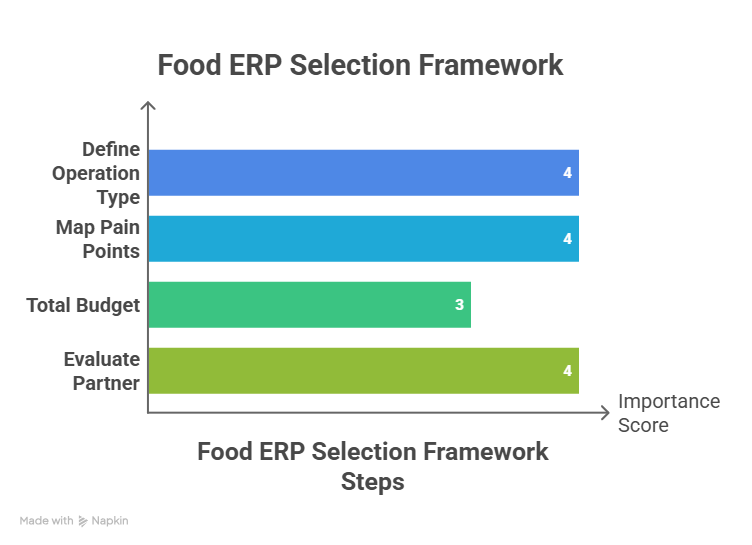
Step 1: Define your operation type. Are you primarily a food manufacturer, a food distributor, or both? Manufacturers need strong recipe management and batch costing. Distributors need strong lot traceability, FEFO controls, and order management. Each type has different priority capabilities.
Step 2: List your five biggest operational pain points. Not features you want. Problems you have right now. Bring those five problems to every vendor demo and ask them to show you specifically how their system handles each one.
Step 3: Budget for total cost, not just licensing. First-year total cost for a mid-market food ERP implementation typically runs 2 to 3 times the annual licensing fee when you include implementation, data migration, training, and integration work.
Step 4: Choose your implementation partner before you finalize your platform. A food ERP configured by a partner who has never worked in food production will be generic. A partner with food industry experience builds the workflows that reflect your operation. Ask for food industry references specifically before you sign anything.
Final Thoughts
Food businesses face complexity that most industries do not. Perishable inventory. Allergen management. Batch-level compliance. Tight production windows. Buyers who expect full lot traceability the same day they ask for it.
The right ERP connects every layer of your operation, i.e., production, quality, inventory, distribution, and finance, so your team spends less time looking for information and more time acting on it.
If you want to see what a well-configured food and beverage ERP looks like for your specific operation, the Folio3 team works with food businesses at every scale. We will give you a straight answer on whether NetSuite is the right fit and what the implementation scope looks like for your business.
FAQs
What is the best ERP software for the food industry?
For most mid-market food manufacturers and distributors, NetSuite configured by Folio3 is the strongest choice. It covers production, lot traceability, recipe management, financials, and distribution in one cloud system with food-specific configuration. For small batch manufacturers, BatchMaster is worth evaluating. For large global food enterprises, SAP or Infor M3 handles the complexity at enterprise scale.
What features does the food industry ERP need that a generic ERP does not have?
Food ERP needs recipe and formula management with batch scaling, forward- and backward-lot traceability, FEFO inventory controls, allergen tracking linked to production orders, catch-weight handling for meat and seafood, and compliance documentation workflows for FSMA, SQF, BRC, and HACCP. Generic ERP platforms require expensive customization to deliver these.
How does ERP help with food safety compliance?
ERP captures compliance evidence as a by-product of daily operations. Receiving inspections, quality checks, supplier certifications, temperature logs, and batch records all live in the system, linked to specific production lots. When an auditor requests documentation, it is generated from the ERP rather than assembled manually from paper files.
What does ERP implementation cost for a food manufacturer or distributor?
For a mid-sized food business, expect total first-year investment, covering licensing, implementation, training, and integration, to range from $50,000 to $120,000 depending on scope and complexity. Multi-site operations with significant compliance requirements or third-party integrations will invest more.
How long does NetSuite implementation take for a food business?
With clean data and a focused scope, most mid-sized food businesses go live on NetSuite in 12 to 20 weeks. Folio3 typically structures this as a phased implementation, production and inventory first, then financials, integrations, and reporting in subsequent phases, to keep the business running smoothly during the transition.