The agriculture industry in 2026 faces challenges far beyond traditional crop management. Farmers and agri-businesses now deal with complex supply chains, unpredictable seasonal cycles, strict regulatory requirements, and growing sustainability expectations.
On top of that, rising costs, climate variability, and the push toward data-driven decision-making have made efficiency and traceability more important than ever.
That’s where Enterprise Resource Planning (ERP) comes in. A modern ERP system helps connect every part of an agricultural business, from field operations and procurement to accounting, inventory, and compliance.
With the rise of digital agriculture, including IoT sensors, drone data, and precision farming, choosing the right ERP in 2026 can significantly impact an agri-enterprise’s ability to adapt to these new realities.
In this blog, we’ll review 15+ of the best ERP software solutions for agriculture in 2026, starting with Oracle NetSuite. Each ERP is analyzed for its strengths, suitability, and key features, with a subtle focus on how an experienced implementation partner like Folio3 can help you deploy and customize the right system for your agricultural business.
Evaluation Criteria for Choosing the Best ERP For Agriculture
Each ERP reviewed in this list has been evaluated against a consistent set of functional, technical, and operational criteria designed for 2026’s agricultural landscape.
Our evaluation focused on both industry-specific functionality and long-term adaptability. We looked for systems that empower agricultural businesses to plan efficiently, manage risks, and scale operations while keeping costs predictable.
Cloud readiness, IoT integration, and ease of customization were also major factors, especially for organizations adopting precision farming technologies or managing multi-location farms.
Below are the key criteria used in this assessment:
- Crop and Farm Planning: Ability to manage planting schedules, harvest cycles, and yield forecasts.
- Inventory and Warehouse Management: Tracking of seeds, fertilizers, and harvested goods with real-time stock visibility.
- Livestock and Farming Operations Support: Features for managing animal health, feed, and production data.
- IoT and Sensor Data Integration: Support for collecting and analyzing field data from sensors, drones, or smart devices.
- Multi-Site and Multi-Country Scalability: Handling distributed farms, diverse climates, and local regulations.
- Sustainability and Regulatory Tracking: Compliance tools for environmental regulations, pesticide use, and carbon reporting.
- Implementation Partner and Ecosystem Support: Availability of expert implementers, like Folio3, an award-winning Oracle NetSuite partner, who can customize and integrate ERP systems for complex agri-businesses.
These benchmarks ensure each ERP listed is practical, scalable, and ready for the realities of modern agriculture.
Top ERP Solutions for Agriculture in 2026
Below are some of the best ERP systems for agriculture in 2026, carefully evaluated for scalability, flexibility, and agricultural specialization.
List of ERP Systems Covered:
- Oracle NetSuite
- AgriERP
- FarmERP
- Cloud ERP
- SAP S/4HANA
- Microsoft Dynamics 365
- Infor M3
- Odoo
- Sage X3
- Priority Software
- BatchMaster Manufacturing
- Agvance
- Agrivi
- Croptracker
- AgriChain
1. Oracle NetSuite
Oracle NetSuite stands as one of the most comprehensive cloud ERP platforms available in 2026, trusted by agribusinesses around the world for its scalability, flexibility, and real-time data visibility.
Built on a unified cloud architecture, NetSuite integrates finance, supply chain, production, sales, and compliance into a single connected system. For agriculture companies facing complex challenges, like fluctuating crop yields, multi-location operations, and seasonal workforce management, NetSuite delivers the visibility and control required to make data-backed decisions in real time.
Why did we pick it?
Agricultural producers, processors, and distributors benefit from NetSuite’s industry-specific customizations, advanced analytics, and seamless integration with IoT and precision farming tools. Whether it’s tracking seed-to-sale operations, managing field inventories, or automating financial reporting, NetSuite provides the foundation for end-to-end digital transformation in modern agriculture.
Agriculture Features:
- Comprehensive supply chain management: Track raw materials, production batches, and distribution flows from the field to the customer.
- Crop and yield planning: Use NetSuite’s planning modules to forecast harvest volumes, manage input utilization, and reduce waste.
- Real-time inventory tracking: Centralized control over seeds, fertilizers, machinery, and produce storage.
- Multi-entity and multi-location support: Perfect for large farms, co-ops, and export-oriented agribusinesses operating across regions.
- Financial management & cost control: Automate budgeting, expense allocation, and profitability tracking by crop, season, or location.
- Compliance and sustainability: Maintain transparent records aligned with IFRS/ASC 606, food safety standards, and local agricultural regulations.
- Integration with IoT and analytics: Collect data from field sensors for better irrigation scheduling, pest control, and environmental monitoring.
Strengths:
- Highly scalable: Suitable for both mid-sized agribusinesses and global producers managing multi-country operations.
- Modular ecosystem: Add-ons for CRM, human capital management, procurement, and advanced manufacturing.
- Robust partner network: Supported by certified implementation partners like Folio3, offering tailored solutions for agriculture.
- Automation-ready: Streamlines repetitive tasks in invoicing, order fulfillment, and crop costing with minimal manual intervention.
- Advanced reporting and dashboards: Real-time visibility into operations, enabling better decision-making for seasonal and long-term planning.
Limitations:
- Higher implementation cost compared to smaller, niche agricultural ERPs.
- Complex configuration process for small farms with limited IT resources.
- Requires expert customization to align with highly specific agricultural workflows
With our certified Folio3 NetSuite team, you can customize modules to track input costs, automate crop production workflows, and achieve full farm-to-shelf visibility, all within a unified ERP system.
Check our detailed blog on NetSuite pricing to get a full-fledged understanding of how NetSuite costing works.
2. AgriERP

AgriERP is an AI-powered, cloud-based ERP built specifically for modern farms and agribusinesses. Designed by farmers for farmers, it streamlines every aspect of operations, from crop planning and resource management to regulatory compliance and financial tracking. Recognized as “The ERP Solution for the Year 2025” by the AgTech Breakthrough Awards, AgriERP continues to lead innovation in digital farm management.
Why did we pick it?
Its flexible deployment options make it ideal for small to medium-sized farms, offering a comprehensive, mobile-accessible system that grows with your business.
Agriculture Features:
- Crop and farm operations management with job planning and scheduling
- AI-powered analytics for resource utilization and weather forecasting
- Seamless ERP integration with financial tools like Xero or QuickBooks
- Real-time inventory, shipping, and packing management
- Regulatory compliance tracking (USDA, FSA, and land lease management)
- Built-in communication tools for field teams
- Geospatial integration with NDVI and soil mapping
Strengths:
- Affordable and scalable solution for small and mid-tier farms
- Microsoft Azure-based architecture for data security and uptime reliability
- Mobile-ready with AI-driven insights and automation
- Strong focus on sustainability and waste reduction (up to 20% lower costs reported)
Limitations:
- Limited global localization support
- May lack the complexity required by large, multinational agricultural corporations
Our experts can help you configure AgriERP, connect it with your preferred ERP (NetSuite or Dynamics 365), and build custom crop-cycle dashboards to optimize yield and resource planning.
3. FarmERP

FarmERP is a purpose-built agricultural ERP platform designed to manage every stage of the farming lifecycle. It’s used globally by agribusinesses, cooperatives, and food producers seeking data-driven decision-making and traceability.
Why did we pick it?
It is a comprehensive farm management system that covers both crop and livestock operations with strong sustainability tracking capabilities.
Key Features:
- Field activity management and crop planning
- Contract farming and grower coordination
- Input logistics and resource inventory tracking
- Sustainability monitoring and compliance reports
- Mobile access and IoT-based data capture
Strengths:
- Deep specialization in agriculture and allied sectors
- Advanced traceability and environmental tracking features
- Scalable for farms of varying sizes and complexities
Limitations:
- Smaller integration and partner ecosystem
- May require customization for financial or CRM connectivity
4. Acumtica Cloud ERP
Acumatica Cloud ERP is a modern, cloud-based platform known for its flexibility and scalability across multiple industries, including agriculture. It offers a unified view of operations for mid-sized farms and agribusinesses, helping them manage finances, resources, and field operations efficiently.
Key Features:
- Financial and inventory management
- Farmland and equipment operations tracking
- Mobile accessibility for remote teams
- Role-based dashboards and reporting
Strengths:
- Highly configurable and scalable for growing farms
- Strong mobile and cloud capabilities
- Simple user interface and broad integration options
Limitations:
- Lacks deep agriculture-specific functionality
- Requires industry-specific customization for advanced needs
5. SAP S/4HANA

SAP S/4HANA is an enterprise-grade ERP built for large agricultural corporations, cooperatives, and multinational agribusinesses. Recognized as one of the most powerful systems for complex operations, it enables real-time control and data visibility across the entire agricultural supply chain, from production to distribution.
Key Features:
- Multi-entity and multi-country financial management
- IoT and sensor integration for precision farming
- AI-driven analytics and forecasting with the SAP HANA engine
- Built-in sustainability and compliance reporting
Strengths:
- Exceptional scalability and flexibility for global operations
- Advanced analytics and predictive insights
- Strong focus on compliance, sustainability, and risk management
Limitations:
- High total cost of ownership
- Lengthy implementation process
- Better suited for large enterprises than small farms
Why We Picked It: SAP S/4HANA made our list for its unmatched ability to handle complex, large-scale agribusiness operations. Its powerful analytics, IoT compatibility, and real-time financial visibility make it a top choice for organizations that need precision, control, and scalability at a global level.
6. Microsoft Dynamics 365 / Business Central
Microsoft Dynamics 365 Business Central is a robust ERP solution widely adopted by mid-sized agribusinesses and cooperatives. It combines financial management, operations, and customer relationship tools under one cloud-based system. Its flexibility makes it suitable for farms that want to modernize without the heavy infrastructure requirements of larger systems.
Key Features:
- Integration with the full Microsoft ecosystem (Excel, Power BI, Teams)
- Inventory and warehouse tracking for farm inputs and outputs
- Field service modules for equipment and maintenance scheduling
- Strong reporting and analytics through Power BI
Strengths:
- Easy integration with familiar Microsoft tools
- Excellent mobile and remote access
- Scalable for growing farm operations
Limitations:
- Not agriculture-specific; customization required for crop or livestock tracking
- Some features rely on third-party extensions
Why We Picked It:
It’s ideal for medium-sized farms that want to digitize financial and operational workflows while staying within the Microsoft ecosystem. The platform’s flexibility allows agriculture businesses to tailor the system to their needs without the complexity of enterprise-level ERPs.
7. Infor CloudSuite Industrial / Infor M3
Best for: Large agribusinesses, food processors, and manufacturing-oriented farms.
Features: Advanced lot traceability, integrated supply chain, sustainability dashboards, and built-in tools for production planning and compliance.
Strengths:
Infor’s CloudSuite Food & Beverage (built on M3) is one of the most agriculture-aware ERP systems available. It manages variables like shelf life, catch weight, and quality grading, features critical for meat, poultry, and fresh produce operations.
The system also offers predictive demand planning, AI-driven forecasting, and grower contract management, helping agribusinesses maintain efficiency and profitability.
Limitations:
Its partner ecosystem is smaller compared to major ERPs like SAP or Microsoft Dynamics, which can make finding regional implementation support more difficult.
Why we picked it:
Infor M3 stands out for its deep process manufacturing and food supply chain focus. Unlike general-purpose ERPs, it includes prebuilt tools for traceability, compliance, and sustainability, key areas for modern agriculture. This makes it ideal for farms and processors managing perishable goods, variable yields, and multi-site operations.
8. Odoo Farming Management System

Odoo’s Farming Management System is a modular, open-source ERP that helps farmers manage crop cycles, livestock, equipment, and sales within a unified system. It integrates key modules like Inventory, Accounting, CRM, and Field Service, offering flexibility for both small and mid-sized farms.
Users can install agriculture-focused extensions such as Crop Cycle Management, Fertilizer Planning, and Farm Equipment Tracking to tailor the system to their specific needs. Its cloud and mobile support make it practical for field use and real-time monitoring of farm operations.
Strengths:
- Modular and open-source, allowing full customization.
- Integrates business and farm operations seamlessly.
- Large app ecosystem for agricultural add-ons.
- Affordable option for smaller farms and cooperatives.
- Cloud-based access with mobile support for field teams.
Limitations:
- Requires technical setup and customization to match agri workflows.
- Fewer native farm-specific modules compared to dedicated agri ERPs.
- May need third-party extensions for advanced features like IoT or weather data.
Best For:
Small to mid-sized farms, agri-startups, cooperatives, and agribusinesses are looking for a budget-friendly, flexible ERP system.
Why We Chose It:
Odoo’s open architecture and scalability make it a strong choice for farms that want to digitize operations without investing in complex enterprise systems. Its customization potential allows it to adapt to different farm types, making it a practical and cost-effective ERP option for growing agricultural businesses.
9. Sage X3
Sage X3 is a versatile ERP system widely used in distribution and manufacturing, making it well-suited for agricultural inputs and processing operations. It offers robust finance, inventory, and multi-entity features tailored for agribusinesses that handle bulk inputs or operate processing plants.
Strengths:
- Proven track record in processing and agriprocessor industries
- Strong multi-entity and financial consolidation capabilities
- Solid inventory and warehouse management for ag-input distributors
Limitations:
- Less specialized modules for field operations or crop tracking
- May require additional customizations to support full farm lifecycle management (planting to harvest)
Best For: Agri-input suppliers, agro-processors, mid-sized agribusinesses with distribution and manufacturing operations.
Why We Chose It:
Sage X3 made our list because it bridges the gap between manufacturing/distribution workflows and agricultural processing needs. Its mature inventory and finance modules give agribusinesses strong control over costs and margins, especially when processing
10. Priority Software

Priority ERP is a versatile and cloud-ready solution built to support agriculture, food processing, and distribution operations. Designed with real-time visibility, compliance management, and supply chain resilience in mind, it helps agribusinesses maintain traceability from farm to fork. The system handles operations such as harvesting, packaging, distribution, and financial management while ensuring end-to-end compliance with agricultural standards and regulations.
Key Features:
- Crop production, harvesting, and processing management
- End-to-end traceability and recall management
- Multi-unit inventory tracking for varied produce and locations
- Integration with IoT and peripherals for field data capture
- Advanced financials, profitability tracking, and customer service tools
Strengths:
- Real-time insights into crop, cost, and compliance data
- Multi-unit and multi-facility product handling capabilities
- Cloud and mobile accessibility for field operations
Limitations:
- UI can be complex for smaller operators
- May require dedicated training for advanced modules
Best For
Agri-input suppliers, mid-to-large agribusinesses managing multiple sites, and producers needing traceability and export compliance.
- Why We Chose It:
Priority ERP’s strong agricultural traceability, real-time cost visibility, and compliance management make it ideal for modern agri-enterprises aiming to balance profitability with regulatory demands in 2026.
11. BatchMaster Manufacturing
BatchMaster Manufacturing is a process manufacturing ERP widely used across the food, feed, and agri-input industries.
It’s designed for companies involved in formulation-based production, such as fertilizers, animal feed, or processed foods, them maintain consistency, traceability, and compliance from raw materials to finished goods.
Key Features:
- Batch and formula management for fertilizers, feed, and food products
- Lot traceability and quality control for full product visibility
- Regulatory compliance tools for labeling, safety, and documentation
- Inventory and warehouse control optimized for batch processing
- Integration with ERP platforms like SAP Business One and Microsoft Dynamics
Strengths:
- Excellent for managing recipe-based or formula-driven production
- Strong focus on compliance and quality management
- Seamless integration with major ERP systems
Limitations:
- Less suitable for crop or livestock farm management
- Primarily geared toward processing and manufacturing operations
Best For:
Food processors, agri-input manufacturers, and feed production companies need precise formulation control and compliance tracking.
Why We Chose It:
BatchMaster stands out for its deep process manufacturing expertise, making it ideal for agribusinesses that rely on blending, batching, or formulation, key aspects of modern agricultural production chains.
12. Agvance

Agvance is an agriculture-focused ERP designed to streamline financial, agronomy, and retail operations for agri-service providers and co-ops. It offers strong financial management tools and contract tracking features, helping small and mid-sized agribusinesses manage sales, inventory, and customer accounts with better visibility.
Key Features:
- Detailed financial and accounting modules
- Contract and inventory tracking for agri-retailers
- Customer relationship and billing management
- Integration with grain, fuel, and agronomy operations
Strengths:
- Excellent financial and accounting depth
- Tailored for agri-retail and co-op management
- Easy to use for smaller agricultural operations
Limitations:
- Limited scalability for larger enterprises
- Fewer advanced automation and analytics tools
Best For:
Small to mid-sized agri-retailers, grain handlers, and co-ops needing a finance-focused ERP system.
Why We Chose It:
Agvance earns its place for its strong financial and retail management capabilities, making it a practical choice for small agricultural businesses looking to tighten control over accounting, contracts, and customer operations without the complexity of enterprise-level ERPs.
13. Agrivi
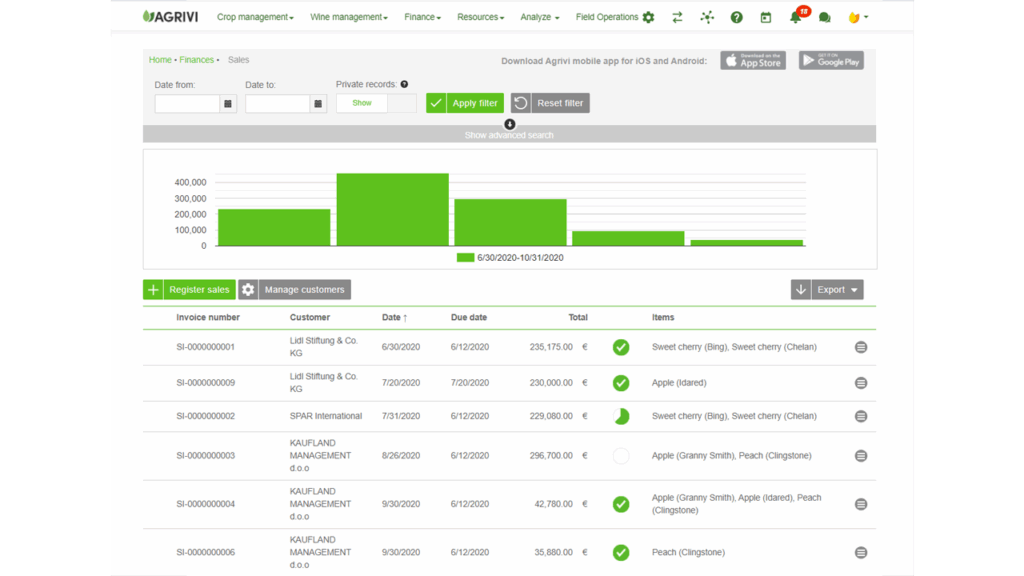
Agrivi is a modern, data-driven farm management ERP built to help farmers and agribusinesses enhance productivity and sustainability. It brings together planning, analytics, and reporting tools that track everything from crop performance to input usage and financial outcomes.
Key Features:
- Crop management and rotation planning
- Farm budgeting and cost tracking
- Weather and pest monitoring for predictive risk control
- Yield forecasting and ROI assessment
- Sustainability and compliance reporting
- Integrations with major ERPs like NetSuite, SAP, Dynamics, and Xero
Strengths:
- Advanced analytics for data-driven decisions
- Excellent budgeting and cost visibility
- Real-time insights into farm operations
- Supports sustainable and traceable farming practices
Limitations:
- Limited offline access in remote field areas
- Requires regular updates to maintain full functionality
Why We Chose It:
Agrivi stands out for its intelligent data use. Its integrations with major ERP platforms make it a strong complement for farms transitioning toward precision agriculture and digital transformation.
14. Croptracker

Croptracker is a farm management and traceability software developed specifically for growers of fruits and vegetables.
Since 2006, the platform has supported single farms, cooperatives, and packers by offering modules such as spray-recording, harvest yield tracking, field mapping and real-time traceability from planting through to shipment.
Features:
- Spray and fertilizer application record-keeping with cost tracking and safe re-entry alerts.
- Harvest yield recording by block and by picker, including piece-rate calculations and lot linking.
- Field mapping (GIS), packing and shipping traceability, storage and quality control records.
Strengths:
- Strong traceability and compliance support for fresh produce growers.
- Mobile-friendly and field-job oriented, allowing real-time record entry from any device.
- Modular and scalable for growers and packers of various sizes.
Limitations:
- More narrowly focused on horticulture/fresh produce rather than broad crop/livestock farming.
- Lacks full ERP features such as full financial management or deep supply-chain modules.
Best For: Fruits, vegetables, orchard growers, packers, and exporters needing detailed operational tracking and traceability rather than full enterprise-ERP breadth.
Why We Chose It:
Croptracker stands out as a specialist tool in the fresh-produce segment with proven features around compliance, labor tracking, and traceability, areas of increasing importance in 2026’s agriculture ecosystem.
15. AgriChain

AgriChain is a cloud-based agriculture supply-chain software designed to manage stock, contracts, logistics, and payments across farms, growers, bulk handlers, and traders. With features such as auto-weighing, digital contracts, bulk inventory management, and container packing, it supports transparency and traceability across complex agro supply networks.
Strengths:
- Streamlines procure-to-pay automation, including contracts, subscriptions, deliveries, and invoicing
- Advanced site, stock, and logistics management tailored for grain handling and multi-location operations
- Mobile and web-friendly applications suited for growers, carriers, brokers, and exporters
Limitations:
- Primarily focused on inventory, logistics, and the trading side of agriculture, with less focus on field operations like crop planning or livestock management
- May require additional modules or integrations for full farm-to-harvest workflow support
Best For:
Agribusinesses, grain traders, growers cooperatives, and bulk commodity handlers that need strong inventory, logistics, and contract-management tools in their agriculture supply chain.
Why We Chose It:
AgriChain stands out for its specialized focus on agricultural supply-chain transparency, contract commoditisation and bulk handling logistics, features increasingly critical for farms and agribusinesses in 2026, facing export demands, compliance pressures and multi-site operations.
What is Agriculture ERP?
Agriculture ERP (Enterprise Resource Planning) is a centralized software system designed to manage every aspect of a farming or agribusiness operation. It connects processes like crop planning, field operations, inventory, sales, accounting, and logistics into one unified platform.
By replacing spreadsheets and manual tracking, an agriculture ERP gives farmers, cooperatives, and agri-enterprises better control and visibility over their entire value chain — from planting to harvest to distribution.
Key functions include:
- Crop and livestock management
- Farm budgeting and financial accounting
- Supply chain and inventory tracking
- Procurement and sales order management
- Equipment maintenance and workforce planning
- Quality control and traceability tracking
Why Do Agricultural Businesses Need It?
Modern agriculture is a data-driven, multi-layered business. Managing everything manually often leads to inefficiencies, high costs, and missed opportunities. An ERP system helps overcome these challenges by connecting every department and process in one place.
Benefits of using an Agriculture ERP:
- Better visibility: Real-time data on crops, costs, and performance across locations.
- Improved decision-making: Analytics and forecasting tools support smarter farm and business planning.
- Cost control: Tracks input costs and optimizes resource usage to improve profitability.
- Regulatory compliance: Simplifies audits and ensures traceability for exports and certifications.
- Inventory accuracy: Keeps stock and raw material data updated to avoid shortages or waste.
- Collaboration: Connects field teams, suppliers, and buyers under one digital system.
In short, an Agriculture ERP helps agribusinesses work smarter, reducing waste, improving yield, and increasing operational efficiency.
Discover how Native American Seed modernized its operations with a Folio3-built NetSuite AgriERP solution, achieving faster fulfillment, real-time visibility, and complete farm-to-shipment traceability.
How to Choose an Agriculture ERP
Selecting the right ERP for your farm or agribusiness depends on the size of your operation, the type of production you manage, and your growth goals. Here’s a quick comparison table to help evaluate what matters most when choosing an agriculture ERP system.
| Evaluation Criteria | What It Means | Why It Matters | What to Look For |
|---|---|---|---|
| Farm Size & Type | Whether you’re managing crops, livestock, or processing operations | Determines module fit (e.g., crop management vs. manufacturing) | Look for ERPs with modules specific to your operation |
| Deployment Model | Cloud-based or on-premise | Cloud ERPs offer scalability; on-premise gives more control | Choose cloud for flexibility and remote access |
| Integration Capabilities | Ability to connect with accounting, CRM, or supply chain tools | Smooth data flow reduces manual errors | Check integrations with tools like NetSuite, QuickBooks, or SAP |
| Data & Analytics | Reporting, dashboards, and forecasting | Helps make informed decisions on costs, yields, and risks | Prioritize systems with real-time dashboards and predictive analytics |
| Regulatory Compliance | Support for traceability, quality, and certifications | Ensures compliance with local and export requirements | Ensure traceability features and audit trails |
| User Experience | Ease of use for farm staff and managers | Reduces training time and adoption challenges | Look for intuitive dashboards and mobile access |
| Scalability | Ability to grow with your business | Ensures long-term system viability | Choose an ERP that can handle more products, farms, or locations over time |
| Support & Vendor Expertise | Quality of implementation and ongoing support | Impacts how smoothly your ERP runs post-deployment | Prefer vendors with agriculture ERP experience |
| Cost & ROI | Licensing, setup, and maintenance costs | Helps budget effectively and measure returns | Ask for transparent pricing and implementation timelines |
Conclusion
The right ERP system and implementation partner can completely transform how an agricultural business runs. From planning crops to managing harvests and sales, it brings every operation together in one platform. With better visibility, accurate data, and real-time control, farms can improve productivity and make smarter decisions. As agriculture continues to modernize, having the right ERP and an experienced team to guide the setup can make a lasting difference.
Our experts help agribusinesses choose, customize, and implement ERP solutions that truly match their operations and goals.
FAQs
1. What are the main modules included in an Agriculture ERP system?
An Agriculture ERP system brings together several modules that cover all aspects of farm and agribusiness management. These often include:
- Crop and farm management
- Finance and accounting
- Procurement and inventory control
- Production and quality management
- Logistics and sales management
Advanced systems may also include CRM, IoT integration, and sustainability reporting. These tools ensure that every process, from seeding to shipment, stays connected and well-tracked.
2. How does ERP help with traceability and compliance in farming?
ERP systems make it easier to maintain records of every stage in the agricultural process. They keep track of:
- The type and source of inputs like seeds and fertilizers
- Harvest details and production batches
- Processing, packaging, and delivery information
This complete traceability helps farms comply with industry and export regulations while maintaining transparency with buyers and distributors.
3. Can small and mid-sized farms use ERP systems effectively?
Yes, ERP solutions today are flexible and scalable. Many cloud-based systems like NetSuite and AgriERP allow smaller farms to start with essential modules such as:
- Crop management
- Inventory control
- Financial tracking
As the business grows, new modules and features can be added without replacing the system. This makes ERP an affordable and future-ready investment even for small and mid-sized farms.
4. How does ERP connect with IoT and smart farming tools?
Modern Agriculture ERP systems work well with IoT devices and precision farming tools. They can receive real-time data from sensors that monitor conditions like:
- Soil moisture
- Temperature and humidity
- Equipment performance
- Weather patterns
This data helps farmers plan irrigation, fertilization, and harvesting more accurately, improving yield and reducing waste.
5. What challenges can ERP solve in agriculture supply chains?
Agriculture supply chains often face issues like delays, waste, and limited visibility. ERP systems help by:
- Automating order and logistics management
- Tracking produce from farm to warehouse
- Providing accurate demand forecasting
- Reducing manual errors and improving coordination
With all data in one place, it becomes easier to manage inventory, maintain quality, and respond quickly to market changes.
6. How can a business choose the right ERP for agriculture?
Selecting an ERP starts with understanding your business priorities. You should consider:
- The type of crops or livestock you manage
- The size and scale of your operations
- Your need for traceability, financial control, or production planning
- The availability of local implementation partners
Working with a technology partner experienced in agricultural ERP solutions can make the process smoother and help ensure the system aligns with your long-term business goals.