Every business faces a crucial question: how much does it really cost to produce one more unit of product or deliver one more service? This is where marginal cost becomes an essential concept. Understanding marginal cost helps businesses make smarter decisions about pricing, production levels, and profitability.
Many organizations focus on total costs but overlook the incremental cost of additional output. This oversight can lead to inefficient pricing, underproduction, or even lost profits. Tracking the marginal cost provides clarity on whether increasing production will add value or reduce margins.
In this guide, we’ll explain what marginal cost is, how to calculate it using a simple formula, walk through step-by-step examples, discuss limitations, and explore how understanding it can improve your company’s decision-making, business efficiency, and cost efficiency.
Key Takeaways
- Marginal cost measures the additional expense of producing one more unit of output.
- It helps businesses make informed pricing and production decisions for profit optimization.
- The marginal cost formula is ΔTC ÷ ΔQ, focusing mainly on variable costs.
- Understanding the marginal cost curve helps identify the most efficient production level.
- Tools like NetSuite make it easier to track real-time cost changes and improve decision-making.
What Is Marginal Cost?
Marginal cost refers to the additional cost a business incurs to produce one more unit of a product or service. In other words, it measures the change in total production cost when output increases by a single unit. This cost helps businesses determine whether scaling up production is financially worthwhile.
Unlike total cost, which includes all expenses involved in production, marginal cost focuses on the incremental cost, which is what it actually takes to produce the next item.
For example, if producing 100 units costs $10,000 and producing 101 units costs $10,050, the marginal cost of the extra unit is $50.
How Marginal Cost Differs from Other Costs
To avoid confusion, it’s important to distinguish marginal cost from average cost and total cost:
- Total Cost (TC): The overall cost of producing all goods or services, including both fixed and variable costs.
- Average Cost (AC): The total cost divided by the number of units produced, essentially, the cost per unit at a given level of output.
- Marginal Cost (MC): The additional cost of producing one more unit beyond the current output.
While average cost gives a general idea of efficiency, marginal cost provides actionable insight for production decisions, helping managers determine whether increasing or reducing output will improve profitability.
What is the Marginal Cost Formula?
The marginal cost formula helps calculate the additional cost of producing one extra unit of output. It’s expressed as:

This formula essentially measures how much total production cost changes when the quantity produced increases by a specific number of units.
Breakdown of Each Component
- ΔTC (Change in Total Cost):
This represents the difference in total production cost before and after increasing output. It includes both variable costs (like materials and labor) and any additional fixed costs if they change with production.
- ΔQ (Change in Quantity):
The difference between the number of units produced after and before the change. For example, if production increases from 100 to 120 units, ΔQ = 20.
When you divide the change in cost (ΔTC) by the change in output (ΔQ), you get the marginal cost per unit, a key figure for deciding whether producing more is financially efficient.
What Is a Marginal Cost Curve?
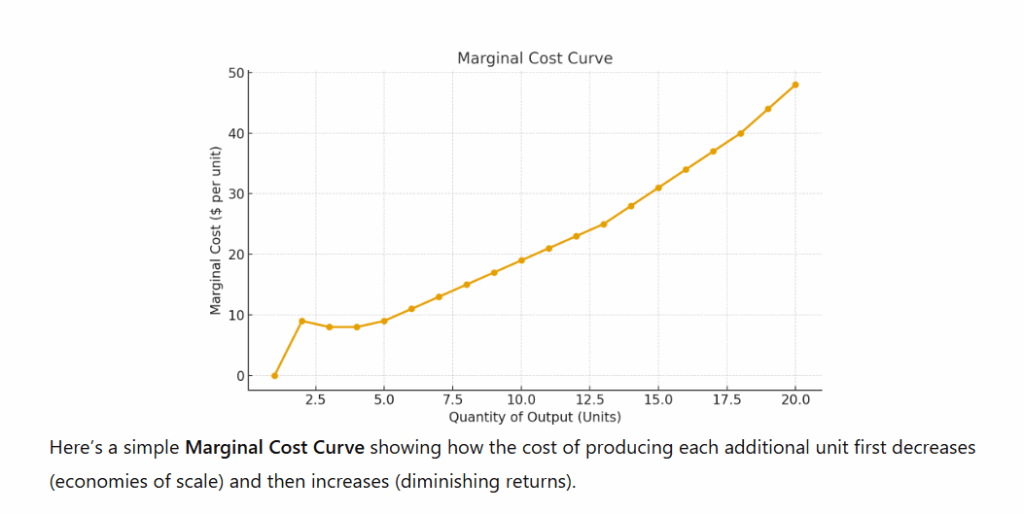
A marginal cost curve is a graphical representation that shows how the marginal cost (MC), the cost of producing one additional unit, changes as output increases. It helps visualize how efficiently resources are being used in the production process.
In most cases, the marginal cost curve is U-shaped:
- At first, marginal cost decreases as production increases because of economies of scale, workers become more efficient, machinery is better utilized, and fixed costs are spread across more units.
- After reaching a minimum point, marginal cost begins to rise due to diminishing returns, resources become strained, production inefficiencies increase, and additional output becomes more expensive.
How to Interpret the Curve
- The downward slope shows increasing efficiency and cost savings in the early stages of production.
- The lowest point represents the optimal production level, where producing one more unit is at its lowest possible cost.
- The upward slope indicates rising costs per additional unit, signaling the business may be operating beyond its most efficient capacity.
Understanding this curve helps businesses decide how much to produce, when to expand capacity, and how pricing decisions affect profitability.
Marginal Cost vs Average Cost
While both marginal cost (MC) and average cost (AC) measure production expenses, they focus on different aspects of cost behavior.
- Marginal Cost shows how much it costs to produce one additional unit of output.
- Average Cost, on the other hand, represents the total cost per unit when producing a certain quantity of goods.
In short, marginal cost helps guide short-term production decisions, while average cost reflects overall efficiency and pricing in the long run.
Key Differences between Marginal Cost vs Average Cost
| Aspect | Marginal Cost (MC) | Average Cost (AC) |
|---|---|---|
| Definition | Cost of producing one more unit. | Total cost divided by total quantity produced. |
| Formula | MC = ΔTC / ΔQ | AC = TC / Q |
| Focus | Incremental or additional cost. | Overall cost per unit of output. |
| Relation | When MC < AC → AC falls; When MC > AC → AC rises. | AC is minimized when it equals MC. |
| Decision Use | Helps decide optimal output level and pricing. | Helps assess cost efficiency and profitability. |
NetSuite’s costing tools can calculate both marginal and average costs in real time, giving finance and production teams accurate data to manage pricing and capacity more effectively.
Benefits of Calculating Marginal Costs for Businesses
Understanding marginal cost gives companies a sharper view of how production decisions affect profitability. Here are five key benefits:
- 1. Better Pricing Decisions
Knowing the marginal cost helps determine the lowest price a company can charge while still covering additional production costs and maintaining profit margins.
- 2. Optimized Production Levels
Businesses can identify the most efficient level of output, where marginal cost equals marginal revenue, to avoid overproduction or underutilization of resources.
- 3. Improved Cost Control
Tracking how costs change with output helps pinpoint inefficiencies, such as rising variable costs or capacity constraints, allowing for better resource management.
- 4. Enhanced Profitability Analysis
Marginal cost analysis supports decisions about whether to expand production, introduce new products, or discontinue underperforming lines.
- 5. Data-Driven Forecasting and Planning
Using tools like NetSuite’s cost management and analytics modules, businesses can forecast future costs and simulate different production scenarios for more informed planning.
Limitations in Calculating Marginal Cost
While marginal cost is a powerful decision-making tool, it has its limitations. It’s most useful when variable costs dominate, but can be misleading if used in isolation.
Key limitations include:
- Fixed costs are excluded: Marginal cost considers only variable costs, ignoring fixed overheads like rent or salaries, which can distort total profitability.
- Inconsistent cost behavior: In real operations, costs don’t always change proportionally with production; bulk discounts or equipment inefficiencies may skew results.
- Changes in fixed costs complicate analysis: If a new investment alters capacity or overheads, marginal cost alone can’t reflect the true cost structure.
- Demand is not captured: Marginal cost focuses on the supply side; it doesn’t indicate whether additional units can actually be sold profitably.
- Short-term focus: It’s most effective for short-term production decisions, not long-term strategic planning.
Why Marginal Cost Matters for Business Decisions
Understanding marginal cost helps companies make smarter, data-driven decisions about pricing, production, and profitability.
Here’s how it influences business strategy:
- Pricing Strategy: Helps determine the minimum viable price for products while maintaining margin targets.
- Production Planning: Guides decisions on whether to increase or decrease output based on cost efficiency.
- Product Mix Optimization: Assists in identifying which products contribute the most to profit when resources are limited.
- Evaluating Special Orders: Businesses can decide whether to accept large, low-margin orders without affecting profitability.
- Strategic Insights: Using ERP systems like NetSuite, managers can track real-time cost changes, forecast marginal impacts, and align operations with financial goals.
Optimize Cost Efficiency and Decision-Making With Folio3 NetSuite ERP Implementation Services
Accurately calculating marginal cost depends on having complete visibility into your production, inventory, and financial data. Folio3’s NetSuite ERP implementation helps businesses achieve that visibility through seamless system integration and real-time cost tracking. By automating manual processes and centralizing key data, companies can analyze cost behavior more accurately and make smarter production and pricing decisions.
With Folio3’s expertise, organizations can turn NetSuite into a powerful tool for cost control, margin improvement, and long-term operational efficiency. If you’re looking to strengthen your financial insights and optimize performance, our certified NetSuite consultants can help you get there.
FAQs
1. How can businesses use marginal cost to make smarter production decisions?
Understanding marginal cost helps leaders decide when scaling production actually benefits profitability.
In practice:
- If the marginal cost is lower than the selling price, increasing production can boost profits.
- If the marginal cost exceeds the selling price, producing more leads to losses.
- Managers can use this insight to adjust production schedules, control raw material use, and plan capacity expansion effectively.
Platforms like NetSuite ERP make this analysis more accurate by combining financial data, production metrics, and demand forecasts in one dashboard.
2. How does marginal cost analysis improve pricing strategies?
Marginal cost is critical for setting prices that balance competitiveness and profit margins.
Businesses can:
- Identify the minimum price point that covers additional production costs.
- Adjust prices dynamically during demand fluctuations.
- Evaluate promotional discounts or bulk order pricing based on incremental costs rather than averages.
This approach allows businesses to stay profitable even when market conditions change.
3. What role does marginal cost play in scaling operations or expansion?
Before scaling, companies need to know if producing more units will yield diminishing returns.
By analyzing marginal cost trends:
- Businesses can spot when additional production starts eroding profits.
- Identify when to invest in automation, outsourcing, or new facilities.
- Use cost insights to forecast ROI and operational break-even points more accurately.
This ensures expansion is data-driven, not guesswork.
4. Can marginal cost analysis help identify inefficiencies?
Absolutely. A sudden rise in marginal cost often signals inefficiencies within production or supply chains.
Common causes include:
- Increased raw material costs or supplier pricing.
- Bottlenecks in manufacturing or logistics.
- Poor inventory turnover or equipment downtime.
Using ERP tools like NetSuite, businesses can trace which cost components (labor, materials, logistics) are inflating and fix them before they impact profitability.
5. How does ERP software like NetSuite support marginal cost tracking?
ERP platforms centralize cost and production data, making marginal cost analysis easier and more accurate.
Key advantages:
- Real-time visibility into total and variable costs.
- Automated calculation of cost per additional unit.
- Integration with inventory, procurement, and accounting modules for consistent data flow.
- Predictive analytics to simulate how production changes affect marginal cost and profit.
This helps managers make faster, smarter financial and operational decisions based on reliable insights.
6. When should a company reconsider its marginal cost strategy?
Companies should revisit their marginal cost strategy when:
- Input prices (like raw materials or labor) rise significantly.
- They introduce new product lines or change production processes.
- Customer demand shifts or economies of scale start to diminish.
Reevaluating at these points ensures that decisions remain aligned with actual cost structures and profitability goals.