These frequently asked questions (FAQs) are for businesses selling on Amazon and implementing the Folio3 Amazon-NetSuite Connector to automate their marketplace operations and financial reconciliation. They are designed to clarify how the integration synchronizes orders, inventory, and complex settlement data between the two platforms. This guide helps ensure accurate financials and streamlined operations for multi-channel, multi-marketplace sellers.
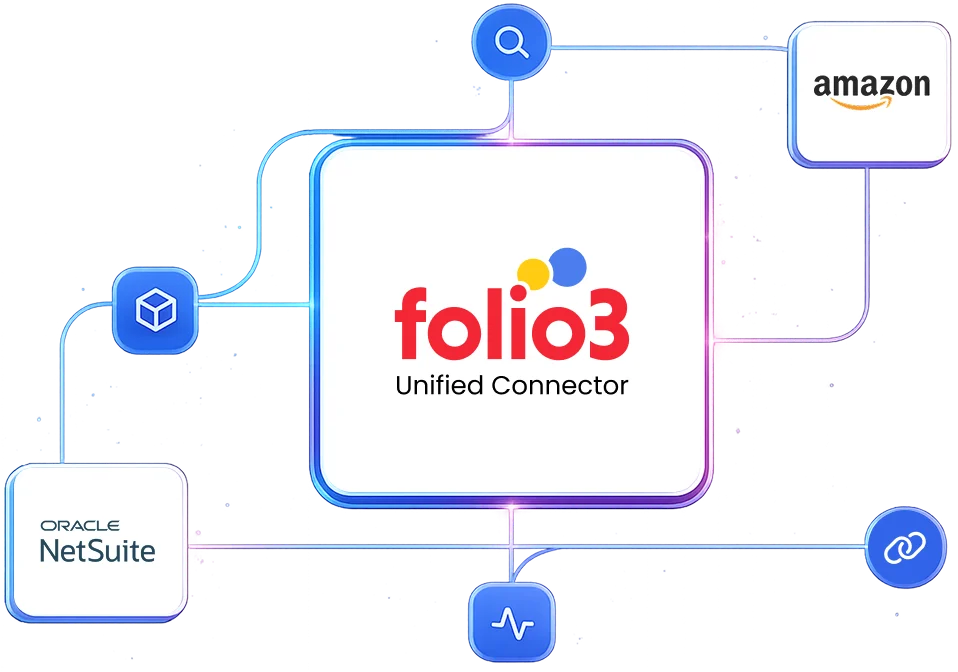
When connected correctly, Amazon and NetSuite form a powerful operational engine. The pain points typically arise from manual processes, poor data alignment, or brittle integrations.
A robust connector like that of Folio3 automates the critical flows (orders, inventory, items, settlements). This changes a potentially high-friction relationship into a streamlined operation. The key is choosing an integration built for the scale and complexity of Amazon’s ecosystem.
NetSuite should be the source of truth for master data. This is a non-negotiable principle for financial integrity and operational control.
Not if you are serious about scaling. For a single-SKU seller, it might be overkill. However, if you have multiple SKUs, manage inventory across FBA and your own warehouses (FBM), sell in multiple currencies, or require consolidated financials, NetSuite is essential. The “heaviness” is managed by a smart connector that handles the high-volume, transactional sync. This helps you leverage NetSuite’s power without manual overhead.
The trigger is usually complexity, not the volume alone. Consider NetSuite + a dedicated connector when:
This is a standard and highly scalable setup for mid-market to enterprise brands selling on Amazon. The force-fitting occurs when companies try to use generic iPaaS tools not purpose-built for Amazon’s nuances or attempt heavy custom code. Using a specialized connector like that of Folio3 is the established path to scale.
The following data syncs between NetSuite and Amazon:
No. The integration is a data synchronizer. It does not perform any data validation or data cleansing operations. The customer must ensure that data input in one system meets the requirements of the other system. Efforts required to debug data-related errors caused by incorrect data input will be charged separately.
No. Syncing of historical data from NetSuite to the other system or vice versa is out of scope. The connector starts syncing data from the point of deployment forward.
True real-time sync is impossible due to API latency and limits. Professional connectors like Folio3 achieve near-real-time through optimized polling cycles (e.g., every 15 minutes for inventory updates). For FBA inventory, the sync is dependent on Amazon’s SP-API feed processing times. Critical workflows like order import can be triggered more frequently.
No. A well-configured integration prevents overselling by using a calculated “Available to Sell” (ATS) quantity. The connector pushes a safety-stock-buffered quantity from NetSuite to Amazon. It can be configured to rapidly reduce listing quantities or unpublish items when NetSuite stock falls below a threshold.
Yes, but only with a connector designed for it. The Folio3 connector maps each Amazon marketplace (e.g., Amazon.com, Amazon.ca, Amazon.co.uk) to corresponding entities in NetSuite, typically different subsidiaries or classes. This ensures orders, settlements, and inventory are segregated correctly for financial reporting and tax compliance.
This is a core strength of a dedicated connector.
Refund synchronization from Amazon to NetSuite is not supported in the standard connector. It is available as an add-on. Refunds are imported from the Amazon settlement report with RMA, Item Receipt, and Credit Memo created in NetSuite.
The golden rule is that pricing logic lives in NetSuite (your system of record). The connector pushes price updates from NetSuite Item records or Price Lists to Amazon Listings. This maintains control and ensures alignment with your CRM/quoting. Amazon may be used for tactical, marketplace-specific promotions that are then reconciled financially via settlements.
NetSuite supports customer-specific pricing through Price Lists and Custom Item Fields. A sophisticated connector can filter and apply these rules when determining the price to push to a specific Amazon marketplace in order to support strategies like Minimum Advertised Price (MAP) compliance or regional pricing.
Amazon expects a flat item catalog, while NetSuite excels at matrix items. The connector must flatten the NetSuite matrix. Each Child item (e.g., “T-Shirt – Blue – Large”) syncs as a unique ASIN/SKU on Amazon. The Parent item in NetSuite acts as a reporting and planning tool, not a listing.
These are stored in different fields on the NetSuite Item record (e.g., CustItem_MapPrice, MSRP, Purchase Price). The connector is configured to read from the specific field designated as the “Amazon Selling Price” for sync, while other fields are used for reporting and internal analysis.
For FBM orders, the connector creates Customer records in NetSuite using the shipping/billing address. For FBA orders, a generic “Amazon Customer” or marketplace-specific customer record is typically used, as Amazon does not share individual buyer details. This streamlines the process while maintaining financial integrity.
This is the most critical financial function. The connector:
Refunds are initiated from the Amazon Seller Central or via the connector. The corresponding transaction is recorded in the next settlement report. The connector identifies the refund in the settlement data and creates a Credit Memo or Customer Refund in NetSuite linked to the original sale, ensuring accurate revenue reversal and GL impact.
Discover how the native NetSuite connector by Folio3 helps you connect with Amazon.
For FBA orders, they are imported as Cash Sales (invoice immediately) because Amazon has already captured payment. For FBM orders, they are imported as Sales Orders (to allow for picking/packing workflows) and then invoiced upon shipment. The connector supports both models based on configuration.
Absolutely. When an FBM Sales Order is fulfilled and shipped in NetSuite, the connector:
Yes, but it requires careful handling. If an order is partially shipped from NetSuite, the connector sends a partial shipment update to Amazon. The settlement reports later reflect any adjustments. The integration logic must handle this to avoid a data mismatch.
The Folio3 Amazon-NetSuite connector employs end-to-end encryption (TLS 1.2+) for data in transit. For data at rest, encryption follows your existing NetSuite and Amazon security policies. The connector can be configured to exclude sensitive fields (like full credit card numbers, SSNs) from synchronization entirely. This ensures only necessary contextual data is shared with support agents.
Folio3’s infrastructure and development processes are SOC 2 Type II compliant. The Amazon-NetSuite connector supports GDPR/CCPA requirements through:
A prebuilt connector like that of Folio3 is almost always the right choice. It offers lower risk, faster time-to-market, proven patterns, and ongoing support. Custom integration is justified for highly unique business models where no connector can accommodate core processes.
When your business logic deviates radically from standard e-commerce patterns, for example, you need real-time, bi-directional inventory sync across 50+ warehouses with complex allocation rules that conflict with the connector’s architecture. Even then, an extensible connector like that of Folio3 can often be customized.
Yes, the Folio3 connector can be customized to handle your edge cases. We can customize the Amazon-NetSuite connector to fit your business needs and workflows. This way, you don’t have to learn new ways of doing things. Instead, the connector adapts to your business needs.
With Folio3, “outgrowing” the connector is not a dead end. Our solution is built on a scalable platform that allows for progressive enhancement. We offer roadmap-aligned development services to extend functionality. This ensures the integration evolves with your business rather than requiring a costly and disruptive rip-and-replace project.
You need an E-commerce Manager to define requirements, a NetSuite Admin to configure NetSuite, and a Technical Analyst to monitor the connector, handle basic errors, and liaise with Folio3 support. Deep developer skills are not required with a managed service.
Standard implementation of the Amazon-NetSuite integration takes 2-8 weeks, apart from the one-week BPQ and one-week UAT phases. All timelines depend on the customer providing all access and prerequisites in a timely manner.
The implementation process follows these steps:
If you do not have a sandbox account, the connector’s deployment will be done on your live production accounts. If you obtain a sandbox later, you will be additionally charged for migration of the connector’s deployment to the sandbox environment.
If your sandbox is refreshed, expired, or deleted, and Folio3 loses any work in progress once the connector’s deployment has started, additional charges will be applicable for re-implementing the solution.
Implementation and explicit testing of the integration against that new release are not included in the scope. Such requests will be treated as a Change Order and will be additionally charged.
Once the connector has been deployed after successful sign-off, if any issues emerge, Folio3 will charge separately for support as per their standard support rates.
A comprehensive test plan must cover:
Customers get five days of post-go-live support. If additional support is required beyond these hours, Folio3 will provide a separate statement of work (SOW). Dedicated support options (including 24/7 support) are also available at an additional cost for customers who need stricter SLAs.
The connector’s subscription includes regular updates to keep the product compliant with future releases for the standard feature set. But if the integration requires changes due to updates the customer has made in their accounts, or changes in customizations, these changes will be charged separately.
While technically possible, building a reliable integration directly using NetSuite’s REST APIs requires significant development expertise and ongoing maintenance. The Folio3 connector abstracts this complexity by leveraging both REST and SOAP APIs appropriately based on the specific data operation. This provides a stable, optimized layer that handles authentication, error recovery, and performance optimization automatically.
Folio3 provides comprehensive long-term maintenance through our support agreements, including monitoring for compatibility issues, applying necessary updates, optimizing performance, and addressing any emerging requirements. This managed approach transfers the maintenance burden from your internal IT team to our specialized experts, ensuring sustained reliability without draining your technical resources.
Folio3 typically charges a fixed annual license fee, a fixed one-time setup fee, variable customization charges, and variable on-demand support charges. The cost of the standard connector starts at around $400 per month.
TCO is typically lower than a fully custom build or an unwieldy iPaaS setup for this specific point-to-point integration. You avoid the ongoing developer cost of maintaining custom scripts and benefit from Folio3’s upgrades and support. The biggest cost saver is preventing operational inefficiencies and errors caused by not having the integration.
If you’re tired of manually downloading Amazon settlement reports, parsing thousands of lines in Excel, and manually creating journal entries in NetSuite, this connector solves that core pain point. It automates the entire financial reconciliation process. This changes complex settlement reports into accurate NetSuite journal entries automatically.
Moreover, if you sell on Amazon.com, Amazon.ca, Amazon.co.uk, EU marketplaces, etc., and need each marketplace’s transactions properly segregated in NetSuite by subsidiary, class, or location for accurate financial reporting and tax compliance, this connector is built for that kind of complexity.
Regret usually comes from:

By submitting the form you agree to terms & condition and privacy policy of Folio3
Meet the Folio3 team at the largest NetSuite community gathering.