Folio3 implements NetSuite for construction companies that have outgrown standalone accounting systems like QuickBooks and Sage. NetSuite gives your finance team real-time visibility into every project’s cost, margins, and cost position, and improves construction schedule accuracy and workforce coordination across job sites.
We take pride in implementing NetSuite for companies to remove blind spots in their financials. So they can actually see what’s happening with their inventory, orders, financials, and other business processes in real time, and not weeks later.





Most mid-sized contractors still run finance on tools designed for general accounting, and not for project-based execution and control. This disconnect between finance and operations creates a lack of clear visibility into profitability and cash flows. This impacts the overall project performance that only becomes evident when it is too late to respond.

Financial reporting is consolidated at the entity level. Project performance is only understood after the month-end close, when corrective action is no longer possible.
Job costs are split across systems, spreadsheets, and field inputs. Finance teams are constantly reconciling instead of relying on a single source of truth.
Payments from clients, staged billing, and project timing make cash movement hard to predict. Forecasting becomes based on assumptions instead of actual project data.
Project management, accounting, and field operations run separately. Finance teams are forced to reconcile systems instead of governing outcomes.
Being an award-winning NetSuite Alliance Partner, Folio3 helps construction companies implement NetSuite ERP solutions built around their project-based workflows, contract billing, and regulatory requirements. Whether you’re a growing contractor or a large construction firm, our scalable NetSuite implementations will help your business build and grow.
Here’s how our NetSuite implementation manages your construction-specific workflows:
Automate project accounting, revenue recognition, WIP tracking, and contract billing with NetSuite AIA billing for construction. AI-enabled financial anomaly detection helps identify unexpected cost spikes and revenue recognition risks before project margins are affected.
Track labor costs, material expenses, and overhead calculations with precision through NetSuite construction industry scheme for projects. Advanced analytics can improve estimation accuracy by learning from historical project performance.
Access live data updates and manage workers across multiple construction locations to strengthen field-to-office collaboration. Mobile AI insights can help supervisors monitor productivity trends and flag operational delays.
Handle project workflows, team onboarding, resource allocation, and expense authorizations with NetSuite project management for construction. AI-powered scheduling can dynamically adjust timelines when disruptions such as material shortages or weather delays occur.
Stay aligned with ASC 606/IFRS 15, tax laws, and subcontractor licensing through NetSuite. AI-assisted document intelligence can extract key clauses from contracts and highlight compliance risks.
Use Gantt charts and scheduling tools to gain control over projects across multiple construction sites. Predictive scheduling intelligence helps maintain project momentum by recommending mitigation strategies.
Improve bid competitiveness and cost forecasting by analyzing historical project data and market trends.
Analyze productivity patterns and safety incidents to identify high-risk activities and support preventive action.
Track completion status, detect deviations, and reduce rework costs using image analytics and project performance data.
Benchmark completed projects to improve future cost estimation, resource planning, and asset maintenance strategies.
Businessmen who own construction companies are familiar with the constant disruptions in project management, resource allocation, and budget overruns. Without an ERP that consolidates all your data in one place, your construction workers are stuck with poor communication and rely on outdated information. Folio3 solves these problems by implementing NetSuite for construction companies so your office and field team can collaborate and plan projects properly.
With NetSuite project management for construction, you can easily create and manage construction project schedules to make sure the projects are completed on time. You can also assign resources to tasks, control project billing, and report on project profitability using NetSuite for construction.
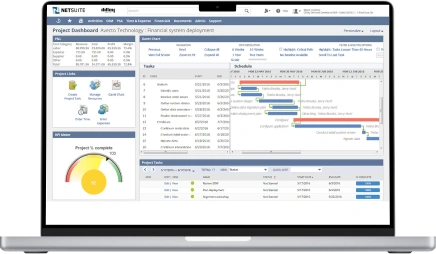
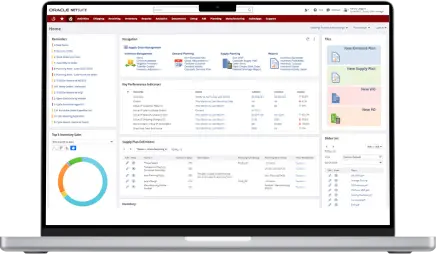
For holistic business financial reporting, construction companies can benefit from NetSuite OneWorld, fixed assets management, and electronic bank payments. The financial management module also offers SuiteBilling with NetSuite AIA billing for construction, revenue recognition regulations, secure and fast payment, planning and budgeting, and account reconciliation.
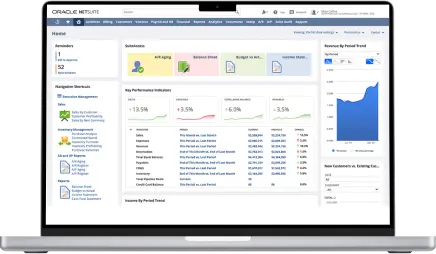
Prevent costly stockouts or overstocking with NetSuite inventory management. With purchase order automation and cost variance analysis, procurement processes can be streamlined through NetSuite project procurement for construction, and opportunities for cost savings can be identified. NetSuite’s robust reporting capabilities ensure compliance with industry regulations.
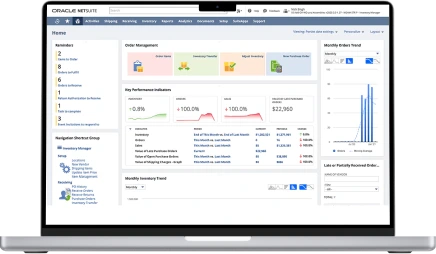
Centralize procurement processes, refine inventory, and manage logistics with NetSuite. With features like vendor collaboration and analytics, data-driven decision-making becomes easier, and it fosters stronger relationships with suppliers. Moreover, through NetSuite project procurement for construction, you get better control over your business operations.
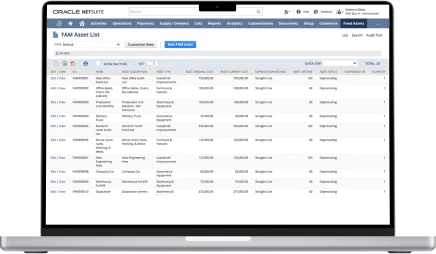
The NetSuite Fixed Assets Management module saves time and manual work by providing easy access to all standard and custom depreciation methods. Real-time fixed asset and lease reporting solutions allow your staff to accurately report the valuation, depreciation, expenditure, and amortization of your fixed assets using NetSuite construction industry scheme for projects.
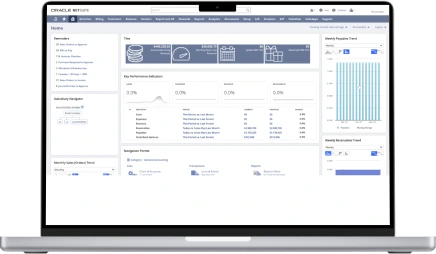
SuiteBilling offers flat, tiered, and bulk pricing models to your team, giving you more billing options through customer-specific pricing and discounts. Multiple pricing models, billing procedures, and real-time financial activity visibility will assist you in managing invoices for multiple construction projects for B2B and B2C customers.
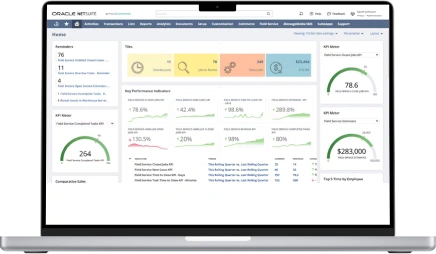
If your construction business needs ERP implementation, integration with existing applications, or ERP customization, our NetSuite-certified consultants are here to help you. Your construction business can have a comprehensive, personalized, and industry-specific solution for all its needs and pain points.
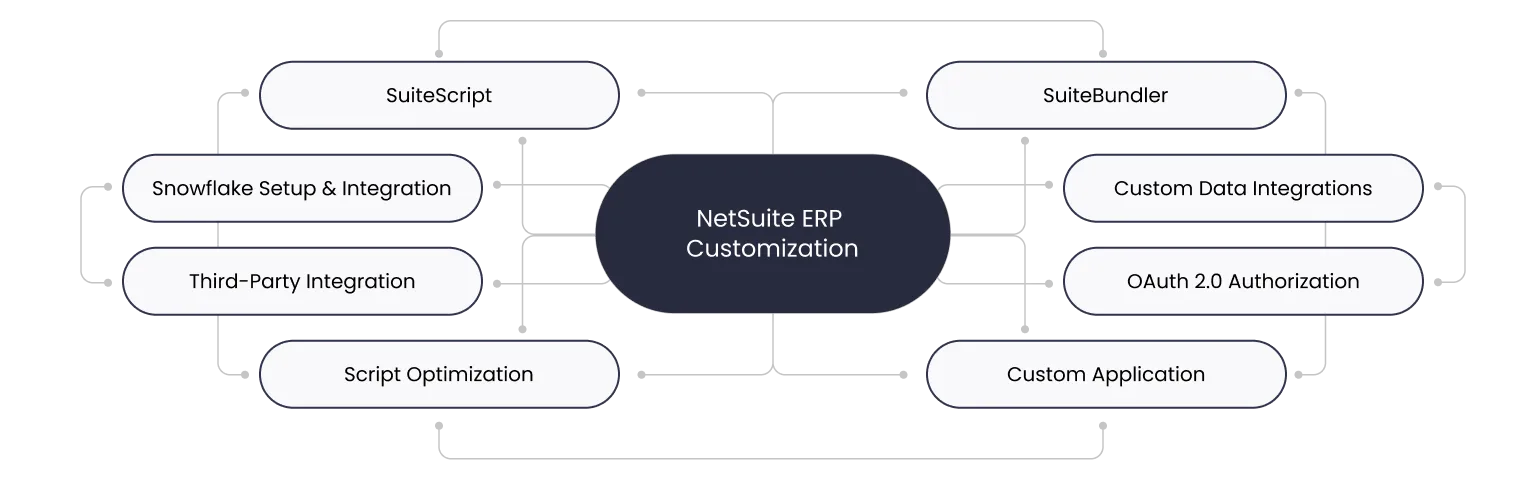
We offer post-deployment NetSuite managed services, including module implementations, workflow customizations, and bug fixes. Our specialized team provides personalized NetSuite support for any industry.

Book a 60-minute discovery call. We’ll show you how our NetSuite implementation helps you track financials around your construction projects.
QuickBooks and similar systems are built for basic accounting, not project-based work. NetSuite is designed for construction, where every dollar needs to be tracked by project. It connects financials directly to jobs, so you can see costs, margins, and performance at the project level instead of only at the company level.
Most systems only produce job cost reports after month-end closing, which is too late to act. NetSuite gives you live job costing, so you can see budget vs actuals while the project is still running. This helps you identify cost issues early instead of after the project is completed.
Yes. NetSuite tracks project costs and revenue as they happen. You can see if a project is on track or losing margin without waiting for month-end reports.
In many systems, retainage is tracked manually or in separate spreadsheets, which often leads to missed or delayed amounts. NetSuite tracks retainage automatically for each project, both receivables and payables. This gives you a clearer and more accurate view of expected cash flow.
Yes. Because billing, payments, and retainage are tied to each project, you get a more accurate picture of when money is expected and when it will actually arrive.
Yes. Costs from labor, materials, and subcontractors are tied directly to the project. This reduces reliance on spreadsheets and manual tracking, which are often inconsistent or delayed.
Yes. NetSuite can integrate with tools like Procore so that project updates, change orders, and cost changes flow into your financial system without manual entry.
NetSuite is a good fit if your construction business is running multiple projects and basic accounting tools no longer give you clear visibility into job costs, margins, or cash flow. It is designed for companies that need structured, project-based financial control rather than simple bookkeeping.
A company typically moves to NetSuite when managing projects becomes difficult to control using spreadsheets or entry-level accounting tools. This usually happens when you are handling multiple active projects, dealing with complex job costing, or struggling to get timely and accurate financial reporting.
NetSuite is commonly used by mid-sized to large construction firms, including general contractors and specialty contractors. These are companies that need better control over project financials, standardized job costing, and reliable reporting across multiple ongoing projects.
NetSuite is a powerful system, so implementation needs industry experience. That is why it is usually configured by specialists like Folio3 who understand construction workflows, job costing, and project accounting.

Find out if your customizations survive the Redwood UI upgrade.