Key Takeaways
- Start with flows, not vendors: Orders, inventory, fulfillment, and payouts each behave differently. A tool that handles three of them well can still cost you a month-end close.
- Manual transfer has a ceiling: Most teams hit it somewhere between 50 and 150 orders a day, and the first symptom is usually a reconciliation backlog, not a missed order.
- Direction of truth matters more than speed: Deciding which system owns inventory and pricing prevents more problems than shortening the sync interval ever will.
- Payouts are the flow most sellers underestimate: Shopify settles net of fees, and the accounting treatment has to be defined before the connector is configured.
- Fit is about operating profile: A single-warehouse DTC brand and a B2B plus DTC operation with three fulfillment points need different answers, and neither needs the most expensive one.
Understanding the Bigger Business Impact
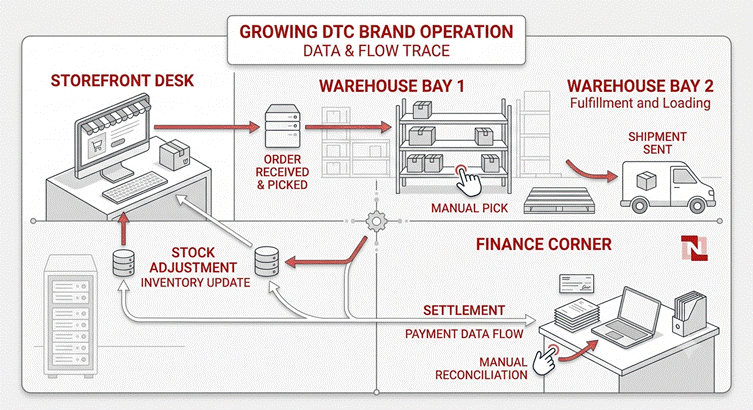
A poorly chosen Shopify to NetSuite sync often leads to a controller relying on a spreadsheet at month-end due to mismatched orders and payouts. This evaluation process focuses on data flows rather than just vendor features, promoting a more cost-effective and thorough selection.
The Mapping Decisions That Outlive the Vendor Choice
A handful of record mapping decisions get made in the second week of the project, before a single live order has been processed, and those decisions shape your reporting for years.
Order Type Decides When You Recognize Revenue
Cash sales post revenue at checkout for immediate fulfillment, while sales orders hold transactions for later delivery; choosing incorrectly affects revenue timing, necessitating a tailored approach for sellers with mixed models.
Variants Become Matrix Items, or They Do Not
A shirt in five sizes and four colors is one Shopify product and twenty NetSuite records. Mapping those as matrix children gives you parent-level demand reporting and cleaner replenishment.
This choice establishes a sync volume cap set by Shopify’s API limits, which affects how quickly stock levels refresh based on inventory updates.
Locations, Subsidiaries, and Where Tax Gets Decided
Shopify locations map to NetSuite inventory locations, but complications arise with multiple legal entities, leading to potential issues like misposted orders if subsidiary ownership isn’t clearly determined.
Tax reporting makes the same point in blunter terms. The IRS instructions for Form 1099-K state that the gross amount a payment settlement entity reports carries no deduction for fees, refunds, discounts, or shipping, and that is the figure your books have to agree with.
Settlement Records and the Gross Figure
Shopify Payments settles on its own schedule, net of fees, with refunds and chargebacks netted against later deposits. A day of sales and a day of cash rarely match, so the mapping has to treat revenue and settlement as separate events.
Ask Which Ones Are Reversible
Before signing, ask each vendor which of these four mappings can be changed after go-live and what the change costs. Some are a configuration screen. Altering order type after 40,000 posted transactions is a data migration with a project plan attached.
What Manual Data Transfer Between Shopify and NetSuite Actually Costs?
ALT – Comparison matrix of NetSuite sync options
Manual transfers can cause unnoticed gaps, impacting accurate financial reporting. A NetSuite Shopify Integration Comparison Across Four Sync Options
- Manual Export and Import
- Shopify App Store Connectors
- Native SuiteApp Connectors
- iPaaS or Custom API Build
The configuration sequence is worth understanding before you sit through demos. Our walkthrough on how to integrate Shopify with NetSuite covers the data flows, field mapping, and setup tasks step by step.
Best Shopify NetSuite Sync Options Compared
| Manual | App Store Connector | Native SuiteApp | iPaaS or Custom | |
| Typical fit | Under 50 orders/day | Simple DTC catalogs | Multi-location, B2B plus DTC | Many connected systems |
| Inventory freshness | Daily at best | Scheduled batches | Near real time | Configurable |
| Payout reconciliation | Manual | Often partial | Gross with fee posting | Built to spec |
| Custom fields | Not applicable | Limited | Extensive | Unlimited |
| Who owns failures | Nobody | Vendor support | Your NetSuite partner | Your integration owner |
| Cost curve | Rises with headcount | Flat monthly | License plus scope | Build plus maintenance |
Matching the Option to Your Operating Profile
Single warehouse, DTC only, one currency. An app connector or an entry-level SuiteApp covers this. Spending on middleware here buys flexibility you will not use.
Multi-warehouse, B2B alongside DTC, tiered pricing. A native SuiteApp is usually the fit, because customer-specific pricing and allocation logic already live in NetSuite records. If you also sell on marketplaces, the same reasoning applies to those channels. Our NetSuite marketplace connectors page shows how Amazon, eBay, and Walmart data lands in the same account.
Shopify plus WMS plus POS plus a payment processor. This is an orchestration problem, so iPaaS earns its cost. One caution: if your storefront requirements are modest, running commerce on NetSuite itself removes the sync entirely.
Where Syncs Break After Go-Live
- Discount codes with no matching NetSuite record – Orders post with the wrong revenue split until someone builds the mapping.
- Timezone and cutoff mismatch – Shopify reports in store time, NetSuite posts in subsidiary time, and one day’s sales lands in the wrong period.
- Deleted or renamed SKUs – The sync keeps referencing an item that no longer exists and fails quietly.
- Inventory drift after manual adjustments – A warehouse correction made directly in Shopify gets overwritten on the next push, so the count looks fixed for an hour.
None of these are exotic. They are the standard first-quarter issues, and the difference between products is whether they surface as alerts or as surprises.
Why Folio3?
We built our Shopify connector as a SuiteApp that runs inside your NetSuite account, with Built for NetSuite certification, real-time two-way sync, multi-warehouse inventory handling, and payout reconciliation that posts gross revenue with fees separated.
If you want to see how each flow is configured before committing to an approach, our NetSuite Shopify integration connector page details what syncs in each direction and where custom flows are added.
Conclusion
A useful NetSuite Shopify integration comparison ends with a match between your flows and one approach, not a ranked list of vendors. Write down your daily peak order count, your number of stock locations, and how you want payouts posted, then take those three answers into every demo.
Most mid-sized sellers land on a native SuiteApp because their complexity sits inside NetSuite rather than across a dozen systems. The ones who should look elsewhere usually know it already, because their integration problem was never really about Shopify.
Frequently Asked Questions
1. How fast should a Shopify to NetSuite sync run?
Inventory usually needs near real-time to prevent overselling. Orders can tolerate a few minutes, and payouts are typically daily. Match the interval to the flow rather than buying the fastest option across the board.
2. Which system should own product data?
Whichever one your merchandising team works in daily. Split ownership by field if needed, with NetSuite owning cost, item type, and stock, while Shopify owns images, descriptions, and SEO fields.
3. Can a connector handle Shopify POS and the online store together?
Yes, provided inventory is allocated from a single NetSuite source and each channel maps to a distinct location or subsidiary. Problems appear when POS stock is reserved separately from web stock.
4. What breaks when I add a second Shopify store?
Customer duplication and inventory allocation. Confirm the connector supports multiple stores against one NetSuite account before you launch the second storefront rather than after.
5. How long does implementation take?
Two to six weeks for a standard setup with clean data. Historical order migration, custom fulfillment logic, and multi-subsidiary structures extend that, and data cleanup is nearly always the longest phase.