Key Takeaways
- Fixed Retainer Pricing Is Replacing Hourly Billing for NetSuite Support. Hourly support typically runs $200 to $250 per hour with no cap. A fixed quarterly retainer model is cutting NetSuite support costs by 40 to 60% for businesses that switch.
- Quick Response Time Has Become the Baseline, Not the Premium Tier. Support contracts that still quote 24 or 48-hour response windows are falling behind what businesses now expect as standard.
- Knowledge Transfer Is Becoming a Contractual Requirement. Businesses are tired of inheriting undocumented systems. Structured knowledge transfer and training sessions are now being written into support agreements instead of being left to chance.
- Follow-the-Sun Support Is Now Expected for Any Global NetSuite Operation. A support partner working a single time zone is a liability for businesses running operations across multiple countries.
- Flexible, Scalable Admin Teams Are Replacing the All-or-Nothing Staffing Model. Businesses want to scale a NetSuite admin team up during implementation and scale it back down once the system stabilizes, without being locked into a fixed headcount or a long-term contract.
NetSuite support has quietly become one of the most negotiated parts of any NetSuite relationship. The platform itself gets attention during implementation. What happens after go-live, who answers when something breaks, how much that costs, and whether anyone actually documents what they fixed, is where most businesses end up frustrated.
This guide covers the trends actually reshaping how NetSuite support, managed services, and administration are delivered, based on what is changing in how these services are structured, priced, and scoped.
Trend 1: Fixed Retainer Pricing Is Replacing Hourly Billing
Hourly NetSuite support billing typically runs $200 to $250 per hour. There is no ceiling on that cost, and it scales directly with how many problems your system has, not with how well it is being maintained.
The Shift to Flat-Rate Retainers
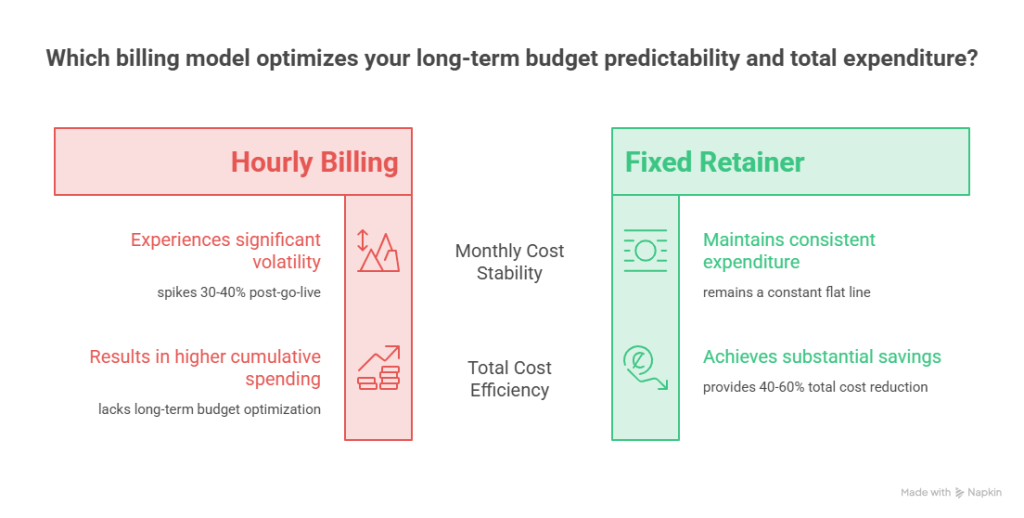
A flat quarterly retainer model, billed the way a SaaS subscription is billed, is replacing the hourly model for a growing share of NetSuite support relationships. The pricing logic is straightforward:
- Hourly billing rewards more hours worked, regardless of whether the underlying problem gets solved or just patched
- A fixed retainer rewards keeping the system healthy, since the provider is paid the same amount whether the month is quiet or chaotic
- Switching from hourly to a fixed quarterly retainer is producing a 40 to 60% reduction in NetSuite support costs for businesses that make the change
Why This Matters for Budgeting
Ad-hoc support bills under the hourly model commonly spike 30 to 40% in the months immediately following go-live, which creates exactly the kind of CFO friction that makes a NetSuite relationship feel unpredictable. A fixed retainer removes that variability entirely. The cost is known in advance, the same way any other SaaS line item is known in advance.
Trend 2: Quick Response Time Is Now the Baseline
Response time has quietly shifted from a premium-tier selling point to a baseline expectation. Support contracts still quoting a 24 or 48-hour response window are no longer competitive against what the market has moved to.
What “Fast” Now Means
A 2-hour response time is increasingly the standard businesses expect from any serious NetSuite support or managed services provider, not an upgrade they have to pay extra for. Combined with follow-the-sun coverage, this means a critical issue raised at any hour gets a response within two hours, regardless of when it was raised.
Why Response Time Became the Negotiating Point
Technical issues rarely wait for business hours. A broken integration that stops orders from syncing, a workflow that silently fails at month-end close, or a permission error that locks a finance team out of period close, all of these compound the longer they sit unresolved.
Response time is the metric that determines how much damage accumulates before anyone starts working on the problem.
Trend 3: AI-Driven Automation Is Now Essential, Not Optional
AI has moved from a feature MSPs mention to infrastructure clients expect by default. 87% of MSPs plan to increase AI investment by 2026, with service desk automation expected to reduce ticket volume by 40 to 60%. Providers deploying AI agents report resolution times three times faster than the manual process they replaced.
Where AI Is Actually Being Used
- Intelligent ticketing that automatically categorizes, prioritizes, and routes support requests
- Predictive maintenance that flags potential equipment or system failures before they affect clients
- Automated reporting that removes hours of manual data compilation
55% of US businesses already expect their MSP to be using AI by 2026. Gone are the days of creating flashy AI roadmap slides. A provider that cannot point to a live AI tool is starting the conversation behind.
What This Means for NetSuite
NetSuite is going through the identical shift. At SuiteConnect San Francisco 2026, Oracle showcased NetSuite Next, including an Intelligent Close Manager that accelerates month-end close by identifying discrepancies and automating reconciliation, and EPM Reconciliation and Planning Agents that help finance teams forecast with more accuracy. Bill Capture and Text Enhance already ship inside NetSuite today.
For businesses already running NetSuite, the setup guide for the NetSuite AI Connector covers how to wire AI tools directly into NetSuite data now, rather than waiting for a future release.
Trend 4: The Real Cost of Poor Support Is Now Quantifiable
NetSuite support failures used to be described in vague terms, like “things broke,” “it took a while to fix.” That language is being replaced by specific dollar figures, because businesses have started tracking what unsupported NetSuite environments actually cost them.
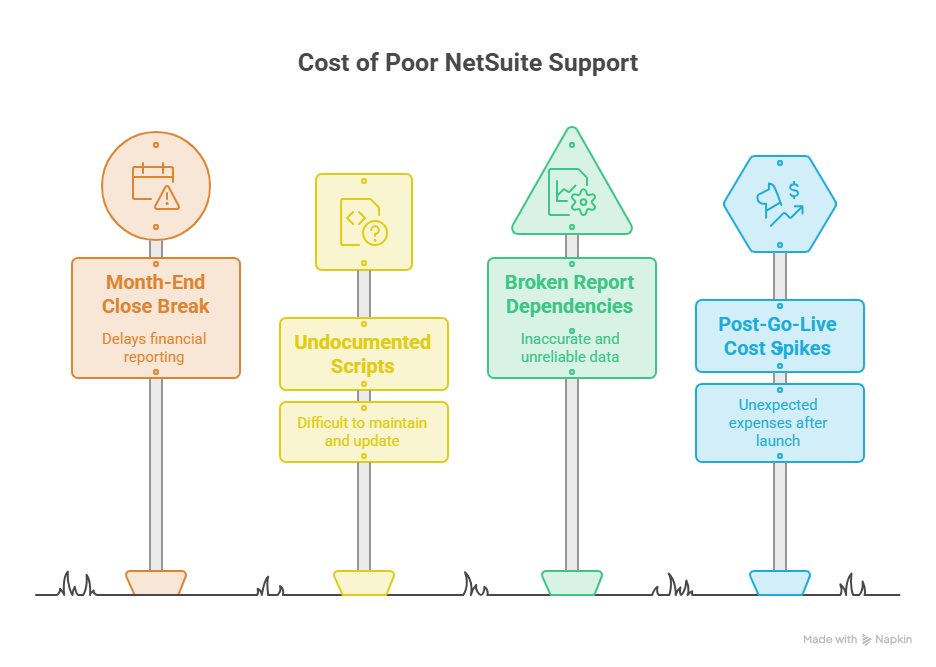
The Numbers Behind Common Failure Points
If you’re getting poor NetSuite support, it might result in high costs and unprecedented problems. Below are the common numbers that you can expect if you are not getting the right NetSuite support for your business.
- Unmonitored workflows that break at month-end close cost $5,000 to $15,000 per incident in lost productivity and delayed financial closing
- Undocumented custom scripts that nobody can operate cost 40+ hours of onboarding time per new employee, since HR and training teams absorb the burden of figuring out tribal knowledge that was never written down
- A single field change that breaks downstream reports without warning costs $250 to $500 per hour in reactive fixes, because without dependency mapping, nobody knows what else that field touches until something else breaks
- Ad-hoc support spikes of 30 to 40% post-go-live blow apart budget forecasts that finance teams built around a stable, predictable cost
What This Trend Signals
Businesses are no longer accepting “support issues happen” as a complete explanation. They are asking providers to quantify what proactive monitoring, dependency mapping, and structured documentation are actually worth in avoided cost, not just in service hours delivered.
Trend 5: Structured Knowledge Transfer Is Becoming Contractual
For years, NetSuite knowledge lived in the heads of whichever functional consultant or admin built the customization. When that person left or the contract ended, the knowledge was left with them. That is no longer an acceptable default.
What Changed
Structured knowledge transfer, meaning formal training sessions, documentation, and role-based onboarding built into the support engagement itself, is increasingly written into the scope of work. It is no longer being treated as an informal courtesy. The goal is to make sure that the client’s team knows and owns the systems being supported. They should not depend indefinitely on the support provider to explain them.
Why This Trend Emerged
Poor user adoption is consistently cited as the leading reason NetSuite deployments underperform relative to what they could deliver. Adoption improves through people actually understanding the system they are using, which only happens with real training, rather than a single onboarding session during go-live week, and nothing after.
Businesses that have inherited a completely undocumented NetSuite environment, where a previous provider built customizations and left no documentation behind, are increasingly vocal about wanting this to never happen again. Structured knowledge transfer is the direct response to that pattern.
Trend 6: Follow-the-Sun Support Is Now Expected for Global Operations
A NetSuite support partner that operates in a single time zone is a structural liability for any business running operations across multiple countries or regions.
What Follow-the-Sun Actually Requires
Genuine follow-the-sun support means a provider has staff physically distributed across multiple regions, commonly the US, Canada, the UK, Europe, and Australia, for global NetSuite operations, so that support coverage genuinely tracks the sun rather than relying on a single overnight on-call rotation.
Why This Distinction Matters
There is a real difference between a provider that claims “24/7 support” through an answering service or a single overworked on-call engineer, and a provider with actual teams awake and working in each major region. The first model degrades under pressure, whereas the second model is built to handle a critical issue at 3 am local time as a normal support ticket, not an emergency escalation.
Trend 7: Flexible, Scalable Admin Teams Are Replacing Fixed Headcount Models
NetSuite administration needs are not constant. They spike hard during implementation and major upgrades, then settle into a steadier maintenance rhythm once the system stabilizes. Support models are starting to reflect that reality rather than ignore it.
What Scalable Administration Looks Like
Below are some deterministic factors to consider when building scalable admin teams that help your business grow and deliver ROI.
- Scaling up during implementations and major projects, when the volume of configuration, testing, and training work is highest
- Scaling down once the system stabilizes, rather than paying for a fixed team size that is overcapacity during quiet periods
- No long-term lock-in contracts, giving businesses control over scope, duration, and team size as their needs change
- A full administration team available at a fraction of the cost of hiring, onboarding, and retaining the equivalent in-house staff, since the alternative is recruiting individual NetSuite-certified specialists directly
Why Rigid Staffing Models Are Losing Ground
A business that staffs for peak implementation load year-round is paying for capacity it does not need most of the time. A business that staffs only for steady-state maintenance gets blindsided every time a major upgrade or new module rollout hits.
Flexible team sizing solves both problems at once, and it is becoming the expected model rather than a negotiated exception.
Trend 8: Visibility Into Support Work Is Moving Into the Client’s Own Tools
NetSuite support and administration work used to live entirely inside the provider’s own systems, visible to the client only through status update emails or monthly reports. That is shifting toward direct visibility inside whatever project management tool the client already uses.
What This Looks Like in Practice
Every piece of support and administration work is being tracked and reported through the client’s preferred PM tool, whether that is Jira, Basecamp, Azure Boards, or anything else already in use internally, rather than forcing the client to learn or check a separate provider-specific portal.
Why This Is a Meaningful Shift
This removes a layer of friction that used to be standard. Previously, you would be logging into a separate support portal to check ticket status, or waiting for a weekly summary email to find out what got done. Direct visibility inside the client’s existing workflow tools means support work is as transparent as any other internal project, rather than a black box that requires a status meeting to understand.
What to Ask Any Managed Services Partner Based on These Trends
The six trends above translate into four direct questions worth asking any MSP or NetSuite partner before signing or renewing a contract.
- Is AI already live in their operations, or still on a roadmap? Ask for one specific tool they have implemented for another client.
- Do they have named, verifiable experience in your industry? Ask for three examples in your exact vertical, not an adjacent one.
- Is pricing tied to outcomes, or still billed by the hour? If hourly, ask what a retainer or managed services model would cost and cover.
- Have they consolidated multiple systems for a client that grew through acquisition? Ask them to walk through how they did it.
For a fuller framework on evaluating a NetSuite partner against these criteria, including partner tier and the difference between a named consultant and a pooled support queue, how to choose the right NetSuite managed services provider covers the full evaluation process.
How Folio3 Aligns With Top Managed NetSuite Service Provider Trends
As NetSuite environments become more complex, businesses increasingly expect predictable pricing, faster response times, stronger documentation practices, and access to specialized expertise without maintaining a large in-house team. These trends are religiously followed by Folio3 and are part of how our NetSuite Support Services are delivered.
- Fixed monthly support plans provide predictable costs and eliminate the uncertainty of hourly billing.
- Rapid response SLAs help teams resolve issues quickly before they impact operations.
- Dedicated NetSuite specialists support functional, technical, integration, and optimization requirements.
- Knowledge transfer and documentation ensure businesses retain visibility into customizations, workflows, and system changes.
- Flexible support models allow organizations to scale support coverage as business requirements evolve.
- Global delivery capabilities enable support across multiple regions and time zones for distributed operations.
Whether the goal is maintaining system stability, supporting new initiatives, or optimizing an existing NetSuite environment, the focus is on providing long-term operational support rather than reactive issue resolution alone.
Final Thoughts
The trends reshaping NetSuite support in 2026 are not abstract. They show up directly in how contracts are priced, how response times are set, how knowledge gets documented, and how teams are staffed. Fixed retainer pricing, two-hour response baselines, contractual knowledge transfer, true follow-the-sun coverage, and flexible team sizing are becoming the standard a business should expect, not the exception a premium provider offers.
If your current NetSuite support relationship is still billed hourly, still quotes a response window measured in days, or has left your team without documentation for customizations someone else built, that gap is worth addressing directly rather than working around indefinitely.
See what a fixed-cost, fast-response NetSuite support model actually looks like for your business. Talk to a NetSuite Support Expert!
FAQs
Why is fixed retainer pricing replacing hourly billing for NetSuite support?
Hourly billing rewards a provider for taking longer to resolve issues and creates unpredictable monthly costs, with ad-hoc bills commonly spiking 30 to 40% in the months after go-live. A fixed quarterly retainer, billed like a SaaS subscription, gives businesses budget certainty and produces 40 to 60% lower total support costs compared to hourly billing at $200 to $250 per hour.
What response time should a NetSuite support provider offer in 2026?
Two-hour response time has become the baseline expectation rather than a premium add-on. Providers still quoting 24 or 48-hour response windows are behind where the market has moved. Combined with follow-the-sun coverage, this means critical issues get addressed quickly, regardless of what time they are reported.
How much does poor NetSuite support actually cost a business?
Specific failure points now have quantified costs: $5,000 to $15,000 per incident when an unmonitored workflow breaks at month-end close, 40-plus hours of onboarding time per new hire when custom scripts are undocumented, and $250 to $500 per hour in reactive fixes when an unmapped field change breaks downstream reports. These figures are why proactive monitoring and dependency mapping are increasingly built into support contracts rather than treated as optional extras.
What does structured knowledge transfer mean in a NetSuite support contract?
It means formal training sessions, documentation, and role-based onboarding are written into the scope of the support engagement, so the client’s internal team actually understands and can operate the systems being supported. This directly addresses the common failure pattern where a previous consultant built customizations, left no documentation, and the knowledge disappeared when the contract ended.
Why are scalable admin team models replacing fixed in-house NetSuite teams?
NetSuite administration demand spikes during implementations and major upgrades, then settles into steadier maintenance work afterward. A fixed in-house team is either overstaffed during quiet periods or overwhelmed during major projects. A flexible outsourced model that scales up and down with actual need, without long-term lock-in contracts, matches cost to actual workload instead of a static headcount.
What are the most important MSP trends for 2026?
The trends with the most measurable impact are AI-driven automation becoming standard rather than a differentiator, cybersecurity growing faster than the rest of the MSP market, vertical specialization commanding a real pricing premium, outcomes-based pricing replacing hourly billing, and continued M&A consolidation across the industry.
How does AI adoption in MSPs relate to AI in NetSuite specifically?
Both reflect the same shift from experimental to operational. MSPs are deploying AI for ticket automation and threat detection. NetSuite has shipped Bill Capture, Text Enhance, and an AI Connector, with agentic capabilities like the Intelligent Close Manager and EPM agents announced for 2026. A business evaluating a NetSuite partner should expect that partner to already be using these tools, not planning to eventually.
Why does vertical specialization matter when choosing an MSP or ERP partner?
Different industries carry different operational patterns, module combinations, and compliance requirements. A partner with verified experience in your specific vertical applies proven configurations immediately. A generalist learns your industry through your billable hours. Specialized providers report higher margins and command premium pricing meaningfully for the same reason of solving the problem faster.
What does outcomes-based pricing mean for NetSuite support specifically?
It means moving away from hourly billing toward a monthly retainer or managed services agreement, typically $3,000 to $12,000 per month, depending on scope, that covers system health, optimization, and release management as a package tied to defined service levels rather than hours logged.