Jewellery manufacturing is one of the most operationally complex verticals in discrete manufacturing. You are dealing with precious metal spot pricing, multi-stage production from raw casting to stone setting, hallmarking compliance, serialised finished goods, consignment stock for retail partners, and multi-currency transactions across global supply chains, all at the same time.
Generic ERP platforms handle none of this natively. That gap is expensive. When costing is off by even a fraction on a gold item, margin erosion compounds across hundreds of SKUs. When compliance documentation is manual, audit risk multiplies. When inventory counts do not reconcile with the shop floor, production stalls.
This guide evaluates the top ERP platforms for jewellery manufacturers, covers what each does well and where it falls short, and explains why NetSuite consistently ranks as the most capable choice for mid-market and growing jewellery businesses, and why Folio3 is the implementation partner that gets it configured seamlessly.
The Best ERP Systems for Jewellery Manufacturers: Detailed Comparison
Below is an in-depth evaluation of the leading ERP platforms relevant to jewellery manufacturers. The comparison covers functional depth, industry fit, deployment model, and total cost of ownership.
1. Oracle NetSuite: Best Overall ERP for Jewellery Manufacturers
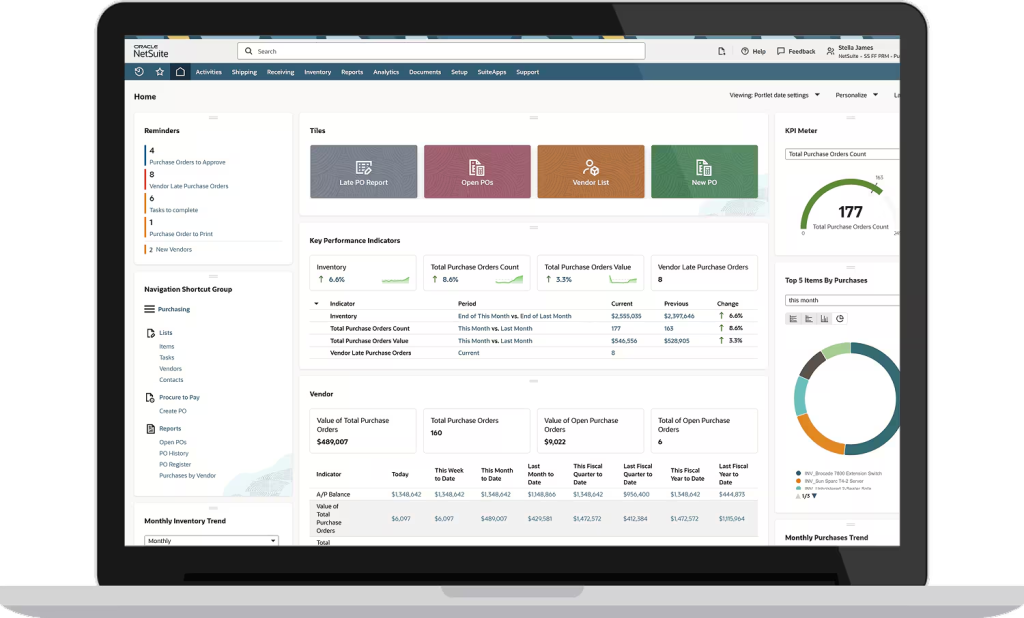
NetSuite is the most widely deployed cloud ERP for mid-market jewellery manufacturers globally, and for jewellery specifically, it offers the most configurable foundation of any platform in this tier. It does not ship with a jewellery-specific vertical out of the box, but its architecture (flexible BOM structures, lot and serial tracking, native multi-currency, and a real financial engine) means that a competent implementation partner can build a jewellery-ready environment without layering on third-party applications for core functions.
What NetSuite Does for Jewellery Manufacturers
- NetSuite’s Manufacturing module handles multi-level BOMs with component-level costing. For a jewellery manufacturer, this means you can define a finished ring with sub-assemblies for the shank, setting, and stone, each with its own cost inputs, wastage factors, and routing steps. Actual costs are captured against the work order as it progresses through production stages.
- Lot and serial number tracking in NetSuite operates natively across the entire inventory and order management module. Every gram of gold received from a refinery can carry a lot number that traces through the entire production process to the finished serialised piece. This is the foundation of both compliance reporting and insurance documentation.
- NetSuite’s financial management module includes multi-currency transaction processing, automated exchange rate updates, revaluation of open balances, and intercompany eliminations. For a jewellery group with entities in multiple countries, this eliminates the manual month-end reconciliation that consumes finance team capacity.
- The SuiteCommerce module extends NetSuite into B2B and B2C ecommerce, allowing jewellery brands to run their wholesale ordering portal and consumer-facing store from the same system that runs their inventory and production. Orders, inventory levels, and customer data are unified without integration middleware.
- Custom fields, custom forms, and SuiteFlow (the built-in workflow engine) allow teams to build hallmarking workflows, certificate generation processes, and consignment tracking structures directly inside NetSuite without writing code. SuiteScript provides a full API layer for integrations with CAD software, gemstone lab systems, or POS platforms used by retail partners.
Where NetSuite Requires Careful Configuration
Precious metal spot price integration requires a connector, either a SuiteApp from the NetSuite marketplace or a custom integration built by your implementation partner. Without this, material costs in BOMs are static rather than dynamic, which undermines the margin visibility that makes NetSuite valuable for jewellery.
Consignment stock management is possible in NetSuite but requires deliberate configuration. Standard NetSuite does not have a consignment module. The correct approach is to use location-based inventory management combined with custom transaction types for consignment placements and returns. This is a solved problem for experienced NetSuite partners but represents a gap if the implementation is handled by a generalist.
Ideal For
- Mid-market jewellery manufacturers with 20 to 500 employees
- Brands with direct-to-consumer and wholesale channels
- Businesses with multi-entity or multi-country structures
- Manufacturers who need to scale without re-implementing their ERP
Deployment
Cloud-native SaaS. No on-premises option. Updates are automatic, twice per year.
Pricing
Licence fees start in the range of USD 1,000 to 2,000 per month for a base platform, with module and user costs added on top. Implementation costs vary significantly based on complexity. Folio3 offers fixed-scope implementation packages for jewellery manufacturers.
Book a demo with our team to see how we can help you scale your jewellery business and operate more efficiently with the right ERP.
2. SAP Business One: Strong for Small Jewellery Operations
SAP Business One is an SMB-focused ERP that covers the basics of manufacturing, inventory, and financials competently. It has a large ecosystem of add-on modules from SAP’s partner network, and some of those partners have built jewellery-specific extensions.
The core platform handles BOM structures, production orders, and inventory management, but precious metal cost integration, lot-level traceability at the granularity jewellery requires, and multi-entity financial consolidation are all areas where Business One shows its SMB origins. Businesses that outgrow it typically find that the add-on layer they have built to cover gaps becomes a maintenance burden.
Business One is available in both on-premises and cloud (SAP Business One Cloud) deployments. Total cost of ownership on the cloud version is competitive, but the platform does not scale as cleanly as NetSuite when businesses move into enterprise territory or add legal entities.
Best For
- Small jewellery manufacturers under 50 employees
- Businesses primarily operating in a single country
- Operations that have outgrown accounting software but are not yet ready for a full mid-market ERP investment
Limitation to Note
The add-on ecosystem for jewellery in SAP Business One is fragmented. You may end up running three or four separate vendor relationships to cover hallmarking, precious metal costing, and certificate management, all of which need to be maintained across each SAP version update.
3. Microsoft Dynamics 365 Business Central and Finance and Operations
Microsoft’s ERP portfolio spans two products: Business Central for SMBs and Finance and Operations (now Dynamics 365 Finance plus Supply Chain Management) for enterprises. Both are built on a cloud-first model and integrate tightly with the Microsoft 365 productivity suite.
For jewellery manufacturers, Dynamics 365 Finance and Supply Chain Management is the relevant platform at the enterprise level. It handles advanced manufacturing, multi-entity financials, and global trade compliance with depth comparable to NetSuite. The platform is stronger on the financial side than the production side out of the box, and jewellery-specific functionality (precious metal costing, hallmarking workflows, consignment management) requires either ISV extensions or custom development.
The Microsoft ecosystem advantage is real. If your organisation is heavily invested in Azure, Power BI, Teams, and Office 365, the integration story is cleaner than with NetSuite. However, implementation complexity for Dynamics 365 Finance is significant, and the total cost of ownership for a mid-market jewellery manufacturer is typically higher than NetSuite on a five-year basis.
Best For
- Enterprise jewellery groups are already deep in the Microsoft ecosystem
- Organisations with a strong internal IT team capable of managing a complex implementation
- Businesses that require tight integration with Microsoft Power Platform for custom applications
Limitation to Note
Mid-market jewellery manufacturers often find that Dynamics 365 Finance is over-engineered for their current needs and under-configured for jewellery specifics. The implementation investment required to achieve the same level of jewellery functionality that NetSuite delivers with a competent partner is substantially higher.
4. Sage X3: Capable Mid-Market Option with Gaps in Jewellery Specifics
Sage X3 is a mid-market ERP with decent manufacturing depth, particularly around discrete and process manufacturing. It handles multi-level BOMs, production routing, and basic costing competently. The financial module is solid, with multi-currency and multi-entity support.
For jewellery manufacturers, Sage X3 presents the same challenge as most horizontal ERPs: the jewellery-specific layer is thin. Precious metal costing requires customisation, serial and lot tracking works but requires careful configuration, and the consignment functionality is limited without add-ons.
Sage X3 is predominantly deployed on-premises, though a cloud option exists. The on-premises model means your IT team owns upgrades, which affects the total cost of ownership calculation over time.
Best For
- Mid-market manufacturers in industries where Sage has strong vertical coverage
- Businesses that prefer on-premises deployment for data sovereignty reasons
- Organisations with existing Sage relationships and a preference to stay in that ecosystem
5. Epicor Kinetic: Manufacturing Depth, Limited Jewellery Focus
Epicor Kinetic (formerly Epicor ERP) is a manufacturing-focused platform with deep functionality in job shop and discrete manufacturing environments. Its production management, scheduling, and shop floor control capabilities are strong.
For jewellery manufacturers, Epicor’s manufacturing depth is a positive, but the platform’s focus on industrial manufacturing means that jewellery-specific requirements (precious metal spot pricing, gemstone inventory management, hallmarking, consumer-facing ecommerce integration) are not areas where the platform has invested.
Epicor is a reasonable consideration for jewellery manufacturers whose primary challenge is production management and who have simpler requirements around precious metal costing and compliance. For businesses where the financial and compliance dimensions are as important as production, NetSuite or Dynamics 365 Finance are stronger choices.
ERP Comparison Summary for Jewellery Manufacturers
The table below summarises how each platform addresses the core requirements of jewellery manufacturing. NetSuite shows consistent strength across the dimensions that matter most.
| Feature | NetSuite | SAP Business One | Microsoft Dynamics 365 | Sage X3 | Epicor |
|---|---|---|---|---|---|
| Jewellery BOM | Multi-level, configurable | Basic BOM support | Moderate, needs ISV | Configurable | Strong in manufacturing |
| Precious Metal Costing | Native lot/serial cost tracking | Manual workarounds | Requires customisation | Limited native support | Moderate |
| Hallmark Compliance | Custom fields plus workflows | Manual process | Manual or 3rd party | Limited | Manual |
| Real-Time Inventory | Native, multi-location | Native | Native | Native | Native |
| Multi-Currency | Native, full | Native | Native | Native | Native |
| Cloud-Native | Yes, true cloud | On-prem plus cloud option | Cloud plus on-prem | On-prem primary | Cloud plus on-prem |
| Scalability | Mid-market to enterprise | SMB focused | Mid to enterprise | Mid-market | Mid-market to enterprise |
| Implementation Partner | Folio3 (certified) | Various | Various | Various | Various |
Why Jewellery Manufacturing Needs a Purpose-Configured ERP
Below are a few reasons jewellery manufacturers need a proper ERP implementation, as it will help make their business operations smoother and more efficient.
The Core Operational Challenges
Most manufacturers deal with inventory, production orders, and financials. Jewellery manufacturers deal with all of that, plus a set of requirements that have no parallel in other industries.
Precious Metal Cost Volatility
Gold, silver, platinum, and palladium prices move daily. A production order raised on Monday using Monday’s gold price may close on Friday when the spot rate has shifted 2 to 3 percent. Without real-time cost linkage and lot-level tracking, your actual margin versus planned margin diverges in ways that are only visible after the fact, too late to act.
Multi-Level Bill of Materials
A finished jewellery piece involves raw metal inputs, alloys, gemstones, findings, and finishing consumables. Each sub-assembly has its own yield rate, wastage factor, and quality checkpoint. A BOM in jewellery manufacturing is not a flat list. It is a multi-level structure that must account for metal loss during casting, stone breakage allowances, and labour routing at each stage.
Hallmarking and Compliance
Regulatory requirements in markets like the UK (Assay Office), India (BIS hallmarking), and the UAE (Dubai Central Laboratory) mandate that finished pieces carry verifiable hallmarks. Managing this through spreadsheets or disconnected systems creates compliance gaps that are expensive to remediate and can result in shipment holds.
Serial Number and Certificate Tracking
High-value pieces require full traceability, from the raw metal lot, through production stages, to the final serial number on the finished piece. Certificates of authenticity, gemstone grading reports, and insurance valuations must be linked to individual items, not batches.
Consignment and Retail Distribution
Jewellery brands frequently place stock on consignment with retail partners. This creates an inventory ownership and reconciliation problem that most ERP systems handle poorly. You need to track what is on consignment, where it is, how long it has been there, and when unsold goods are returned, all without creating false revenue recognition.
Multi-Currency and International Trade
Raw material sourcing (Antwerp, Mumbai, Bangkok), manufacturing (often in low-cost locations), and sales (global retail and wholesale) operate in different currencies. FX exposure on open purchase orders, landed cost calculation for imported gemstones, and transfer pricing between legal entities all require a financial engine that handles currency at a transactional level.
Why NetSuite Is the Right Foundation for Jewellery Manufacturers
The comparison above points to a consistent pattern: NetSuite requires configuration to serve jewellery manufacturing well, but it starts from a stronger foundation than any competitor at its price point. The architecture decisions that Oracle made when building NetSuite (true cloud, unified data model, native multi-currency, lot and serial tracking as a core capability) align with the operational reality of a jewellery business more closely than the alternatives.
1. Total Cost of Ownership Over Five Years
Mid-market jewellery manufacturers who evaluate ERP on licence cost alone consistently underestimate implementation, customisation, and integration costs. On a five-year basis, NetSuite’s cloud model, where updates are included, infrastructure is managed, and the platform scales without re-licensing, compares favourably with on-premises alternatives that require hardware refreshes, IT staff for maintenance, and paid upgrade projects.
2. Scalability Without Re-Implementation
The most expensive ERP decision a growing jewellery business can make is choosing a platform that cannot grow with it. Businesses that start on a basic accounting or SMB ERP platform typically hit a ceiling at around 20 to 30 million in revenue, at which point they face a full re-implementation. NetSuite’s architecture supports businesses from startup through to multi-hundred-million-dollar enterprises without a platform change.
3. Integration Ecosystem
Jewellery manufacturers use specialised software that needs to connect to their ERP: CAD and CAM tools for design and production, gemstone trading platforms for purchasing, POS systems at retail locations, and marketplace integrations for ecommerce. NetSuite’s SuiteScript API and the SuiteApp marketplace provide a well-documented integration layer. Folio3 has built and maintains connectors for the most common jewellery industry integrations.
How to Choose the Right ERP for Your Jewellery Business
The right ERP depends on where your business is today and where it is going. The questions below consistently determine which platform is the best fit.
What is your current revenue and growth trajectory?
Under USD 5 million with limited growth: SAP Business One or Sage 50 may be sufficient. USD 5 to 150 million with growth: NetSuite is the primary recommendation. Over USD 150 million with complex multi-entity structures: NetSuite or Dynamics 365 Finance depending on existing ecosystem investments.
How important is precious metal cost accuracy to your margins?
If precious metal cost is a significant percentage of your COGS, which it is for most jewellery manufacturers, then real-time or near-real-time cost integration is not optional. Platforms that cannot support dynamic material costing will undermine your margin visibility regardless of how well everything else works.
Do you sell through multiple channels?
Manufacturers who sell wholesale to retailers, operate their own stores, and run a direct-to-consumer ecommerce channel need an ERP that can manage all three without requiring separate systems for each. NetSuite with SuiteCommerce is the clearest solution to this requirement.
How many legal entities do you operate?
Single-entity businesses have more options. Businesses with manufacturing in one jurisdiction, sales in another, and a holding company in a third need an ERP with genuine multi-entity financial management. NetSuite handles this natively. Most alternatives require add-ons or manual consolidation.
How Folio3 Helps Jewellery Manufacturers Get NetSuite Right
NetSuite’s value to a jewellery manufacturer is determined almost entirely by how well it is configured. A generic NetSuite implementation, the kind that follows a standard template without deep industry knowledge, will leave significant functionality unconfigured and require expensive retrofits within 12 to 18 months.
Folio3 is a certified Oracle NetSuite Alliance Partner with a dedicated manufacturing and wholesale practice. The team has implemented NetSuite for jewellery and precious goods manufacturers across North America, the Middle East, and South Asia, including businesses with operations spanning multiple legal entities, consignment networks, and direct-to-consumer channels.
Precious Metal Costing Configuration
Folio3 configures NetSuite’s costing engine to reflect how precious metals are actually priced in your business, whether that is standard cost updated periodically, average cost updated on receipt, or a custom integration with a metal exchange feed. The costing configuration is validated against real production scenarios before go-live, not after.
Lot and Serial Traceability
The lot and serial tracking configuration Folio3 builds covers the full chain: supplier lot on receipt, sub-lot assignment during production, and final serial assignment at finished goods. This traceability structure supports both internal quality control and external compliance reporting without manual reconciliation.
Consignment Management
Folio3 builds the consignment workflow structure that standard NetSuite does not include out of the box: location-based inventory separation for consigned goods, custom transaction types for placements and returns, and reporting that shows consignment ageing by retail partner and product category.
Hallmarking and Compliance Workflows
Custom workflows built in SuiteFlow handle the production hold, submission, and approval steps required for hallmarking. Documentation is generated automatically from the NetSuite transaction record and stored against the relevant items, reducing the manual effort at compliance checkpoints.
Integration with Industry-Specific Tools
Folio3 builds and supports integrations between NetSuite and the tools jewellery manufacturers actually use: RhinoGold and Matrix for CAD, Rapnet and Polygon for diamond and gemstone trading, and Shopify or WooCommerce for consumer-facing ecommerce. These integrations are built on NetSuite’s SuiteScript API and are maintained through version updates.
Post Go-Live Support
Folio3 provides ongoing support and optimisation services after implementation, including quarterly business reviews to assess whether the NetSuite configuration continues to serve operational needs as the business evolves. This is particularly relevant for jewellery manufacturers in growth phases who are adding product lines, entering new markets, or acquiring other businesses.
Bottom Line
Choosing the right ERP system can have a major impact on the efficiency and profitability of a jewellery manufacturing business. The best ERP solutions help manufacturers manage complex inventory, track precious metals and gemstones, streamline production processes, maintain quality standards, and gain real-time visibility into financial performance.
While several ERP platforms offer industry-specific capabilities, the right choice ultimately depends on your business size, operational complexity, growth plans, and customisation requirements. For jewellery manufacturers looking for a scalable solution that combines manufacturing, inventory, financials, CRM, and reporting in a single platform, NetSuite remains one of the strongest options available.
Before making a decision, evaluate your current challenges, define your long-term business goals, and choose an ERP solution that can support both your present needs and future growth.
FAQs
What is the best ERP for small jewellery manufacturers?
For small jewellery manufacturers under USD 5 million in revenue with straightforward operations, SAP Business One or NetSuite’s starter tier are the most practical options. As the business grows past USD 10 million and operational complexity increases (multiple product lines, precious metal cost tracking, consignment distribution) NetSuite becomes the more scalable choice.
Does NetSuite have a jewellery-specific module?
NetSuite does not ship a dedicated jewellery vertical module. What it provides is a highly configurable manufacturing and financial platform that, when implemented by a partner with jewellery industry experience, can handle the specific requirements of precious metal costing, lot traceability, hallmarking workflows, and consignment management. Folio3 has built this configuration for jewellery manufacturers across multiple markets.
How long does a NetSuite implementation take for a jewellery manufacturer?
A standard NetSuite implementation for a mid-market jewellery manufacturer with one legal entity, one manufacturing facility, and up to three sales channels typically takes four to six months from kickoff to go-live. Implementations involving multiple legal entities, complex consignment networks, or custom integrations with CAD or gemstone trading platforms will take longer. Folio3 provides fixed-timeline implementation packages with defined scope and milestones.
Can NetSuite handle precious metal spot price integration?
Yes. NetSuite supports real-time and scheduled cost updates for inventory items, and Folio3 builds integrations with metal exchange data feeds to keep material costs in NetSuite’s BOM and costing engine current. The specific configuration depends on how your business prices production (standard cost, weighted average, or actual lot cost) and Folio3 designs the integration accordingly.
How does NetSuite handle hallmarking compliance documentation?
Hallmarking compliance documentation in NetSuite is handled through custom workflows, custom fields on item and transaction records, and document generation using NetSuite’s PDF template engine. Production orders can be placed on hold pending hallmark submission, and the approval record is stored against the relevant item serial number. Folio3 configures this workflow to match the specific regulatory process in your market.
What does an ERP implementation with Folio3 cost for a jewellery manufacturer?
ERP Implementation costs depend on the scope of configuration, number of users, integrations required, and data migration complexity. Folio3 offers scoped implementation packages and will provide a detailed estimate after an initial discovery session. NetSuite licence costs are separate and are quoted directly by Oracle based on modules and user count.