Key Takeaways
- Off-the-shelf ERP is not enough for the automotive industry. The industry runs on fitment data, VIN-based catalogs, high-SKU distribution, multi-channel pricing, and supplier compliance requirements that a standard ERP was not designed to handle without serious configuration.
- The aftermarket will contribute nearly $600 billion to the automotive industry by 2026. The Auto Care Association projects growth at a 5.7% CAGR, driven by eCommerce adoption, aging vehicle fleets, and data-driven demand forecasting. Businesses not on the right platform will struggle to capture any of it.
- Most automotive businesses come to ERP with five or more disconnected systems. AutoRimShop ran QuickBooks, Salesforce, Deposco, Magento 2, and Zendesk before Folio3 implemented NetSuite.
- Fitment data is the first hard requirement, and most ERPs ignore it. ACES and PIES are the industry standards for part fitment and product data in the aftermarket. An ERP that cannot connect to fitment data providers cannot support accurate catalog management.
- Engineering change orders are where chargebacks start. A single ECO that reaches email but never updates the work order is how 200 parts ship to the wrong spec, and a chargeback arrives three days later. Documented change control inside the ERP is not optional.
A production manager at an auto parts manufacturer realized his team had built 200 brackets to the wrong spec. The engineering change had come through email two weeks earlier. Someone saw it, but the work order stayed unupdated. Three days later, the chargeback arrived. That single event cost more than a full year of ERP licensing.
We see variations of it across automotive businesses every year. The problem is not that the team was incompetent. The problem is that the change lived in email, not in the system that controlled production.
So, what does ERP for the automotive industry actually need to do? For the specific operations, automotive ERP runs multi-channel distribution, fitment catalog management, engineering change control, multi-brand consolidation, and supplier compliance.
This guide breaks down each requirement, where generic ERP falls short for the automotive industry, and what it looks like when the configuration is right.
Does Your ERP Handle the Automotive Aftermarket’s Real Complexity?
The automotive aftermarket has specific operational requirements that generic platforms do not handle appropriately without the proper configuration.
The aftermarket is projected to reach nearly $600 billion by 2026. The Auto Care Association identifies eCommerce adoption, aging vehicle fleets, and data analytics as the three primary growth drivers, and all three of those drivers put direct pressure on the ERP layer.
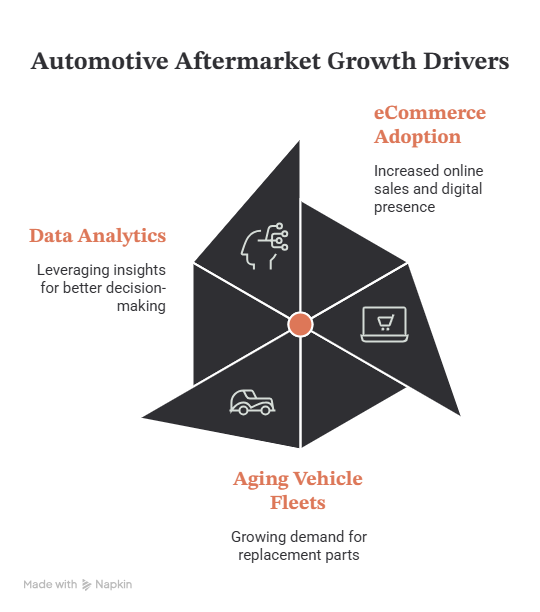
Your ERP for the automotive industry needs to sync inventory in real time as aging fleets drive demand for a wider range of part numbers across more vehicle years, makes, and models.
Data analytics requires clean, centralized data, which disconnected systems across the business operations cannot provide.
The businesses that capture that growth are the ones whose systems can handle the volume. The ones that miss it are the ones reconciling spreadsheets between QuickBooks and a webstore.
What Is Fitment Data and Why Does It Break Most ERPs?
This is the requirement that separates automotive aftermarket ERP from every other distribution context. Fitment data describes which parts fit which vehicles. Without it, a customer searching for a wheel hub bearing for a 2019 Ford F-150 with a specific trim level gets either no result or the wrong result.
What ACES and PIES Are
ACES (Aftermarket Catalog Exchange Standard) manages vehicle fitment data. PIES (Product Information Exchange Standard) manages product attribute data. Together, they are how the automotive aftermarket communicates which parts go on which vehicles, and they are the backbone of catalog management for any business selling parts online or through retail channels.
An ERP that cannot connect to ACES and PIES data, either natively or through an integration, cannot accurately manage an automotive parts catalog. A business selling 50,000 SKUs across 15 years of vehicle applications is dealing with a fitment matrix that no human team can reliably manage in spreadsheets.
What Happens When Fitment Data Lives Outside the ERP
When fitment data lives in a separate catalog tool that does not sync in real time with the ERP, inventory, and catalog management drift apart.
When fitment data is not managed and synced by an ERP, automotive manufacturers face data discrepancies of different kinds, such as:
- A part that is out of stock still shows as available in the catalog
- The superseded part number still shows as the current one.
- Returns happen because the customer received the right part for the catalog record, but the wrong part for the actual vehicle, and so on.
NetSuite does not carry native ACES/PIES management inside the core platform, but it supports integrations with fitment data providers through the SuiteApp ecosystem and custom connectors.
Getting this integration right is one of the most important configuration decisions in any automotive NetSuite implementation.
How Does ERP Handle High-SKU Automotive Catalog Management?
Catalog size is where automotive businesses outgrow entry-level ERP fastest. QuickBooks can handle 1,000 item records reasonably, but the catch is that it does not scale to 100,000. The item record in automotive is also more complex than in most industries.
What a Single Automotive Item Record Needs to Carry
An automotive part item record is not just a SKU and a price. It typically needs to hold:
- Part number cross-references (OEM part number, aftermarket equivalents, competitor cross-references)
- Fitment data links (which vehicles the part fits, by year, make, model, and trim)
- Multiple pricing levels (wholesale, retail, fleet, channel-specific pricing)
- Supersession chains (which newer part number replaces this one)
- Core tracking (for parts with a core charge and deposit)
- Hazmat flags (for batteries, fluids, and restricted items)
- Warranty data (duration, coverage terms, claim procedure)
A standard ERP item record does not carry all of these without custom fields and configuration, whereas an ERP that has been configured specifically for automotive includes these fields by default.
What AutoRimShop’s Catalog Looks Like at Scale: Case Study
AutoRimShop, one of the largest OEM factory wheel retailers in the US, runs 320,000 items and 100,000 customers on NetSuite with real-time Magento synchronization and integrated WMS. Before the NetSuite implementation, the business was running across QuickBooks, Salesforce, Deposco, Magento 2, and Zendesk. Every order required manual data movement between systems. Inventory synchronization between the webstore and warehouse was not real-time.
When Folio3 implemented NetSuite SuiteSuccess Manufacturing Standard with WMS, Demand Planning, Rebate Management, and the Magento 2 and Zendesk connectors, the result was a fully integrated platform supporting 100,000 customers and 320,000 items with automated order flow from Magento to NetSuite and no manual entry.
The change that had the most immediate impact was eliminating the sync lag between the webstore and the warehouse. When a part is sold, inventory is updated in real time across every channel.
That single change removed the category of customer service calls that came from customers ordering parts that were already sold.
How Does Automotive ERP Handle Multi-Channel Pricing?
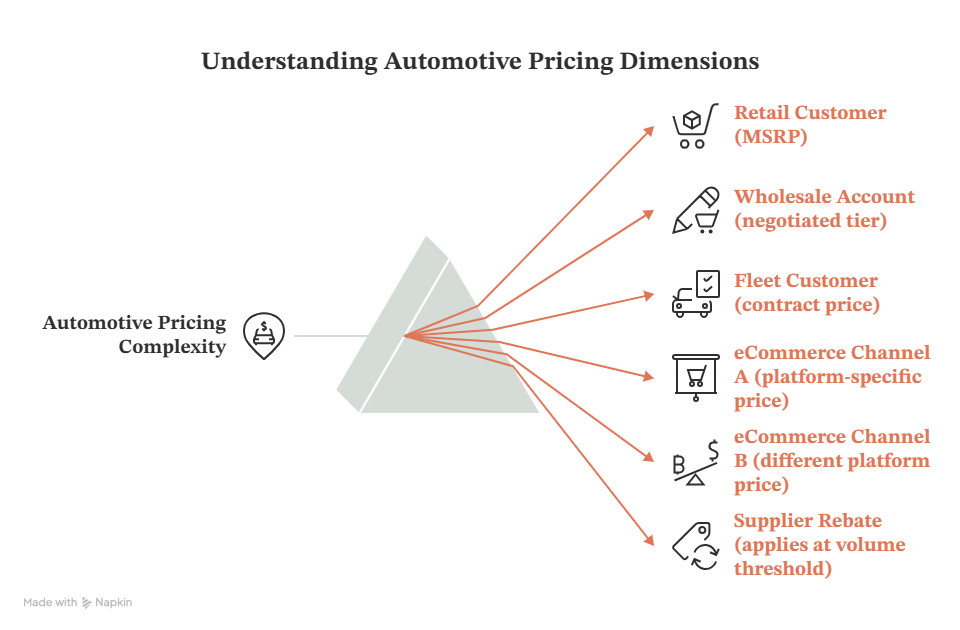
If we talk about the automotive ERP pricing, a single part number may carry a different price for a walk-in retail customer, a wholesale account, a fleet customer, a dealer, and each eCommerce channel the business sells through. Managing that manually across five systems produces errors, but managing it inside a properly configured ERP removes the errors at the source.
The Specific Pricing Requirements
Below are the specific pricing requirements that are very common for automotive manufacturers and their customers.
- Customer-level pricing supports negotiated pricing agreements for individual customer accounts.
- Channel-specific pricing allows different prices for the same SKU across ecommerce, marketplace, and wholesale channels.
- Volume-based pricing applies automatic discounts when order quantities reach defined thresholds.
- Rebate management tracks supplier rebate programs based on category-specific purchasing volumes.
- Core charge handling records refundable core deposits separately from product sale prices for accurate accounting and reporting.
NetSuite’s price level and customer group configuration handle the first three natively. Rebate management is a separate module that tracks supplier and customer rebate agreements and calculates earned rebates automatically.
If you want to understand how Rebates and Trade Promotions SuiteApp works, here is a quick video
This matters significantly for auto parts distributors who receive quarterly rebates from major suppliers. A distributor who tracks rebate eligibility in a spreadsheet separately from the ERP is leaving money on the table when the manual calculation misses eligible volume.
What Does Automotive ERP Need for Manufacturing and Engineering Change Control?
For businesses that manufacture components (and not just distribute them), ERP requirements add another layer. The problem that caused the bracket chargeback above becomes a process problem, and implementing an automotive ERP helps businesses overcome this.
The Engineering Change Order Gap
In most small and mid-size automotive manufacturers, engineering changes move through email, shared drives, or verbal communication. So in this scenario, what mostly happens is that an engineer sends a revised drawing, someone forwards it, and someone else does not see the forward. Parts are built to the wrong drawing, and as a result, the customer gets the wrong parts.
The fix is to control engineering changes inside the system that drives production. When an Engineering Change Order (ECO) in the ERP is the gate that determines what spec the work order carries, an unreviewed change cannot reach the floor. It is held in review status until the right person approves it.
Once approved, the work order automatically updates.
Bill of Materials (BOM) Accuracy as a Financial Control
Every cost calculation in manufacturing depends on BOM accuracy. If a BOM is outdated because an ECO was never processed into the system, the cost rolled up from that BOM is wrong, hence the margin calculated from that cost is wrong. The pricing decision made from that margin is wrong.
For automotive parts and component manufacturers, NetSuite handles BOM management, work order processing, and route-based production tracking as core manufacturing capabilities. When an ECO updates the BOM, the cost roll recalculates. The next production run is costed against the current spec rather than the one that existed before the change.
The Mishimoto NetSuite implementation is a good example of how these manufacturing controls work in a real automotive environment. Folio3 connected production, planning, and finance in a single NetSuite system for Mishimoto. This gave the manufacturing team visibility into work orders, BOM revisions, and cost tracking without the manual reporting lag that had previously delayed decision-making.

What does ERP for the automotive industry need for Multi-Brand and Multi-Entity Automotive Operations?
As automotive businesses grow through acquisition or expand into multiple brands, the ERP requirements expand with them. A business running three brands each on separate accounting systems cannot see its consolidated financial picture without a weekly manual reconciliation process.
The Multi-Entity Problem in Automotive
AutoRimShop’s situation under Alloy Capital Partners is a common pattern in automotive: a portfolio company structure where each brand has its own operations but the parent needs consolidated financials. Running QuickBooks per entity produces a financial picture that is assembled monthly rather than available in real time.
NetSuite handled every layer of AutoRimShop’s multi-brand complexity: high SKU counts, channel-specific pricing, and consolidated financials across brands. With NetSuite OneWorld, intercompany transactions clear automatically. Consolidated financial statements are available in real time, not after a week of manual journal entries.
Motorsport as a Distinct Operational Context
Motorsport businesses have a specific version of this challenge. They often run a retail or wholesale operation alongside event-based revenue, sponsorship income, and inventory that serves both commercial customers and racing teams. The accounting structure for this is more complex than a standard distribution business.
Mosites Motorsports needed a clean financial foundation that could support its growing motorsport operation without over-engineering the configuration. Folio3 implemented NetSuite SuiteSuccess Financials First for Mosites Motorsports to build structured, scalable financial management as the first layer before adding operational complexity on top. The Financials First approach is the right starting point when the accounting foundation is the primary problem, and adding modules before that foundation is solid only creates more complexity.
What Are the Compliance Requirements ERP Must Handle for Automotive?
Compliance in the automotive industry is not uniform. Requirements differ sharply between Tier-1 and Tier-2 suppliers manufacturing to OEM specifications and aftermarket distributors focused on retail and eCommerce.
For Manufacturers Supplying OEMs
Tier-1 and Tier-2 automotive manufacturers typically operate under IATF 16949 quality management requirements and MMOG/LE (Materials Management Operations Guideline/Logistics Evaluation) standards. These require documented quality control processes, defect tracking, corrective action workflows, and materials management discipline that goes beyond standard ERP configuration.
In 2024, a Tier-2 automotive supplier modernized its operations with a cloud ERP platform. Defect rates dropped to under one part per million across eight years, and the company achieved over 250 inventory turns annually. That level of quality discipline requires a system that tracks every defect, every corrective action, and every process change with the traceability that an OEM customer or a quality audit demands.
For Aftermarket Distributors
The compliance requirements for aftermarket distributors are different. The primary concerns are:
- Hazmat compliance for batteries, refrigerants, and other restricted materials
- Core charge compliance and proper accounting for refundable deposits
- Sales tax compliance across multiple states for eCommerce businesses
- Product liability documentation for safety-critical parts
An ERP serving aftermarket distributors’ needs to handle these without custom workarounds for each one. NetSuite’s multi-state tax engine, hazmat item flags, and core charge tracking handle the aftermarket compliance layer without requiring a separate compliance tool.
What Does Good Automotive ERP Implementation Actually Look Like?
Below are some of the factors that will help you assess a good ERP implementation for the automotive business.
Start With the Right Scope
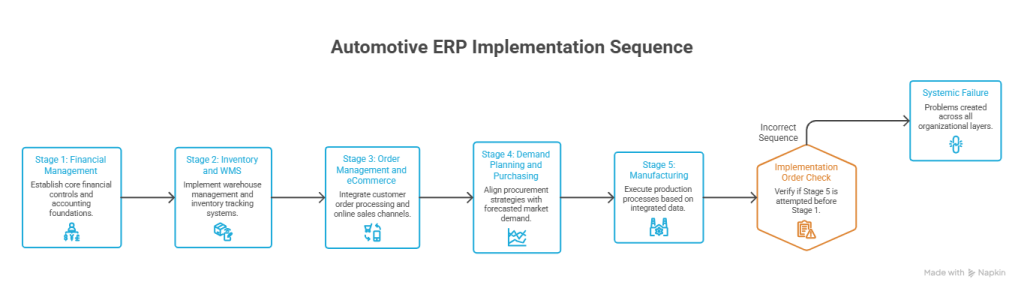
A common mistake that most automotive manufacturers make is implementing all the solutions at once without completely assessing the need for it. Mosites Motorsports succeeded with a Financials First approach because the scope was right for where the business was. Adding inventory management, demand planning, and eCommerce integration on top of an accounting foundation that is not yet stable creates problems in every layer at the same time.
For most automotive businesses, the right sequence is:
- Financial management and reporting (chart of accounts, multi-entity if applicable, period close process)
- Inventory and warehouse management (item catalog, receiving, fulfillment, WMS if needed)
- Order management and eCommerce integration (sales orders, channel sync, pricing rules)
- Demand planning and purchasing (reorder points, purchase order automation, supplier management)
- Manufacturing: BOM, work orders, routing, ECO management. This stage applies to manufacturers only, not distribution-only operations.
So, first see what scope for your automotive business is and how you want to categorize the requirements to finalize the implementation stages for each of the solutions.
The Integration Architecture Is as Important as the ERP
For an automotive business with an eCommerce presence, the integration between the webstore and the ERP is where the most immediate operational impact shows up. When Folio3 built the Magento connector for AutoRimShop, removing the sync lag between the webstore and the warehouse was the single change with the most immediate operational impact. Inventory levels are updated in real time across the webstore and warehouse, along with customer and shipping data that stayed consistent without manual syncing.
For auto parts businesses evaluating ERP options and the integration architecture needed for their specific channel mix, the best ERP software for auto parts businesses guide covers how to evaluate platforms against the specific needs of distribution and retail operations.
Final Thoughts
The automotive industry has a specific set of operational requirements that a generic ERP handles badly without deliberate configuration. Fitment data, multi-channel pricing, engineering change control, high-SKU catalog management, and multi-entity financial consolidation are not afterthoughts to configure in year two. They are the core requirements the platform needs to meet before it earns the right to call itself automotive ERP.
The businesses in this industry that are positioned for the $600 billion aftermarket opportunity are the ones whose systems handle those requirements correctly. The ones that are not positioned are still reconciling order data manually between five tools at the end of every week.
If you want a direct consultation on how your current system handles the specific requirements your automotive operation runs on, the Folio3 team has implemented NetSuite for auto parts retailers, distributors, and manufacturers across a range of configurations and complexity levels.
Talk to a NetSuite specialist today!
Frequently Asked Questions
What does an ERP for the automotive industry need to do that a generic ERP does not?
Automotive ERP needs to handle fitment data integration (ACES/PIES for aftermarket businesses), VIN-based catalog management, multi-level pricing across customer types and channels, engineering change order control that connects directly to production work orders, core charge tracking, and either OEM supplier compliance (IATF 16949, MMOG/LE) or aftermarket compliance requirements. A generic ERP handles none of these without configuration.
How does NetSuite handle fitment data for automotive aftermarket businesses?
NetSuite does not carry native ACES/PIES management in its core platform. It supports integration with fitment data providers through the SuiteApp ecosystem and custom connectors. Getting this integration right is a critical configuration decision in any automotive aftermarket NetSuite implementation because disconnected fitment data produces catalog errors, wrong parts shipped, and customer service overhead.
Can NetSuite handle 100,000+ SKUs for an automotive business?
Yes. AutoRimShop runs 320,000 items and 100,000 customers on NetSuite with real-time Magento synchronization and integrated WMS. NetSuite’s inventory module handles large catalogs without performance issues when configured correctly.
What is the right ERP implementation approach for an automotive business?
Start with financial management and inventory before adding eCommerce integration and demand planning. Add manufacturing modules last, on top of a stable operational foundation. The Mosites Motorsports implementation used a Financials First approach that delivered a clean, scalable financial foundation before adding complexity. Attempting to implement all modules at once, especially across multiple entities or channels, is one of the most common causes of automotive ERP project failure.
How does ERP help prevent chargebacks in automotive manufacturing?
Chargebacks most commonly result from engineering changes that reach email but never update production work orders. When ECO management lives inside the ERP, an approved engineering change automatically updates the BOM and the work order. Production cannot continue to the old spec because the system carries the new one. Without this control, the change lives in email and reaches the floor only if someone manually communicates it.
What automotive businesses are a strong fit for NetSuite specifically?
Mid-market auto parts retailers, distributors, and manufacturers with high SKU counts, multi-channel sales, eCommerce integration needs, or multi-entity financial consolidation requirements. AutoRimShop (retail/distribution), Mosites Motorsports (motorsport operations), and Mishimoto (manufacturing) are three different automotive segments where NetSuite delivered real operational outcomes.