Key Takeaways
- Electronics manufacturing is more complex to manage than most industries. Short product cycles, global supply chains, strict environmental compliance, and thousands of components on a single PCB create operational pressure that generic ERP systems were not designed to handle.
- 58% of manufacturers had inventory accuracy below 80%. In an industry where a single missing component stops an entire production line, that accuracy level becomes a production risk.
- Power discrete lead times hit 9 months in Q1. Supply chain fragility is an ongoing operational reality that affects purchasing decisions, production planning, and customer commitments every week.
- The BOM is where most electronics ERP failures begin. A single BOM in electronics manufacturing can contain thousands of parts. When that BOM lives in a spreadsheet disconnected from procurement and production, errors are guaranteed.
- ERP does not solve all of these challenges out of the box. The right platform, configured for electronics-specific workflows, addresses them. A generic deployment of the wrong ERP makes some of them worse.
Electronics manufacturers deal with a set of operational challenges that pile on top of each other. These challenges include component shortages that appear without warning, BOMs with thousands of parts where one wrong revision ripples into three downstream systems, compliance requirements that change by regulation and by market, and product cycles so short that a component can move from “active” to “not recommended for new designs” before you finish the production run that depends on it.
Generic ERP handles some of this while a system built for electronics manufacturing handles all of it, because the challenges are specific enough that general-purpose tools leave real gaps.
This guide breaks down the ten biggest operational challenges electronics manufacturers face and what an ERP needs to do to address each one. Let’s get into it.
Top 10 Operational Challenges Electronics Manufacturers Face (And How ERP solves them)
Below are the top ten operational challenges that electronics manufacturers face along with their solutions by implementing ERP.
Challenge 1: Demand Volatility and Inaccurate Forecasting
Electronics demand varies a lot as consumer devices spike at product launch and drop at refresh cycles. Automotive and defense electronics swing with procurement contracts, whereas industrial electronics respond to capital expenditure cycles that are hard to predict more than a quarter out.
Most electronics manufacturers try to manage this with spreadsheets, historical patterns, and the judgment of planners who have been with the business long enough to know what usually happens. That works until it does not, and the cost of being wrong shows up fast.
How ERP for Electronics Manufacturing Addresses It?
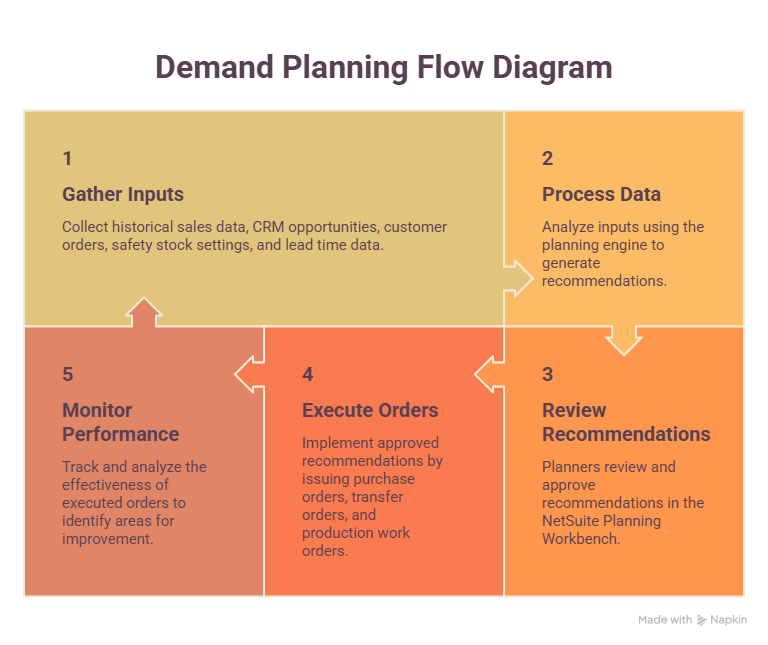
A properly configured ERP replaces general forecasting with demand-driven planning. 73% of retailers report that using forecasting tools improves inventory accuracy and reduces stock imbalances. The same logic applies in electronics manufacturing. When demand data from CRM, historical sales patterns, and open order books feed into a single planning engine, the plan reflects real data rather than vague input.
NetSuite’s Demand Planning module calculates expected demand and generates recommended purchase orders, transfer orders, and production work orders based on that demand. It connects directly to MRP, which then explodes the demand plan through the BOM to calculate component-level purchase requirements.
This means a change in the sales forecast automatically recalculates what needs to be ordered and when, without a planner manually adjusting a spreadsheet.
Challenge 2: Component Shortages and Supply Chain Fragility
Supply chain fragility is a structural feature of global electronics procurement, and the data support that view. According to a report, in Q1 2025, lead times for power discretes climbed to 9 months, requiring planners to secure long-lead-time parts well in advance to avoid production delays. When a single missing component can stop an entire production line, a 9-month lead time on any critical part is a risk that shows up in the production schedule every week.
Many electronics components have a small number of qualified suppliers. A geopolitical disruption, a factory fire, or a shipping lane closure affects all of them at once. Most electronics manufacturers have experienced at least one version of this in the last three years.
How ERP Addresses It?
A connected ERP gives the procurement team real-time visibility into what is on hand, what is on order, what is in transit, and when each purchase order is due. When a supplier misses a committed date, the ERP shows the impact on the production schedule immediately, not after a planner asks and waits for a status email.
Multi-sourcing and alternate supplier management are the structural solutions for this challenge. An ERP that tracks approved vendor lists (AVL) by component lets procurement quickly identify qualified alternates when a primary supplier cannot deliver. This requires the AVL to live inside the ERP rather than in a separate spreadsheet that someone may or may not update when a supplier is added.
Supply chain risk visibility also means tracking supplier performance over time. On-time delivery rate, fill rate, and quality rejection rate by supplier are metrics that influence sourcing decisions. An ERP that aggregates this data across all purchase orders gives procurement a factual basis for those decisions rather than relying on relationship history alone.
Challenge 3: Multi-Level BOM Complexity and Engineering Change Control
A single PCB assembly can contain 500 to 3,000 individual components from 50 to 100 different suppliers across multiple countries. An electronics manufacturer with a product catalog of 50 SKUs is managing tens of thousands of component relationships at once.
Managing a BOM at that scale in a spreadsheet produces errors. When your BOM exists in a spreadsheet, disconnected from purchasing and production, errors are inevitable.
In electronics manufacturing, engineering changes are constant. For example, a component reaches “not recommended for new designs” status, or there might be regulation changes regarding what hazardous materials can be in the product. These changes need to update the BOM, the procurement records, and the production schedule, in the right order, at the right time.
When that change propagates through email or a shared drive rather than through the ERP, the system controlling production never gets the update. And the results look like this: Parts get built to the wrong revision → The customer received the wrong product → The chargeback follows.
How ERP for Electronics Addresses It?
The best practice is a unified system where the BOM serves as the single source of truth and directly drives purchasing requirements based on real-time inventory and production demand. This means one BOM in one system that procurement, production, and engineering all reference.
Engineering change orders (ECOs) in ERP work the same way. A modern ERP for electronics manufacturing automatically propagates changes from the engineering BOM to the manufacturing BOM, procurement records, and production schedules in real time. An approved ECO in the system updates the work order before the production run. A planner does not need to remember to manually update anything.
NetSuite’s multi-level BOM management with version control and engineering change tracking handles this directly. Multi-level sub-assemblies, substitute components, and revision history all live in one place. When a change is approved and applied, every downstream document reflects it automatically.
Challenge 4: Regulatory Compliance (RoHS, REACH, WEEE, and Beyond)
Electronics manufacturers face one of the most complex compliance environments in any manufacturing sector. The requirements are specific, cross-jurisdictional, and change regularly.
- RoHS (Restriction of Hazardous Substances) restricts the use of specific hazardous materials in electronics sold in the European Union. Any product containing restricted substances above threshold concentrations cannot be sold in those markets.
- REACH (Registration, Evaluation, Authorization and Restriction of Chemicals) controls the use of chemical substances across the EU supply chain. Electronics manufacturers must track whether any substance of very high concern (SVHC) is present in their products and in what concentration.
- WEEE (Waste Electrical and Electronic Equipment) governs the disposal and recycling of electronics. Manufacturers bear responsibility for the end-of-life handling of products they place on the market.
- IATF 16949 applies to electronics manufacturers supplying the automotive sector. It requires documented quality management processes, corrective action workflows, and materials management discipline that goes beyond general ISO 9001 requirements.
How ERP Addresses It?
Compliance management without an ERP is a documentation exercise that consumes a large amount of administrative time and still leaves audit risk. An ERP that stores supplier compliance certificates against each component, flags components containing restricted substances, and generates compliance reports on demand changes the administrative burden from a manual process to an automated one.
The administrative burden of managing compliance documentation for standards like RoHS and REACH can be immense. An ERP system that stores supplier compliance certificates and automates the generation of audit reports confirms that you always meet compliance requirements.
The ERP also provides the audit trail that compliance audits require. When an auditor asks for the full history of a substance in a specific product, the answer comes from a query, not from someone spending a week searching email and shared drives.
Challenge 5: Component Traceability and Recall Management
In 2023, the average cost of an electronics product recall was $3.8 million. That number reflects direct costs in the form of product retrieval, replacement manufacturing, customer notification, and regulatory reporting. It does not capture the long-term reputational and relationship costs that often exceed the direct figure.
The ability to conduct a recall surgically, identifying exactly which units used components from a specific supplier lot and notifying only those customers, depends entirely on the traceability data collected during production. If that data does not exist, the recall covers every unit ever produced with that component type. That is a much larger and more expensive exercise than a targeted recall.
How ERP Addresses It?
Lot and serial number tracking in ERP is the foundation of electronics traceability. At incoming inspection, each supplier lot receives a lot number in the ERP tied to the supplier, the purchase order, and the delivery date. On the production floor, each component lot consumed in a production run is recorded against the work order and the finished goods serial number.
When a field failure occurs, the traceability chain runs in reverse, from the failed unit’s serial number to the work order, to the component lots consumed, to the supplier shipment, to all other units that used components from the same lot.
A robust ERP should automatically capture and store data, enabling you to perform surgical recalls and quickly identify the root cause of any quality issue. The difference between a $3.8 million recall and a much smaller one is the granularity of the traceability data the ERP has been collecting.
NetSuite’s lot and serial number tracking covers this from supplier receipt through finished goods to customer shipment. Every movement of a serialized or lot-tracked item is recorded with the associated transaction, operator, and timestamp.
Important: Read the documentation for an overview of how to perform the serial or lot trace in the Lot and Serial Number Trace SuiteApp.
Challenge 6: Rapid Product Obsolescence and Short Life Cycles
Electronics product cycles are shorter than in almost any other manufacturing sector. A consumer product that launched 18 months ago may already be approaching end-of-life, or a component that was active when the product was designed may be “not recommended for new designs” by the time the product reaches its production peak.
This creates two specific operational problems:
- First, component obsolescence, i.e., if a component in an active product reaches end-of-life at the supplier, the manufacturer has to find a qualified alternate, validate it, update the BOM, and make procurement decisions about how much of the original component to buy as a last-time purchase. All of this has to happen before the supplier stops making it.
- Second, product-level inventory risk. Finished goods that do not sell before the next product revision is released become obsolete inventory. Electronics manufacturers carry write-off risk on both components and finished goods at the same time.
How ERP Addresses It?
A modern ERP system for electronics manufacturing should actively track component life cycle data, such as Active, Not Recommended for New Designs (NRND), or Obsolete statuses. This enables procurement teams to proactively identify at-risk parts and find qualified alternatives, preventing an obsolete component from halting the production line.
When component lifecycle data is tracked inside the ERP and linked to the BOM, the system can flag at-risk components before they become a production problem. A procurement team that sees a critical component moving to NRND status with 6 months of advance notice can evaluate alternates, run qualification testing, and make a last-time buy decision in an orderly way. The same team managing this from a spreadsheet discovers the problem when the supplier says the part is discontinued and the next delivery is the last one.
Inventory aging reports in ERP identify finished goods approaching their commercial end-of-life before they become write-offs. The earlier a business sees an inventory aging signal, the more options it has in the form of accelerated sell-through, targeted promotions, or controlled wind-down of production to match remaining demand.
Challenge 7: Quality Control at Production Scale
Electronics quality control is more demanding than in most manufacturing sectors because the cost of a quality failure in electronics is not just a scrap or rework cost. It can be a product recall, a customer safety issue, or a lost market access certification.
The challenge is maintaining consistent quality standards across high-volume production, where defects at the component level may not manifest as product failures until the device is in the field. A capacitor derating issue may cause intermittent power supply failures that appear months after the product ships. By that time, thousands of units with the same issue may already be in customer hands.
How ERP Addresses It?
Quality management in ERP covers the full production lifecycle, from incoming inspection at receipt to in-process quality checks at defined production stages and final inspection before shipment. Each inspection result is recorded against the relevant lot number, work order, or serial number. This creates the audit trail that a corrective action investigation needs.
ERP’s quality management tracks product components, which helps identify them quickly if any issues arise. Manufacturing ERP uses quality management to track product components and uses algorithms and consumption analysis to forecast supply needs.
Non-conformance reports (NCRs) and corrective and preventive actions (CAPAs) in ERP create a structured workflow for quality problems. When an inspection finds a defect, the NCR documents it, routes it to the appropriate team, tracks the investigation, and records the corrective action. The next time a similar defect pattern appears, the CAPA history provides context for the investigation.
The practical improvement is moving from reactive quality management, finding problems after they ship, to proactive quality management, finding them before they leave the facility. An ERP that flags components from a supplier with recent quality rejections before they enter production is doing something that a disconnected quality spreadsheet cannot do.
Challenge 8: Subcontractor and Outsourced Manufacturing Visibility
In electronic manufacturing, there are a few of the most common cases:
- Some send partially assembled boards to a contract manufacturer for specific processes (wave soldering, conformal coating, testing) and receive them back.
- Others outsource complete product manufacturing and manage only design, procurement, and logistics.
In all of these models, the challenge is the same. You have to maintain visibility into work that is happening outside your facility.
When a subcontractor is three days behind on a delivery that feeds your final assembly line, you want to know three days before the delivery is due, not on the day it does not arrive. When a contract manufacturer is reporting a yield issue on your product, you want that data in your quality system, not sitting in an email thread.
How ERP for Electronics Addresses It?
Subcontractor management in ERP tracks what has been sent out, what is expected back, and when. Purchase orders to subcontractors record the work being done and the expected return date. When the work comes back, receiving against the subcontract PO updates the inventory and the production record at once.
NetSuite’s manufacturing implementation covers subcontractor visibility as part of the production planning layer.
When Folio3 implements NetSuite for manufacturers with outsourced production stages, the subcontractor workflow is built into the production routing so that the WIP status reflects work happening at the subcontractor just as it reflects work on the internal floor.
For a full look at how NetSuite’s manufacturing modules handle the complete production lifecycle, including outsourced stages, this overview of NetSuite manufacturing modules covers WIP, routing, and subcontract purchase orders in context.
Challenge 9: Labor Shortages and Skills Gaps
Electronics manufacturing is technically demanding. Skilled operators, quality inspectors, and engineers with specific process knowledge are not interchangeable with general production workers. As experienced staff retire, the knowledge they carry often does not get documented, and the next person learning the process learns it from the one who knows it rather than from a system that has it recorded.
Labor shortages and skills gaps are a documented challenge for the sector. It is a structural feature of the industry as complexity increases and the pool of experienced technical staff does not grow at the same rate.
How ERP Addresses It?
ERP reduces the operational dependency on institutional knowledge by putting process information in the system rather than in someone’s head.
So here is how it helps overcome this challenge:
- Work instructions attached to operations in the routing tell an operator exactly what to do at each step without relying on verbal handoff.
- Quality inspection criteria attached to the quality record define what “passing” looks like without requiring a supervisor to interpret it each time.
- BOM version control records who changed what and why, so the next person to look at the BOM does not have to ask the engineer who made the change.
Automation of routine tasks through ERP also reduces the number of high-skill hours consumed by low-skill work. When a purchase order generates automatically from an MRP run rather than a planner manually entering it, that planner’s time goes to exception management rather than data entry. In a skilled labor-constrained environment, that is a real improvement.
Challenge 10: Data Silos Across Disconnected Systems
A 2024 survey found that 58% of manufacturers had inventory accuracy below 80%, mainly due to siloed data. In electronics manufacturing, where one missing component stops the line, 80% inventory accuracy is not good enough.
Most electronics manufacturers who reach the point of evaluating ERP are running some combination of an accounting system, a production system, a quality system, a procurement tool, and one or more spreadsheets that act as the connective point between all of them.
This is the same pattern across every industry at a certain size. In electronics manufacturing, the cost of that fragmentation is higher than in most sectors because the data dependencies are tighter.
A BOM update that does not reach procurement produces a wrong purchase order. A quality rejection that does not reach production planning produces a work order that runs against a component that should be on hold. A demand signal that does not reach inventory produces a stockout on a component with a 9-month lead time.
How ERP Addresses It?
A single, unified ERP platform replaces the silos as it unifies engineering, procurement, production, quality, and finance to operate from the same data.
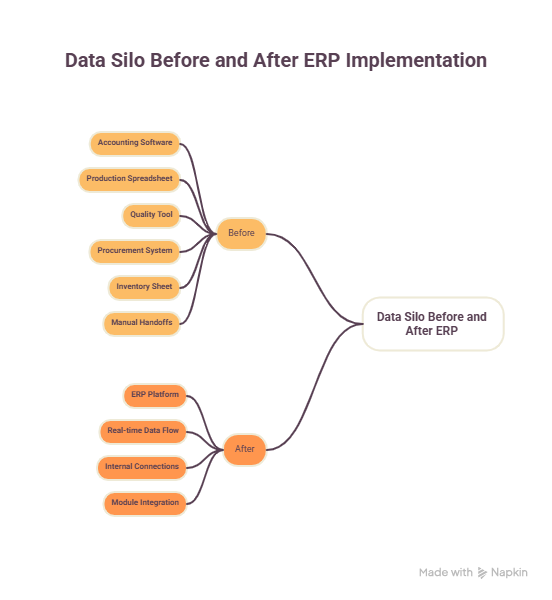
By implementing NetSuite for electronics companies, the following changes happen:
- A BOM update is visible to procurement immediately
- A quality hold on an incoming lot flags to production planning before anyone builds with it.
- A demand plan change ripples through MRP to procurement without a planner manually translating it.
This is the core value proposition of manufacturing ERP. The electronics manufacturing industry is highly competitive and requires companies to work smarter. ERP software automates and connects the entire business to reduce errors, optimize processes, and keep the business running at peak performance.
The data silo problem is also where ERP implementation sequencing matters. A phased implementation that starts with financials and inventory, then adds manufacturing and quality, builds on a foundation rather than trying to connect everything at once.
For electronics manufacturers evaluating how to structure an ERP rollout, this practical guide on cloud ERP for manufacturing covers what to prioritize in which order.
Final Thoughts
The ten challenges covered in this guide are not independent problems. They form a connected system where a weakness in one area amplifies the cost of a failure in another
ERP breaks individual links in that chain by making the right data available to the right person at the right time. So, the biggest operational challenges for electronics manufacturers are solved when the forecast informs the inventory plan, and the inventory plan drives the purchase order. The purchase order enforces the approved vendor list. The approved vendor list protects quality. Quality data supports traceability, and traceability limits the recall.
That is what ERP for electronics manufacturing needs to do. If you want a direct consultation on how your current systems handle these specific challenges, or what a NetSuite implementation scoped for electronics manufacturing looks like in practice, the Folio3 manufacturing team works through exactly these problems with clients across the sector.
FAQs
What are the biggest challenges for electronics manufacturers?
The biggest operational challenges are demand volatility and forecasting inaccuracy, component shortages and supply chain fragility, multi-level BOM complexity and engineering change control, regulatory compliance (RoHS, REACH, WEEE, IATF 16949), component traceability and recall management, rapid product obsolescence, quality control at scale, subcontractor visibility, labor shortages, and data silos across disconnected systems. These challenges are interconnected. A failure in one area typically creates problems in others.
How does ERP help electronics manufacturers manage component shortages?
ERP provides real-time visibility into inventory on hand, open purchase orders, in-transit stock, and supplier lead times. This lets procurement identify shortages before they halt production rather than discovering them when a supplier fails to deliver. Approved vendor lists in the ERP support rapid alternate sourcing when a primary supplier cannot deliver. MRP-driven purchasing ensures purchase orders are placed with enough lead time to cover the required production schedule.
What ERP features are essential for RoHS and REACH compliance?
Compliance documentation storage by component (supplier declarations, test certificates), substance tracking by component across the BOM, automated compliance reporting, and audit trail generation are the core features. The ERP should store compliance certificates against each component, flag components containing restricted substances above threshold levels, and generate compliance reports without manual compilation.
How does ERP support electronics product recall management?
Lot and serial number tracking from incoming inspection through production to customer shipment creates the traceability chain needed for a targeted recall. When a field failure occurs, the ERP traces the failed unit back to the component lot that caused the failure and identifies all other units that used components from the same lot. This limits a recall to the affected population rather than all units ever produced.
Is NetSuite suitable for electronics manufacturers?
NetSuite handles the core requirements of electronics manufacturing: multi-level BOM management with version control, engineering change tracking, MRP and demand planning, lot and serial number traceability, quality management, subcontractor purchase orders, and multi-entity financial consolidation. It is a strong fit for mid-market electronics manufacturers with complex supply chains, multi-channel sales, or multi-entity structures. The configuration matters as much as the platform: an electronics-specific implementation delivers real operational differences compared to a generic manufacturing deployment.