Key Takeaways
- Tier-2 and Tier-3 Suppliers Face the Hardest Pressures: Tighter margins, multi-customer quality demands, and zero-buffer JIT schedules hit smaller auto ancillary suppliers the hardest.
- The “Invisible Supplier” Problem is Real: Most Tier-3 suppliers have no direct visibility into OEM demand signals. ERP bridges that gap by connecting EDI and production scheduling upstream.
- IATF 16949 Compliance is Non-Negotiable: Quality failures at the Tier-2/3 level trigger chargebacks and de-listing. ERP tracks quality at every stage of production with full audit trails.
- Engineering Change Notices Are a Major Risk: ECN mismanagement is one of the top causes of defective parts at the Tier-3 level. ERP enforces version control across BOMs and work orders.
- Cloud ERP Removes the IT Barrier: You do not need a dedicated IT team to run a modern ERP. Cloud deployment means Tier-3 suppliers can go live without having to invest in expensive infrastructure.
- NetSuite Scales with Your Supplier Tier: Whether you are a 20-person stamping shop or a 200-person casting company, NetSuite’s modular structure lets you start with what you need and grow from there.
Picture this. You are running a Tier-3 auto ancillary company. You manufacture forged brackets that go into suspension assemblies. Your customer is a Tier-2 supplier. Their customer is a Tier-1. And somewhere at the top of the chain, a global OEM is building 4,000 vehicles a day.
Now your Tier-2 customer sends you a revised Engineering Change Notice at 9 PM on a Thursday. It affects the part specification on the batch you are already 60% through producing. Your production supervisor finds out on Friday morning. The batch ships anyway. Three weeks later, you get a chargeback notice for defective parts.
We have seen this exact scenario play and in every case, the root cause is the same: no integrated system connecting purchase orders, production schedules, BOM versions, and quality checks in one place.
That is precisely what ERP software for the auto ancillary industry solves.
The auto ancillary sector is one of the largest manufacturing segments in the world, with combined annual revenues exceeding $1 trillion globally. Yet the majority of Tier-2 and Tier-3 suppliers still run on disconnected spreadsheets, legacy accounting software, and paper-based quality records. The gap between what these businesses need and what their current tools provide is enormous. And it is costing them customers, margins, and growth.
This blog breaks down the specific challenges faced by Tier-2 and Tier-3 auto ancillary suppliers and how ERP software for the automotive industry solves them at every level.
What Does the Auto Ancillary Supply Chain Actually Look Like?
Here is how the chain for the auto industry breaks down:
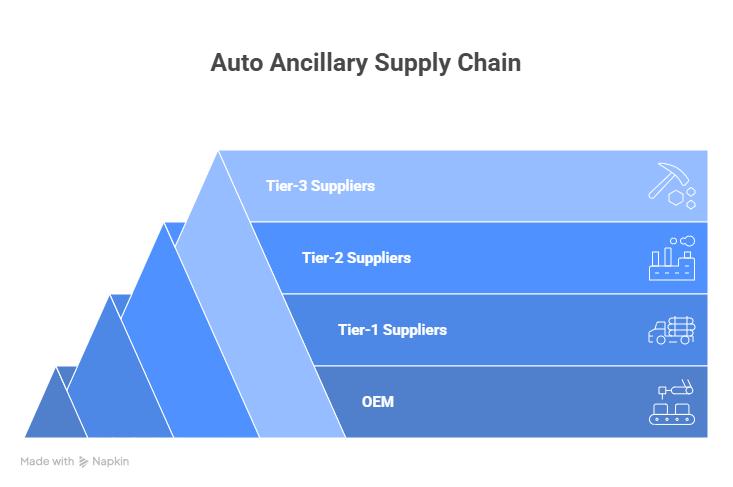
- OEM (Original Equipment Manufacturer): Companies like Ford, Toyota, or BMW. They build the final vehicle.
- Tier-1 Suppliers: They deliver complete systems directly to the OEM. Think dashboards, engine assemblies, or braking systems.
- Tier-2 Suppliers: They supply components that go INTO the Tier-1’s assemblies. Pistons, valves, sensors, brackets.
- Tier-3 Suppliers: They supply raw materials, basic sub-components, or processed parts to Tier-2. Castings, forgings, stamped metal parts, specialty chemicals.
What most people miss is that the further down the tier, the higher the operational volatility and the lower the margin buffer.
A Tier-1 supplier has direct contracts with the OEM and some forecast visibility. A Tier-3 supplier often has no direct line to OEM demand signals at all. They depend entirely on what their Tier-2 customer tells them. And if that Tier-2 customer has poor planning systems, the Tier-3 gets last-minute schedule changes with zero warning.
Top Options of ERP software for Auto Ancillary?
There are several ERPs for auto ancillary industry. The right choice for automotive ERP depends on your company size, production complexity, budget, and how much automotive-specific functionality you need out of the box. Here is an honest look at the top options, including where each one excels and where it falls short for Tier-2 and Tier-3 suppliers.
| ERP Software | Best For | Key Strength | Primary Limitation | Supplier Tier Fit |
|---|---|---|---|---|
| NetSuite (via Folio3) | Mid-sized Tier-2 and Tier-3 suppliers needing full business management | Cloud-native, integrated production + financials + CRM + quality in one system. No IT infrastructure needed. Strong automotive config via Folio3 | Not an automotive-exclusive ERP. Complex shop floor machine monitoring may require a separate MES | Tier-2 and Tier-3 (20–500 employees) |
| SAP Business One | Suppliers operating within SAP-heavy OEM and Tier-1 customer chains | SAP brand credibility during OEM audits. Good financial and procurement management. Strong OEM portal compatibility | Often requires on-premise or hosted infrastructure. Automotive compliance features need add-on modules | Tier-2 (50–250 employees) |
| Epicor Kinetic | Job shops producing machined, stamped, or forged components with complex routing | Deep shop floor scheduling, job costing, and capacity planning. Strong mixed-mode manufacturing support | Financial and CRM capabilities less mature than NetSuite. Multi-entity and customer management may need add-ons | Tier-2 and Tier-3 job shops |
| QAD Adaptive ERP | Larger Tier-2 suppliers with direct OEM relationships and global operations | Purpose-built for automotive. APQP, PPAP, MMOG/LE, and IATF 16949 workflows are built in natively | Over-specified and over-budget for most Tier-3 suppliers. High implementation complexity | Tier-1 and larger Tier-2 (200+ employees) |
| Plex Manufacturing Cloud | Production-heavy Tier-2 and Tier-3 suppliers needing MES and ERP in one platform | Real-time machine monitoring, shop floor data capture, and production quality tracking at the unit/lot level | Financial management less deep than NetSuite. Multi-entity accounting may require supplemental tools | Tier-2 and Tier-3 (North America focus) |
1. NetSuite for Automotive (via Folio3)
Best for: Mid-sized Tier-2 and Tier-3 suppliers that need a full business management platform and not just production, but also financials, CRM, procurement, and multi-customer operations in one unified system.
NetSuite is a cloud-native ERP that runs in the browser, needs no on-premise servers, and updates automatically. For auto ancillary companies that do not have a dedicated IT team, this matters a lot. You are not hiring someone to maintain hardware. You are buying a system that runs itself.
What makes NetSuite strong for auto ancillary suppliers specifically:
- Full BOM and production management with multi-level assemblies, work orders, and routing
- Quality management module that supports inspection plans, lot traceability, and non-conformance tracking, aligned with IATF 16949 requirements
- Customer-specific pricing, quality plans, and shipping rules; critical when you serve both a Tier-1 and a Tier-2 simultaneously
- Integrated financials that connect production costs to invoicing without manual reconciliation
- Strong partner ecosystem and Folio3 has deep experience configuring NetSuite specifically for automotive component manufacturers, which means you get automotive-specific workflows built in, not bolted on
Limitation to know: NetSuite is the best ERP software for auto ancillary, especially for the most complex shop floor execution requirements (like minute-level machine monitoring on a high-volume stamping line).
Best fit for: Tier-2 suppliers with 20 to 500 employees, multi-customer operations, and a need for integrated financial management alongside production.
2. SAP Business One
Best for: Smaller auto ancillary companies that want the SAP brand name on their systems, which carries weight during OEM supplier audits.
SAP Business One is SAP’s mid-market ERP. It is more affordable than SAP S/4HANA but still carries the SAP credential. For Tier-2 suppliers whose Tier-1 customers audit their systems, the SAP nameplate matters. Some OEM supplier portals are built around SAP integration standards, which makes compatibility smoother.
Key strengths for auto ancillary:
- OEM-recognized brand with strong integration to SAP-based OEM and Tier-1 customer portals
- Solid financial and procurement management for mid-sized manufacturers
- Good partner network for implementation and support
Limitation to know: SAP Business One is often deployed on-premise or through a hosted server, which adds infrastructure costs. Automotive-specific features like IATF compliance tracking typically require add-on modules or customization rather than being built in natively.
Best fit for: Tier-2 suppliers with existing SAP relationships in their customer base, or companies that prioritize brand recognition during supplier audits.
3. Epicor Kinetic
Best for: Tier-2 and Tier-3 job shops and component manufacturers doing machined, stamped, or forged parts with complex shop floor scheduling needs.
Epicor has a long history in discrete manufacturing. Its shop floor execution capabilities are deeper than most general ERP platforms. If your operation involves multiple machine work centers, detailed routing, and real-time labor tracking at the job level, Epicor Kinetic handles it well.
Key strengths for auto ancillary:
- Advanced production scheduling with job costing, routing, and capacity planning built for job shop environments
- Mixed-mode manufacturing support, useful for suppliers running both make-to-stock standard parts and make-to-order custom components
- Strong quality and traceability features with automotive compliance in mind
Limitation to know: Epicor’s financial and CRM capabilities are less mature than NetSuite’s. For Tier-2 suppliers who also need strong customer management, multi-entity financials, or e-commerce, Epicor often requires add-on tools.
Best fit for: Tier-2 and Tier-3 job shops focused primarily on precision machining, stamping, or forging where shop floor execution is the top priority.
4. QAD Adaptive ERP
Best for: Tier-1 and larger Tier-2 suppliers who need purpose-built automotive manufacturing workflows, global supply chain coordination, and deep OEM integration.
QAD is purpose-built for manufacturing industries, with automotive as a core vertical. Its MMOG/LE supply chain evaluation support, EDI handling, and automotive compliance tools are among the strongest on the market.
Key strengths for auto ancillary:
- Automotive-native workflows, including APQP, PPAP, and IATF 16949 processes, built in from day one
- MMOG/LE compliance support; valuable for Tier-2 suppliers whose Tier-1 customers require Materials Management Operations Guideline / Logistics Evaluation assessment
- Strong multi-site and multi-currency support for suppliers with global footprints
Limitation to know: QAD is sized and priced for larger operations. For a 30-person Tier-3 casting company, QAD is likely over-specified and over-budget. The implementation complexity also tends to be higher than cloud-native options.
Best fit for: Larger Tier-2 suppliers with 200+ employees, global operations, and a direct OEM supply relationship that requires deep automotive process support.
5. Plex Manufacturing Cloud
Best for: Tier-2 and Tier-3 suppliers who need a strong manufacturing execution system (MES) integrated with ERP in a single cloud platform.
Plex sits at the intersection of ERP and MES. Its shop floor data collection capabilities are excellent, machine monitoring, production counting, quality recording at the line level, and real-time OEE tracking. For auto ancillary companies where shop floor visibility is the primary gap, Plex is a strong contender.
Key strengths for auto ancillary:
- Real-time shop floor data capture with machine integration and operator touchscreens
- Production quality tracking at the unit or lot level with automotive compliance workflows
- Proven in automotive supply chains, Plex has a strong reference base among Tier-2 and Tier-3 suppliers in North America
Limitation to know: Plex’s financial management capabilities are not as deep as NetSuite’s. For companies that need sophisticated multi-entity accounting, revenue recognition, or customer financial management alongside production, Plex may require supplemental tools.
Best fit for: Tier-2 and Tier-3 production-heavy operations in North America, where real-time shop floor monitoring and MES capabilities are the primary need.

How Does ERP Software for Auto Ancillary Suppliers Solve Challenges?
Now, let us get specific. Here is how the right ERP system addresses various challenges at the Tier-2 and Tier-3 levels.
Real-Time Production Scheduling Tied to Demand
The core of auto ancillary operations is the production schedule. Every day starts with the question: “What do we need to make, and do we have the materials to make it?”
ERP answers that question automatically. It pulls open sales orders and purchase orders into a production plan. It checks raw material inventory. It flags where shortages exist. It builds a schedule based on machine capacity and labor availability. Your production manager does not have to build this in Excel every morning. The system does it, and it is always based on current data.
For JIT suppliers, this is the difference between meeting delivery windows and missing them.
Engineering Change Control as a System Workflow
We talked about ECN chaos earlier. ERP solves this by making engineering change management a structured, system-driven process.
Here is how it works in practice. A customer sends a revised drawing. Your engineering team creates a new BOM version in the ERP. The system compares the new BOM to the old one and flags every impacted work order, purchase order, and existing stock item. A review workflow is triggered. Once the change is approved, the old BOM version is locked. No new production order can be raised against it.
This is not just good practice. In an automotive audit, documented change control is a specific requirement. ERP provides the audit trail automatically.
Multi-Level BOM Management for Complex Parts
Auto ancillary components often have multiple sub-levels in their BOM. A single stamped and welded assembly might have a parent part, sub-assemblies, and raw material inputs across three levels. Managing this in a spreadsheet works until it does not. Then you have a production stoppage or a quality escape.
ERP handles multi-level BOMs natively. Every level is linked. Every engineering change cascades correctly. Costing rolls up through every level automatically, so you always know the true cost of the finished part.
If you want to understand how NetSuite specifically handles manufacturing BOMs, our detailed page on NetSuite for auto parts and motorsport covers the full capability set for automotive component manufacturers.
IATF 16949 Quality Module
NetSuite’s quality management tools let Tier-2 and Tier-3 suppliers define inspection plans for incoming materials, in-process checkpoints, and final inspection. Results are captured against specific production lots. Non-conformances are logged with disposition decisions (use-as-is, rework, scrap). Corrective actions are tracked to closure.
Every record is tied to a production order and a lot of numbers. If a customer raises a warranty claim three months later, you can pull the exact quality records for that specific batch in under a minute.
Supplier Portal and Procurement Visibility
Tier-3 suppliers are not just downstream from Tier-2. They also have their own supply base for raw materials, tooling, and subcontracted processes. ERP gives you visibility into supplier lead times, open purchase orders, and delivery performance.
If your key casting supplier is running late on a material delivery, ERP shows you that today, not the day before the material was due. You can reschedule production, communicate with your Tier-2 customer proactively, and avoid a late delivery penalty.
Integrated Financials for Cash Flow Management
Because ERP connects production and finance in a single system, every production event has a financial footprint. When a work order is issued, raw material is consumed from inventory. When production is completed, the finished goods value is updated. When a delivery is made, the customer invoice is generated automatically.
This means your finance team always has accurate, real-time data on work-in-process value, finished goods inventory, and outstanding receivables. No more waiting for the month-end to understand your cash position.
To see how NetSuite has helped automotive businesses improve their operational and financial performance, our blog on operational efficiency with NetSuite ERP for automotive businesses walks through real use cases and outcomes.
Why Cloud ERP is the Right Choice for the Automotive Industry
One of the biggest objections we hear from smaller auto ancillary companies is this: “We are not big enough for an ERP. We do not have an IT team.”
That objection made sense 15 years ago. It does not hold anymore.
Cloud-based ERP like NetSuite runs entirely in the browser. There is no server to maintain, no software to install, no IT infrastructure to manage. Your team accesses the system from any device, anywhere. Updates happen automatically. Your data is backed up in real time.
For a 30-person Tier-3 forging company, this means you get enterprise-grade ERP capabilities without an enterprise IT budget. The automotive ERP market is growing quickly, valued at $815 million in 2024 and projected to reach $1.22 billion by 2031. The shift is happening because cloud deployment has made ERP accessible at every tier of the supply chain, not just the top.
What Should Tier-2 and Tier-3 Suppliers Look for in an ERP?
Not every ERP is built for auto ancillary production. When you evaluate options, look for these specific capabilities:
- Multi-level BOM management with engineering change control and version locking
- Production scheduling that is tied to machine capacity, material availability, and open sales orders in real time
- Quality management that supports IATF 16949 inspection plans, non-conformance tracking, and corrective action workflows
- EDI integration for connecting to Tier-1 and Tier-2 customer demand signals without manual rekeying
- Lot and serial number traceability from incoming raw materials through to final delivery
- Integrated financials that connect production costs to customer invoices without manual reconciliation
- Cloud deployment that eliminates the need for on-premise servers and dedicated IT staff
If the ERP you are evaluating cannot check every box on this list, it is not the right tool for automotive supply chain work.

How Does NetSuite Address the Specific Needs of Auto Ancillary Suppliers?
Tier-2 and Tier-3 auto ancillary businesses are not just automotive manufacturers. They also manage multi-customer relationships, run financial operations, handle HR for shop floor workers, and in many cases, also sell through distributor channels. A purely automotive ERP often handles production well but falls short on the broader business management side.
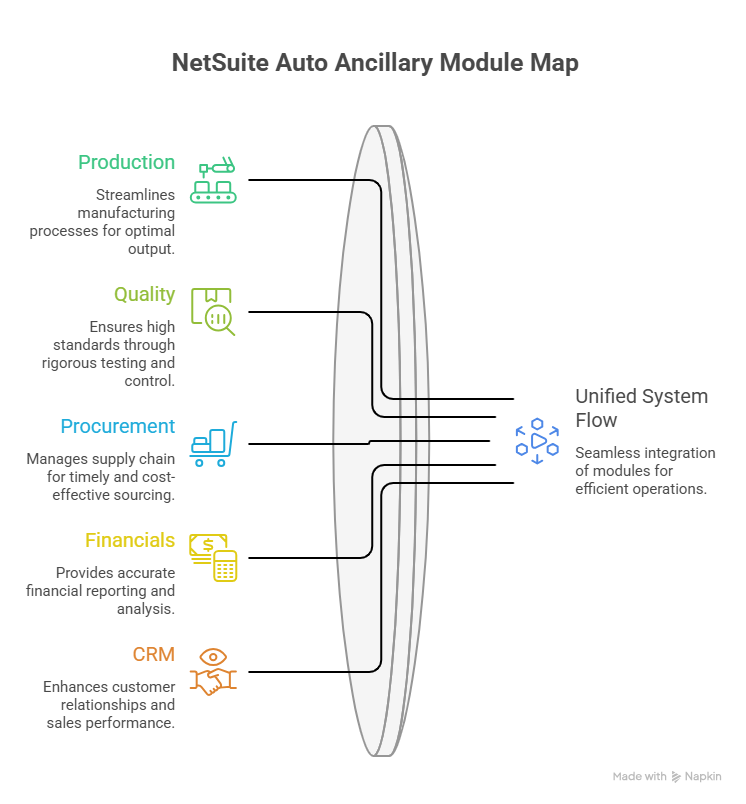
NetSuite for the automotive industry provides an end-to-end solution that covers the full business. Production planning, quality management, supply chain, financials, CRM, and reporting all live in one system. You do not need a separate accounting package, a separate quality system, and a separate sales tool. Everything connects.
For Tier-2 suppliers managing multiple customer accounts with different quality requirements, NetSuite’s customer-specific configurations allow you to set up separate quality plans, pricing structures, and shipping requirements for each customer.
For Tier-3 suppliers managing raw material procurement under tight lead times, NetSuite’s demand planning gives you forward visibility into exactly when to order and how much.
Folio3 has helped auto parts and component manufacturers configure NetSuite specifically for their production workflows. We understand the difference between what a generic SuiteSuccess implementation looks like and what an automotive supplier actually needs on the shop floor.
What Does ERP Implementation Look Like for a Tier-3 Supplier?
A common fear among smaller auto ancillary businesses is that ERP implementation is a massive, disruptive project. That fear is partly justified; badly managed implementations are painful. But with the right partner and the right scope, a Tier-3 supplier can go live in 8 to 12 weeks.
Here is how we typically approach it with auto ancillary clients:
Step 1: Define the Core Processes First
Production scheduling, BOM management, and quality recording are the three processes that drive the most daily pain for Tier-2 and Tier-3 suppliers. Start there. Get those working cleanly in the new system before adding anything else.
Step 2: Migrate Clean Data Only
One of the biggest mistakes in ERP implementations is migrating years of messy data into the new system. Clean your item master, your customer list, and your BOM structures before migration. Bringing bad data into a new system just means bad data in a better package.
Step 3: Train the Shop Floor Separately from the Office
Production supervisors, quality inspectors, and warehouse staff interact with ERP very differently from accountants and planners. Run separate training sessions for each group. Focus on the specific transactions each role performs. Do not put a shop floor supervisor through a finance module training session.
Step 4: Go Live in Phases
Start with production and inventory. Add financials in month two. Add customer portals and advanced reporting in month three. Phased go-lives keep the business stable and give your team time to adjust.
For a broader look, we suggest you read our detailed case study on Mosites Motorsports that showcases our automotive ERP implementation with all the challenges and outcomes.

Is ERP Worth the Investment for a Small Auto Ancillary Business?
For a Tier-3 supplier with 25 to 50 employees, the investment is real. The question is whether the cost of NOT having ERP is higher.
In 2024, Ralco Industries, a Tier-2 automotive supplier based in Michigan, modernized its operations with a cloud ERP platform. The results showed defect rates dropping to under one part-per-million across eight years, and the company achieved over 250 inventory turns annually.
That kind of outcome is not unique to large Tier-2 companies. We see it at the Tier-3 level too. The pattern is consistent: once a supplier has real-time visibility into production, quality, and inventory, delivery performance improves. Customer chargebacks drop. Cash flow becomes predictable. And the business stops fighting fires daily.
The ROI for auto ancillary ERP typically comes from three places:
- Reduced quality chargebacks: One prevented chargeback event can cover months of ERP subscription cost.
- Better material utilization: Real-time inventory visibility reduces over-ordering and excess stock write-offs.
- Faster invoicing cycles: Integrated financials mean invoices go out the day shipment is confirmed, not a week later.
Final Thoughts
Tier-2 and Tier-3 auto ancillary suppliers operate in one of the most demanding environments in manufacturing. Tight margins, JIT delivery expectations, multi-customer quality requirements, and constant engineering changes make the operation complex. And most of them are still managing that complexity with tools that were not built for it.
ERP software does not magically make these challenges disappear. But it gives you the visibility, control, and traceability to handle them without daily fire-fighting.
If you are a Tier-2 or Tier-3 supplier that is still running on spreadsheets and legacy accounting software, the question is not whether you need ERP. It is how much longer you can afford to wait.
Connect with the Folio3 team to understand how NetSuite can be configured for your specific auto ancillary operation. We know what Tier-2 and Tier-3 suppliers actually need, not just the generic automotive ERP checklist.
FAQs
Is NetSuite a good ERP for Tier-3 auto ancillary suppliers?
Yes. NetSuite’s modular, cloud-based structure makes it well-suited for smaller auto ancillary businesses that need production, quality, and financial management in one system without on-premise infrastructure.
What is IATF 16949, and why does it matter for auto ancillary ERP?
IATF 16949 is the international quality management standard for automotive suppliers. It requires documented inspection plans, lot traceability, corrective action records, and continuous improvement processes. ERP systems with built-in quality management make compliance easier by storing all records digitally and linking them to production orders.
Does ERP help with Engineering Change Notice (ECN) management?
Yes. ERP enforces ECN control by version-locking BOM changes, triggering approval workflows, and preventing production from starting against superseded specifications. This is one of the most valuable things ERP does for Tier-2 and Tier-3 suppliers.
How long does it take to implement ERP for a small auto ancillary company?
With a focused scope and good data preparation, a Tier-3 supplier can typically go live in 8 to 12 weeks. The timeline depends on data readiness, the number of integrations required, and how quickly the team adapts to the new workflows.
Can Folio3 help configure NetSuite specifically for auto ancillary production?
Yes. Folio3 has experience configuring NetSuite for automotive component manufacturers, covering production scheduling, quality management, BOM control, and EDI integration.
Get in touch with our team today!