Key Takeaways
- NetSuite contract management is built across three connected modules. The Contract Renewals SuiteApp handles recurring license and maintenance renewals. SuiteBilling handles subscription and usage-based billing. Advanced Revenue Management handles ASC 606 and IFRS 15 recognition. Each has a distinct role.
- Contracts scattered across inboxes put revenue at risk and slow finance down at every close. NetSuite centralizes every signed agreement alongside the dates, pricing, and approval rules that drive each invoice.
- Automatic renewal windows prevent revenue from slipping. NetSuite can automatically generate renewal transactions within a predefined window, such as 90 or 120 days before expiration. This removes the risk of renewals being missed when a contract manager is on leave or transitions out.
- Co-termination is one of the most underused features. Multiple contracts with different end dates can be merged into a single renewal, simplifying billing and improving the customer experience.
- Billing dates and revenue recognition dates are managed separately. A contract can bill quarterly while revenue is recognized monthly. NetSuite handles both schedules without a spreadsheet in between.
- Uplift and discount rules apply at the customer or portfolio level. Price increases can be applied across the board or to specific customer segments. Discounts are managed down to the individual transaction level.
Every missed contract renewal is a revenue leak. Every manual billing adjustment based on a contract change is an error waiting to happen. Every spreadsheet tracking renewal dates is a liability when the person who built it leaves.
Contract management is not a documentation exercise. It is a revenue protection exercise. The moment contract terms, renewal schedules, billing rules, and approval workflows live outside your ERP, you lose the ability to enforce them consistently. Invoices go out at the wrong rate. Renewals are missed. Finance cannot close fast because nobody is sure which billing schedule is current.
NetSuite’s contract management capabilities exist to close that gap. This guide covers what those capabilities are, how the three core modules work, and which situations each one is designed to handle.
What Is NetSuite Contract Management?
NetSuite contract management is the set of tools within NetSuite that handles the full lifecycle of a customer contract. This includes creating contracts from sales orders, managing billing schedules tied to contract terms, automating renewals, handling mid-cycle changes like upsells and cancellations, and recognizing revenue in compliance with accounting standards.
The process begins at the sales order level. When a sales order is accepted, a contract record is generated based on the order details. That contract record connects to the billing schedule, the renewal schedule, and the revenue recognition schedule. All three stay linked throughout the contract’s life.
The NetSuite Contract Management process simplifies contracts and helps businesses manage their contracts. The process begins with a sales order, where details like start date, end date, and term lengths specific to contracts are entered. Once approved, a contract is created based on the sales order.
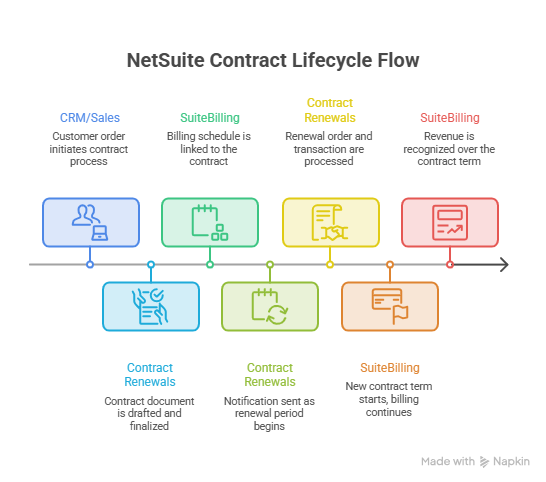
A key difference from standalone contract management tools is that NetSuite contracts are connected to live financial data. When a contract changes, the billing schedule updates. When a renewal processes, an invoice generates automatically. There is no manual handoff between contract records and the billing system.
The Three NetSuite Contract Management Modules
Understanding which module handles which function is the most important thing to know before configuring NetSuite for contract management. These three modules overlap in some areas but serve distinct primary purposes.
Most businesses that deal with recurring contracts use all three in combination.
Module 1: The Contract Renewals SuiteApp
The Contract Renewals SuiteApp is designed for software companies and technology vendors that sell perpetual and term licenses, support and maintenance agreements, and annual subscriptions. It is not a core NetSuite module. It is a SuiteApp, installed separately and configured for your specific renewal model.
NetSuite Contract Renewals automates contract renewal workflows for software companies with perpetual and term licenses. It creates contracts from initial sales orders, tracks renewable assets (licenses, support, maintenance) in install base, automatically generates renewal transactions at pre-defined intervals before contract expiration, and manages multi-contract co-termination into single renewals.
The SuiteApp tracks what it calls the “install base,” the active, renewable products and services each customer holds. When a renewal window opens (configured at 30, 60, 90, or 120 days before expiration), the system generates a renewal transaction automatically. Your sales team reviews it, applies any pricing changes, and sends it to the customer, without having to find the original contract first.
Best suited for:
- ISVs and software companies with annual license renewal cycles
- Businesses with support and maintenance agreements attached to product purchases
- Organisations managing a mix of renewable (licenses) and non-renewable (training, consulting) items on the same customer account
- Channel sales environments where end users, resellers, and distributors are all tracked
Module 2: SuiteBilling
SuiteBilling handles the billing layer for subscription and usage-based businesses. Where the Contract Renewals SuiteApp manages renewal events, SuiteBilling manages the ongoing billing schedule between those events.
SuiteBilling unifies and automates billing for recurring subscriptions, usage-based charges, and complex pricing models. It supports flat-rate, usage-based, tiered, and combination pricing, giving you full flexibility with promotions, volume discounts, and customer-specific rates.
In a contract management context, SuiteBilling is where you configure how the customer is billed throughout the contract term. Monthly SaaS subscriptions, quarterly maintenance fees, usage-based charges that vary each period, and hybrid models that combine a fixed base with variable usage charges: all of these are managed through SuiteBilling’s billing schedules.
The critical capability SuiteBilling adds to contract management is proration. When a customer upgrades mid-cycle, adds seats two months into a quarterly period, or cancels before a renewal, SuiteBilling calculates the prorated amounts automatically. Without this, every mid-cycle change requires a manual billing adjustment that someone has to calculate, approve, and enter.
For a full breakdown of how SuiteBilling handles subscription lifecycle management, what is NetSuite SuiteBilling and how does it work covers the pricing models, proration logic, and billing schedule configuration in detail.
Best suited for:
- SaaS businesses with monthly, quarterly, or annual subscription billing
- Businesses with usage-based pricing that varies by consumption (cloud compute, API calls, storage)
- Professional services firms with retainer-based contracts billed on a recurring schedule
- Any contract that requires proration when terms change mid-cycle
Module 3: Advanced Revenue Management (ARM)
Advanced Revenue Management handles the accounting compliance layer. It is the module that keeps revenue recognition in line with ASC 606 and IFRS 15, even when billing schedules do not match recognition schedules.
This separation matters more than most people realize. A customer pays an annual software license upfront on January 1st. The cash arrives in January. But under ASC 606, the revenue is recognized monthly over the 12-month service period, not all at once when the invoice is paid. ARM manages that recognition schedule automatically, posting the correct monthly revenue entries without a spreadsheet or manual journal entry.
NetSuite Contract Renewals module provides the flexibility to manage different dates for revenue recognition purposes. This capability ensures that the contract renewal and billing process flows automatically, while revenue recognition can follow a separate process without the need for additional spreadsheets and complexity.
For businesses operating under ASC 606 or IFRS 15, ARM is not optional. It is the control that keeps your revenue figures auditable and defensible. Connected to the billing data from SuiteBilling and the contract data from the Contract Renewals SuiteApp, ARM keeps all three schedules linked and consistent.
The broader context of how billing, revenue recognition, and financial reporting connect across NetSuite’s financial modules is covered in NetSuite financial management modules explained, which walks through how each layer interacts.
Best suited for:
- Public companies or those preparing for audit
- Businesses subject to ASC 606 or IFRS 15
- SaaS and software companies with multi-element arrangements
- Any business where billing dates and recognition dates are different
Co-Termination: The Feature Most Teams Never Configure
Co-termination is one of the most valuable contract management capabilities in NetSuite and one of the least commonly configured. If you have never heard of it, here is why it matters.
Customers who have been with you for several years often end up with a collection of contracts that started at different times. An initial license bought in March. A second license added in September. A support upgrade added the following February. Each one has a different renewal date.
Managing three separate renewal conversations for the same customer every year is inefficient. Sending three separate invoices on three separate dates creates confusion. Co-termination solves this.
NetSuite simplifies this process by allowing the co-termination of multiple transactions into a single contract with a single renewal. This approach benefits both the vendor and the customer, ensuring maximum revenue during the renewal process.
When co-termination is configured, all of a customer’s active contracts are merged into a single renewal event on a single date. The customer receives one renewal quote. You send one invoice. The renewal conversation is cleaner, and the billing is simpler.
Co-termination is configured at the Contract Renewals SuiteApp level. Short-period invoices are generated for each contract to align end dates before the unified renewal takes effect.
Uplift and Discount Management at the Contract Level
Most software businesses increase prices at renewal. Most also have customers who negotiate discounts. Managing both across a customer base with hundreds of active contracts requires rules, not spreadsheets.
NetSuite’s contract management supports both:
Uplift rules apply price increases at renewal based on configurable logic. You can set a standard uplift percentage applied across all renewing contracts. You can override that at the customer segment level for strategic accounts. You can set a higher uplift for specific product lines while keeping others flat. All of these variations are configured as rules that apply automatically when renewal transactions generate.
Discount management works at the transaction level. A discount can be applied to an individual renewal line, to a specific customer’s entire renewal, or to a defined segment of customers based on account classification. The discount is tracked in the contract record and flows through to the invoice automatically.
NetSuite supplies features that allow companies to manage uplifts across the board or on a customer basis, while supporting granular discounting down to the individual transaction level. This removes the risk of spreadsheet-managed discount tracking where errors compound over multiple renewal cycles.
Channel Sales: Managing Contracts Through Distributors and Resellers
Many software and technology companies do not sell directly to end users. They sell through distributors, resellers, or value-added resellers (VARs). Contract management in a channel model has an additional layer of complexity. The customer billing might go to the reseller, but the contract and renewal obligation belongs to the end user.
NetSuite’s Contract Renewals SuiteApp handles this through two fields on every sales transaction: End User and Bill To Customer. These can be different entities.
Every end user of your products needs a customer record in your NetSuite account even if they purchase through a distributor or a reseller. With Contract Renewals, these channels are managed through two fields on sales transactions: End User and Bill To Customer.
This matters for renewals because the renewal transaction generates against the correct billing entity (the reseller) while the install base and contract history stays connected to the end user. Reporting by end user, managing entitlements by end user, and tracking renewal rates by end user all work correctly even when billing flows through a third party.
How Contract Management Connects to Order-to-Cash
Contract management does not operate in isolation. It sits inside the broader order-to-cash (O2C) cycle. A contract defines the terms. Billing executes those terms. Revenue recognition reports them. Collections follow up when invoices go unpaid.
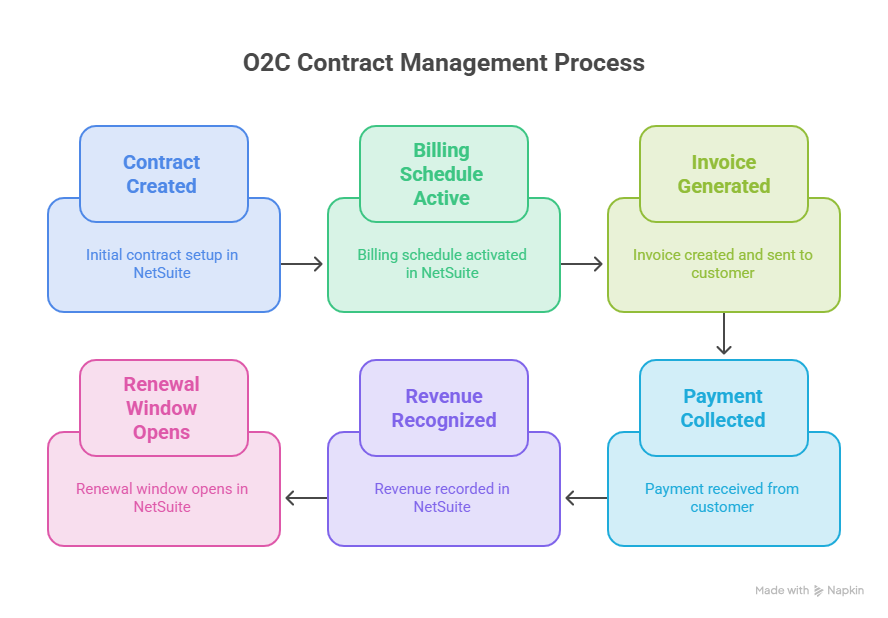
When these stages are all connected in NetSuite, the financial close accelerates. Finance does not need to reconcile billing records against contract terms manually because they are the same record. The AR aging reflects actual contract obligations. Forecast revenue is based on active contract data, not a separate spreadsheet that someone updates monthly.
The complete picture of how these financial stages connect, from contract creation through cash collection, is covered in detail in the order-to-cash process in NetSuite. That guide walks through every stage of the cycle and where contract data influences downstream financial outcomes.
For how working capital is affected by contract billing timing, payment terms, and renewal cycles, using NetSuite for working capital management covers the cash flow mechanics in detail.
When Contract Management Fails: The Revenue Leakage Signals
The most common signs that contract management is not working correctly in NetSuite are not system errors. They are operational patterns.
Renewals are processed late or missed entirely. If your team regularly discovers that a contract expired two weeks ago and the renewal was never initiated, the automated renewal window is not configured or not being acted on.
Billing does not match signed contract terms. If customers regularly dispute invoices because the amount does not match what they agreed to, billing schedules are not connected to the correct contract version. This often happens when contracts are amended but the billing schedule is not updated.
Revenue numbers do not match billing numbers. If your monthly revenue report does not reconcile with what was billed, ARM is either not configured or the billing schedule and recognition schedule are not linked correctly.
Mid-cycle changes create billing errors. If every upsell, downgrade, or cancellation requires a manual billing adjustment, proration in SuiteBilling is not configured. Every manual adjustment is a potential error and an accounting record that needs to be reversed if it is wrong.
Each of these signals points to a specific configuration issue in a specific module. The good news is that they are fixable. The bad news is that they compound the longer they run uncorrected.
For the specific mechanisms of automated invoicing and how NetSuite generates invoices from contract and billing data, NetSuite automated invoicing covers the invoice generation and delivery layer in detail.
For a complete view of how NetSuite’s accounting capabilities connect contract data to financial reporting, closing, and compliance, the NetSuite for accounting page covers the full financial management scope.
Final Thoughts
Contract management in NetSuite is not one feature. It is a connected layer of three modules that each handle a different stage of the contract lifecycle. Getting that architecture right, knowing which module handles renewals, which handles ongoing billing, and which handles revenue recognition, is the foundation for contract management that actually works.
The businesses that struggle with contract management are usually missing a configuration in one of the three layers. Renewals are automating but billing is still manual. Billing is working but revenue is recognized on cash receipt instead of on performance. All three layers are configured but co-termination is not enabled, so customers are receiving three renewal invoices instead of one.
If you want a straight answer on which configuration your specific contract model needs, the Folio3 team has built this for software companies, SaaS businesses, professional services firms, and technology vendors across dozens of implementations.
Get a direct answer on the right NetSuite contract management setup for your business. Book a Consultation
FAQs
What is NetSuite contract management?
NetSuite contract management is the set of tools and modules within NetSuite that manage the full lifecycle of a customer contract: creating contracts from sales orders, attaching billing schedules to contract terms, automating renewals, handling mid-cycle changes, and recognizing revenue in compliance with ASC 606 or IFRS 15. It spans three primary modules: the Contract Renewals SuiteApp, SuiteBilling, and Advanced Revenue Management.
What is the NetSuite Contract Renewals SuiteApp?
The Contract Renewals SuiteApp is a NetSuite module designed for software companies with perpetual and term licenses. It tracks renewable assets in an install base, automatically generates renewal transactions within a configurable window before contract expiration (typically 90 to 120 days), manages co-termination of multiple contracts into a single renewal, applies uplift and discount rules, and supports channel sales with distributor and reseller models.
What is co-termination in NetSuite contract renewals?
Co-termination is the process of aligning multiple contracts with different end dates for the same customer into a single renewal event. NetSuite’s Contract Renewals SuiteApp generates short-period invoices to align contract end dates, then produces a single renewal quote covering all active contracts on one date. This simplifies the renewal conversation and reduces billing complexity for customers with multiple product or service agreements.
How does NetSuite handle ASC 606 compliance for contracts?
NetSuite’s Advanced Revenue Management (ARM) module handles ASC 606 compliance. ARM separates billing dates from revenue recognition dates, manages performance obligation tracking, automates monthly recognition entries, and maintains a complete audit trail. When a customer pays an annual contract upfront, ARM recognizes revenue in equal monthly amounts over the service period rather than recognizing the full amount when cash is received.
What is the difference between the Contract Renewals SuiteApp and SuiteBilling?
The Contract Renewals SuiteApp handles renewal events at the end of a contract term. It is designed for businesses with annual license and maintenance cycles. SuiteBilling handles the ongoing billing schedule during the contract term. It manages subscription invoices, usage-based billing, proration for mid-cycle changes, and complex pricing models. Most software and SaaS businesses use both: the SuiteApp for renewal management and SuiteBilling for in-term billing.
How does NetSuite handle price increases at contract renewal?
NetSuite’s Contract Renewals SuiteApp supports uplift rules that automatically apply price increases when renewal transactions generate. Uplifts can be configured as a standard percentage applied to all renewing contracts, overridden at the customer segment level, or applied only to specific product lines. Discounts are managed at the transaction level and can apply to individual customers, customer groups, or specific renewal line items.