Choosing the right NetSuite support partner goes beyond comparing prices. Here’s what to look for, the questions to ask, and the mistakes to avoid.
Key Takeaways
- The best NetSuite support partner isn’t always the biggest or the cheapest. The right choice depends on your business goals, industry, and support needs.
- Looking beyond technical expertise and evaluating communication, response times, and scalability can help you avoid costly support issues later.
- Asking the right questions during the selection process often reveals more about a support provider than their sales presentation.
- A proactive support partner helps prevent problems before they affect your operations, rather than simply fixing issues after they occur.
- Using a structured evaluation framework makes it easier to compare potential NetSuite support partners with confidence.
Every Business Needs Support But Not the Same Partner
Picture this. Your NetSuite system goes down on the last day of the month. Financial close is due in three hours. Your support partner acknowledges the ticket, tells you it has been escalated, and goes quiet.
That is not a hypothetical. It happens more than most businesses want to admit, and almost always because the wrong support partner was chosen for the wrong reasons.
Choosing a NetSuite support partner is not the same as choosing a vendor. You are not just buying a service.
You are deciding who will be responsible for keeping your ERP running when things go wrong, who will prepare you for system updates before they break your customizations, and who will help your business grow into NetSuite rather than getting stuck in it.
In many cases, businesses don’t realize how important their support partner is until the first critical issue appears. That’s why it’s worth asking the right questions before signing a contract.
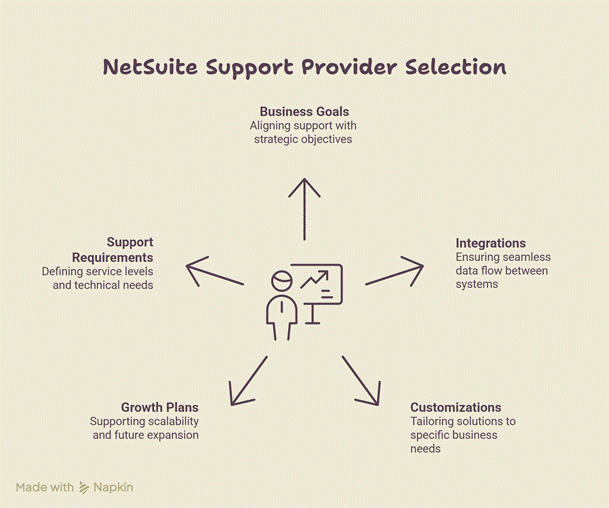
Many businesses spend months evaluating ERP features, comparing pricing, and planning implementation. But when it’s time to choose a support provider, the decision is sometimes based on who responds first or offers the lowest price.
This guide covers the best practices for selecting the right NetSuite support partner so that the decision is based on what actually matters, not what looks good in a proposal.
Before Comparing Providers, Start By Understanding Your Own Business
It’s difficult to choose the right partner if you’re not clear about what your business actually needs.
A company that’s recently implemented NetSuite won’t have the same priorities as one that’s been using it for years. Likewise, a business with multiple integrations will need different expertise than one using standard NetSuite features.
Before you start choosing a NetSuite support provider, take a step back and identify where your biggest challenges are today.
| If Your Business… | You Should Look For… |
| Has recently gone live with NetSuite | Strong post-implementation support |
| Uses multiple third-party applications | Integration expertise |
| Frequently customizes NetSuite | Technical consultants with customization experience |
| Operates across multiple locations | Scalable, responsive support |
| Plans to expand in the near future | A flexible support partner that can grow with your business |
A structured support provider selection process helps you compare vendors based on business needs instead of making a decision based on price alone. And that’s where the real evaluation begins.
You Are Not Just Buying Support. You Are Choosing A Long-Term Relationship
Here is something worth saying upfront. NetSuite support is not a product you buy once and forget about.
Your ERP is the engine of your business. It processes your orders, manages your inventory, closes your books, and connects every system you depend on. When it works well, nobody notices. When it breaks, everything stops.
ERP implementation failure rates sit between 55% and 75%, and poor partner selection is consistently cited as one of the leading causes. Even businesses that implement NetSuite successfully often struggle post-go-live because they did not plan for what ongoing support would actually require.
Think of it like hiring a doctor for your business. You do not want someone who only treats symptoms after they appear.
You want someone who monitors your health, catches issues early, and knows enough about your history to give you advice that is actually relevant to you.
You must know what type of partner you are looking for.
Quick Comparison
| If You Want… | Choose… |
| Basic issue resolution | Standard support provider |
| Strategic guidance | NetSuite support partner |
| Help with integrations | Experienced ERP partner |
| Long-term optimization | Proactive support team |
| Business-specific recommendations | Industry-focused provider |
So what should you actually be looking for? Let me walk you through some practices. If you want any of these partners, Folio3 provides all these trusted partner services.
Best Practices For Choosing The Right NetSuite Support Partner
Practice #1: Start With Certification, But Do Not Stop There
Every credible NetSuite support partner will tell you they are certified. That is table stakes. What the certification actually tells you is that the firm has met Oracle NetSuite’s baseline requirements for technical knowledge and delivery capability.
What it does not tell you is who will actually be sitting at the keyboard when your account has a problem.
This is one of the most common traps in partner selection. A firm earns its Oracle NetSuite certification through its senior leaders and most experienced consultants. Then it staffs your account with junior team members who are still building their skills.
You never met them during the sales process, and by the time you realize the support is not what you expected, you are already locked into a contract.
What To Do?
Before you sign anything, ask to meet the consultant who will be assigned to your account. Ask for their name, their certification level, and how many accounts they currently support. If a partner cannot tell you who will be working on your system before you sign, that is a problem.
Also, ask which specific certifications are relevant to your setup. NetSuite offers certifications across areas, including SuiteFoundation, ERP Consultant, SuiteCloud Developer, Administrator, and SuiteAnalytics.
Practice #2: Industry Experience Is Not A Nice-to-Have
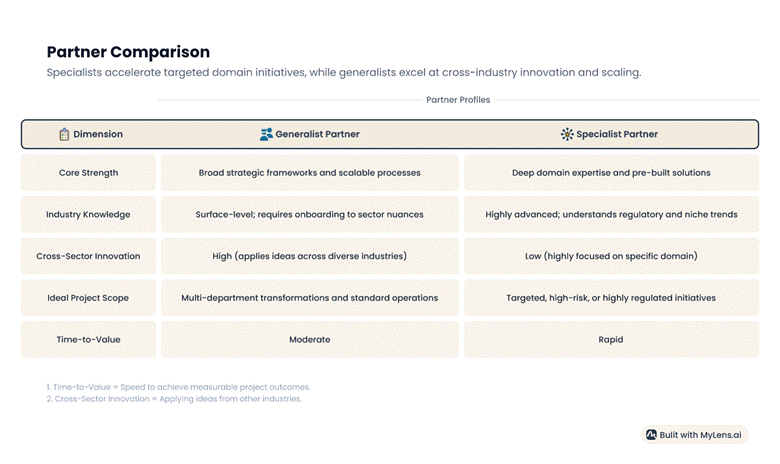
You could hire the most technically capable NetSuite partner in the country, and they could still fail to support your business well if they have never worked in your industry.
NetSuite is highly configurable. The way a distribution company sets up its inventory, approval workflows, and reporting is completely different from how a professional services firm structures its project billing and resource management.
Those differences go deep into how the system is built, which modules are activated, and which customizations are in place.
What To Do?
Ask every potential support partner for references from companies that operate in your specific industry, not just companies that are a similar size.
Ask those references targeted questions: Did the partner understand your workflows without extensive hand-holding? Did they flag industry-specific risks before they became problems? Would you use them again?
Practice #3: Read The SLA Like A Contract, Not A Formality
A Service Level Agreement (SLA) is the document that defines what your partner is actually committing to. Most businesses skim it. That is a mistake.
SLAs have two metrics that are often confused with each other. Response time is how quickly the partner acknowledges your ticket. Resolution time is how quickly the problem is actually fixed.
A partner can respond in 30 minutes and take five business days to resolve a critical workflow failure. That is not support. That is an acknowledgment with no follow-through.
A Well-structured SLA for each. Response time means when your partner acknowledges the issue. Resolution time means when it is fixed. Both matter, and most businesses forget to ask about resolution benchmarks specifically.
What to Do?
Before finalizing a NetSuite support partner, go through the SLA line by line. Ask specifically for resolution time benchmarks at each priority level, not just response time.
Ask what happens if those benchmarks are missed. Does the contract include any remedies, escalation paths, or performance reviews?
Also, check whether the SLA is customizable. Your business may have periods when system uptime is especially critical, like month-end financial close, a peak sales season, or a major product launch.
A flexible support partner will build that context into your agreement rather than offering a one-size-fits-all tier.
Practice #4: Know Who Picks Up The Phone When Something Goes Wrong
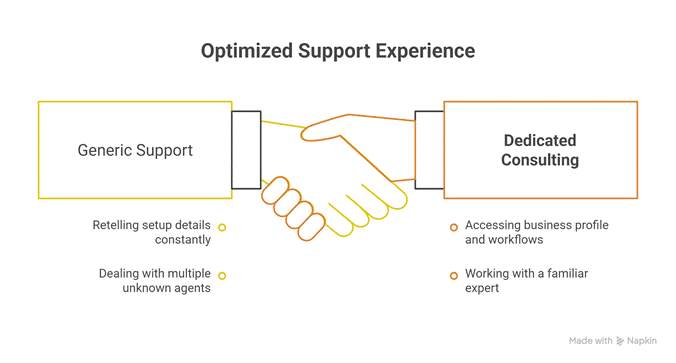
When something goes wrong, the last thing you want is to explain your entire NetSuite setup to someone seeing it for the first time.
Some providers assign a dedicated consultant. Others place every request into a shared support queue, meaning you may speak to a different person each time.
It’s like working with the same accountant year after year instead of explaining your finances to a new one every tax season. Familiarity leads to faster, more relevant support.
For a side-by-side view of how third-party partner support compares to Oracle’s own model, our article on Third-party NetSuite support vs Oracle covers where each option performs better
Most proposals from Managed services providers look identical on the surface. The real differences only become visible when you ask specific, detailed questions about how services are actually delivered, supported, and scaled.
What to Do?
Ask directly: Will I have a named consultant assigned to my account? What happens if that consultant leaves the company or is unavailable? How is institutional knowledge about my system documented and transferred?
A partner who cannot answer these questions clearly is likely running a pooled support model.
Practice #5: Proactive Support Is What Separates Good Partners From Adequate Ones
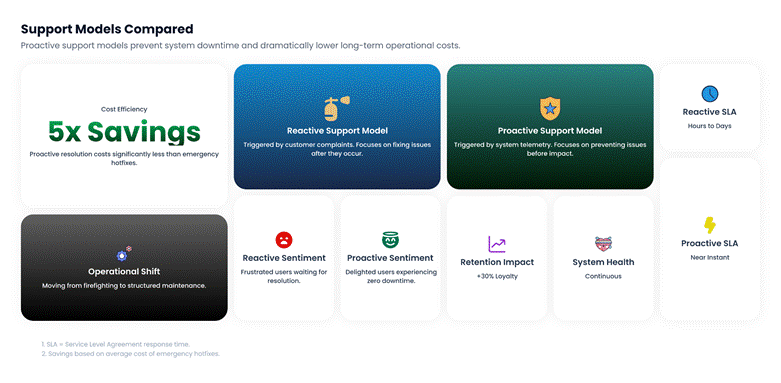
There is a version of NetSuite ERP support that works like a help desk. Something breaks, you raise a ticket, the partner fixes it, and the ticket closes. That is reactive support, and for a system as central to your business as NetSuite, it is not enough.
NetSuite releases two major updates every year. Each update can change how your custom scripts behave, affect your third-party integrations, or introduce new features that conflict with existing configurations.
If your partner is not monitoring for these changes and preparing you in advance, you find out something broke the same way your team does, when it stops working.
What to Do?
Ask every NetSuite support provider you are evaluating to describe their process for managing NetSuite’s twice-yearly updates.
Do they review release notes on your behalf? Do they test your customizations against the update in a sandbox environment before it reaches production? Do they alert you to potential conflicts before your business is affected?
If the answer is vague, the support model is reactive. For a growing business, that creates ongoing risk.
Practice #6: Scalability Should Be Part Of The Conversation Before You Sign
Your support needs today are not your support needs in two years.
Maybe your business is adding a new line of business that requires a different NetSuite module. Maybe you are expanding internationally and need OneWorld support.
Maybe you are onboarding a new e-commerce platform that needs to integrate with NetSuite. These are normal parts of business growth, and they all affect what you need from a support partner.
A partner who is great at supporting your current setup but has no experience with OneWorld or complex integrations becomes a liability the moment your requirements change. Switching support partners mid-growth is disruptive and expensive.
What To Do?
Before finalizing a NetSuite support partner, share your growth plans and ask specifically whether the partner has supported businesses through the same kind of expansion you are planning.
Have they helped clients roll out additional NetSuite modules post-go-live? Have they managed multi-entity or multi-currency configurations? Have they built integrations with the platforms you are considering?
A flexible support partner answers these questions with specific examples. A partner who pivots to a generic sales pitch when you get specific is probably not the right fit for where your business is going.
Mistakes That Make This Decision Harder Than It Needs To Be
| Common Mistake | Why It Causes Problems | What to Do Instead |
| Choosing based on price alone | The cheapest support partner usually delivers the slowest resolution times and the least experienced consultants | Compare total value: response time, industry expertise, named consultant, and SLA terms |
| Assuming the implementation partner is the best support partner | Implementation and support are different skill sets. Great implementers are not always great at ongoing support | Evaluate the support model separately, even if you stay with the same firm |
| Skipping the reference calls | References are the only way to validate what the partner claims during the sales process | Call at least three references and ask targeted questions about support quality, not just implementation |
| Ignoring cultural fit | If communication styles clash during the evaluation, they will not improve once you are a client | Pay attention to responsiveness, clarity, and how the partner handles your questions before you sign |
| Locking into a rigid contract without flexibility | Business needs change. A support contract with no room to adjust leaves you paying for what you no longer need | Ask specifically about flexibility in scope, hours, and engagement model before signing |
Red Flags Before Signing A Contract
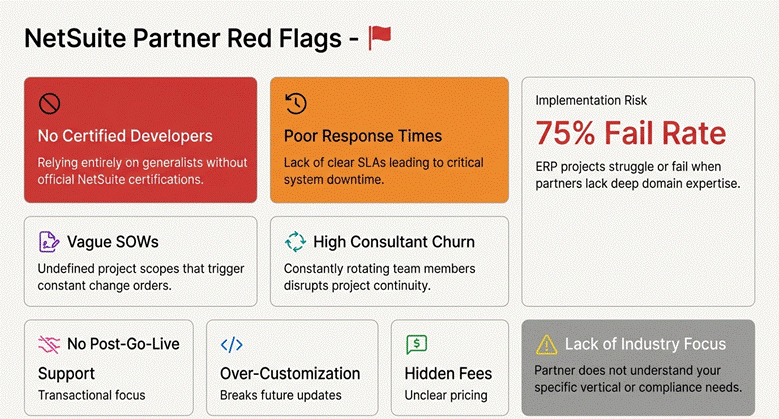
A polished presentation doesn’t always reflect the quality of support you’ll receive after onboarding. Keep an eye out for these common warning signs.
🚩 Everything sounds like a “yes.”
If a provider claims they can do everything without asking questions about your business, they’re probably oversimplifying the work involved.
🚩 Response times are vague.
If they can’t clearly explain how quickly they’ll respond to support requests, you may find yourself waiting when issues become urgent.
🚩 They focus only on fixing problems.
The best NetSuite support services don’t just solve today’s issues. They help prevent tomorrow’s.
🚩 No experience with your industry.
Every industry has different workflows and compliance requirements. Relevant experience can significantly reduce your learning curve.
🚩 Pricing isn’t transparent.
Unexpected charges for additional hours or services can quickly increase your support costs. Make sure you understand exactly what’s included.
Sometimes, avoiding the wrong partner is just as important as choosing the right one. Once you’ve shortlisted a few providers, the next step is comparing them side by side.
Not All Support Looks the Same, Even If It Sounds The Same
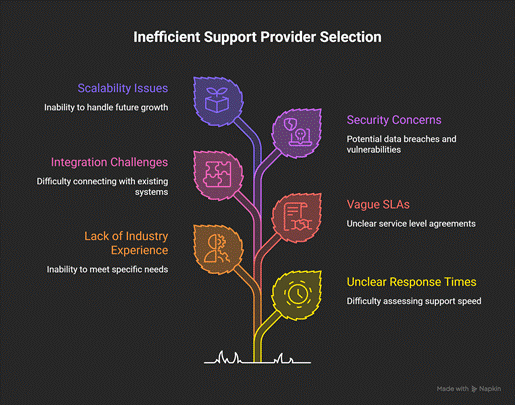
On paper, two providers might offer similar services. In practice, the experience can be very different.
The goal isn’t simply to find someone who can answer support tickets. It’s to find a partner who helps your NetSuite environment continue delivering value as your business evolves.
Now that you’ve narrowed your options, there’s one final exercise that can make your decision much easier.
| Basic Support Provider | Strategic NetSuite Support Partner |
| Responds when issues are reported | Helps identify and prevent issues early |
| Focuses on ticket resolution | Focuses on long-term system performance |
| Limited understanding of business goals | Takes time to understand your business processes |
| Offers standard support packages | Tailors support based on your needs |
| Solves technical problems | Recommends improvements and optimization opportunities |
| Supports today’s requirements | Plans for future growth and scalability |
How to Use The Scorecard – Given below
Score each partner independently before comparing. Do not fill it out from memory after the meetings. Take notes during each evaluation conversation and score immediately after, while details are fresh.
The criteria around resolution time, named consultant assignment, and proactive update management carry the most real-world weight. If a partner scores below 3 on any of those three, treat it as a serious concern regardless of their total score.
If you want a deeper look at what Folio3’s support model covers across each of these criteria, our NetSuite managed services page walks through how we structure engagements for businesses at different stages of growth.
NetSuite Support Partner Scorecard
Use Folio3’s scorecard when evaluating multiple potential support partners side by side. Score each criterion from 1 to 5, then total the scores. The highest total is your strongest candidate.
| Evaluation Criterion | What to Look For |
| Certification and Credentials | Named consultants on your account are individually certified, not just firm leadership |
| Industry Experience | Has references from companies in your specific vertical with similar system complexity |
| SLA – Response Time | Defined response time benchmarks for each priority level in writing |
| SLA – Resolution Time | Defined resolution time benchmarks for each priority level, separate from response time |
| Named Consultant Assignment | A specific consultant is assigned to your account before you sign |
| Proactive Update Management | Documented process for testing customizations before NetSuite’s twice-yearly updates |
| System Monitoring | Active monitoring and alerting for integration failures, script errors, and performance issues |
| Scalability | Experience supporting businesses through module expansion, OneWorld, or integration growth |
| Support Model Flexibility | The contract can be adjusted in scope, hours, or model as your business requirements change |
| Transparent Pricing | Clear breakdown of what is included in the retainer vs billed separately |
| Escalation Path | Documented escalation procedure when critical issues are not resolved within the SLA window |
| Communication and Responsiveness | Responsive and clear during the evaluation process itself |
| References Quality | References are from relevant industries, willing to answer targeted questions |
| Cultural Fit | Communication style, availability, and working approach align with your team’s expectations |
| TOTAL SCORE (1 TO 5) |
Using a scorecard makes NetSuite support provider selection more objective and helps your team compare multiple providers fairly.
Scoring Guide
| Total Score | What It Means |
| 60 to 70 | Strong fit. Proceed with confidence and finalize contract details. |
| 45 to 59 | Reasonable fit with gaps. Clarify the low-scoring areas before signing. |
| 30 to 44 | Significant concerns. Push for specific answers on weak areas or keep evaluating. |
| Below 30 | Poor fit. The gaps in this evaluation will become operational problems. Keep looking. |
Before You Finalize A NetSuite Support Partner
Think of this as your last review before signing the contract. If you can confidently check every box below, you’re probably making a well-informed decision.
Final Selection Checklist
- The provider understands our business and industry.
- They have experience supporting businesses of our size.
- Response times and SLAs are clearly documented.
- They can support our customizations and integrations.
- Security and data protection practices have been explained.
- Pricing is transparent, with no hidden costs.
- They can scale their support as our business grows.
- Customer references or case studies have been shared.
- Our team feels comfortable communicating with them.
Pro Tip
Don’t judge a support provider only by how they answer your questions. Pay attention to the questions they ask you.
A good partner wants to understand your business goals, challenges, and future plans before recommending a solution. If the conversation is only about pricing, you may not be speaking to the right partner.
Why Choose Folio3 as Your NetSuite Support Partner?
The right support partner should do more than resolve technical issues. Folio3 provides proactive NetSuite support, ongoing system optimization, and expert guidance to help businesses keep their ERP running efficiently as they grow.
Final Thoughts
Choosing a NetSuite support provider isn’t just about finding someone who can solve technical issues. It’s about finding a team that understands your business, communicates clearly, and helps your ERP keep pace with your growth.
One thing I’ve noticed is that businesses often compare support partners based on hourly rates alone. But the real value usually comes from everything that happens behind the scenes, like faster issue resolution, proactive recommendations, and a team that helps you avoid problems before they affect your operations.
Take your time, ask the right questions, and compare providers using a clear framework instead of assumptions. The best NetSuite support partner won’t just keep your system running. They’ll understand your business, recommend improvements, and support your growth long after implementation. They’ll become a trusted extension of your team.
Frequently Asked Questions
Can a NetSuite support partner help with integrations?
Yes. Many support partners assist with maintaining and troubleshooting integrations between NetSuite and CRM systems, ecommerce platforms, payment gateways, shipping providers, and other business applications.
Should I choose a local or global NetSuite support partner?
The best choice depends on your business. Local providers may offer closer collaboration, while global partners often provide broader expertise and extended support hours.
How much does a NetSuite support partner cost?
The cost depends on the level of support you need. Some providers charge by the hour, while others offer monthly retainers or fully managed support. If you need ongoing assistance, a monthly retainer is often the most cost-effective option.
Can I switch NetSuite support partners if it isn’t working out?
Yes, but switching takes time and planning. Your new provider will need to understand your customizations, integrations, and system setup. That’s why it’s worth choosing the right partner from the start.
What’s the difference between reactive and proactive NetSuite support?
Reactive support fixes issues after they happen. Proactive support works to prevent problems through regular monitoring, system reviews, and maintenance, helping your business avoid unexpected disruptions.