Oracle NetSuite support is offered directly by the company, providing guaranteed service-level agreements, bug fixes, compliance guidance, and official updates. It is reliable for standard NetSuite functionality and regulatory requirements, but can be more expensive and may be slower in addressing highly customized workflows.
Third-party NetSuite support, on the other hand, is provided by independent certified firms that specialize in troubleshooting, customizations, integrations, upgrades, and ongoing optimization. These providers often offer more flexible service plans, faster response times for complex issues, and access to global expertise, usually at a lower cost.
Choosing the right NetSuite support can significantly impact your ERP’s efficiency and ROI. Businesses often weigh third-party NetSuite support vs Oracle to balance cost, expertise, and flexibility. This guide compares both options, highlighting benefits, risks, and use cases to help you make an informed decision for 2026.
What Is Third-Party NetSuite Support?
Third-party NetSuite support refers to services provided by independent NetSuite-certified firms that are not owned or operated by Oracle. These providers support businesses after NetSuite goes live, helping them maintain, optimize, and extend the platform based on real operational needs.
An independent NetSuite support provider typically focuses on hands-on, day-to-day system support rather than standard ticket-based assistance. This model is commonly used by businesses that want faster issue resolution and deeper involvement in customized environments.
Services commonly included in third-party NetSuite support services:
- Troubleshooting functional and technical issues
- Customizations using SuiteScript and workflows
- Third-party integrations with ecommerce, CRM, WMS, or POS systems
- User training and role-based system guidance
- Post-go-live optimization and performance improvements
Benefits of NetSuite third-party support:
- Greater flexibility in support plans and SLAs
- Faster response times for complex or customized systems
- Access to a specialized NetSuite module and industry expertise
- Cost-effective alternatives to premium Oracle support
Risks to consider:
- Quality can vary between providers
- SLAs may differ from Oracle’s official guarantees
- Long-term dependency on a single support partner
Choosing the right third-party provider is critical to minimizing these risks.
What Is Oracle NetSuite Support?
Oracle NetSuite support is the official support service provided directly by Oracle, the owner of the NetSuite platform. It is designed to ensure system stability, compliance, and consistent access to platform updates.
Oracle offers multiple technical support tiers, including standard and premium support plans. These plans focus on system availability, core functionality, and infrastructure-level support rather than business-specific customization.
Oracle NetSuite support typically covers:
- Bug fixes and system defect resolution
- Scheduled NetSuite upgrades and cloud updates
- Platform security, compliance, and performance monitoring
- Access to official documentation and training resources
Key advantages of Oracle NetSuite support:
- Direct access to official NetSuite product expertise
- Guaranteed service-level agreements (SLAs)
- Seamless compatibility with new NetSuite releases
- Reduced risk for compliance-driven organizations
Limitations to be aware of:
- Higher overall support and licensing costs
- Limited flexibility in service scope
- Slower response for highly customized workflows
- Less involvement in business-specific optimizations
When comparing NetSuite support, Oracle vs third-party, Oracle support works best for organizations that prioritize official backing and standardized environments over flexibility and cost control.
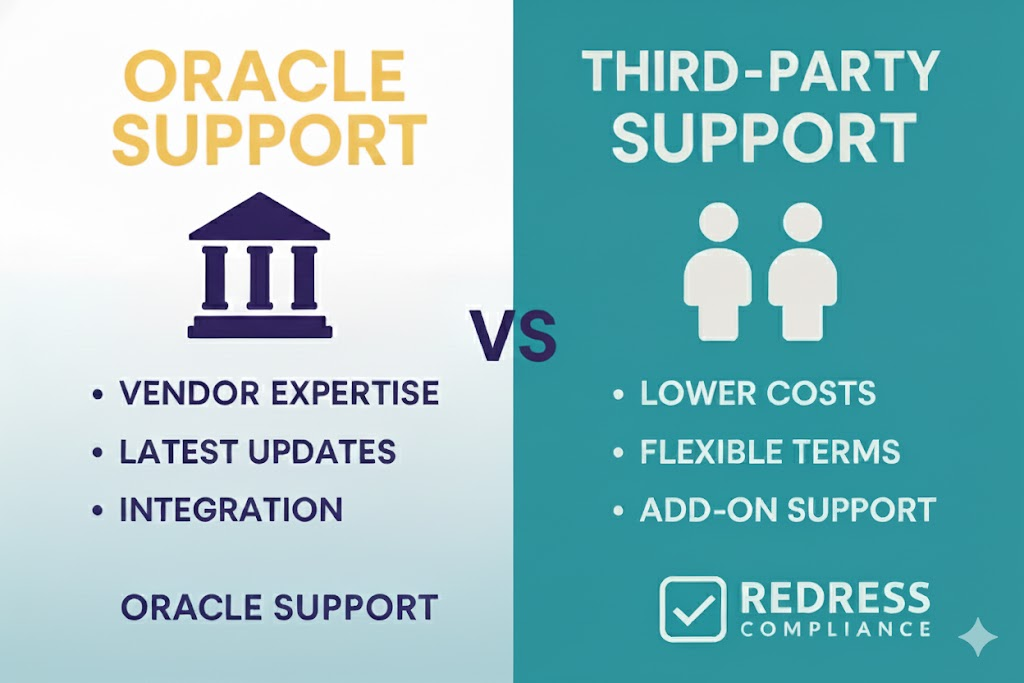
Cost Comparison: Third-Party vs Oracle NetSuite Support
Evaluating NetSuite support cost comparison means looking beyond surface numbers to understand how each model charges, what you get for those fees, and where hidden costs can add up over time. Oracle’s official support is typically tied to your license value and escalates yearly, while third-party providers base their pricing on services you actually use, often at a significantly lower total cost.
Oracle Support Pricing
Oracle’s official NetSuite support is typically calculated as a percentage of your original license list price, often around 22% annually, and is designed to rise over time due to built-in uplift increases (commonly 3–5% per year). This means even if your usage doesn’t change, your support bill does. Oracle may also charge extended support premiums if you remain on older versions and require upgrades in order to stay supported, further increasing long-term costs.
Components of Oracle support costs:
- Base annual support fee (~22% of license list price)
- Mandatory annual uplift increases (~3–5%)
- Extended support surcharges for older releases
- Limited room for negotiation or partial support reduction
Third-Party Support Pricing
Third-party support providers typically offer a flat, predictable annual fee that can be 50–70% lower than Oracle’s official support cost, without automatic uplifts or forced upgrades. These providers tailor pricing to the actual support scope you need rather than tying it directly to your original license cost.
Typical features of third-party support pricing:
- Lower base annual fees, often ~50% of Oracle support
- No automatic yearly uplifts — stable pricing
- Support for legacy software versions without extra fees
- Optional upgrades priced separately
Hidden and Long-Term Costs to Consider
When comparing cost models, be sure to budget for:
- Customizations and integrations: Both third-party and Oracle environments may incur fees for maintaining custom workflows and integrations.
- Upgrades and forced renewal costs: Oracle’s model can push expensive updates, whereas third-party support lets you choose when and if to upgrade.
- Travel, training, or expanded SLAs: On-site or premium support options may add extra charges depending on the provider.
- Managed services contracts: Many third-party providers offer bundled NetSuite managed services that include support, optimization, and administration — often more cost-effective than hourly ad-hoc support. For context on typical managed support costs, see our complete guide on NetSuite pricing for small businesses.
Cost Comparison of third-party NetSuite Suppoort vs Oracle at a Glance
| Cost Element | Oracle NetSuite Support | Third-Party NetSuite Support |
|---|---|---|
| Annual Fee (Base) | ~22% of license list price | Typically ~50–70% less than Oracle |
| Yearly Price Uplift | Yes (~3–5% per year) | Usually no automatic increases |
| Version Support Beyond EOL | Extra surcharges | Included at standard rate |
| Upgrade Pressure | Often required to stay supported | Optional, at your discretion |
| Price Predictability | Low; costs grow over time | High; flat fees and stable contracts |
Example: Three-Year Support Cost Comparison
Imagine an organization with a $1,000,000 license list price:
- Oracle Support Fees:
- Year 1: ~$220,000
- Year 2: ~$228,800 (4% uplift)
- Year 3: ~$237,952 (4% uplift)
Total (3 years): ~$686,752
- Year 1: ~$220,000
- Third-Party Support Fees (flat):
- Year 1: ~$110,000
- Year 2: ~$110,000
- Year 3: ~$110,000
Total (3 years): $330,000
- Year 1: ~$110,000
In this scenario, third-party NetSuite support can save over 50% of annual support costs over three years, with even greater savings if you avoid forced upgrades or extended support charges.
Summary: When comparing Oracle vs third-party NetSuite support pricing, third-party providers generally offer a more flexible and predictable cost structure that aligns with actual support needs, while Oracle’s official model is higher and designed to rise yearly. Choosing the right support model ultimately depends on your business goals, budget, and how you plan to use and evolve your NetSuite system.
Service Levels and Responsiveness: Third-Party NetSuite Support vs Oracle
Service quality and responsiveness are among the most important factors when comparing third-party NetSuite support vs Oracle support. How quickly issues are acknowledged, the depth of expertise brought to bear, and how escalations are handled can significantly impact business continuity and user experience.
Oracle NetSuite Support: Structured, Tiered, and Standardized
Oracle’s official support model uses standardized service levels and structured escalation paths defined by severity tiers. Customers open cases through the support portal, and issues are assigned based on severity classifications such as Severity 1 (critical), down to lower-priority categories. These SLAs include targeted response times, but first response does not always mean full resolution, it simply acknowledges receipt of the issue before an engineer begins work.
- Queue-based routing: Tickets may sit in a queue before an engineer begins work, which can delay initial engagement on complex issues.
- Strict severity definitions: Only Severity 1 issues typically get immediate 24/7 attention; other cases are handled during standard business hours unless you’ve purchased Premium Support.
- Escalation through multiple tiers: Oracle uses a multi-level support path (Level 1 → Level 2 → Level 3), which can introduce additional delays as cases move between teams.
- Centralized global support: While this delivers consistency, it can feel impersonal and follow rigid processes.
This structured approach works well for standardized NetSuite environments and guaranteed basic uptime, but it may feel slow or detached when business-specific customizations or urgent workflow disruptions occur.
Third-Party NetSuite Support: Personalized, Flexible, and Fast
In contrast, third-party NetSuite support providers, including independent specialists and certified partners, emphasize responsiveness, relationship-driven service, and deep familiarity with your specific environment. Many organizations switching from Oracle report a more attentive and rapid experience, particularly on complex issues that involve custom code, integrations, or performance tuning.
- Direct access to senior engineers: Rather than tiered queues, third-party support often assigns a dedicated engineer or small team who are familiar with your system from day one.
- Faster response times: Because there’s no rigid global queue, many providers guarantee quicker initial responses and begin troubleshooting immediately.
- Flexible escalation: Issues can be escalated internally without waiting for procedural hand-offs, improving both speed and resolution depth.
- Support for customizations and integrations: Third-party teams typically cover custom modules and third-party integrations that Oracle support often won’t address directly.
Many businesses also appreciate the personalized communication style, frequent updates, single points of contact, and proactive problem management, which enhances service experience and avoids repetitive retracing of issue history.
Responsiveness and Coverage Comparison
| Aspect | Oracle NetSuite Support | Third-Party NetSuite Support |
|---|---|---|
| Initial Response | Based on severity and the global queue | Faster, often guaranteed via custom SLA |
| Availability | 24/7 only for the highest severity | 24/7 for all severity levels (if contracted) |
| Access to Experts | Escalated through tiers | Direct access to senior engineers |
| Escalation Process | Multi-tier procedural | Flat, streamlined escalation |
| Customization Support | Limited to standard issues | Comprehensive, covers custom systems |
| Communication Style | Structured and formal | Personalized, proactive |
What This Means for Your Business
- Oracle’s structured model ensures consistent support for standard NetSuite platform issues and broad coverage across regions, but response times and personalization can lag, especially for customized environments or urgent business processes.
- Third-party roviders tend to deliver quicker engagement, deeper expertise in custom environments, and relationship-based service that feels attentive and aligned with your business priorities.
Ultimately, choosing between these models comes down to your business’s complexity, need for rapid resolution, and how much personalization and continuous engagement you expect from your support partner.
Benefits of Third-Party NetSuite Support
Many businesses choose third-party NetSuite support because it offers a more flexible and business-aligned alternative to standard vendor support models. These providers focus on how NetSuite is actually used day to day, rather than limiting support to platform-level issues.
One of the biggest NetSuite third-party support benefits is flexibility. Support teams can scale up or down based on workload, seasonal demand, or project phases. Service-level agreements are often personalized, allowing businesses to define response times, coverage hours, and escalation paths that match real operational priorities rather than fixed tiers.
Key flexibility advantages include:
- Faster response times with direct access to experienced consultants
- Custom SLAs instead of one-size-fits-all support tiers
- Scalable support teams without long-term overhead
Another reason businesses ask why choose third-party NetSuite support is access to specialized expertise. Third-party providers typically employ consultants who focus on specific NetSuite modules and industries. This includes deep experience with SuiteCommerce, SuiteBilling, Advanced Financials, and complex integrations that official support may not fully cover.
Expertise-driven benefits:
- Hands-on support for customized workflows and scripts
- Module-specific specialists instead of general support agents
- Practical guidance based on real implementation experience
Cost efficiency is also a major factor. Third-party support is often significantly more affordable than Oracle’s official support, with flat or predictable pricing models. Businesses avoid automatic annual uplifts and only pay for the services they actually need.
Global availability further strengthens the offshoring NetSuite support advantages. Distributed teams enable 24/7 or multi-timezone coverage, ensuring issues are addressed quickly regardless of location. This makes third-party support especially valuable for global and multi-entity organizations.
Overall, third-party NetSuite support delivers flexibility, expertise, cost control, and global responsiveness, making it a strong choice for businesses seeking practical, long-term ERP support.
Benefits of Oracle NetSuite Support
For many organizations, staying with Oracle’s official support remains a strategic choice, especially when stability, compliance, and platform reliability are top priorities. One of the key Oracle NetSuite support advantages is direct access to the vendor that develops and maintains the NetSuite platform.
Reliability is a major benefit of official support. Oracle provides certified assistance backed by deep knowledge of NetSuite’s core architecture. This ensures issues related to system availability, performance, and security are handled using approved methods and best practices. Official patches and updates are tested within Oracle’s ecosystem, reducing the risk of unexpected conflicts.
Key reliability benefits include:
- Vendor-certified support engineers
- Official bug fixes and security patches
- Reduced risk when addressing core system issues
Another important factor is seamless compatibility with new NetSuite releases. Oracle manages all upgrades and ensures that supported features remain aligned with platform updates. This is particularly valuable for businesses that prefer to stay on the latest NetSuite versions without worrying about long-term version support.
Official NetSuite support benefits also include:
- Smooth adoption of new features and enhancements
- Platform updates without third-party dependency
- Consistent support experience across releases
Guaranteed service-level agreements are another reason businesses rely on NetSuite SLA Oracle offerings. Oracle defines response times based on issue severity and provides structured escalation paths. This approach works well for organizations that need predictable support coverage and documented compliance processes.
Accountability is also clearer with Oracle support. When critical system failures occur, responsibility remains with the software owner, reducing vendor coordination and finger-pointing. For highly regulated industries or enterprises with strict audit requirements, this single-vendor accountability can be a deciding factor.
Overall, Oracle NetSuite support is best suited for organizations that prioritize official backing, compliance assurance, and long-term platform stability over customization flexibility or cost savings.
When to Choose Third-Party vs Oracle NetSuite Support
Choosing between third-party and Oracle support depends on how your business uses NetSuite, your budget, and the level of flexibility you need. Companies are increasingly evaluating NetSuite support options based on real operational requirements rather than default vendor contracts.
Third-party NetSuite support works best for small to mid-sized businesses and cost-conscious enterprises that want more control over support spend. It is also well-suited for organizations with heavily customized NetSuite environments, complex integrations, or industry-specific workflows that require hands-on expertise.
Common third-party support use cases include:
- Businesses with extensive custom scripts, workflows, or integrations
- Companies looking to reduce recurring NetSuite support costs
- Teams that value faster response times and personalized SLAs
- Organizations operating across multiple regions that need flexible, multi-timezone coverage
In contrast, Oracle NetSuite support is often the better choice for large enterprises with strict compliance requirements. Companies in regulated industries may prefer Oracle’s official backing, standardized processes, and documented SLAs for audits and risk management.
Oracle support is typically ideal when:
- The NetSuite environment has minimal customizations
- Regulatory compliance and audit readiness are critical
- Premium SLA guarantees are required
- A single-vendor accountability model is preferred
Many organizations adopt a hybrid NetSuite support model, combining both approaches. Oracle support is retained for core platform coverage and compliance, while third-party providers handle customizations, integrations, and day-to-day optimization. This blended approach is increasingly seen as the best NetSuite support model for balancing cost, flexibility, and risk.
Ultimately, the right choice depends on your system complexity, business goals, and long-term support strategy.
Compliance and Risk Considerations
Compliance and risk management are critical factors when choosing between third-party and Oracle NetSuite support. Oracle’s official support is often preferred by organizations operating in highly regulated industries because it provides direct vendor-backed compliance assurance. This includes standardized processes, documented controls, and clear audit trails.
Third-party NetSuite support can also meet compliance needs, but it requires careful provider selection and well-defined contracts. Independent providers rely on their own internal controls and security practices, which means businesses must validate certifications, data handling policies, and access management procedures.
Key compliance and risk considerations include:
- Industry regulations such as SOX, GDPR, or financial reporting standards
- Internal audit and documentation requirements
- Data access controls and segregation of duties
- Risk tolerance for relying on a non-vendor support partner
For risk-averse enterprises, Oracle support may reduce exposure. For others, third-party support can still be compliant when governance is properly managed.
Updates, Patches, and Security
Oracle NetSuite support handles all official system updates, security patches, and platform-level enhancements. These updates are automatically applied as part of NetSuite’s cloud release schedule, ensuring systems remain current and protected against known vulnerabilities.
Third-party support providers do not control core NetSuite updates but play an important role in managing their impact. They help test changes, validate customizations, and ensure integrations continue to function after updates are deployed.
How updates and security differ by model:
- Oracle applies mandatory upgrades and security patches
- Third-party teams focus on regression testing and post-update stabilization
- Custom scripts and workflows are reviewed to prevent breakage
- Security best practices are reinforced through configuration and role management
This collaborative role makes third-party support especially valuable in customized environments where updates can introduce unexpected issues.
Contract and Licensing Implications
Choosing a support model also affects your NetSuite contracts and licensing obligations. Oracle support is typically tied to your NetSuite license agreement and includes automatic renewals, annual uplifts, and limited flexibility in scope reduction.
Third-party NetSuite support contracts are usually separate and more flexible. They allow businesses to define service scope, response times, and pricing models independently of Oracle licensing terms.
Key contractual differences to evaluate:
- Ability to reduce or modify support scope
- Term length and exit clauses
- Impact on license renewals and future upgrades
- Restrictions related to rejoining Oracle support later
Businesses considering a switch should review contractual terms carefully to avoid unintended licensing or reactivation costs. A well-planned approach ensures compliance while maintaining flexibility and cost control.
Conclusion
Choosing the right NetSuite support is not one-size-fits-all. In a NetSuite support comparison 2026, businesses must weigh factors such as budget, system complexity, industry requirements, and expected service levels.
At the same time, Oracle support continues to be a strong option for larger enterprises that prioritize official reliability, structured service levels, and compliance documentation. Oracle’s certified processes, guaranteed SLAs, and seamless platform updates provide reassurance to organizations with stringent regulatory or audit demands.
Some businesses find that a hybrid model strikes the right balance, combining Oracle’s official backing for core platform issues with third-party expertise for customizations, integrations, and day-to-day support. When choosing the right NetSuite support, evaluating both approaches ensures you align service with strategy.
For tailored NetSuite support that combines deep technical expertise with flexible engagement models, consider providers like Folio3. Folio3 offers a spectrum of support options designed to fit diverse business needs, delivering both responsiveness and industry-driven insights as part of your long-term ERP success.
FAQs
1. Is third-party NetSuite support safe and reliable?
Yes, third-party NetSuite support can be both safe and reliable, provided you select a certified and experienced provider. Independent support firms like Folio3 follow strict security protocols, maintain qualified NetSuite consultants, and offer service-level agreements (SLAs) to ensure accountability.
Key factors that make third-party support reliable:
- Certified NetSuite experts with proven module-specific experience
- Transparent SLAs for response times, escalation, and resolution
- Security measures such as role-based access, encryption, and audit trails
- Dedicated teams familiar with your unique customizations and workflows
When properly managed, third-party support can match or even exceed the responsiveness of official Oracle support while providing a more tailored, hands-on approach.
2. Can I switch from Oracle support to third-party support?
Yes, switching from Oracle support to a third-party provider is possible, but careful planning is required to avoid service interruptions. Most businesses follow a structured transition process.
Steps to ensure a smooth switch:
- Review current Oracle support contracts and notice periods
- Document all customizations, workflows, and integrations
- Engage the third-party provider for knowledge transfer and onboarding
- Ensure SLAs and coverage match or exceed Oracle support commitments
- Validate compliance and data security standards
Switching allows companies to reduce costs, gain flexibility, and receive more personalized support while maintaining continuity of service.
3. How much can I save with third-party NetSuite support?
Third-party support is generally more cost-effective than Oracle support because it does not tie pricing to license value and avoids automatic annual fee increases. Savings vary depending on system size and complexity.
Typical cost benefits:
- Annual fees are often 50–70% lower than Oracle’s official support
- No mandatory price uplifts or forced upgrades
- Flexible service plans that focus on actual business needs
- Reduced overhead for legacy version support or custom module maintenance
Over a multi-year period, these savings can be substantial, especially for small-to-medium businesses or highly customized NetSuite environments.
4. Do third-party consultants provide 24/7 coverage?
Yes, many third-party NetSuite providers offer 24/7 support, particularly those with distributed or offshore teams. This is especially useful for global businesses operating across multiple time zones.
Coverage features may include:
- Multi-timezone support teams for round-the-clock issue handling
- Dedicated engineers familiar with your system to reduce resolution time
- Proactive monitoring and scheduled system checks
- Custom SLAs that match business priorities and critical workflows
This flexibility often surpasses Oracle’s official coverage for non-critical issues or medium-priority support requests.
5. What is the difference between offshoring vs onshoring NetSuite support?
Offshoring and onshoring differ primarily in location, cost, and resource availability.
Offshore NetSuite support:
- Teams located in lower-cost regions for cost efficiency
- Often 24/7 support due to time zone coverage
- Access to a larger pool of certified NetSuite experts
Onshore NetSuite support:
- Consultants based in the same country or region
- Easier face-to-face collaboration and alignment with local regulations
- Potentially higher costs due to local labor rates
Many businesses adopt a hybrid model, combining onshore project leadership with offshore technical support, to balance cost, expertise, and responsiveness.