Key Takeaways
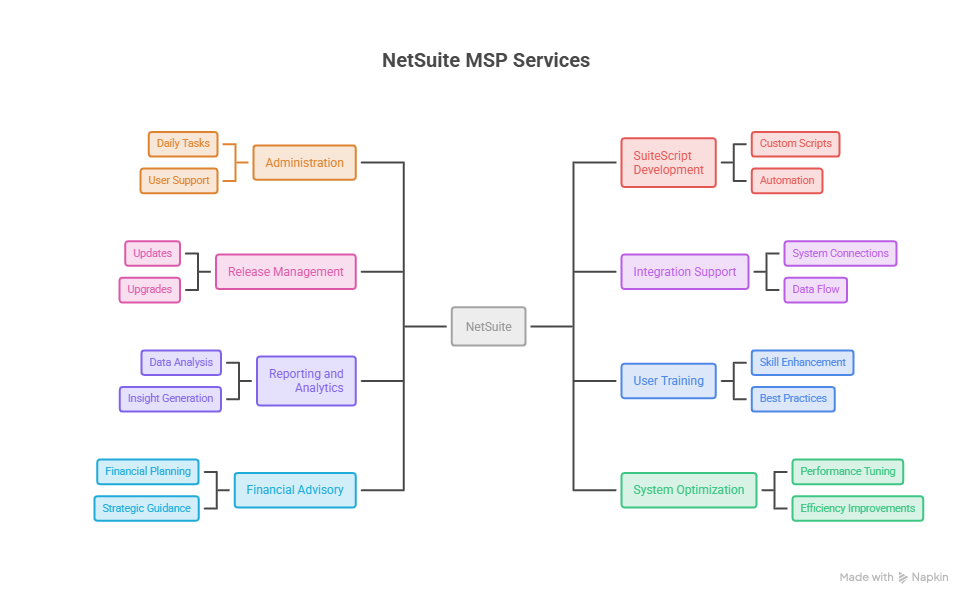
- NetSuite MSP services fall into eight categories. Administration, SuiteScript development, release management, integration support, reporting, training, financial advisory, and system optimization. The best providers cover all eight. Most basic plans cover only two or three.
- 75% of NetSuite value comes from continuous optimization, not initial setup. Yet most businesses only purchase support for break-fix and administration. The services that drive ROI are the ones left out of the cheapest plans.
- Release management is the most underdelivered service in the market. Every MSP lists it. Very few test your customizations before each update the way the job actually requires.
- Break-fix models cost 3 to 5 times more than proactive managed services. Reactive support is not cheaper. It just feels cheaper until something breaks at quarter-end.
- Top MSPs offer services specific to your industry and business model. An eCommerce business needs SuiteCommerce support and multi-channel inventory management. A manufacturer needs BOM support and production order management. Generic MSPs offer generic services.
We reviewed 12 NetSuite MSP proposals last year across various client evaluations. Every single one listed “system administration,” “ongoing support,” and “optimization” as core services.
What they did not list was what those words actually meant.
For one provider, “optimization” meant running a quarterly report review. For another, it meant a full monthly system health audit with documented recommendations, a prioritized improvement backlog, and tracked implementation. Same word. Completely different deliverable.
For one provider, “release management” meant forwarding the NetSuite release preview email with a note. For another, it meant six weeks of sandbox testing, conflict identification, and documented fixes before the release reached production. Same words. Completely different deliverable.
The difference is not visible in a proposal. It shows up when you ask the right questions, read the contract carefully, and call the references.
This blog covers every service category a top NetSuite MSP should offer, what each one involves at the operational level, which services are genuinely essential, and how to tell whether a provider actually delivers what they are describing.
The Eight Service Categories of a Top NetSuite MSP Services
Top NetSuite MSPs organize their work across eight functional areas. Understanding each one helps you evaluate proposals accurately and build a scope of work that covers what your business actually needs.
1. System Administration
Administration is the operational foundation of every managed services engagement. It covers the day-to-day work that keeps a NetSuite environment running correctly and aligned with how the business operates.
What top MSPs include:
| Administration Task | What It Involves |
|---|---|
| User management | Creating, deactivating, and auditing user accounts as staff changes occur |
| Role and permission management | Configuring role-based access, scoping permissions, auditing access levels |
| Workflow maintenance | Updating workflow logic when business processes change, troubleshooting failures |
| Saved search maintenance | Updating saved searches when record structures change, building new operational views |
| Module settings | Adjusting configuration as the business adds subsidiaries, entities, or product lines |
| Data quality management | Routine data audits, duplicate record management, import support |
For a detailed look at how roles and permissions work within a managed NetSuite environment, our guide on NetSuite roles and permissions covers the full configuration scope a managed services team handles daily.
What separates top from average: Average MSPs do administration on demand when a ticket arrives. Top MSPs run periodic access audits without being asked, flag stale user accounts, and keep permission structures aligned with how the business has actually evolved, not how it was set up during implementation.
2. SuiteScript Development and Customization
Most NetSuite environments have custom scripts. A managed services team that cannot develop in SuiteScript is limited to maintaining what is already there. When a script breaks or business logic needs to change, a team without scripting depth cannot fully resolve it.
What top MSPs include:
- Script troubleshooting: Diagnosing and fixing errors in SuiteScript 1.0 and 2.x scripts, including user event scripts, client scripts, scheduled scripts, and RESTlets
- Script modifications: Adjusting existing scripts to accommodate changes in record structure, business logic, or integration requirements
- New development: Building new SuiteScript functions, SuiteLets, workflow action scripts, and custom portlets within the monthly scope
- Workflow automation: Creating and maintaining SuiteFlow workflows, including condition logic, action sequences, and approval routing
- Custom records and fields: Adding custom fields, maintaining custom record types, updating form layouts
What separates top from average: Ask directly: does the consultant assigned to your account write SuiteScript, or do they escalate all scripting work to a separate developer? The answer determines how quickly script-related issues get resolved and whether minor changes require a separate project scope.
3. Release Management
NetSuite releases two major updates per year, plus monthly patches. Missed release preparation means missed value and sometimes broken functionality. Release management is how a top MSP protects your environment before each update, not after it.
What genuine release management involves, step by step:
- Sandbox environment setup: Configuring a sandbox that mirrors your production environment 6 to 8 weeks before the release date
- Custom element testing: Testing every custom script, workflow, saved search, and integration against the upcoming release in the sandbox
- Conflict identification: Documenting every issue found, what breaks, why it breaks, and what the fix requires
- Fix development and deployment: Building and testing fixes in the sandbox, then deploying to production before the live release
- Client communication: Delivering a release impact report showing what was tested, what conflicts were found, and what was fixed before the update goes live
What release notification looks like instead: An MSP forwards you the NetSuite release preview notes with a summary. If something breaks after the release goes live, you submit a ticket.
The test: Ask any MSP you are evaluating to describe their release management process step by step for a client with 15 custom scripts. A partner doing this systematically describes every step above with specific timing and deliverables. A partner doing release notification gives a reassuring answer that does not include the words “sandbox testing.”
4. Integration Support and Monitoring
Most NetSuite environments connect to at least one external system. eCommerce platforms, CRMs, EDI networks, 3PLs, payment processors, and shipping carriers are all common integration points. Each one is a potential failure point.
What top MSPs include:
- Active monitoring: Watching for integration failures in real time, not just responding when a user reports something broke
- Error resolution: Diagnosing and fixing failures whether the issue originates in NetSuite, the third-party platform, or the connector middleware
- Mapping maintenance: Updating field mappings and transformation logic when record structures or data formats change
- Performance monitoring: Identifying slow data flows before they cause backlogs or sync failures
- New integration scoping: Evaluating and scoping new integration requirements as the business adds platforms or changes vendors
What separates top from average: Average MSPs fix integrations when they break and a user notices. Top MSPs catch silent failures, data that flows but maps incorrectly, before they corrupt records that downstream financial processes depend on.
5. Reporting, Dashboards, and Analytics
Most businesses use a fraction of NetSuite’s reporting capabilities. The tools improve with every release, but adopting them requires someone actively reviewing what is available and applying it to your operation.
What top MSPs include:
- Saved search development: Building operational and financial saved searches for teams across the business
- Dashboard configuration: Setting up role-specific dashboards with relevant KPIs, portlets, and saved search results
- Report builder maintenance: Updating existing reports when business structure or reporting requirements change
- SuiteAnalytics Workbook: Building cross-module analytical workbooks for complex reporting needs
- Financial report packs: Maintaining income statements, balance sheets, management dashboards, and board reporting packs
- Custom KPI setup: Building transaction-level and business performance KPIs tailored to how leadership actually measures the business
What separates top from average: Most businesses have dashboards built during implementation that nobody uses anymore. A top MSP reviews reporting infrastructure periodically, identifies what is stale or unused, and rebuilds it to match how the business makes decisions today.
6. User Training and Onboarding
Staff turnover is constant. Every new hire who starts using NetSuite without proper training builds workarounds from day one. Those workarounds accumulate into operational debt that takes months to unwind.
What top MSPs include:
- New hire onboarding: Role-specific training covering the exact processes and workflows the new user will run
- Process documentation: Written standard operating procedures for how the business uses NetSuite for key workflows
- Feature adoption training: When new NetSuite features or modules are released, training existing users on how to apply them
- Power user development: Building internal NetSuite capability within the client team so dependence on the MSP decreases for routine tasks
What separates top from average: A top MSP with genuine knowledge of your environment trains new hires on your specific workflows, your edge cases, and your common mistakes, not on NetSuite in general. Generic training produces generic users who figure out the specifics on their own and build their own workarounds in the process.
For context on why ongoing training and support drive better user adoption than one-time implementation training, our blog on reasons to use NetSuite managed support after going live covers the operational situations where training support pays for itself.
7. Financial Advisory and Period Close Support
Some top MSPs combine NetSuite administration with accounting-level financial expertise. At providers like ScaleNorth, 57% of team members are CPAs, which gives clients access to both ERP and financial knowledge from the same team.
What top MSPs include:
- Period close support: Walking finance teams through month-end and quarter-end close, diagnosing anomalies, and confirming reports reconcile before sign-off
- Revenue recognition support: Maintaining NetSuite Revenue Management for businesses with ASC 606 requirements
- Multi-entity consolidation: Supporting intercompany elimination, currency translation, and subsidiary roll-up in OneWorld environments
- Financial report development: Building management packs, CFO dashboards, and board-level financial analysis views
- License optimization: Reviewing NetSuite license usage and recommending adjustments as the business changes
What separates top from average: One documented example: a managed services team reduced a client’s month-end close from 12 days to 4 days by automating reconciliation workflows and journal entries. That outcome requires a team that understands the financial process and the NetSuite configuration at the same depth. Most MSPs can fix a report. Fewer can design and automate the close process itself.
8. System Optimization and Health Reviews
Optimization is the service that separates a maintenance vendor from a strategic partner. A maintenance MSP keeps the system working as configured. An optimization partner makes it better over time.
75% of NetSuite value comes from continuous optimization, not initial setup. Most businesses capture a fraction of their NetSuite ROI because nobody systematically identifies what has not been configured, what has been misconfigured, and what new functionality applies to their operation.
What top MSPs include:
- Monthly system health reviews: Structured audits that surface technical debt, underused features, broken configurations, and improvement opportunities
- Process improvement recommendations: Identifying manual processes that could be automated and reporting that could be improved
- New feature adoption guidance: When NetSuite releases new functionality, evaluating which features apply to your business
- Performance tuning: Identifying and resolving saved searches, workflows, or scripts that have degraded over time
- Strategic roadmap input: Recommending modules, integrations, or configuration changes that would deliver material operational improvement
What separates top from average: The monthly check-in call is either a status update or a working session. That difference compounds significantly over a 12 to 24-month engagement.
Services by Business Type: What You Actually Need
Not every business needs the same MSP services at the same depth.
| Business Type | Essential Services | Nice-to-Have |
|---|---|---|
| Manufacturing and Distribution | SuiteScript development, EDI/3PL integration monitoring, release management, system optimization | Financial advisory for landed costs, multi-entity consolidation |
| eCommerce and Retail | Integration monitoring (Shopify/Amazon), SuiteCommerce support, reporting, release management | Google Analytics and GTM support, custom pricing logic |
| Multi-Entity and International | Financial advisory and consolidation support, administration, release management, reporting | Compliance support, license management across subsidiaries |
| Professional Services and SaaS | Reporting and dashboards, revenue recognition, user training, integration support (Salesforce/HubSpot) | OpenAir integration, advanced billing configuration |
For guidance on what a well-structured managed services engagement costs across different service scopes, our guide on NetSuite managed services cost and pricing covers the pricing variables in detail.
What Is Not Typically Included in MSP Services
Understanding what falls outside standard managed services scope prevents billing surprises.
Most MSPs do not include in standard monthly scope:
- Full implementation of new modules: Adding WMS, SuiteCommerce, or Advanced Manufacturing is scoped as a separate project
- Large-scale data migration: Moving data from a legacy system to NetSuite is project work, not managed services
- Net-new integration development from scratch: Maintaining existing integrations is typically in scope. Building a new one from nothing usually is not.
- Major business process redesign: Restructuring how a process works in NetSuite goes beyond maintenance and requires a separate engagement
Knowing these boundaries protects you from scope disputes. A well-written contract defines exclusions specifically.
For businesses transitioning between MSP arrangements, our blog on best practices for NetSuite data migration covers how to protect data integrity through any significant system change.
Emerging Services: What Top MSPs Are Adding 2026
The service landscape is changing. Top MSPs are adding capabilities that were not standard two years ago.
AI-assisted health monitoring: Some MSPs now use AI tools to scan NetSuite environments for performance anomalies, deprecated API usage, and configuration drift. AI-powered monitoring is moving from differentiator to expectation for enterprise-tier clients.
Automated release testing: Rather than manual sandbox testing, top MSPs are building automated test suites that run against each release and flag conflicts systematically. This covers more ground in less time and produces documented test results as a client deliverable.
License and cost optimization: As NetSuite pricing complexity grows, MSPs are including periodic license audits that identify unused modules and opportunities to right-size license spend.
NetSuite AI feature adoption: NetSuite’s own AI capabilities, including AI-powered forecasting, anomaly detection, and narrative reporting, require configuration and adoption guidance. Top MSPs now include evaluation and implementation of these features as part of optimization scope.
How Folio3 Managed Services Covers All Eight Categories
Folio3’s SmartCare managed services program covers all eight service categories under one fixed monthly fee.
| Service Category | SmartCare Scope |
|---|---|
| System Administration | User management, role and permission configuration, workflow maintenance, module settings, data quality |
| SuiteScript Development | Script troubleshooting, modifications, new development within scope, workflow automation |
| Release Management | Sandbox testing begins 6 weeks before each release, all custom elements tested, conflict report delivered before go-live |
| Integration Support | Active monitoring, error resolution, mapping maintenance, new integration scoping |
| Reporting and Analytics | Saved search development, dashboard configuration, financial report maintenance, KPI setup |
| User Training | New hire onboarding, role-specific training, process documentation, feature adoption |
| Financial Advisory | Period close support, revenue recognition, multi-entity consolidation, license review |
| System Optimization | Monthly system health reviews, improvement recommendations, new feature adoption guidance |
For the full SmartCare scope, SLA structure, and how to get started, our NetSuite managed services page covers the program in detail.
Schedule a Demo today!
Final Thoughts
Every MSP proposal lists the same services. The difference between proposals is not visible in the service names. It shows up in what those services involve when someone is actually doing the work.
Release management that means sandbox testing every custom element is a different product from release management that means forwarding the release notes. Optimization that means a documented monthly system health audit is a different product from optimization that means a quarterly phone call.
The businesses that get the most from their MSP relationships are the ones who go into evaluation knowing what these services should look like operationally, not just what they are called.
FAQs
What services do NetSuite managed services providers offer?
Top NetSuite MSPs cover eight categories: system administration, SuiteScript development, release management, integration support and monitoring, reporting and analytics, user training, financial advisory, and system optimization. Basic plans typically only cover administration and break-fix support. The services that drive the most long-term ROI, optimization and release management, are the ones most commonly excluded from entry-level plans.
What is the difference between basic and full-service NetSuite MSP plans?
Basic plans cover user management, ticket-based break-fix support, and limited reporting. Full-service plans add SuiteScript development, structured release management with sandbox testing, active integration monitoring, proactive system health reviews, and optimization guidance. The cost difference is typically $2,000 to $5,000 per month. The outcome difference over 12 months is significant.
Do NetSuite MSPs handle SuiteScript development?
Top MSPs include SuiteScript development in their scope. This covers troubleshooting broken scripts, modifying existing scripts, and building new SuiteScript functions within the monthly allocation. Not all MSPs have certified SuiteScript developers on their account teams. Ask specifically whether the consultant assigned to your account can write and debug SuiteScript, not just configure the functional side.
What NetSuite MSP services do I actually need for my business?
It depends on your business type. Manufacturing and distribution businesses prioritize SuiteScript development, EDI integration monitoring, and release management. eCommerce businesses prioritize integration monitoring, SuiteCommerce support, and multi-channel reporting. Multi-entity businesses prioritize financial advisory, consolidation support, and administration. Professional services firms prioritize reporting, revenue recognition, and user training.
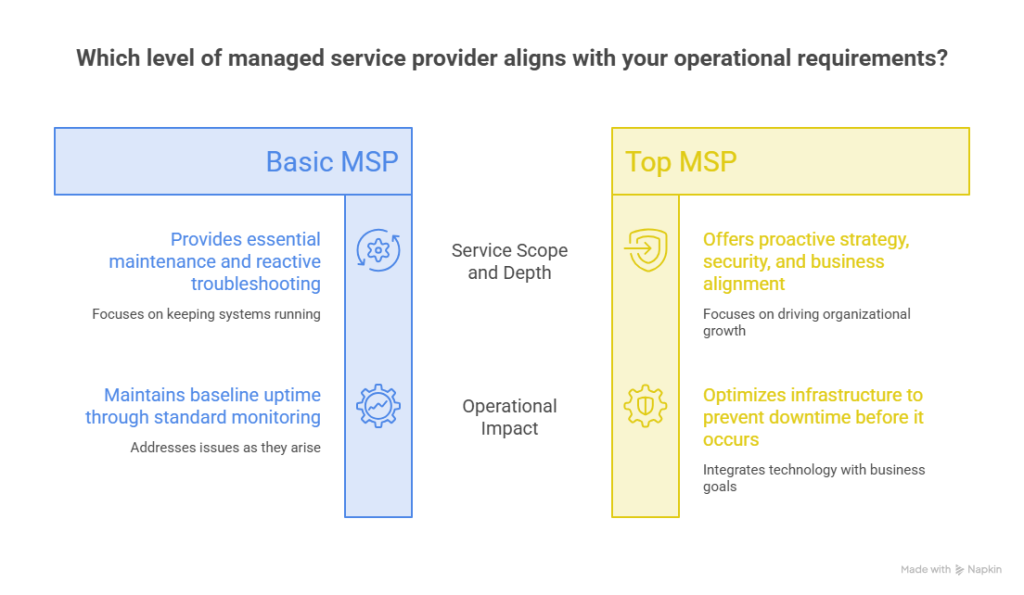
How do top NetSuite MSPs differ from basic support providers?
Top MSPs are proactive. Their release management involves actual sandbox testing, not release notes forwarding. Their optimization service involves documented monthly system health reviews. They assign named consultants who build genuine knowledge of your system over time. Their pricing is fixed-fee, which aligns their interests with yours.
What is not typically included in a NetSuite managed services plan?
Standard MSP plans typically exclude full implementation of new modules, large-scale data migration from legacy systems, net-new integration development from scratch, and major business process redesign. These are usually scoped as separate project engagements. A well-written contract defines these exclusions specifically.