

Key Takeaways
- Hypercare is short-term post-go-live support focused on stabilizing your NetSuite environment, resolving early issues, and helping users adjust to new workflows.
- Managed services provide ongoing NetSuite support covering system monitoring, troubleshooting, optimization, enhancements, and day-to-day administration.
- Choose Hypercare when your priority is a stable go-live, while Managed Services makes more sense when you need continuous support after the initial implementation period.
- Many businesses use both at different stages. They start with Hypercare after go-live and move to Managed Services once the system is stable.
Hypercare is short, intense, and reactive by design, built for the first 30 days after launch. This is the stage where emerging critical issues could break business operations.
On the other hand, managed services are sustained, proactive, and built to run for years.
Confusing the two, or trying to make one do the other’s job, is how businesses end up either overpaying for intensity they don’t need anymore or underprepared for problems a short engagement was never built to catch.
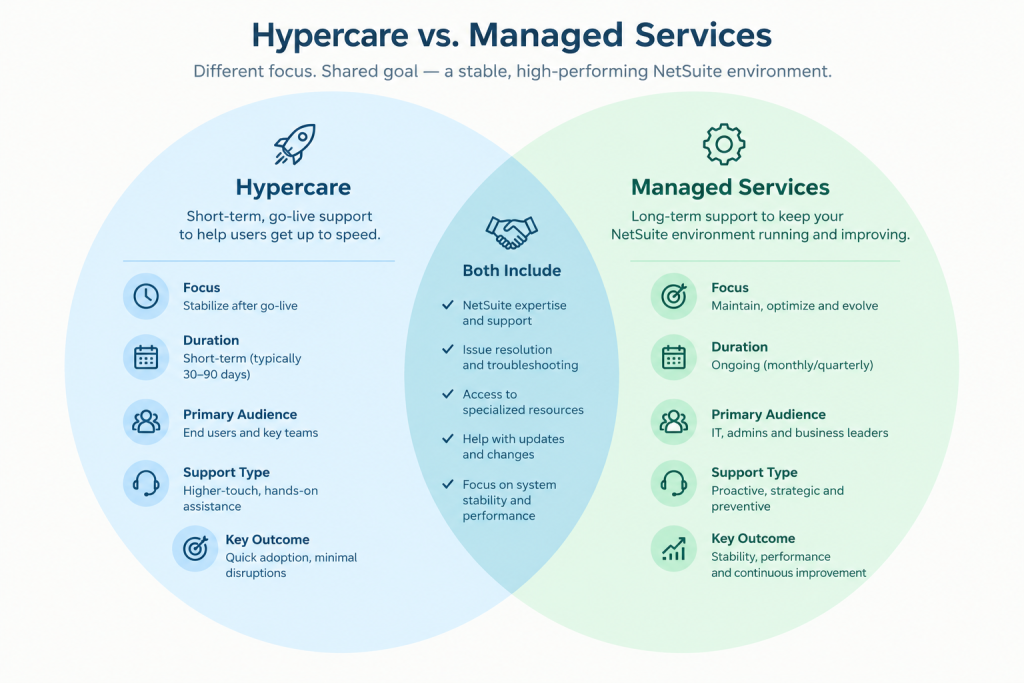
This blog covers exactly what each model is, how they differ in duration, scope, and cost, and which one, or which sequence of both, fits a given business.
What Is NetSuite Hypercare?
Hypercare is intensive, on-call support delivered immediately after go-live for 30 days. It exists to catch business-critical issues before they become business-threatening ones, during the exact window when a system is meeting transaction volume and users for the first time.
The scope is deliberately narrow and urgent. A shipping delay that has to be resolved within 24 hours, a workflow that breaks during the first invoice run, a login issue locking out an entire department, these are hypercare problems.
Non-critical adjustments, a report format that needs tweaking, or a role permission that could wait until next week don’t belong in hypercare.
Mixing urgent and non-urgent work into the same engagement is what makes hypercare expensive and unfocused when it isn’t scoped tightly.
What Is NetSuite Managed Services?
NetSuite Managed Services is an ongoing partnership, typically running for months to years, where a team stays accountable for keeping the system running well. This is sort of a proactive approach since the NetSuite managed services partner doesn’t wait for your ERP system to break. The goal here is the prevention of disruption rather than treating it.
The scope includes system administration, SuiteScript development, report building, integration monitoring, user training, and testing for NetSuite’s twice-yearly releases. For a closer look at what to expect from a managed services relationship, see our guide on choosing a NetSuite managed services provider.
A managed services team watches for what’s about to become a problem, not only what’s already broken, testing customizations against the next release before it ships and making optimization recommendations as the business itself changes shape.
How Do Hypercare and Managed Services Differ?
Below are some of the key differentiators for NetSuite hypercare vs. NetSuite managed services.
| Hypercare | Managed Services | |
|---|---|---|
| Duration | 30 days | Months to years, open-ended |
| Purpose | Urgent triage during initial go-live | Ongoing optimization and system health |
| Typical trigger | Go-live itself | Post-stabilization, or a standing need for accountable support |
| Scope | Business-critical issues only | Administration, scripting, reporting, integrations, training, release management |
| Team structure | On-call, intensive availability | Named consultant or team, retained relationship |
| Cost model | Priority hourly or short fixed engagement | Monthly retainer, outcome-based |
The single clearest signal for telling them apart in practice is the time horizon. If the question is “how do we get through the next two weeks without this launch collapsing,” that’s hypercare. If the question is “who’s responsible for this system a year from now,” that’s managed services.
What Does Hypercare vs Managed Services Cost?
The price depends on how much support you need and how long you need it. Ad-hoc support is around $150 to $250 per hour, while fixed monthly retainers range from $2,000 to $8,000. Full managed services are listed at around $3,000 to $12,000 per month.
And mind you, these figures are indicative ranges. NetSuite support costs vary based on your system complexity, number of users, integrations, customization, support hours, response requirements, and the scope of services included in the agreement.
Hypercare is priced differently because it covers a defined period after go-live. The cost depends on how much support your team needs during stabilization, the complexity of the implementation, and the level of coverage included in the engagement.
When comparing quotes, look at what the price includes. Response times, support hours, technical resources, monitoring, development work, and release testing can all affect the final cost.
For a detailed cost breakdown, take a look at our pricing tiers and choose the most suitable one for your business.
Can a Business Use Both?
Yes, and for most businesses coming off a NetSuite go-live, that’s the more common pattern than choosing one permanently. That handoff point matters. The 15 issues that typically surface after go-live are a useful marker for it. Once the business-critical version of those issues has been triaged through hypercare, dependency mapping, permission cleanup, and configuration governance is the ongoing work managed services is built to handle.
Dropping straight from go-live into a standard support ticket queue with no hypercare bridge is how the urgent issues in that first window get missed.
Planning the Handoff From Hypercare to Managed Services
If you’re heading into a go-live and aren’t sure which one you need right now, that’s exactly the conversation worth having before launch, not during it. Folio3’s NetSuite support services team can help figure out where your specific timeline sits.
FAQs
How long does NetSuite hypercare typically last?
Usually for 30 days. It’s scoped around the highest-risk window right after go-live, and the intensity is meant to reduce once that window closes.
Is managed services more expensive than hypercare?
Hypercare is typically a short, intensive support period with higher concentrated costs, while managed services distributes support costs over a longer period through predictable monthly fees. Once the initial post-go-live risk period has passed, managed services can provide a more cost-efficient approach for ongoing NetSuite support.
Can a business skip hypercare and go straight to managed services?
No, not at all. Our NetSuite support experts strongly recommend against skipping the hypercare stage. The first weeks after go-live are critical for identifying and resolving business-impacting issues quickly, and handling these issues as routine support tickets can delay resolution when operations are still stabilizing.
Does every NetSuite implementation need hypercare?
Not every NetSuite implementation requires the same level of hypercare, but higher-risk go-lives generally benefit from a dedicated post-launch support period. This is particularly important for first-time implementations, major module rollouts, business-critical process migrations, and environments where multiple systems or teams must work together from day one.
High-growth businesses may need hypercare as they rapidly scale operations, add new workflows, or increase transaction volumes. Mid-market companies expanding internationally or adding new subsidiaries can also face additional risk as they introduce new entities, currencies, tax requirements, locations, and intercompany processes.
Large enterprises with global operations and complex integrations may have an even broader range of dependencies to monitor after go-live. Issues involving ecommerce, CRM, WMS, payroll, payment platforms, EDI, third-party applications, or custom integrations can affect multiple business functions if they are not identified and resolved quickly.
How do you know when hypercare should transition into managed services?
When the volume of business-critical, urgent issues drops off and what’s left is more routine, such as configuration governance, dependency mapping, and ongoing optimization. That’s the signal the system has stabilized enough to move into a managed services rhythm.
