Key Takeaways
- The automotive ERP market reached $815 million in 2024 and is projected to hit $1.22 billion by 2031. More businesses are moving off disconnected systems, and the ones that move faster are winning on margin and customer experience.
- Automotive businesses need an ERP that handles fitment data, VIN tracking, high-volume SKU management, JIT inventory, and multi-channel orders natively. Generic platforms miss most of these out of the box.
- NetSuite is the most deployed cloud ERP for mid-market automotive and auto parts businesses, covering inventory, financials, ecommerce, and WMS on one platform.
- Real implementations of ERP software autoparts show that replacing disconnected systems eliminates manual data entry and unifies ecommerce, warehouse, and finance operations.
- Platform selection must match your business model. OEM manufacturers and aftermarket distributors have fundamentally different requirements. Choosing the wrong one costs more to fix than to get right the first time.
We worked with an auto parts distributor a couple of years ago that was managing 320,000 SKUs across five separate systems. QuickBooks for accounting. Salesforce for CRM. Deposco for the warehouse. Magento for the webstore. Zendesk for customer support.
On paper, each system was doing its job. In practice, every order that came in touched all five. Someone on their team was moving data manually between them every single day. Inventory in the webstore did not update in real time. Customer service had no visibility into order status without logging into three different tabs.
When we asked the operations manager how long it took to close the books each month, he laughed. Not because it was a short answer.
After implementing NetSuite with a fully integrated Magento connector and WMS, the manual data movement stopped. Orders flowed automatically from the webstore into NetSuite. Inventory updated in real time. The warehouse team worked from directed picks, not paper lists. Finance had a live view of the business.
That is not an unusual story. We see a version of it in almost every automotive ERP evaluation we do. The tools in use are fine individually. But they were never designed to talk to each other at the speed automotive operations actually run.
This guide covers what to look for when you’re selecting an Automotive ERP, which platforms are worth evaluating, and how NetSuite addresses the gaps that hold automotive businesses back.
Why Does Standard ERP Fall Short for Automotive Operations?
This is the question worth sitting with before you look at any platform. Most ERP systems were designed for businesses that sell a manageable number of products with stable specifications. Automotive is the opposite.
A distributor carrying wheels, rims, and tyre packages may manage 300,000 or more active item records. Each one needs fitment data showing compatible vehicle makes, models, and years. That data must be accurate across inventory, sales, and purchasing simultaneously. One wrong mapping means a customer orders a part that does not fit their car. That is a return, a service call, and a damaged reputation.
Here is where standard platforms consistently fall short.
1. The Scale of the Automotive Parts Data Problem
According to Statista, Global vehicle production reached 92.5 million units, with each vehicle containing 30,000-plus components sourced from multi-tier supplier networks. Aftermarket catalogues must account for multiple vehicle generations across dozens of manufacturers.
Parts supersession chains require tracking when old part numbers are replaced by new ones. A customer searching for a part number that was superseded three years ago needs to land on the correct current item. No spreadsheet manages this at scale. Most entry-level ERP platforms do not either.
2. Just-in-Time Pressure Without the Right Tools
Just-in-time has been the standard model in automotive for decades. Inventory is ordered as close to the point of need as possible to reduce holding costs. The margin in automotive parts distribution is thin. Carrying the wrong stock for too long erodes it quickly.
An ERP without demand-driven reordering creates consistent overstock or stockout cycles. We see this pattern regularly in distributors running basic inventory tools. Fast-moving parts go out of stock. Slow-moving parts pile up in the warehouse. Neither problem is obvious until it shows up in a financial report that arrives too late to act on.
Supplier lead time management and real-time multi-location visibility are requirements in this environment and shouldn’t be considered optional.
3. Multi-Channel Complexity Gets Expensive Fast
Modern automotive parts businesses sell through ecommerce, wholesale accounts, third-party marketplaces, and retail simultaneously. Each channel has different pricing rules, availability displays, and fulfilment requirements.
Every channel added to a disconnected system increases manual reconciliation. Overselling happens when inventory updates lag between a webstore and a warehouse system. Stockout errors happen when a marketplace order commits stock that was already allocated elsewhere.
Managing channels from a single inventory record with channel-specific rules applied automatically is a core requirement. Platforms without unified inventory allocation push the reconciliation work onto your team.
| Automotive Requirement | Why Generic ERP Struggles |
|---|---|
| Fitment data (ACES/PIES) | No native fitment schema — requires third-party add-ons |
| Parts supersession tracking | Single item records with no supersession chain logic |
| 300,000+ SKU management | Performance degrades at scale |
| VIN decoding and vehicle lookup | Not a standard ERP feature |
| JIT replenishment | Demand planning too basic for automotive velocity |
| Multi-channel order management | Separate systems required per channel |
What Should You Look for in Automotive ERP Software?
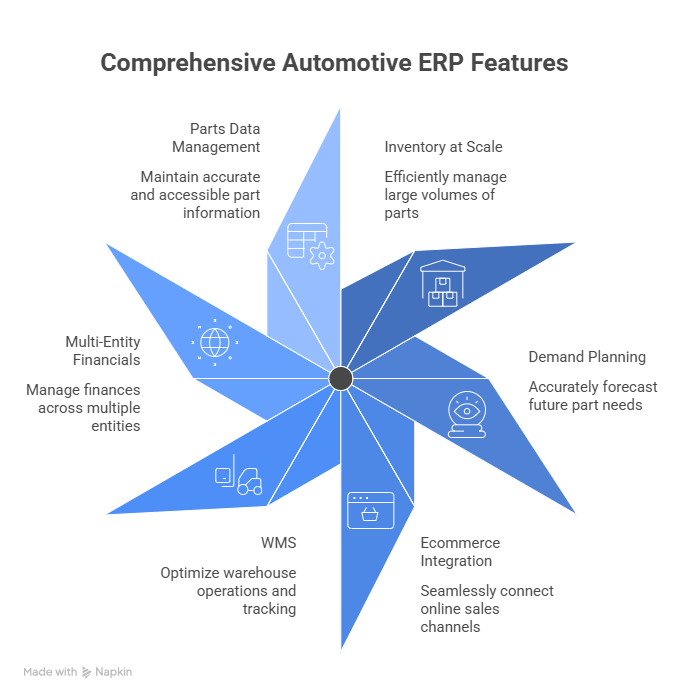
Before you evaluate specific platforms, define what an auto parts ERP system needs to do in practical terms. The features below separate platforms that work for automotive from those that require workarounds within the first year.
These are not features we picked from a vendor’s marketing page. They are the capabilities that come up in every automotive ERP scoping conversation we have.
Inventory Management at Scale
Automotive parts distributors need inventory management that handles hundreds of thousands of SKUs without the system slowing down.
- Bin-level warehouse tracking across multiple locations
- Real-time availability with cycle counting workflows
- Lot and serial number tracking for regulated or high-value components
- Accurate landed cost allocation for imported parts covering freight, duty, and handling
Demand Planning and Replenishment
Demand planning for auto parts is driven by seasonal patterns, vehicle population data, and supersession effects.
Reorder suggestions need to account for velocity, safety stock, and supplier lead times simultaneously. Without this, overstock and stockout cycles become a fixture of the operation. This process must work at the SKU level across a catalogue of 100,000-plus items.
Ecommerce Integration
An automotive ecommerce operation needs bidirectional synchronisation between the webstore and ERP. Any lag creates overselling, incorrect availability, and manual intervention.
Orders should flow from the webstore automatically. Inventory levels should update in real time across the webstore and warehouse. Customer and shipping data should stay consistent without manual syncing. When we built the Magento connector for AutoRimShop, eliminating that sync lag was the single change with the most immediate operational impact.
Warehouse Management
Automotive parts warehouses handle high volumes of small, visually similar items. A barcode scan at the wrong bin costs more than one pick error; it creates customer service calls and returns downstream.
- Directed putaway and optimised pick paths reduce pick errors on visually similar parts
- Barcode scanning at receipt, transfer, and dispatch keeps records accurate
- 3PL integration keeps inventory records accurate without manual count reconciliation
Multi-Entity Financial Management
Automotive groups with multiple brands, distribution entities, or regional subsidiaries need financials that consolidate automatically.
Intercompany billing and eliminations should be handled natively. Multi-currency operations across sourcing, manufacturing, and sales entities are standard for any business with international supplier relationships. Consolidated reporting should be available in real time, not after a manual close that takes two weeks every month.
Which ERP Platforms Are Worth Evaluating for Automotive Businesses?
The automotive ERP market spans platforms built for OEM manufacturing, platforms adapted for automotive from general manufacturing, and cloud ERPs suited to aftermarket distribution and multi-channel retail. The right choice depends on your business model.
Here is an honest breakdown of the main options.
1. SAP S/4HANA and SAP Business One – Best for Enterprise OEMs
SAP S/4HANA is the enterprise choice for large OEMs and Tier 1 suppliers with deep manufacturing needs and global trade compliance requirements.
S/4HANA handles complex production environments well. The implementation complexity and cost make it a poor fit for most mid-market businesses. Business One is more accessible for smaller automotive businesses but requires add-ons for high-SKU catalogues and ecommerce.
Best for: enterprise OEMs (S/4HANA), small single-entity automotive businesses (Business One)
2. Oracle NetSuite (Configured by Folio3) – Best for Mid-Market Aftermarket Distributors
NetSuite is the most widely deployed cloud ERP for mid-market automotive parts distributors and aftermarket businesses. The reason is practical. It handles inventory, order management, warehouse operations, demand planning, and financials in one system without middleware holding it together.
For an aftermarket distributor managing ecommerce, wholesale, and warehouse operations simultaneously, that unified architecture eliminates the data synchronisation failures that come with running five or six disconnected systems.
- Native multi-location inventory, demand planning, WMS, and multi-entity financials
- SuiteCommerce connects the consumer-facing store directly to the same inventory record
- Fitment data management requires an integration with an ACES/PIES provider, well-supported through the SuiteApp ecosystem
Best for: aftermarket distributors, multi-channel auto parts retailers, and multi-entity automotive groups.
3. Microsoft Dynamics 365 – Best for Microsoft-Ecosystem Automotive Businesses
Dynamics 365 Finance and Supply Chain Management handles multi-entity financials and complex supply chains well, particularly within a Microsoft ecosystem.
Aftermarket ecommerce and high-volume parts catalogue management requires ISV extensions. For businesses already invested heavily in Microsoft infrastructure, this is worth evaluating. For businesses without that foundation, the setup effort rarely justifies the outcome for mid-market automotive operations.
Best for: mid to enterprise businesses already operating within the Microsoft stack
4. Infor CloudSuite Automotive – Best for Large OEMs and Tier 1 Suppliers
Infor is built for automotive OEMs and Tier 1 suppliers. Native MMOG/LE compliance, APQP processes, and automotive-specific production scheduling make it the right fit for production-intensive environments.
It exceeds the requirements for most aftermarket distributors. The cost reflects OEM-level depth, which means it is not the right fit for a mid-market parts distribution business.
Best for: large OEMs and Tier 1 suppliers in Honda, BMW, or Porsche ecosystems
5. QAD Adaptive ERP – Best for Toyota and Ford Supplier Ecosystems
QAD has strong automotive vertical coverage, particularly for Toyota and Ford supplier ecosystems. It is well-suited for last-mile S&OP and compliance in OEM supply chains.
It is not suited for aftermarket distribution or multi-channel retail. If your business sits in a Toyota or Ford supply chain and compliance is the primary driver, QAD belongs on your shortlist.
Best for: OEM and Tier 1 manufacturers in Toyota and Ford supply chains
| Platform | Best Fit | Aftermarket Strength |
|---|---|---|
| Oracle NetSuite | Mid-market distributors, multi-channel | Strong |
| SAP S/4HANA | Enterprise OEMs, Tier 1 suppliers | Limited without add-ons |
| SAP Business One | Small automotive businesses | Moderate with add-ons |
| Microsoft Dynamics 365 | Mid to enterprise, Microsoft ecosystem | Moderate, needs ISV |
| Infor CloudSuite Automotive | Large OEMs, Tier 1 suppliers | Over-specified for aftermarket |
| QAD Adaptive ERP | Toyota/Ford ecosystem OEMs | Limited for distribution |
| Acumatica | Small to mid, flexible budget | Moderate with add-ons |
How Does NetSuite Address Automotive ERP Requirements?
NetSuite’s advantage for automotive businesses is not a single feature. It is the combination of inventory management, order management, warehouse operations, demand planning, and financials in one system.
When we configure NetSuite for an automotive client, the first thing we focus on is where data is currently breaking between systems. In almost every case, the answer is the same: inventory availability is not real-time, orders require manual intervention to move between systems, and financial reporting is always a week behind operations. NetSuite addresses all three at the architecture level.
Inventory Management for High-Volume Parts Catalogues
- Handles large item catalogues with bin-level tracking and multi-location visibility
- Lot and serial number tracking without performance issues at scale
- FIFO, LIFO, and average cost valuation configurable at the item level
- Landed cost allocation covers freight, duty, and handling across received purchase orders
Demand Planning for Parts Distribution
- Generates replenishment suggestions based on historical velocity, safety stock, and lead times
- Prevents manual reordering that creates overstock on slow-moving parts and stockouts on fast-moving parts
- Operates at SKU level across catalogues with hundreds of thousands of items
WMS for Automotive Warehouses
- Directed putaway and optimised pick paths reduce pick errors on visually similar parts
- Barcode scanning at every transaction point keeps records accurate in real time
- Reduces the customer service cost of incorrect shipments at scale
For a full breakdown of how Folio3 configures NetSuite for automotive businesses, our NetSuite for auto parts and motorsport page covers the specific modules, integrations, and configuration approaches used across automotive implementations.
What Do Real Automotive ERP Implementations Actually Look Like?
We include these not to sell you on a specific outcome, but because the details of what went wrong before and what changed after are more useful than any feature list.
How AutoRimShop Unified 5 Disconnected Systems on One Platform
AutoRimShop, one of the largest one-stop shops for OEM factory wheels, centre caps, and TPMS sensors in the US, ran five disconnected systems: QuickBooks, Salesforce, Deposco, Magento 2, and Zendesk.
Every order required manual data movement between systems. Inventory synchronisation between the webstore and warehouse was not real-time. Customer service had zero visibility into ERP order status without opening multiple applications.
The problem was not the systems themselves. Each one worked. The problem was that they were never designed to share data at the speed the business needed.
Folio3 implemented NetSuite SuiteSuccess Manufacturing Standard with WMS, Demand Planning, Rebate Management, and Folio3’s Magento 2 and Zendesk connectors.
- Fully integrated platform supporting 100,000 customers and 320,000 items
- Automated order flow from Magento to NetSuite, no manual entry
- Real-time inventory synchronisation across the webstore and the warehouse
- Integrated customer service case management connected directly to order records
Read the AutoRimShop case study to see how the integration architecture of the automotive parts ERP system was structured and what the go-live process looked like.

How Ramy Automotive Consolidated Scattered Data Into a Single Source of Truth
Ramy Technologies was operating with scattered sales and order data across multiple systems. No consolidated view existed. Reporting was manual, slow, and frequently inaccurate. Management was making operational decisions based on data that was days old by the time it was compiled.
Folio3 implemented NetSuite to bring together the scattered data, creating one source of truth for sales and order information across the entire business.
- Single system for all sales and order data, no more reconciliation across platforms
- Real-time operational visibility for management
- Manual data movement between systems has been eliminated entirely
The operational change that mattered most to Ramy’s management team was not a specific feature. It was seeing accurate data the moment they opened a dashboard rather than waiting for a report to be compiled manually.
How Do You Choose the Right ERP for Your Automotive Business?
Selecting the wrong ERP for an automotive business is expensive to fix. The questions below help determine whether a platform fits your specific operating model, not just a generic automotive profile.
We use these in every scoping conversation we have with automotive clients before recommending a platform.
Are You a Manufacturer, Distributor, or Both?
This is the most important question to answer first. Manufacturers need production management, BOMs, routing, and compliance capabilities. Distributors need high-volume inventory management, demand planning, and ecommerce integration. Businesses doing both need a single platform that handles both without separate systems for each function.
Getting this wrong at the start means buying a platform built for the wrong business model. The cost of fixing it mid-implementation is significantly higher than getting it right from the beginning.
What Is Your SKU Volume and Growth Trajectory?
- 5,000 active SKUs: most mid-tier systems will serve you adequately
- 100,000 to 300,000 SKUs: validate platform performance at that scale before committing
- Performance degradation at scale is a real failure mode in automotive parts ERP, ask every vendor for customer references at your SKU volume
Which Channels Do You Sell Through?
Every channel added to a disconnected system increases manual reconciliation work. Unified inventory allocation with channel-specific rules is a firm requirement for omnichannel operations. Overselling is a direct result of inventory records that do not update in real time across channels.
| Business Type | Recommended Platform |
|---|---|
| OEM manufacturer / Tier 1 supplier | Infor CloudSuite Automotive or SAP S/4HANA |
| Mid-market aftermarket distributor | Oracle NetSuite with WMS and Demand Planning |
| Multi-channel auto parts retailer | Oracle NetSuite with SuiteCommerce |
| Small parts retailer or workshop | SAP Business One or Acumatica |
| Multi-entity automotive group | Oracle NetSuite (multi-entity native) |

Final Thoughts
The automotive and auto parts industry operates at a level of complexity that most ERP platforms were not designed to handle. High SKU volumes, fitment requirements, JIT supply chains, and multi-channel sales demand a platform configured for these realities.
We have seen what happens when businesses try to manage this complexity with the wrong tools. Manual data entry fills the gaps. Errors compound. Reporting arrives too late. The business grows despite the system, not because of it.
For mid-market automotive businesses, NetSuite, with the right implementation partner, closes that gap. If you are evaluating an automotive parts ERP system for your business, reach out to the Folio3 team for a scoped implementation plan built around your specific operation.
FAQs
What is the best ERP for automotive industry businesses?
For mid-market aftermarket distributors and multi-channel auto parts businesses, Oracle NetSuite is the most practical choice. For large OEM manufacturers and Tier 1 suppliers, Infor CloudSuite Automotive and SAP S/4HANA lead the category. The right answer depends on whether you manufacture, distribute, or both.
What are the key features of automotive ERP software?
Core features include high-volume SKU management, fitment data support, JIT replenishment, demand planning, multi-location WMS, ecommerce integration, parts supersession tracking, and multi-entity financial management.
Can NetSuite handle automotive parts distribution at scale?
Yes. AutoRimShop runs 320,000 items and 100,000 customers on NetSuite with real-time Magento synchronisation and integrated WMS. NetSuite’s inventory module handles large catalogues without performance issues when configured correctly.
How long does an automotive ERP implementation take?
A mid-market automotive distributor implementation typically takes four to six months for inventory, order management, financials, and ecommerce integration. Multi-entity or complex WMS configurations extend the timeline.
What is ACES/PIES, and does NetSuite support it?
ACES and PIES are industry standards for fitment and product data in the automotive aftermarket. NetSuite does not carry native ACES/PIES management but supports integrations with fitment data providers through the SuiteApp ecosystem and custom connectors.