These frequently asked questions (FAQs) are for businesses implementing the Folio3 Magento-NetSuite Connector to integrate their e-commerce operations with their financial and inventory backbone. They are designed to clarify how the connector synchronizes data, manages workflows, and ensures reliability between the two platforms. This guide helps ensure a seamless and scalable connection that supports growth and operational integrity for your brand.
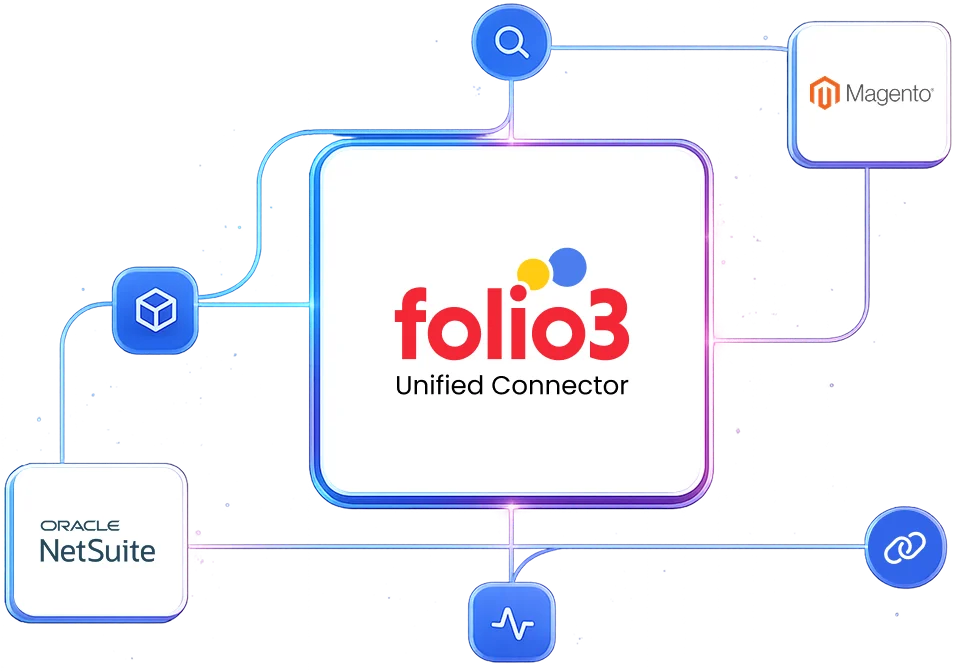
Yes, it works well for the majority of mid-market to enterprise businesses. The Folio3 Magento-NetSuite connector is built specifically for this integration pattern. The connector handles the core bi-directional sync reliably.
NetSuite should unequivocally be the system of record for Financials, Inventory (Quantity on Hand), and Master Product Data.
Magento is the source of truth for the customer-facing experience (product descriptions, rich media, UX) and the shopping cart.
The Folio3 connector is configured to respect this hierarchy as it pushes updates from NetSuite to Magento for critical data and pulls transactional data (orders, returns) from Magento into NetSuite.
Not if your business has outgrown basic accounting software. The “heaviness” is a benefit, not a drawback, when you need centralized financial control, multi-subsidiary/multi-currency management, complex inventory across locations, and sophisticated order management.
If you are a single-store, single-currency startup with simple inventory, it might be overkill. But for scaling businesses, NetSuite provides the necessary backbone.
The Magento-NetSuite integration makes sense at any volume where the complexity of your operations justifies it, not just order count. Common thresholds are:
It is a very common and proven architecture for scaling e-commerce businesses. Companies with hundreds of millions in revenue use this pattern. The key to scalability is a well-implemented connector like that of Folio3 with proper architecture, error handling, and monitoring.
The following data flows between NetSuite and Magento:
No. The integration is a data synchronizer. It does not perform any data validation or data cleansing operations. The customer must ensure that data input in one system meets the requirements of the other system. Efforts required to debug data-related errors caused by incorrect data input will be charged separately.
No. Syncing of historical data from NetSuite to the other system or vice versa is out of scope. The connector starts syncing data from the point of deployment forward.
Folio3’s connector typically supports multiple sync models: scheduled polls (e.g., every 15 minutes), event-driven pushes from NetSuite (using SuiteScript), or a hybrid. For high-velocity items, near-real-time (within 1-2 minutes) is achievable but requires careful architecture. True, sub-second real-time is impractical and usually unnecessary.
The Folio3 Magento-NetSuite connector includes inventory reservation mechanisms to prevent this. When an order is placed in Magento, the connector can immediately send a “preliminary” update to NetSuite to reserve inventory (often creating a Sales Order), reducing available quantity. The sync lag risk is mitigated, not eliminated. Properly configured safety stock levels in Magento provide an additional buffer.
Yes, this is a core strength. The Folio3 connector can map multiple Magento stores (websites) to different NetSuite subsidiaries, price lists, warehouses, or classification hierarchies. Each store can have its own product catalog, pricing, and customer segments sourced from the same NetSuite instance.
The behavior to handle backorders is configurable. Common patterns include:
The connector ensures the backordered order and its status are accurately reflected in both systems.
The Folio3 Magento-NetSuite connector supports Return Merchandise Authorization (RMA) synchronization. A return initiated in Magento can create an RMA or Item Receipt in NetSuite. Credit memos issued in NetSuite can sync status back to Magento.
Master pricing (list prices, cost, base price levels) must live in NetSuite. Magento can apply its own promotional pricing rules (e.g., site-wide sales, cart rules). The Folio3 connector syncs NetSuite price lists (customer-specific, category-specific) to Magento, which then layers its promotions on top. This ensures financial control while enabling marketing agility.
They sync as line-item adjustments on the Sales Order. Magento-calculated promotions (coupon codes, cart rules) are sent to NetSuite as line-level discounts in order to preserve the promotional name and amount. The connector does not typically try to replicate Magento’s complex promotion engine inside NetSuite. It records the financial result.
Yes. When a customer logs into a B2B storefront, the connector can identify them and apply the appropriate NetSuite Price Level or Customer-Specific Price. The priced catalog is then presented in Magento. This is a standard feature of the Folio3 connector for B2B scenarios.
This is a complex area. The recommended pattern is to model Matrix Items in NetSuite as parent-child items. The Folio3 connector can then sync the parent item as a configurable product in Magento, with the children as simple products/variants. Inventory is managed at the child (variant) level in NetSuite and synced accordingly.
Customers are created in NetSuite from Magento through two primary models:
The Folio3 Magento-NetSuite connector supports standard models:
Refunds are typically initiated in NetSuite, as it controls the cash. Creating a Credit Memo and applying a refund in NetSuite can trigger a status update and, if needed, a notification back to Magento’s customer. For gateway reconciliation, the refund transaction ID is recorded. The Folio3 connector facilitates this status and data sync.
This is configurable. The most common and recommended method is as a Sales Order. This supports the full order-to-cash cycle from approval workflows and pick/pack/ship to invoicing. Cash Sales are used for simpler, immediate revenue recognition models (e.g., digital goods). The Folio3 connector supports both.
Yes. When an Item Fulfillment is created in NetSuite (and often when it is shipped), the connector pushes the tracking numbers and shipment status back to Magento. Magento then updates the order status and can trigger customer emails.
Yes. NetSuite natively handles partial fulfillments across multiple warehouses/dates. The Folio3 connector can sync each Item Fulfillment transaction separately back to Magento which updates the relevant line items with their own tracking data.
The Folio3 Magento-NetSuite connector employs end-to-end encryption (TLS 1.2+) for data in transit. For data at rest, encryption follows your existing NetSuite and Magento security policies. The connector can be configured to exclude sensitive fields (like full credit card numbers, SSNs) from synchronization entirely in order to ensure only necessary contextual data is shared with support agents.
Folio3’s infrastructure and development processes are SOC 2 Type II compliant. The Magento-NetSuite connector supports GDPR/CCPA requirements through:
Discover how the native NetSuite connector by Folio3 helps you connect with Magento.
The Folio3 Magento-NetSuite connector‘s architecture is designed to handle this:
The Folio3 Magento-NetSuite connector uses a sophisticated error-handling framework:
Yes, this is a core feature. From the management console, an administrator can view failed records, see the exact error, and trigger a re-sync after resolving the underlying issue. The Folio3 connector’s idempotent design prevents creating duplicate Sales Orders in NetSuite.
A prebuilt connector (like that of Folio3) is almost always the right choice. It offers lower risk, faster time-to-market, proven patterns, and ongoing support. Custom integration is only justified for highly unique business models where no connector can accommodate core processes.
A prebuilt connector may not be suitable if your core business process is fundamentally unique and cannot adapt to the connector’s model. In that case, the Folio3 Magento-NetSuite connector can be customized to adapt to your specific business requirements.
Yes, the Folio3 connector can be customized to handle your edge cases. We can customize the Magento-NetSuite connector to fit your business needs and workflows. This way, you don’t have to learn new ways of doing things. Instead, the connector adapts to your business needs.
With Folio3, “outgrowing” the connector is not a dead end. Our solution is built on a scalable platform that allows for progressive enhancement. We offer roadmap-aligned development services to extend functionality in order to ensure the integration evolves with your business rather than requiring a costly and disruptive rip-and-replace project.
Standard implementation of the Magento-NetSuite integration takes 3-8 weeks, apart from the one-week BPQ and one-week UAT phases. All timelines depend on the customer providing all access and prerequisites in a timely manner.
The following should be tested before going live:
The implementation process follows these steps:
If you do not have a sandbox account, the connector’s deployment will be done on your live production accounts. If you obtain a sandbox later, you will be additionally charged for migration of the connector’s deployment to the sandbox environment.
If your sandbox is refreshed, expired, or deleted, and Folio3 loses any work in progress once the connector’s deployment has started, additional charges will be applicable for re-implementing the solution.
Implementation and explicit testing of the integration against that new release are not included in the scope. Such requests will be treated as a Change Order and will be additionally charged.
Once the connector has been deployed after successful sign-off, if any issues emerge, Folio3 will charge separately for support as per their standard support rates.
Customers get five days of post-go-live support. If additional support is required beyond these hours, Folio3 will provide a separate statement of work (SOW). Dedicated support options (including 24/7 support) are also available at an additional cost for customers who need stricter SLAs.
The connector’s subscription includes regular updates to keep the product compliant with future releases for the standard feature set. But if the integration requires changes due to updates the customer has made in their accounts, or changes in customizations, these changes will be charged separately.
Yes, but you shouldn’t build from scratch. The Folio3 Magento-NetSuite connector already uses the appropriate mix of NetSuite’s REST and older SOAP (SuiteTalk) APIs under the hood. Building your own integration means managing API versioning, authentication, rate limiting, error handling, and the entire sync logic, which is a massive ongoing project.
With Folio3’s managed connector, versioning and upgrades are handled seamlessly by our team. We monitor both NetSuite and Magento release schedules, test compatibility proactively, and deploy necessary updates during maintenance windows. This eliminates the typical pain points of API version deprecation, authentication methods that change, and other changes that break or burden internally maintained integrations.
Folio3 provides comprehensive long-term maintenance through our support agreements, including monitoring for compatibility issues, the application of necessary updates, performance optimization, and addressing any emerging requirements. This managed approach transfers the maintenance burden from your internal IT team to our specialized experts in order to ensure sustained reliability without draining your technical resources.
Folio3 typically charges a fixed annual license fee, a fixed one-time setup fee, variable customization charges, and variable on-demand support charges. The cost of the standard connector starts at around $300 per month.
TCO is typically lower than a fully custom build or an unwieldy iPaaS setup for this specific point-to-point integration. You avoid the ongoing developer cost of maintaining custom scripts and benefit from Folio3’s upgrades and support. The biggest cost saver is preventing operational inefficiencies and errors caused by not having the integration.
The Folio3 BigCommerce-NetSuite connector is ideally suited for mid-market to enterprise businesses that require a production-ready, operationally critical integration with complex requirements and zero tolerance for revenue-disrupting failures.
Regret usually comes from:

By submitting the form you agree to terms & condition and privacy policy of Folio3
Meet the Folio3 team at the largest NetSuite community gathering.