Key Takeaways
- Grower accounting is not general farm accounting. It requires lot-level traceability, harvest batch tracking, and cost allocation from field to invoice, things basic accounting tools cannot do.
- Batch traceability is a food safety requirement and a financial tool. When a buyer raises a quality complaint, you need the full lot record in minutes. Not hours.
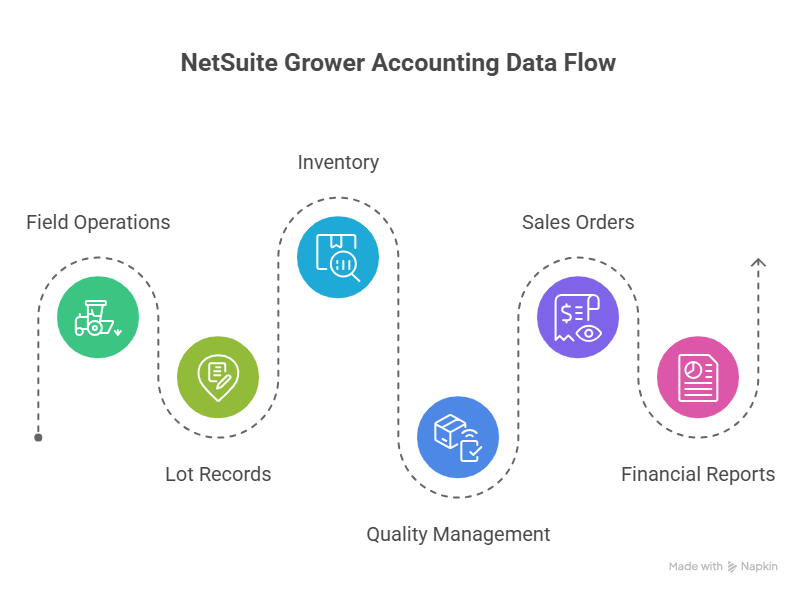
- NetSuite tracks every step of the harvest-to-sale chain. From harvest through storage, processing, and final sale, each batch carries its cost, quality, and movement history.
- Most growers lose margin between harvest and sale. Cooling, freight, packing, and sorting costs disappear into general overhead instead of being matched to specific lots.
- Folio3 configures NetSuite for grower operations. That means agriculture-specific workflows, grower settlement reports, and lot traceability built around how produce and grain businesses actually operate.
- The right accounting software connects field data to financial reporting automatically. No re-keying elevator tickets. No manual freight allocation. One system from harvest to payment.
A produce grower we work with had a solid season. Good yields on their leafy greens. Strong wholesale contracts in place. The operation looked profitable on paper.
Then a retail buyer called.
One pallet of product did not meet spec. They needed a full traceability report within 24 hours. Harvest date, field block, input records, cooling log, delivery documentation, or the account was at risk.
The grower’s team spent six hours pulling paper harvest sheets, cross-referencing cooling records from a separate log, and manually tracking the pallet back to a specific field block. They found the information. But it took most of a day and two people.
That is the problem grower accounting software is supposed to solve.
Most basic accounting tools, or even farm-specific ones, do not solve it. They record transactions. They do not connect harvest batches to costs, quality records, and customer invoices in a single traceable chain.
But the highlight is that NetSuite does. This blog explains exactly how, from the moment the crop leaves the field to the day the payment clears.
What Is Grower Accounting Software?
Grower accounting software is not a general accounting tool applied to farming. It is a financial management system built around how crop production actually works.
The difference comes down to what gets tracked and how.
| General Accounting Software | Grower Accounting Software |
|---|---|
| Records income and expenses | Connects numbers to specific harvests and field blocks |
| Stores invoices and payments | Links each invoice to a specific lot number |
| Shows overall P&L | Shows margin per crop, per field, per buyer |
| Costs averaged across the operation | Costs allocated to the specific lot they touched |
Here is what that looks like in practice. When a buyer pays you $18,000 for a load of corn, a general accounting tool records the invoice. A grower accounting system knows that payment corresponds to Lot 2024-C-047, harvested from the north field on October 3rd, dried to 14.2% moisture, stored in Bin 6, and shipped on October 11th with $840 in freight allocated directly to that lot.
The margin on that specific lot is calculated. Not estimated.
That level of detail is what buyers, auditors, and food safety inspectors now expect.

Why Batch Traceability Is Not Optional Anymore
Ten years ago, batch traceability was a major concern for large food companies. Today it is a standard expectation at every level of the fresh produce and grain supply chain.
Here is why the pressure on growers keeps growing.
Food Safety Regulations Require It
The FDA Food Safety Modernization Act (FSMA) requires growers selling to covered facilities to maintain records that trace produce from the field to the first point of sale.
For operations selling to grocery chains, processors, or food service distributors, this is a legal requirement. A buyer audit or a food safety event without proper lot records puts the entire account relationship at risk.
Buyers Ask for It Before They Order
Major wholesale buyers now include traceability capability as a standard qualification for suppliers. They want to know you can provide a full lot record on demand before they sign a contract.
Growers who cannot show this are losing contracts to those who can.
It Is Your Best Protection in a Dispute
When a buyer claims the product was substandard, your lot record is your defense.
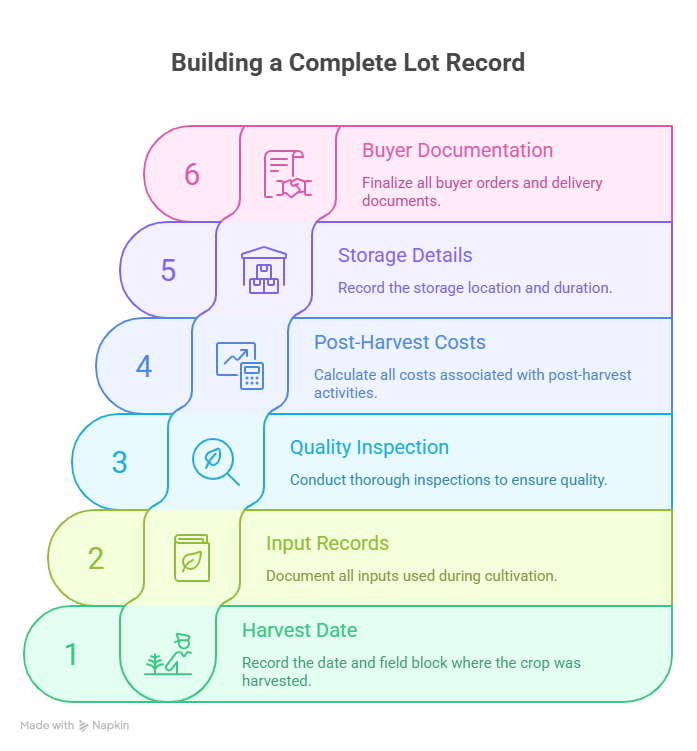
A complete lot record includes:
- Harvest date and field block
- Input records (seed, fertilizer, chemicals applied)
- Quality inspection results at receiving and packing
- Temperature and cooling logs
- Delivery and shipping documentation
Without it, you are relying on memory and paper that may not be organized enough to help you in time.
It Shows You Where You Are Losing Money
NetSuite Batch traceability is a financial visibility tool. When costs are tracked at the lot level, harvest labor, packing, cooling, freight, quality rejections, you see which crops, which fields, and which buyers are actually profitable.
Most growers running without lot-level cost tracking are averaging their way through a financial picture that hides real variation between fields and products.
How NetSuite Handles the Full Harvest-to-Sale Chain
NetSuite is a cloud ERP platform that, when configured correctly for agriculture, covers the full harvest-to-sale operation in one connected system.
Folio3 has built that configuration for growers, food distributors, and agribusinesses. Here is how it works at each stage.
Stage 1: Harvest Batch Creation and Lot Assignment
The traceability chain starts the moment the crop is received from the field.
In NetSuite, a lot record is created at that point, whether grain is going into a bin or produce is coming off a truck. That lot carries forward through every step that follows.
What the lot record captures at harvest:
| Field | Example |
|---|---|
| Harvest date | October 3, 2024 |
| Field block or location | North Field, Block 4A |
| Crop type, variety, grade | Corn, Pioneer P0157, #2 Yellow |
| Quantity and unit of measure | 4,200 bushels |
| Receiving quality inspection | Moisture 14.2%, test weight 56 lbs/bu |
| Input record links | Seed, herbicide, and fertilizer are applied to the source field |
Every movement after that, from the field to storage, storage to packing line, packing to outbound shipment, updates the same record. Nothing falls off the chain.
Stage 2: Post-Harvest Cost Allocation at the Lot Level
This is where most grower accounting tools fail.
Cooling, sorting, packing, freight, and quality-related costs need to be allocated to specific lots. Not averaged across all production. NetSuite handles this through landed cost functionality.
Here is how it works:
- A cooling invoice arrives. It is allocated across the specific lots that moved through that cooler during the billing period.
- Freight is paid on a delivery. It is matched to the lot on that truck.
- A quality rejection creates a credit. It is tied back to the specific lot that was rejected.
The result is a true cost per lot. The actual margin on every batch you sold, calculated from the costs that actually touched that batch.
Stage 3: Multi-Location Inventory Tracking by Lot
Produce and grain businesses manage products across multiple locations. Grain sits in multiple bins at multiple elevators. Produce moves from field coolers to packing facilities to cold storage.
NetSuite tracks every lot across every location in real time.
When you query Lot 2024-C-047, you see:
- Exactly where it is right now
- How much is in which bin or cold room
- What has shipped and what remains
- If a portion was split for two buyer orders, both sub-lots with their own history
This is what makes a traceability report possible in minutes. The data was captured at every step. The report is a query, not an investigation.
Stage 4: Quality Management Linked to the Lot
Quality records live in the same system as the lot record.
In-field scouting notes, receiving inspection results, in-process quality checks, packing line sign-offs, and non-conformance records all attach to the lot. When a buyer requests documentation, you generate a traceability report from the lot record that includes every quality event in sequence.
If a non-conformance was found and corrected, regraded, repacked, or disposed of, that is in the record too. The audit trail is complete.

Stage 5: Grower Settlements and Accounts Payable
For packing houses and food distributors sourcing from multiple growers, NetSuite handles grower settlement accounting directly.
How the settlement workflow runs:
- Crop is received from a grower. A receipt is created against the grower’s account.
- As the product moves through packing, cooling, and sale, costs and revenues are tracked against that lot.
- When the lot sells, the settlement is calculated automatically, sale price minus handling costs.
- A payment is generated to the grower with an itemized settlement report.
Growers receive automated reports showing what sold, at what price, and what deductions were applied. This replaces manual settlement spreadsheets that produce errors and disputes on a regular basis.
Stage 6: Sales Orders Matched to Specific Lots
When a buyer places an order, the sales order in NetSuite is linked to specific lots from inventory.
The grower management solution confirms that quantity is available in the requested specification. When the order ships, the lot record updates, and the inventory reduces. The buyer’s invoice references the specific lot.
If they raise a claim six weeks later, your team pulls the lot record and has the complete documentation in one place.
Stage 7: Financial Reporting Across the Full Chain
At the end of every season, NetSuite produces financial reports that connect field-level costs to product-level revenue.
Available reports include:
| Report | What It Shows |
|---|---|
| Margin by crop | Profitability per product type across the season |
| Margin by field block | Which fields returned the best economics |
| Revenue by buyer | Which accounts drove the most profitable volume |
| Cost per unit by product line | True production cost at the lot level |
These pull directly from the operational records captured throughout the season. No spreadsheet rebuild. No year-end reconciliation project. The financial close is faster because the data was entered once, at the point of activity.
To understand how grower accounting fits into the broader range of farm financial tools, our guide on farm accounting software options covers what is available and where each tool fits.
What Most Grower Accounting Tools Get Wrong
Most tools do one part of this well. Very few connect all of it.
| Problem | What It Looks Like |
|---|---|
| Records transactions but does not connect them to lots | Cooling costs hit a general expense account. The lot never knows what it costs to move through the cooler. |
| Tracks lots but not costs | A produce management tool assigns lot numbers and captures field records. But it does not connect those lots to financial costs. Two systems, no connection. |
| Handles one part of the chain | Elevator software handles grain intake and settlement. Produce tools to handle field records. Accounting tools handle invoices. Someone reconciles all three manually at month’s end. |
NetSuite handles the full chain in one system. The lot record that starts at harvest is the same record on the sales order, the settlement report, and the financial statements.
For growers evaluating whether NetSuite is the right fit, our blog on why NetSuite is the best ERP for agriculture covers the specific capabilities that make it work at scale.
Is This the Right Fit for Your Operation?
NetSuite with Folio3’s grower accounting configuration works well for a specific type of operation.
It fits well if you:
- Sell to wholesale buyers, retailers, or food processors who require lot traceability documentation
- Source from multiple growers and need to run grower settlement accounting
- Manage product across multiple storage locations or packing facilities
- Want actual margin data by crop, field, or buyer account
- Have outgrown QuickBooks or a basic farm accounting tool
- Are growing and need a platform that scales without a system change down the road
It is probably not the right fit if you:
- Are a small operation selling direct-to-consumer with simple financial needs
- Only need field record keeping and basic bookkeeping
- Are not yet at a scale where the implementation cost is proportional to the benefit
To compare platforms across different operation sizes and business models, our blog on the best ERP software for agriculture gives an honest breakdown of the leading options.
Choosing the Right Implementation Partner
NetSuite configured for a wholesale distribution business is not the same as NetSuite configured for a grower operation.
The agriculture-specific workflows — lot traceability from harvest, grower settlement accounting, field-level cost allocation, post-harvest landed costs — require a partner who has built these configurations before.
Questions to ask when evaluating implementation partners:
- Do you have references from produce or grain businesses specifically?
- How do you configure lot traceability from harvest intake through to customer sale?
- How do you handle grower settlement accounting for packing houses sourcing from multiple farms?
- Who will be on our project team and what is their agriculture background?
These questions separate partners with genuine agriculture experience from those who learn on your project.
For guidance on what to look for, our blog on choosing the right NetSuite partner for your agriculture business covers the evaluation criteria that matter most.
Final Thoughts
A lot happens between the moment a crop leaves a field block and the moment a buyer’s payment clears. Inputs get applied. Product gets cooled, sorted, graded, and packed. It moves between locations. Costs accumulate. Quality events happen.
Most grower management solutions capture parts of that chain.
NetSuite, configured by Folio3 for agriculture, captures all of it in one connected system. Full lot traceability on demand. True margin visibility by crop and field. Grower settlements calculated from actual data. Financial reports that reflect the real economics of your operation, not a year-end approximation.
If you want to see what this looks like for your operation, reach out to the Folio3 team. We will give you a straight answer on whether this is the right fit.
FAQs
What is grower accounting software?
Grower accounting software connects crop production records, harvest batches, input costs, quality data, and storage to accounting records like invoices, settlements, and financial reports. It links specific costs to specific lots and gives growers margin visibility at the crop and field level.
How does NetSuite handle batch traceability for growers?
NetSuite batch traceability assigns lot numbers at harvest intake and tracks each lot through every subsequent stage. Storage movements, quality inspections, post-harvest costs, packing line records, and outbound shipments all attach to the lot record. When a buyer requests a traceability report, it pulls from that connected record automatically.
Can NetSuite generate grower settlement reports for packing house operations?
Yes. With Folio3’s agriculture configuration, NetSuite tracks crop receipts from individual growers, allocates handling and packing costs to specific lots, and generates settlement reports showing sale proceeds minus deductions.
How is post-harvest cost allocated to specific lots in NetSuite?
NetSuite uses landed cost functionality to allocate post-harvest costs — cooling, freight, packing, and quality-related expenses — to the specific lots those costs relate to. When a cooling invoice arrives, it is distributed across lots based on quantity, weight, or value.
How do I get started with NetSuite for my grower operation?
Start with a scoping conversation before committing to any configuration. Folio3 works with produce growers, grain operations, and food distributors to define the right setup for each business type. You can reach us through our contact page.