Key Takeaways
- A NetSuite managed services provider is not the same as NetSuite’s own support team. Knowing the difference before you sign anything saves months of frustration.
- In most common articles, the selection criteria cover certifications, industry experience, and response times, but they only tell half the story. Pricing models and red flags in proposals tell the other half.
- The handoff from implementation to ongoing managed services is where most companies lose momentum. Who manages that transition, and how, matters as much as who built the system.
You Went Live. Now What?
Think about the last time you bought a new car. You spent weeks comparing models, test driving, and negotiating the price. Then you drove it off the lot and, six months later, skipped the first scheduled service because you were busy. A year after that, the car started underperforming, and you could not figure out why.
NetSuite implementations follow the same pattern more often than you would expect.
According to McKinsey, only 20% of companies manage to capture more than half the projected benefits from their ERP systems, and most of that value loss does not happen at go-live but in the months and years afterward, when the system is live but nobody is responsible for optimizing it, managing upgrades, or fixing what quietly breaks. You went through the implementation, got the keys, and then the service plan was never part of the conversation.
That is exactly what a NetSuite managed services provider is supposed to solve, but not all of them do. Some hand you a generic retainer proposal that covers as little as possible, assign you to a pooled support queue rather than a named consultant, and disappear after the contract renewal comes around.
This guide tells you what good actually looks like, what to ask before you sign anything, and what red flags look like in a proposal so you can spot them before they cost you.
What Is a NetSuite Managed Services Provider?
A lot of buyers use this term interchangeably with “support” and end up with the wrong thing. So it is worth being clear on what a managed services provider actually is and what it is not.
A NetSuite MSP takes ongoing, structured responsibility for the health, optimization, and evolution of your NetSuite instance after implementation. This is different from three things people regularly confuse it with:
- NetSuite’s own direct support: Oracle’s support team is scoped to product-level issues within the NetSuite platform itself. Their remit covers system functionality, bug resolution, and product questions; it does not extend to custom workflow optimization, bespoke reporting, or third-party integration advisory. For a side-by-side look at how that scope compares to a third-party provider, our blog on third-party NetSuite support vs Oracle covers where each option is the stronger fit.
- Ad-hoc consulting: Hourly or project-based work commissioned for specific needs as they arise. Works well for defined, one-off requirements, but does not provide ongoing accountability for system health or proactive optimization between engagements.
- An internal NetSuite admin: A strong option for companies with consistent, predictable support needs. The practical considerations are hiring and retention costs, depth of coverage across all NetSuite modules, and continuity planning if that resource moves on.
A proper managed services engagement covers system administration, SuiteScript and workflow automation, report and dashboard development, integration monitoring, user training, upgrade testing, and strategic optimization over time.
When Do You Actually Need a NetSuite Managed Services Provider?
This is the question no one else answers clearly, so here it is directly.
You need a managed services provider when any of the following apply to you:
- Your internal team spends more time managing system issues than analyzing the data it produces
- Your customization backlog is growing faster than it is being cleared
- A twice-yearly NetSuite release is coming, and no one is responsible for testing your customizations against it
- Your NetSuite admin is a single point of failure whose departure would create a genuine operational crisis
- You are scaling into new entities, geographies, or business lines that your current setup was not designed for
- It has been 12 or more months since go-live, and no structured optimization review has taken place
If more than two of those apply, your NetSuite investment is running at a fraction of its intended return. The system is operational, but it is running the same way it was configured on day one, regardless of how much your business has changed. Our blog on reasons to use NetSuite managed support after going live goes deeper on the specific triggers and what ignoring them costs over time.
What Should a NetSuite MSP Actually Cover?
Not all managed services engagements are scoped the same way. Before comparing providers, get clear on what baseline coverage looks like so you know when a proposal is underselling you.
Core scope every MSP should include
- System administration: user roles, permissions, configuration changes
- SuiteScript development and workflow automation for process improvements
- Report and dashboard building and ongoing refinement
- Integration monitoring and maintenance with connected third-party systems
- User onboarding and training for new staff
- Upgrade testing: validating that twice-yearly NetSuite releases do not break your customizations or scripts
Strategic scope that separates good MSPs from adequate ones
- Optimization roadmap: proactive recommendations based on how your team actually uses the system
- Module expansion advisory: identifying when a new NetSuite module would solve a problem you are currently working around manually
- Performance monitoring and environmental health checks
- Customization development for new business requirements as they emerge
When a proposal treats optimization, module advisory, and proactive system work as billable extras rather than part of what you are paying for monthly, the engagement is built to keep your system running at the level it was on go-live day, nothing more. That might be fine if your business never changes. For most companies, it is not. For a full picture of what Folio3’s support offering covers, visit the NetSuite support services page.
Understanding MSP Pricing Models
This is the topic that is usually ignored, and it is the one finance leaders want most before they get on a call with a provider.
There are three models you will encounter:
Retainer (fixed monthly hours): A set number of hours per month at a fixed cost. Predictable for budgeting. Works well when your support needs are consistent month to month. Watch for: proposals that do not specify what happens to unused hours, whether they roll over, expire at month end, or get billed regardless.
Time and Materials (T&M): Hourly billing against actual work done. Flexible but unpredictable in monthly cost. Works for sporadic needs. Watch for: no monthly cap, which means a busy month can produce an invoice that was nowhere in your budget.
Tiered or outcome-based: Defined deliverables at a fixed price per tier. Cleanest for scoped work. Watch for: tier definitions that sound comprehensive but exclude the work you will actually need most frequently.
For growing businesses with frequent workflow changes, integrations, and module expansions, a retainer with strategic scope almost always delivers better value over 12 months than time and materials. If you have strong internal coverage and occasional needs, T&M may be sufficient.
For a full breakdown of what NetSuite managed services typically cost across retainer tiers and engagement types, our NetSuite managed services cost and pricing guide covers the numbers in detail.
How to Evaluate a NetSuite Managed Services Provider
Adnan, our CEO, has reviewed many situations where clients are considering switching their NetSuite Managed Services Provider. His observation, consistent across dozens of reviews, is that most proposals offered by MSPs look nearly identical at the surface. However, the real differences only become visible when you go beyond the proposal and ask specific, detailed follow-up questions about how services are actually delivered, supported, and scaled.
Here is what to look for beneath the surface:
NetSuite partner tier: Oracle NetSuite designates Solution Providers and Alliance Partners by tier. Tier signals investment in NetSuite expertise but is not sufficient on its own. A high-tier partner with no experience in your vertical is still the wrong choice for your business.
Industry-specific experience: Has the provider actually worked with companies in your sector? Manufacturing, distribution, SaaS, real estate, and nonprofit have different operational patterns, module combinations, and reporting requirements. A provider who has never supported a multi-subsidiary manufacturer will spend your retainer hours learning your business.
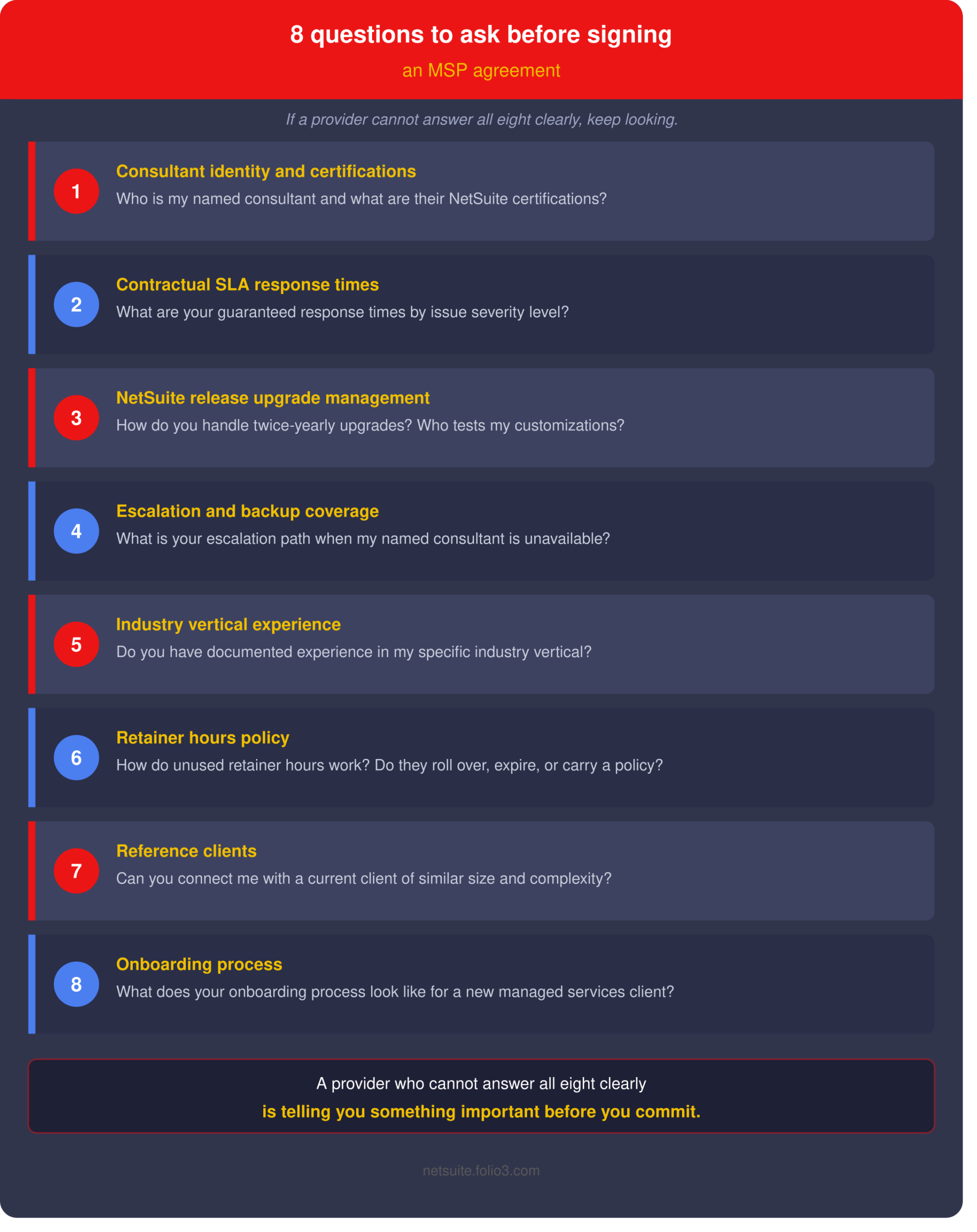
Named consultant vs. pooled team: This distinction changes the experience entirely. A named consultant knows your system, your customizations, and your business logic. A pooled support queue means whoever picks up your ticket that day reads your case notes from scratch. Ask directly: who is my named point of contact and what is their NetSuite certification level?
SLA commitments: Response time guarantees should be contractual, not best-effort language. Ask for the actual SLA document, not the summary page. Look for tiered severity levels: P1 issues (system down) should be measured in hours, P3 issues (non-urgent requests) in business days.
Upgrade and release management: NetSuite releases twice a year. Who is responsible for testing your customizations, scripts, and integrations against each release before it reaches your live environment? If the answer is unclear in the proposal, that is a gap you will discover at the worst possible time.
Reference clients: Ask for a reference from a company of similar size and industry vertical. A provider who cannot produce one either has not done this work or has clients who would not speak positively about the engagement.
Red Flags to Watch for in MSP Proposals
You learn as much from what a proposal does not include as from what it does. These are the patterns worth flagging before you commit:
- Vague SLA language: “We aim to respond within…” is not a contractual SLA. “P1 issues receive a response within 2 business hours.”
- No named consultant: Pooled support models are cheaper to deliver and significantly worse to receive. If the proposal does not name your primary contact, ask why.
- Generic scope language: A proposal listing “NetSuite support” without specifying what that means was not written for your business. It was copied and pasted from a template.
- No documented upgrade management process: If upgrade testing is not explicitly in scope, it will surface as a billable extra twice a year.
- Pricing that seems unusually low: This typically signals junior or pooled resources, a high client-to-consultant ratio, or scope exclusions that will appear later as additional charges.
- No case studies from your industry or complexity level: General NetSuite experience and domain-specific experience are different things.
The Transition from Implementation to Managed Services
The handoff from go-live to ongoing support is where most managed services relationships either start well or start badly, and it is almost entirely determined by whether the transition was planned before go-live.
Think of it this way: if you trained for a marathon with one coach and switched coaches the day after the race, your new coach would have no idea how you trained, what your injury history was, or what a realistic improvement plan looked like. All of that knowledge lived with the first coach and was never transferred.
The same thing happens when an implementation partner hands off to a separate MSP team. Customization logic, integration architecture, business rule decisions made during configuration, all of that knowledge either transfers in a structured way or it disappears.
Best practice is for the managed services engagement to begin before go-live, overlapping with the final implementation phase. At minimum, the transition should include a full system documentation handover, an active customization inventory, an integration map, and a first 90-day support plan. If your implementation involved data migration from a legacy system, our blog on best practices for NetSuite data migration with managed service providers covers how that handoff should be structured specifically.
We conducted an in-depth survey with our clients on outcomes after structuring this transition correctly. A turf manufacturer reported a reduction of 10 hours of manual data entry per day after going live on NetSuite with a structured post-go-live support plan in place. That reduction held because the system was actively maintained and optimized after go-live, not just handed over and left running.
How Folio3 SmartCare Approaches Managed Services
Every Folio3 SmartCare engagement assigns a named NetSuite consultant scoped to your industry vertical before the first retainer period begins. The engagement covers both core administration and strategic optimization, with upgrade testing included as a standard deliverable, not a billable extra.
For clients coming off a Folio3 implementation, the transition is continuous. The same team that built the system manages it, which means no knowledge gap and no ramp-up period. For clients switching from another provider, the first 3 to 4 days include a structured system audit, customization inventory, and optimization gap report before any reactive work begins.
We surveyed clients on outcomes from structured managed services engagements. An education company reported saving an estimated 20 hours per week of senior finance labor after Folio3 automated their revenue recognition and eliminated a manual 1,100-column reconciliation spreadsheet. That is not a go-live outcome; It is a post-go-live optimization outcome, delivered through ongoing managed services work. One of our clients managing 22 entities across land, hospitality, and agriculture reported shaving 10 working days off their month-end close cycle through intercompany automation work carried out under their managed services engagement.
You can also see how a Folio3 managed services engagement is structured in practice. Watch the SmartCare overview here: https://www.youtube.com/watch?v=nex5m_mlBa4
To explore the full offering, visit the NetSuite managed services page.
Finding the Right NetSuite Managed Services Partner
Choosing a NetSuite managed services provider is not a procurement exercise. It is a long-term working relationship that determines whether your NetSuite investment compounds over time or plateaus at go-live.
The right provider will answer every question in this guide clearly, produce reference clients from your industry, name your dedicated consultant before you sign, and show you a documented upgrade management process. The ones who cannot answer these questions are telling you something important before you commit.
If you want to talk through your current setup or get a second opinion on a proposal you have already received, Folio3’s team is available for a no-commitment consultation.
People Also Ask
What is a NetSuite managed services provider?
A NetSuite managed services provider is a partner who takes ongoing responsibility for the administration, optimization, and evolution of your NetSuite instance after implementation. This covers system configuration, SuiteScript and workflow automation, report building, integration maintenance, user training, and twice-yearly upgrade testing, under a structured agreement with defined service level commitments. It is distinct from NetSuite’s own direct product support, which is limited to Oracle’s product scope only.
What does a NetSuite managed services provider typically include?
A complete engagement covers system administration and role management, SuiteScript development and workflow automation, custom report and dashboard building, integration monitoring with third-party systems, user onboarding and training, and upgrade testing for NetSuite’s twice-yearly releases. Strategic providers also include proactive optimization advisory, module expansion recommendations, and ongoing performance monitoring as part of the retainer.
When should a company hire a NetSuite managed services provider?
The clearest triggers are: your internal team is spending more time managing system issues than analyzing data, your customization backlog is growing faster than it is being cleared, a NetSuite upgrade is approaching with no one responsible for testing, your admin is a single point of failure, or it has been more than 12 months since go-live with no structured optimization review. Any one of these signals that the system is running but not improving.
What should I look for when choosing a NetSuite managed services provider?
Evaluate providers on their NetSuite partner tier and certifications, industry-specific experience in your vertical, whether they assign a named consultant or use a pooled support queue, contractually guaranteed SLA response times by severity level, a documented upgrade management process, and reference clients from companies of similar size and complexity. Generic proposals that do not address these points specifically have not been written for your business.
What are the pricing models for NetSuite managed services?
The three common models are retainer (fixed monthly hours at a set cost, best for consistent support needs), time and materials (hourly billing against actual work, best for sporadic needs), and tiered or outcome-based (defined deliverables at fixed price per tier, best for scoped work). For growing businesses with frequent system changes, a retainer with strategic scope usually delivers better value over 12 months than time and materials billing.
What are the red flags to watch for in a NetSuite managed services proposal?
The most important red flags are vague SLA language with no contractual commitments, no named consultant assigned to your account, generic scope descriptions not tailored to your business, no documented upgrade management process, and pricing significantly below market rate, which typically signals pooled resources or scope exclusions that appear later as additional charges.
How does Folio3 SmartCare work as a NetSuite managed services provider?
Folio3 SmartCare assigns a named consultant scoped to your industry vertical before the first retainer period begins. The engagement covers both core administration and strategic optimization, with upgrade testing included as a standard deliverable. For clients transitioning from a Folio3 implementation, the same team continues managing the system, eliminating the knowledge gap that typically occurs at handoff. For new clients, the first 30 days include a structured system audit, customization inventory, and optimization gap report.
What is the difference between NetSuite support and NetSuite managed services?
NetSuite’s own support team handles product-level issues within Oracle’s product scope only. They do not customize workflows, build reports, manage third-party integrations, or provide strategic optimization advice. A managed services provider covers all of that, plus ongoing development work, upgrade management, and proactive system improvement. The distinction matters when evaluating what you actually need after go-live versus what your NetSuite license already includes from Oracle.