Key Takeaways
- Most NetSuite problems after go-live are not system problems. They are support problems. The wrong partner, or no partner at all, lets technical debt accumulate until small issues become expensive ones.
- A revolving door of consultants is one of the most consistent complaints about ACS and generic support partners, I found on Reddit. Every new request goes to someone who has never seen your configuration. The right managed services partner assigns you a named consultant who learns your system once and stays.
- Industry experience is not optional. A partner who has never worked in your industry configures NetSuite generically. A partner who has built the same workflows for businesses like yours builds them correctly the first time.
- Time-and-materials pricing does not align the partner’s and the client’s interests. Every extra meeting, every extra question, every data quality issue becomes a billable hour. Fixed-fee or retainer models give you a predictable cost and give the partner a reason to be efficient.
- Folio3’s SmartCare is a managed services model designed around the problems businesses actually experience post-go-live. Named consultants, SLA-backed response times, release management, and optimization under one predictable monthly fee.
- The right time to find a managed services partner is before you urgently need one. Businesses that wait until a crisis to evaluate partners under pressure and make worse decisions.
A business we worked with had been on NetSuite for 14 months. Their original implementation partner had handed them off six months after go-live, as agreed in the contract. They had Oracle’s standard support in place. On paper, they were covered.
In practice, they had a saved search that had been pulling the wrong data for three months. A workflow that approval managers had stopped using because it kept throwing errors. A custom script that had broken in the 2025.1 release and was still broken four releases later.
None of these were catastrophic on their own. Together, they added up to a finance team that had rebuilt four manual workarounds, a month-end close that took eleven days, and a management team that had quietly stopped trusting their NetSuite reports.
When we audited the system, every one of those problems was fixable. Some took hours. One took two days. The issue was not the platform. The issue was that nobody with the right knowledge had been watching the system since the implementation team left.
This guide covers what a good managed services partner actually provides, how to evaluate one before you commit, and the specific signals that separate partners who deliver from those who do not.
What Is a NetSuite Managed Services Partner?
A NetSuite managed services partner provides ongoing, subscription-based support and optimization of your NetSuite environment after go-live.
This is different from break-fix support or ad hoc consulting. Break-fix responds when something breaks. Managed services work to prevent things from breaking, actively monitor your environment, and optimize the system as your business changes.
A strong managed services engagement typically covers:
- Day-to-day administration, user management, and configuration changes
- Break-fix resolution with SLA-backed response times
- Release management: testing your customizations before each NetSuite update goes live
- Minor customization work and workflow improvements
- User training for new staff and new features
- Periodic system health reviews that surface issues before they become problems
- Guidance on new modules, integrations, and functionality as your business grows
The difference from Oracle’s ACS is important to understand before you evaluate anyone. ACS focuses on platform health and technical guidance. It does not cover your specific configuration, your custom scripts, or the industry-specific workflows your business depends on. A managed services partner covers all of it.
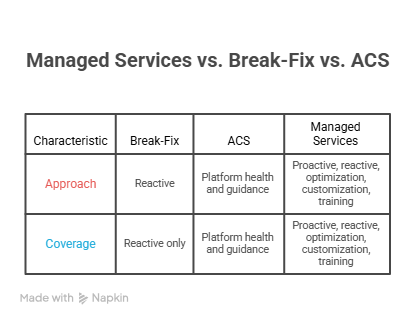
For a detailed breakdown of what different support tiers include, our blog on the NetSuite support partner guide explains the difference between Oracle’s support options and what a partner fills in.
Why Businesses End Up Needing Managed Services (And Why They Wait Too Long)
Most businesses underestimate what post-go-live maintenance actually requires. This is not a criticism. It is a structural reality of how ERP implementations are sold.
The implementation contract ends. The implementation team moves to their next project. You have a working system, trained users, and a document folder full of configuration notes.
Then the business changes. A new subsidiary gets added. A new product line requires different inventory logic. A sales process changes, and the old approval workflow no longer matches it. Staff turns over, and the new hire does not have the same NetSuite knowledge as the person they replaced.
Any one of these things is manageable. All of them, accumulating over 18 months without a partner actively managing the system, produce the situation we described in the introduction: a system that technically works but that nobody fully trusts.
The data is consistent. Nearly 60% of NetSuite implementations exceed their initial cost projections, and a large portion of that excess sits in the post-go-live period, when businesses are paying for ad-hoc fixes to problems that could have been prevented.

The businesses that avoid this pattern are the ones that treat managed services as an operational budget line, not an emergency fund.
For context on why post-go-live support matters more than most businesses anticipate, our blog on reasons to use NetSuite managed support after going live covers the most common situations where the absence of ongoing support costs businesses time and money.
What to Look for in a NetSuite Managed Services Partner
Here are the criteria that actually matter. Not the ones that look good on a capabilities slide. The ones that determine whether you get value or frustration. These are the specific signals that separate partners who deliver from those who do not. Much like a reliable pie chart generator simplifies complex data into clear insights, the right managed services partner helps businesses make smarter operational decisions.
1. Named Consultants, Not a Ticket Queue
This is the single most important structural difference between good and bad managed services.
When something breaks in your NetSuite environment, the person who resolves it needs to already know your system. They need to know your revenue recognition workflow has a custom script on it. Your inventory costing method is average cost, not FIFO. That your approval hierarchy has a specific exception for inter-company transactions.
A ticket queue assigns your problem to whoever is available. That person reads your account notes, gets up to speed on your configuration, and then works the issue. This takes longer, introduces errors, and means you are explaining the same context every time something goes wrong.
A partner who assigns you a named consultant and backs that with a defined SLA delivers faster resolution and fewer errors because the consultant already knows your system before the ticket opens.
Ask directly: “Who will be assigned to our account? Will it be the same person for every engagement? What happens if that person leaves?”
2. Industry-Specific Experience
NetSuite is a flexible platform. That flexibility means it can be configured very differently for a food manufacturer versus a software company versus a wholesale distributor. Workflows that work in one industry are wrong in another.
A partner with industry experience has already built the configurations your business needs. They know the common failure points. They know which custom scripts are typically needed, which SuiteApps solve real problems in your sector, and which configurations create downstream trouble.
A partner without industry experience learns this on your time. Every configuration choice becomes a discovery exercise. You pay for that learning.
When evaluating partners, ask specifically:
- How many businesses in our industry do you currently manage on NetSuite?
- What are the most common configuration mistakes you see in our sector?
- Can you provide references from businesses similar to ours in size and industry?
Require at least 5 to 10 active clients in your industry. Generic answers about “extensive industry experience” without specific client examples are a red flag.
3. Proactive Release Management as a Standard
NetSuite releases two major platform updates per year. Each release can affect custom scripts, saved searches, workflows, and third-party integrations. A release that is not tested against your customizations is a source of unexpected downtime.
The broken script that sat unfixed for four releases in the example we opened with was the direct result of nobody testing the release against that specific customization before it went live.
A managed services partner who includes release management in their scope tests your customizations in a sandbox before each release, finds conflicts, and applies fixes before the update reaches your production environment.
Ask directly: “What is your release management process? When does testing begin before each release? How do you communicate release impacts to our team?”
If a partner cannot describe a specific process, they are not doing this systematically.
4. SLA-Backed Response Times With Priority Tiers
Managed services without a service level agreement is consulting with a monthly invoice attached. An SLA defines exactly how quickly your partner responds to and resolves issues, and creates accountability when they do not.
A well-structured SLA distinguishes between priority levels:
| Priority | Definition | Response Time |
|---|---|---|
| Critical (P1) | System down or financials blocked | 1 to 4 hours |
| High (P2) | Key process broken, workaround available | 4 to 8 business hours |
| Medium (P3) | Issue affecting some users, workaround in place | 1 to 2 business days |
| Low (P4) | Enhancement, training question, minor issue | 3 to 5 business days |
Ask for the SLA in writing before signing. Ask what happens when the SLA is missed. A partner who cannot show you a written SLA is not managing services. They are doing ad-hoc consulting with a recurring payment.
5. A Pricing Model That Aligns Incentives
How a partner prices their services reveals important factors about how they work.
Time-and-materials (T&M): You pay for hours worked regardless of outcome. Every question, every extra call, every data quality issue is billable. The partner has no financial incentive to work efficiently or prevent problems. Problems are revenue for them.
Retainer (fixed hours per month): Predictable cost. Works when your support needs are moderate and consistent. Unused hours are often lost. Overages are billed at standard rates. Better than T&M, but still gives partners a reason to use up retainer hours rather than solve root causes.
Fixed-fee managed services: A defined scope delivered for a defined monthly fee. The partner owns the outcome, not just the hours. This creates real alignment: an efficient partner who prevents problems costs themselves less. It also gives you full budget predictability.
For most growing businesses with evolving NetSuite environments, fixed-fee managed services deliver the most value and the clearest accountability.
For context on how managed services pricing works across different models, our guide on NetSuite managed services cost and pricing covers the numbers in detail.
6. Depth Across NetSuite’s Functional Areas
NetSuite covers financials, inventory, procurement, order management, CRM, eCommerce, and WMS. A managed services partner who is strong on financials but weak on warehouse management is not the right choice for a distribution business.
Map your primary NetSuite modules against the partner’s documented experience. Ask for case studies or references that show their work in the specific modules your business depends on.
The areas that most often need managed services in depth:
- Finance and accounting: Revenue recognition, period close, intercompany, and consolidation
- Inventory and supply chain: Demand planning, landed costs, lot tracking, bin management
- Customization and SuiteScript: Custom scripts, workflows, saved searches, custom fields
- Integrations: EDI, eCommerce connectors, 3PL, payment processors
- Reporting and analytics: Saved searches, dashboards, SuiteAnalytics
A partner who is strong across all of these gives you one relationship for the full scope of your NetSuite environment. A narrow partner forces you to bring in additional consultants for work outside their depth.
7. Transition and Historical Knowledge
If you are moving to a new managed services partner, they inherit your existing NetSuite configuration. How they handle that transition matters.
A good partner starts with a formal system audit: documenting your customizations, reviewing your data quality, identifying technical debt, and flagging the issues that have been accumulating since implementation.
For businesses migrating data or moving between managed services partners, our blog on best practices for NetSuite data migration covers what a structured transition looks like and how to protect data integrity through the process.
8. Optimization, Not Just Maintenance
The best managed services partners do not just keep the lights on. They actively improve the system.
This means periodic reviews that identify underused features, configuration improvements, new modules that would benefit your operation, and automation opportunities that were never in scope during implementation.
The difference in practice: a maintenance-only partner keeps your month-end close at eleven days. An optimization-focused partner gets it to six.
Ask how the partner approaches ongoing improvement. Ask for examples of optimizations they have delivered for current clients. A partner who only describes reactive support is a maintenance vendor, not a strategic partner.
The Partner Evaluation Checklist
Use this before you agree to any managed services contract.
On their team:
- Do they assign named consultants or use a shared pool?
- What is the average tenure of their NetSuite consultants?
- What certifications does the team hold?
- What happens if your named consultant leaves?
On their experience:
- How many clients in your industry do they currently manage?
- Can they provide three references from businesses similar to yours in size and sector?
- What are the most common problems they see in your industry’s NetSuite environments?
On their scope and SLA:
- What is explicitly included in the monthly fee?
- What triggers an out-of-scope charge?
- What are the response time commitments by priority level, in writing?
- What is the escalation process for critical issues?
- What happens when they miss an SLA?
On their release management:
- What is the release management process?
- When does sandbox testing begin before each NetSuite release?
- How do they communicate release impacts and fixes?
On their pricing model:
- Is the monthly fee fixed or variable?
- How are overage hours priced?
- What is the minimum contract term?
- Is there a trial or pilot engagement option?
On their optimization approach:
- How do they approach ongoing system improvement beyond break-fix?
- How often do they conduct system health reviews?
- What does a typical optimization recommendation process look like?
What Folio3’s SmartCare Managed Services Covers
Folio3’s SmartCare program was built around the specific failures businesses experience with ACS and generic support partners. Named consultants. Proactive release management. Fixed-fee predictability. Optimization alongside maintenance.
Here is what SmartCare includes:
- Named dedicated consultant who knows your configuration from day one and stays on your account
- SLA-backed response times with priority tiers: critical issues get same-day response
- Break-fix resolution for functional issues, scripts, workflow failures, and integration problems
- Release management: customizations tested against every NetSuite update before it goes live
- Minor customizations and configuration changes within the monthly scope
- User training for new staff and new feature rollouts
- A monthly system health review that surfaces issues before they affect operations
- Optimization guidance on new modules, features, and efficiency improvements as your business grows
See how the right managed services partner can reduce your NetSuite operational costs by up to 40%. Schedule a Demo
How to Know When You Actually Need Managed Services
Not every business needs a managed services partner immediately after go-live. Here are the signals that tell you the time has come.
You are ready for managed services when:
- Your NetSuite environment has significant customizations that need release management
- You have added or plan to add subsidiaries, modules, or integrations
- Staff turnover has created knowledge gaps in your internal NetSuite expertise
- Your month-end close is consistently longer than it should be
- Your team has built manual workarounds around NetSuite processes
- You are relying on one internal person who knows the system, and you cannot afford to lose them
- NetSuite release updates have caused unexpected issues more than once
You may not need managed services yet if:
- Your NetSuite environment is standard with minimal customizations
- You have a capable internal NetSuite administrator who manages the system well
- Your support needs are genuinely low, and your existing setup handles them
The honest signal: if your team spends more time managing NetSuite problems than using NetSuite to run the business, managed services will pay for themselves.
Not sure if managed services is the right fit for where you are now? Book a 20-Minute Call; No Pitch, Just Answers
Final Thoughts
The businesses that get the most from NetSuite over time are the ones that treat post-go-live support as an ongoing function, not a cost to minimize.
The wrong managed services partner, or no partner at all, produces a predictable outcome. Technical debt accumulates, workarounds multiply, and the system that was supposed to improve operational visibility becomes a source of daily friction instead.
The right partner keeps the system current, grows its capability with your business, and gives your team the confidence to rely on the data it produces.
If you are evaluating managed services options and want an honest conversation about what the right engagement looks like for your specific NetSuite environment, the Folio3 team works with businesses at every stage of this decision.
Find the right NetSuite managed services model for your business today. Schedule a Consultation!
FAQs
Q: What is a NetSuite managed services partner?
A NetSuite managed services partner provides ongoing subscription-based support, optimization, and administration of your NetSuite environment. Unlike break-fix support, managed services is proactive. It includes release management, system health monitoring, minor customizations, user training, and guidance on ongoing improvements, all under a defined monthly engagement rather than ad-hoc hourly billing.
Q: What is the difference between NetSuite ACS and managed services?
NetSuite ACS focuses on platform health, technical guidance, and Oracle-level support. It does not cover your specific configuration, custom scripts, or industry workflows. A managed services partner covers everything ACS does not: your customizations, your workflows, your releases, your team training, and your system optimization. Most businesses benefit from both, but the partner fills the gaps ACS leaves.
Q: How much do NetSuite managed services cost?
Fixed-fee managed services typically range from $3,000 to $12,000 per month, depending on the scope, the number of modules covered, the level of customization in the environment, and the SLA tier. This is typically 40 to 60% of the cost of maintaining an equivalent internal capability. For a detailed breakdown, our guide on NetSuite managed services cost covers the pricing variables.
Q: How do I evaluate a NetSuite managed services partner?
Evaluate on eight criteria: named vs. pool consultants, industry experience, release management process, SLA commitment in writing, pricing model (fixed vs. T&M), module depth, transition and audit approach, and whether they offer optimization or only maintenance. Ask for references from businesses in your industry specifically and call them.
Q: What should a NetSuite managed services contract include?
A well-structured contract includes a defined scope of services, SLA response times by priority level, escalation procedures, release management responsibilities, overage pricing, contract term, and exit conditions, and a named account contact. Any contract that does not define these explicitly should be renegotiated before signing.
Q: How long does it take to transition to a new NetSuite managed services partner?
A well-managed transition typically takes two to four weeks. The new partner conducts a system audit, documents your configuration, reviews open issues, and establishes the support rhythm. The first 90 days should include a system audit, a process review, and a set of quick wins that show the value of the new engagement.