Key Takeaways
- NetSuite support from a certified partner is different from Oracle’s built-in support: Partners offer industry-specific expertise, proactive system optimization, and flexible pricing that Oracle’s standard tiers do not.
- Three support pricing models exist. Hourly billing, monthly retainer, and managed services. Each fits a different business situation. Most growing businesses benefit most from a retainer or managed services model.
- Support scope matters as much as price. Knowing what is covered, break-fix, customization, optimization, training, and release management, before you sign a contract, prevents expensive surprises.
- Most implementations cost 3 to 4 times more than initially budgeted. Post-go-live support is often the budget item that catches businesses off guard.
- Folio3’s SmartCare support gives businesses access to a dedicated NetSuite team. It covers day-to-day issues, system optimization, customization support, and release management under one predictable monthly fee.
- The right support partner grows with your business. They are not just fixing what breaks. They help you get more from the system as your operation evolves.
We speak with a lot of NetSuite customers who went live 6 to 12 months ago. They are past the implementation phase. Their team is using the system daily. Things are largely working.
Then they start noticing gaps.
A workflow that was configured during implementation no longer fits how the business operates. A custom script fails after a NetSuite release update. A report that the finance team needs does not exist. A new business unit needs to be added, and nobody knows how to set it up correctly.
They are the moments when businesses realize that relying on standard support or figuring things out internally is not enough. And instead, we need a NetSuite support partner to troubleshoot complex problems in our system.
This guide covers what to expect from partner support, how pricing models work, what a reasonable support scope looks like, and how to choose the right partner for your operation.
What Is a NetSuite Support Partner?
A NetSuite support partner is a certified company that provides ongoing technical, functional, and strategic support for businesses running NetSuite after go-live.
This is different from Oracle’s own support. Oracle’s baseline support handles platform-level issues, bugs, platform outages, and core product problems. They do not configure your workflows, optimize your custom scripts, train your new staff, or help you extend the system as your business changes.
That is where a partner comes in.
A good support partner works as an extension of your internal team. They know your NetSuite configuration, understand your business processes, and respond when something goes wrong or when you need the system to do something new.
Many businesses assume Oracle’s standard support covers all of this. Oracle’s delivery model is typically more standardized and scope-bound. NetSuite support partners provide more flexibility, deeper industry expertise, and support that scales with your business. Here is a quick comparison for you to view:
Folio3 vs. NetSuite ACS, Side by Side
| Factors | Folio3 | NetSuite ACS |
|---|---|---|
| Cost | 40-60% less than ACS | ~$56K/year (Optimize tier) |
| Billing | Fixed-cost quarterly retainer | Full year, paid upfront |
| Commitment | Quarterly | 12-month minimum |
| Team Structure | Dedicated team, every tier | Dedicated at higher tiers only |
| Queue | No (Direct team access) | Yes (Requests enter queue) |
| Flexibility | Project-based, retainer, or scaled team | Rigid tier structure |
| Industry Expertise | 50+ NetSuite functional consultants | General guidance |
What Do NetSuite Support Partners Actually Cover?
Support scope varies between partners. Here is what a properly structured NetSuite support engagement should include.
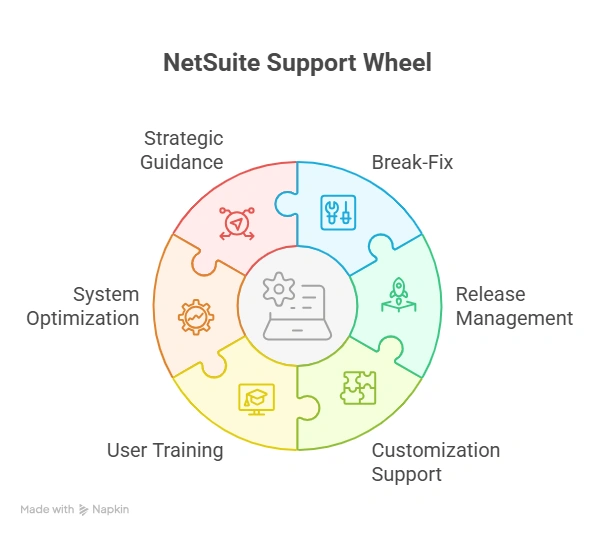
Break-Fix Support
This is the baseline. When something stops working, such as a workflow fails, a script throws an error, or an integration breaks, your support partner diagnoses the issue and resolves it.
Break-fix is reactive. It responds to problems after they happen. Every support engagement should include it. But break-fix alone is not enough for a growing business.
Release Management
NetSuite releases two major updates per year. Each release can affect custom scripts, saved searches, workflows, and third-party integrations in ways that are not always obvious until something breaks in production.
A reliable support partner tests your customizations against the upcoming release before it goes live. They find conflicts early. They apply patches and fixes before your finance team notices something is wrong on a Monday morning close.
Without active release management, you are discovering problems after they have already affected your operation.
To understand what proper NetSuite technical support looks like in practice, our blog on NetSuite technical support covers the specific responsibilities that separate reactive support from proactive system management.
Customization Support
Your NetSuite configuration will change. Business processes evolve. New requirements come up. Regulations change. A support partner who can modify SuiteScript, build new workflows, add custom fields, and reconfigure reports is far more useful than one who can only fix what is already there.
Customization support fills the gap between what NetSuite does out of the box and what your specific operation needs.
For a detailed breakdown of what this involves, our guide on NetSuite customization support covers the types of customization work that typically fall under ongoing support.
User Training and Onboarding
Staff turnover is a reality. When a new accountant joins your team, they need to learn NetSuite. When a new warehouse manager starts, they need to know how to process receipts, run reports, and manage inventory adjustments.
Support partners who include training in their scope save businesses from the alternative, paying for ad hoc training hours every time a new hire joins, or watching new staff build workarounds because nobody showed them the right process.
System Optimization
This is the part most businesses underestimate. A system that was configured correctly at go-live still needs ongoing tuning. Saved searches that run slowly. Reports that are no longer accurate. Workflows that have grown too complex. Automation opportunities that were never in scope during implementation.
A NetSuite support partner who reviews your system periodically and identifies these issues proactively delivers more value than one who only responds to tickets.
Understanding NetSuite Support Tiers
It helps to understand the different NetSuite support tiers that exist before you evaluate partner options. Oracle offers Basic and Premium tiers along with Advanced Customer Support (ACS) with varying response times and access levels.
For a detailed comparison of what each tier includes, our blog on NetSuite support levels explained breaks down the differences and when each tier makes sense.
What Are the Pricing Models for NetSuite Partner Support?
NetSuite support pricing varies widely depending on the level of service. Understanding the three main models helps you choose the right one for your situation.
Hourly Billing
You pay for support hours as you use them. The partner tracks time against each ticket or request and invoices you accordingly.
When it works:
- Your NetSuite environment is stable with minimal customizations
- Your support needs are genuinely low and infrequent
- You have a capable internal NetSuite admin who handles routine issues
When it does not work:
- You have ongoing support needs that are hard to predict
- You need a fast response time; hourly billing often means no committed SLA
- Budget predictability matters for your finance team
Hourly rates for NetSuite support typically range from $150 to $250 per hour, depending on the partner, the complexity of the work, and whether it involves functional consulting or SuiteScript development.
Monthly Retainer
You commit to a fixed number of hours per month at an agreed rate. Unused hours may or may not roll over depending on contract terms.
When it works:
- You have regular but moderate support needs
- You want predictable monthly costs
- You need a committed response time SLA without paying for fully managed services
When it does not work:
- Your needs vary significantly month to month. You either burn through hours quickly or waste them
- You need more than reactive support
Retainers typically range from $2,000 to $8,000 per month, depending on hours committed and the partner’s rate structure. Overage hours are usually billed at the standard hourly rate.
Managed Services
You pay a fixed monthly fee for a defined scope of ongoing support. The partner owns the outcome, not just the hours. The NetSuite Managed Services pricing model is closer to having a dedicated NetSuite team available to you without the cost of hiring one internally.
When it works:
- Your business is growing, and your NetSuite needs are evolving consistently
- You need proactive system management, not just reactive fixes
- Release management, training, customization, and optimization are regular needs
- Budget predictability is important, and you want one number covering all support
When it does not work:
- Your operation is very small and stable, with minimal NetSuite usage
- You have a strong internal NetSuite administrator who handles most issues independently
For growing companies with complex environments, NetSuite support is typically structured as an ongoing partnership rather than ad hoc support. Managed services pricing typically ranges from $3,000 to $12,000 per month, depending on the agreed scope, business size, and the complexity of your NetSuite environment.
Oracle Direct Support vs. NetSuite Partner Support: What Is the Difference?
This is one of the most common questions we get from businesses evaluating their support options after go-live.
Oracle provides the platform. A partner supports your business on that platform. They are complementary options, not competing ones. But they serve very different purposes.
| Oracle Direct Support | NetSuite Partner Support | |
|---|---|---|
| Platform bugs and outages | Yes | No (escalated to Oracle) |
| Custom script issues | No | Yes |
| Workflow configuration | No | Yes |
| Business process changes | No | Yes |
| Release management for customizations | No | Yes |
| User training | No | Yes |
| System optimization | No | Yes |
| Response time SLA | Varies by tier | Partner-defined |
| Industry expertise | Generalist | Partner-specific |
The practical implication: if you rely solely on Oracle’s support after go-live, you are covered for platform-level issues only. Everything specific to your configuration, your workflows, and your users falls on you.
For a detailed comparison of what you get from each option, our blog on third-party NetSuite support vs Oracle covers the differences and helps you decide when partner support is the right investment.
What Does a Good NetSuite Support SLA Look Like?
A Service Level Agreement (SLA) defines how quickly your support partner responds to and resolves issues. Before you sign any support contract, know what SLA you are agreeing to.
Response Time by Priority
A well-structured SLA defines priority levels and response times for each.
| Priority Level | Definition | Expected Response Time |
|---|---|---|
| Critical (P1) | System down, financials affected, business blocked | 1 to 4 hours |
| High (P2) | Key process broken, workaround available | 4 to 8 business hours |
| Medium (P3) | Issue affecting some users, workaround in place | 1 to 2 business days |
| Low (P4) | Minor issue, enhancement request, training question | 3 to 5 business days |
Resolution Time vs. Response Time
Response time means when your partner acknowledges the issue. Resolution time means when it is fixed. Both matter.
A partner who responds in 2 hours but takes 3 weeks to resolve a critical issue is not delivering the right support. Ask specifically about resolution time benchmarks for each priority level before you commit.
Named vs. Pool Resources
Some support partners assign you a named consultant who knows your system. Others put your tickets into a general queue worked by whoever is available.
Named resources mean faster resolution because the consultant already knows your configuration. Pool-based support means more variability. Know which model you are buying before you sign.
What Should You Expect in the First 90 Days of Partner Support?
This is a question most businesses do not think to ask. The first 90 days are when the partner builds the knowledge base they need to support you well.
Here is what good onboarding from a support partner looks like.
Week 1 to 2: System Audit
The partner reviews your NetSuite configuration. They document your customizations, identify technical debt from the implementation, and flag any issues that need immediate attention.
Week 3 to 4: Process Review
The partner maps your core business processes to how they are configured in NetSuite. They identify gaps between what the system is doing and what the business actually needs.
Month 2: Quick Wins
Based on the audit and process review, the partner addresses the highest-impact issues first. These quick wins build confidence and deliver immediate operational value.
Month 3: Support Rhythm Established
A regular cadence is in place. Weekly or bi-weekly check-ins. A clear escalation path for critical issues. A roadmap of medium-term improvements identified during the audit.
When Should You Switch From Oracle Support to a Partner?
Most businesses start with Oracle’s included support and move to a partner when they hit a specific pain point. Here are the most common triggers.
- You are waiting too long for responses. Oracle’s standard support response times do not fit your operational requirements.
- Your tickets keep getting escalated without resolution. Oracle routes issues that touch customizations back to you, because they are not responsible for partner-built configurations.
- You need system changes, but have no internal NetSuite developer. A customization request sits open for months because nobody internally can execute it.
- A NetSuite release broke something. A script or integration stopped working after an update, and you need it fixed now.
- You are adding a new business function and need configuration work. A new entity, a new module, a new integration, these require NetSuite expertise that your internal team does not have.
- Staff turnover removed your NetSuite knowledge. The person who knew the system left, and institutional knowledge walked out with them.
For a full breakdown of what NetSuite’s own maintenance and support model covers, our blog on NetSuite customer support and maintenance explains the boundaries of Oracle’s included support and where a partner fills the gaps.
How Folio3 SmartCare Support Works
Our SmartCare support is a managed services model for businesses that need ongoing NetSuite support without the unpredictability of hourly billing.
What is included in Folio3 SmartCare:
- Dedicated support team with knowledge of your specific NetSuite configuration
- Defined SLA with priority-based response times
- Break-fix resolution for functional and technical issues
- Release management, i.e., testing customizations against upcoming NetSuite updates before they go live
- Minor customizations and configuration changes within the monthly scope
- User training for new staff and new feature rollouts
- Monthly system health review with a summary of open items and optimization opportunities
- Follow-the-sun support with global teams across the US, Canada, Europe, the UK, and Australia
What makes it different from hourly support:
You are not counting hours. You are working with a team that knows your system and is accountable for keeping it running well. When something breaks on a Thursday at 4 PM before a Friday month-end close, your SmartCare team is on it.
What to Ask Before You Choose a NetSuite Support Partner
Use this checklist when evaluating support partners.
About their team:
- How many certified NetSuite consultants do you have?
- Will I have a named consultant or a shared pool?
- What happens if my named consultant leaves?
About their scope:
- What is explicitly included in the monthly fee?
- What triggers an out-of-scope charge?
- How do you handle NetSuite release management?
About their SLA:
- What are your response time commitments by priority level?
- What is your escalation process for critical issues?
- What happens if you miss an SLA?
About their experience:
- Do you have clients in my industry?
- Can you provide references from businesses similar to mine?
- How many NetSuite support clients are you currently managing?
About their pricing:
- Is the monthly fee fixed or does it vary?
- How are overage hours handled?
- What is the minimum contract term?
Final Thoughts
Going live on NetSuite is the beginning, not the end. The business changes. The system needs to change with it. Releases come out twice a year. Staff turns over. New processes get added.
The businesses that get the most out of NetSuite over time are the ones that treat post-go-live support as an ongoing investment, not an afterthought.
A good NetSuite support partner keeps your system stable, helps it grow with your business, and makes sure the people using it every day can actually use it well.
If you want to understand what the right support model looks like for your specific NetSuite environment, the Folio3 team works with businesses at every stage post-go-live. Reach out, and we will give you a straight answer on what fits.
FAQs
What does a NetSuite support partner do?
A NetSuite support partner provides ongoing technical and functional support for businesses running NetSuite after go-live. This includes break-fix resolution, release management, customization support, user training, and system optimization. A partner covers the configuration-specific support that Oracle’s standard support does not.
How much does NetSuite partner support cost?
Hourly support typically runs $150 to $250 per hour. Monthly retainers range from $2,000 to $8,000 per month, depending on hours committed. Managed services engagements range from $3,000 to $12,000 per month, depending on scope and business complexity. The right model depends on your support needs and how much budget predictability matters to you.
For detailed pricing, we recommend that you read our NetSuite pricing guide.
What is the difference between Oracle NetSuite support and partner support?
Oracle support covers platform-level issues, bugs, outages, and core product problems. Partner support covers your specific configuration, custom scripts, workflows, business process changes, training, and release management. Most businesses need both, but a partner fills the gaps that Oracle’s support does not cover.
How do I know if I need managed services or a retainer?
If your NetSuite support needs are regular, evolving, and involve ongoing customization and optimization, NetSuite managed services is the better fit. If your needs are low and occasional, a retainer works. If you are unsure, start with a retainer and assess whether you consistently use all the hours. Consistently running over is a signal to move to managed services.
What is included in Folio3’s SmartCare support?
Folio3 SmartCare includes a dedicated support team, priority-based SLA, break-fix resolution, release management, minor customizations, user training, and monthly system health reviews. It is a fixed-fee managed services model for growing businesses that need predictable, proactive NetSuite support.