Key Takeaways
- The switch point is not when something breaks. It is when your in-house model has structural gaps that make breakdowns predictable.
- Seven specific signals indicate the in-house model has stopped working. Each one alone is manageable. Two or more together is a pattern worth acting on.
- Businesses that switch to managed services typically reduce their NetSuite support costs by 40 to 60%. The cost savings are almost always a secondary benefit. The primary one is operational reliability.
- The most expensive version of the in-house model is not the salary. It is the cost of problems that accumulate when the model cannot keep up with system complexity.
- Transitioning to managed services does not have to be abrupt. A hybrid model works well for many businesses.
- Folio3’s NetSuite Managed Services is designed for exactly this transition moment. Fixed-fee, named consultant, structured onboarding from your current state.
We speak with a lot of businesses at a specific inflection point. They have had someone managing NetSuite internally for one to three years. The person is capable. The system works, mostly.
But “mostly” has started costing them. A script broke two weeks ago and is still not fixed. The last NetSuite release caused a saved search to stop working and nobody noticed for six weeks. The admin is spending half their week on tickets and has no time for the optimization work the finance team keeps requesting.
The question they ask us is always some version of the same thing: is it time to bring in outside support?
The answer depends on which signals you are seeing. This blog covers the seven clearest indicators that the in-house model has hit its limits, the financial tipping point calculation, how the transition works in practice, and how to decide without guesswork.
Why the In-House Mode for NetSuite Support Has Natural Limits
Managing NetSuite in-house works well when the environment is stable, support volume is predictable, and one person’s skill set covers most of what the system needs.
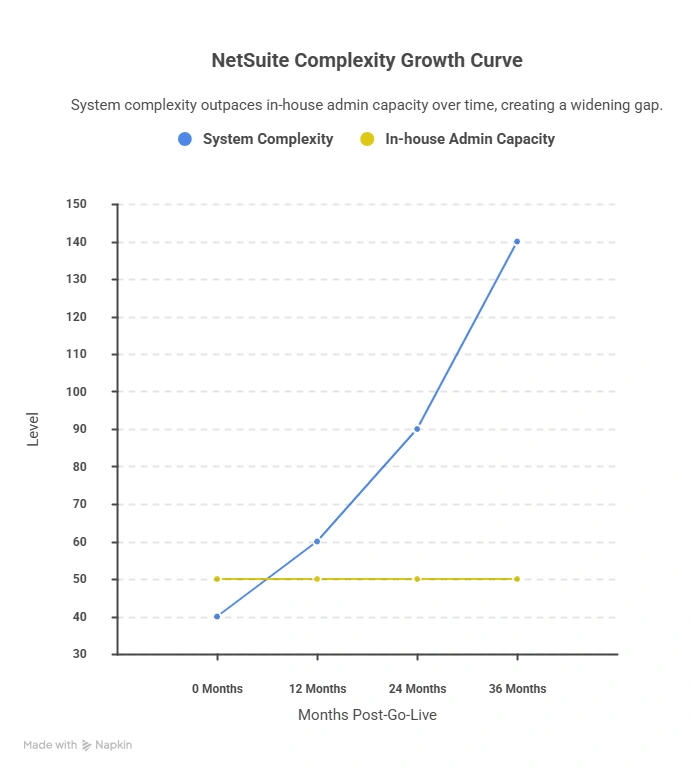
That describes most businesses in the first 12 months after go-live. It describes fewer businesses in month 24. And it describes a small minority by month 36.
Here is why the in-house model degrades over time.
NetSuite gets more complex, not less. Every new module, integration, subsidiary, or customization added after go-live increases the maintenance burden. A system that needed 10 hours per month of admin time at go-live often needs 30 hours per month two years later, with no change to the admin team size.
Up to 70% of ERP projects fail to deliver expected ROI after go-live. The failure is almost never in the software. It is in the absence of structured, ongoing management that keeps the system aligned with how the business actually operates.
One person cannot cover every skill. NetSuite requires functional knowledge across financials, inventory, order management, and reporting, alongside technical knowledge in SuiteScript, integration management, and release testing. No single admin holds all of this at depth simultaneously.
For a detailed comparison of what in-house administration covers versus what it typically misses, our blog on in-house vs. outsourced NetSuite administration covers the full breakdown.
The Seven Signals: Is It Time to Switch to NetSuite Managed Support Services?
These are the specific operational signals that indicate the in-house model has hit its structural limit. Each one is manageable in isolation. Two or more together is a pattern worth addressing.
Signal 1: Your Admin Spends More Time on Tickets Than on Improvement
This is the most common early signal. A capable in-house admin gets buried in day-to-day support requests: user access issues, saved search updates, workflow questions, and minor configuration changes.
Each request is legitimate. Together, they consume the week. The optimization work, the feature adoption, the release preparation, and the proactive health review all of it sits on a backlog that never gets cleared.
If your admin’s week is more than 60% reactive ticket work, the model is consuming resources without generating value.
Signal 2: A NetSuite Release Caused a Problem You Did Not Catch Until After Go-Live
NetSuite releases two major updates per year. Each one can break custom scripts, workflows, saved searches, and integrations. The correct response is structured sandbox testing before the release hits production.
If your last release cycle included any of the following, your release management is reactive, not proactive:
- Problems discovered after go-live
- A custom script that stopped working
- A saved search that quietly started returning wrong data
- Anyone saying “the release must have broken that.”
A managed services team prevents these problems by testing before the release, not after.
See how our managed services can replace your in-house model at a lower total cost. Schedule a Demo
Signal 3: Your Admin Is the Only Person Who Understands Your Configuration
This is the most dangerous structural risk in an in-house model. One person holds all the knowledge. When they are on leave, nothing complex gets resolved. When they leave the company, institutional knowledge leaves with them.
The clearest triggers are:
- Your internal team spending more time on system issues than on data analysis
- Your customization backlog growing faster than it is being cleared
- A NetSuite upgrade approaching with no one responsible for testing
- and your admin being a single point of failure.
If any of these apply, the single-point-of-failure risk has already materialized. The question is not whether it will cause a problem. It is when.
Signal 4: Your Customization Backlog Keeps Growing
Every business has a list of NetSuite improvements they want: new reports, workflow changes, integration updates, custom fields, and SuiteScript modifications. In a healthy model, items get worked on and cleared.
If the backlog is growing faster than it is being cleared, either the admin does not have the capacity or the work requires SuiteScript development skills they lack. Both are structural gaps a single-admin in-house model cannot resolve.
Signal 5: Your Month-End Close Is Getting Longer, Not Shorter
The month-end close is a sensitive indicator of NetSuite’s health. A well-configured, actively managed environment should reduce close time over the months after go-live as automation is added and reporting is refined.
If your close is taking longer than it did 12 months ago, the system is drifting away from your business processes rather than keeping up with them. Reports are not accurate. Manual workarounds have accumulated. The system was not actively maintained.
A managed services team with financial advisory depth catches close-related issues before they add days to your process. Structured optimization can reduce a month-end close from 12 days to 4 days.
Signal 6: Your Admin Handles Issues Outside Their Skill Depth
Not every NetSuite admin writes SuiteScript. Not every admin understands the integration architecture of a Celigo or Boomi connector. Not every admin knows how to debug a RESTlet or configure a complex multi-subsidiary consolidation.
When your admin regularly does any of the following, it signals a skill depth gap:
- Submits Oracle support tickets for issues that are actually configuration problems
- Cannot diagnose a broken integration without external help
- Describes issues they cannot reproduce as intermittent and leaves them open
- Has no plan for the upcoming NetSuite release
A managed services team covers the full range across functional consulting, SuiteScript development, and integration management. No single admin does.
Signal 7: You Added a New Entity, Module, or Integration in the Last 12 Months
Growth events increase NetSuite complexity immediately. Adding a subsidiary requires intercompany billing configuration and multi-entity reporting. Adding WMS or Advanced Manufacturing requires module-specific expertise. Adding a new eCommerce or EDI integration requires ongoing monitoring.
Each growth event adds to the admin workload. If the support model has not scaled with the growth, the new complexity is running without adequate coverage.
The Financial Tipping Point Calculation
Most businesses run this comparison too simply. They compare the managed services’ monthly fee to the admin’s monthly salary and conclude that in-house is cheaper. The accurate comparison includes more.
In-house total annual cost:
| Component | Annual Cost |
|---|---|
| Base salary | $110,000 to $130,000 |
| Benefits and payroll taxes | $23,000 to $37,000 |
| Recruitment (amortized over 3 years) | $4,000 to $7,000 |
| Training and certification | $2,000 to $5,000 |
| Coverage gaps during leave | Variable |
| Cost of missed proactive maintenance | Variable |
| Total (excluding variable costs) | $139,000 to $179,000 |
Managed services total annual cost:
| Business Complexity | Annual Cost |
|---|---|
| Stable, light customizations | $36,000 to $60,000 |
| Mid-complexity, active development | $60,000 to $96,000 |
| Complex, multi-entity, multiple integrations | $96,000 to $144,000 |
For most mid-market businesses, managed services costs 40 to 60% less than a full-time hire. The break-even point where managed services approaches in-house cost only applies to the most complex enterprise environments.
The calculation above excludes the cost of problems that accumulate in a reactive in-house model. The release that breaks a workflow for three weeks. The customization backlog delays a new module by six months. The close takes four extra days because nobody maintained the reports.
For the full cost breakdown, our guide on NetSuite managed services cost and pricing covers every pricing variable.
When Is the Right Moment to Switch from In-house to NetSuite Managed Support Services?
Most businesses switch too late. They wait until a crisis before evaluating alternatives. By then, the evaluation happens under pressure, the transition happens under worse pressure, and the first three months of the new engagement are spent clearing accumulated problems.
The right moment to switch is before you urgently need to.
Three practical timing markers:
Before the next NetSuite release. If a release is coming in the next 60 to 90 days and you have no structured testing process, a managed services partner can be onboarded in time to handle it. Starting after the release means starting after a potential problem.
Before a planned growth event. If you are adding a subsidiary, a new integration, or a major module in the next quarter, onboard a partner first. They will configure the growth correctly and build the supporting processes around it.
When two or more signals from the list above are present. Two signals means a pattern, not an incident. One problem is a problem. Two problems in the same system suggest the model is structurally insufficient.
For context on why post-go-live support structure matters more than most businesses expect, our blog on reasons to use NetSuite managed support after going live covers the operational situations where the switch makes the clearest difference.
How the Transition from In-House to Managed Services Works
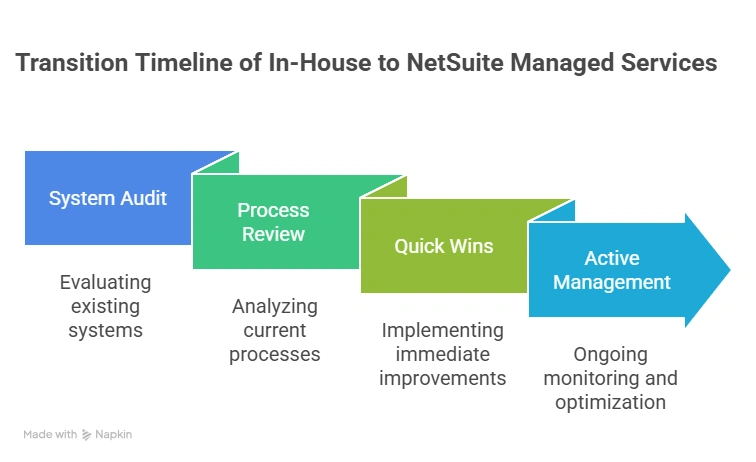
The transition is less disruptive than most businesses expect. A structured handover looks like this.
Week 1 to 2: System Audit
The partner reviews your NetSuite environment. They document every custom script, workflow, saved search, active integration, user, and role structure, open issues, and known technical debt. This audit produces a written deliverable that informs everything the team does going forward.
Week 3 to 4: Process Review
The partner maps your core business processes to your current NetSuite configuration. They identify gaps: processes that changed since go-live but whose configuration has not kept up, automations that were never built, reports that do not reflect how the business currently operates.
Month 2: Quick Wins
The partner works through the highest-priority items from the audit. A broken script gets fixed. A stale report gets rebuilt. An access issue has been resolved. A regular support cadence is established.
Month 3 and Beyond: Active Management
Release management runs on schedule. Optimization opportunities surface at each check-in. Training for new hires becomes part of the engagement. Your internal team, if you keep one, focuses on business-facing tasks.
For guidance on knowledge transfer from your current setup to a managed services partner, our blog on best practices for NetSuite data migration covers configuration knowledge transfer during any system transition.
The Hybrid Model: You Do Not Have to Choose Completely
Many businesses do not choose between in-house and managed services. They choose the right balance of both.
A hybrid model works well when:
- Your internal admin has strong functional NetSuite knowledge but limited technical depth
- The technical work, SuiteScript, integrations, and release management, exceeds their capacity or skill
- You want to retain direct oversight and business context while accessing specialist support on demand
In a hybrid model:
- The internal admin handles requirements gathering, user communication, and day-to-day configuration within their capability
- The managed services team handles SuiteScript development, release management, integration monitoring, and system health reviews
This model is often the most cost-effective option for businesses that are growing but not yet ready to fully outsource NetSuite management.
How Folio3 Handles the Transition
The SmartCare program is built for this specific moment. Not for businesses starting from scratch, but for businesses that have been managing NetSuite in-house and have hit the limits of that model.
The onboarding process starts with a system audit that documents your current environment. Everything the team does for the first 90 days is based on what they find in that audit, not on a generic support template.
SmartCare covers:
- Named consultant assigned from day one
- SLA-backed response times, written in the contract
- Release management with sandbox testing included as standard
- Monthly system health reviews
- Fixed-fee pricing with no variable billing surprises
For the full SmartCare scope, SLA structure, and how to start the transition conversation, our NetSuite managed services cover it all in detail.
Self-Assessment: Score Your Current In-House Model
Answer each question: Never (0), Sometimes (1), Regularly (2).
| Question | Your Score |
|---|---|
| Does your admin spend more than half their week on reactive tickets? | – |
| Has a NetSuite release caused a problem you caught after it went live? | – |
| Is your admin the only person who fully understands your configuration? | – |
| Is your customization backlog growing faster than items are being cleared? | – |
| Is your month-end close taking longer than it did 12 months ago? | – |
| Has your admin handled issues outside their technical skill depth? | – |
| Have you added a module, integration, or subsidiary without increasing support capacity? | – |
Score interpretation:
- 0 to 4: Your in-house model is working. Revisit in six months.
- 5 to 8: Early warning signs are present. A support model review is warranted.
- 9 to 14: Structural gaps exist. The cost of staying in the current model is likely higher than the cost of switching.
Final Thoughts
The in-house model works until it does not. The shift from working to not working is gradual. It shows up in a growing ticket backlog, a release that caused a problem, a close that takes longer than last year.
Each signal on its own is manageable. The pattern is what matters.
The businesses that make the transition well do it before a crisis. They run a clean handover, get through a proper onboarding, and by month three they have a partner who knows their system and is actively improving it.
The businesses that wait do it after a key admin leaves, or after a release breaks critical functionality. The transition still works. It just costs more and takes longer.
If two or more of the seven signals apply to your current situation, the cost of staying in the current model is already higher than you think.
Not sure where your current model stands? Let us audit your NetSuite environment. Book a Call
FAQs
When should a business switch from in-house NetSuite admin to managed services?
The clearest signals are: your admin spends more time on reactive tickets than improvement work, a NetSuite release caused a problem you caught too late, your admin is the only person who understands the configuration, your customization backlog keeps growing, your close is getting longer, your admin handles issues outside their technical depth, or you have added complexity without adding support capacity. Two or more of these signals together indicates a structural gap in the current model.
Is managed services cheaper than an in-house NetSuite admin?
For most mid-market businesses, yes. An in-house admin costs $139,000 to $179,000 annually in total, including salary, benefits, payroll taxes, recruitment, and training. Managed services typically range from $36,000 to $144,000, depending on scope. Most mid-market businesses pay 40 to 60% less for managed services and get broader coverage in return.
Can I keep my in-house admin and add managed services?
Yes. A hybrid model works well when your internal admin handles business-facing tasks while the managed services team handles SuiteScript development, release management, integration troubleshooting, and system optimization. This is often the most cost-effective model for growing businesses.
How long does the transition from in-house to managed services take?
A structured transition takes four to six weeks for onboarding, including a system audit in weeks one and two, a process review in weeks three and four, and quick wins in month two. Full support cadence is typically established by month three. The transition is less disruptive than most businesses expect when the incoming partner conducts a proper system audit.
What happens to my institutional knowledge when I switch to managed services?
A good managed services partner starts with a system audit that documents your current configuration, customizations, integrations, and open issues. This transfers the knowledge that currently lives with one person to a team with documented processes. It is no longer a single-person dependency.