Key Takeaways
- There is a nuance between NetSuite Premium and ACS. Premium Support fixes problems when they happen. ACS monitors your system, works to prevent issues, and guides ongoing optimization.
- ACS has five tiers. Advise, Monitor, Optimize, Architect, and Platform. Each one adds more involvement, more resources, and more cost.
- ACS works best when your business already has direction. It assumes you know what you want to do with NetSuite. If you are still figuring that out, ACS often delivers less than expected.
- The biggest complaint about ACS is inconsistency. Outcomes depend heavily on which consultant you get. Many clients report that calls become status updates rather than working sessions.
- Third-party support partners offer a real alternative. They typically cost 40 to 60% less than ACS, offer more flexibility, and bring industry-specific expertise that Oracle’s generalist consultants often do not.
- Folio3’s SmartCare program is a structured alternative to ACS. It covers break-fix, release management, customization support, and system optimization under one predictable monthly fee.
A finance director we worked with had been on NetSuite ACS Optimize for 14 months. The contract cost her company just under $60,000 a year. When we asked what they were getting out of it, she paused before answering.
“Mostly status updates,” she said. “The calls happen. Someone reads back what is in the queue. We rarely leave with anything resolved.”
That is not an isolated experience. User feedback across forums and industry groups shows a consistent pattern: ACS calls become status updates rather than working sessions, with little movement between meetings. Others point to long turnaround times, vague deliverables, or limited ownership of outcomes.
None of that means ACS is a bad product. It means it is not the right product for every business. Before you pay for a 12-month contract, you cannot exit early; it is worth understanding exactly what you are buying.
This blog explains what NetSuite Premium Support and ACS each include, where each one fits, what the real limitations are, and when a third-party support partner makes more sense.
What Is NetSuite Premium Support?
NetSuite Premium Support is an enhanced support tier that builds on the standard support included in all NetSuite subscriptions. It gives you priority access to support engineers, faster response times, and guidance for configuration, usage, and troubleshooting.
Premium Support responds to problems. It does not look for them before they happen.
Here is what Premium Support includes:
- Priority case management with faster response times than Basic Support
- 24/7 assistance for critical issues with a 1-hour response time
- Telephone support during business hours
- Weekend and holiday coverage for urgent cases
- Early release notifications before NetSuite updates go live
- Commerce Response Services for eCommerce operations
Premium Support does not include deep, ongoing optimization or proactive monitoring. It does not replace the need for specialized help with custom workflows, integrations, or advanced configuration. That typically requires consulting or managed services.
Premium Support is the right fit when:
- Your NetSuite environment is stable with minimal customizations
- You have internal ERP expertise that handles day-to-day system management
- You need faster response times and telephone access, but not ongoing optimization
- Your processes are well-defined, and your team knows what they need from the system
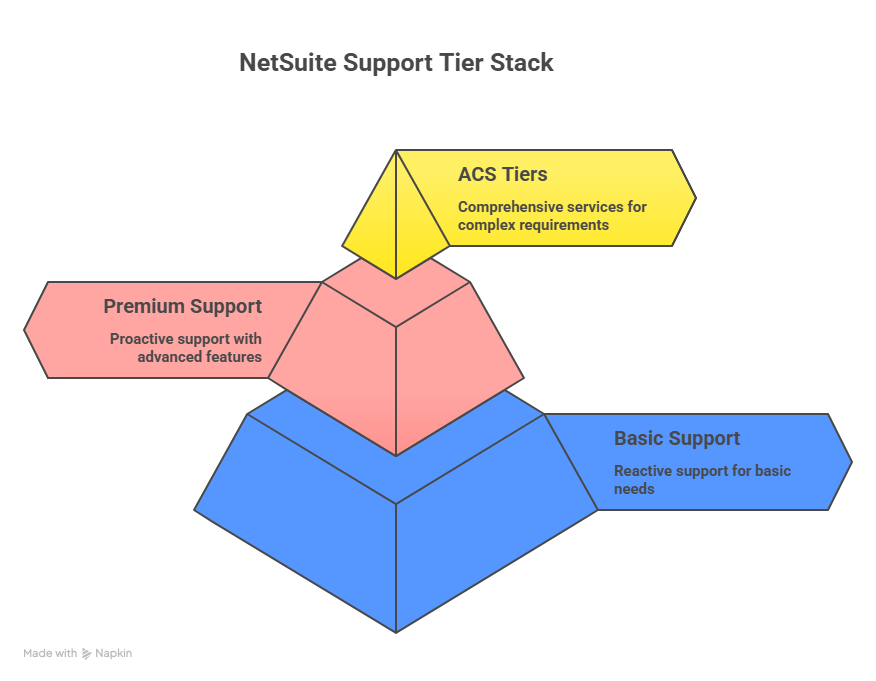
What Is NetSuite ACS?
NetSuite ACS is an Oracle’s premium support subscription, designed to take businesses from reactive to proactive.
Where Premium Support responds to issues, ACS monitors your system actively, looks for optimization opportunities, and provides ongoing advisory as your business grows. It is a subscription layered on top of your existing NetSuite license. It does not replace your license cost. It adds to it.
ACS gives you access to:
- A Customer Success Manager (CSM) assigned to your account
- Solution architects and functional consultants
- Services across nine areas, including remediation, development, performance tuning, and release readiness
- ACS Playbooks designed to enforce best practices across business processes
- Proactive monitoring and system health reviews
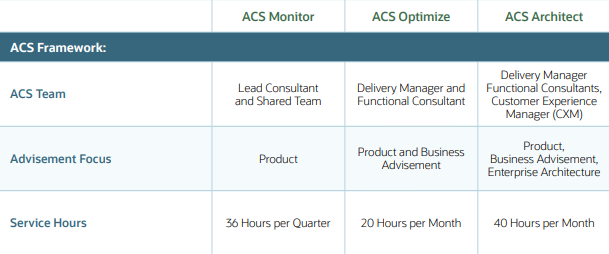
One important thing to understand before you buy: ACS focuses on NetSuite platform health, upgrades, and technical guidance. It does not replace your implementation partner or your internal team.
What Are the Four ACS Tiers?
ACS is not one product. It is a tiered program with four levels. Each level increases the scope of involvement and the cost.
Understanding the tiers helps you see whether the level you are considering actually matches what you need.
ACS Advise
The entry-level ACS offering. It is available to businesses just getting started on NetSuite. AC Advise gives you access to shared NetSuite specialists and basic guidance. It does not include a dedicated consultant or proactive monitoring.
Best for: Businesses new to NetSuite that want guided access to expertise without committing to a deep engagement.
ACS Monitor
ACS Monitor includes more hands-on execution for product-focused activities. You get a designated functional consultant and an initial review at the start of the engagement, with an annual review after that.
Best for: Stable NetSuite environments where you want a designated resource and periodic system reviews without heavy strategic involvement.
ACS Optimize
ACS Optimize adds solution management, performance assessments, and expert guidance on product upgrades and business process improvements. Beyond a designated CSM, it also includes an assigned support team for deeper engagement.
This is the most commonly purchased ACS tier among mid-market businesses. It is also where the disconnect between expectation and reality shows up most often.
Best for: Growing businesses with complex NetSuite environments that need ongoing optimization guidance and a dedicated support team.
ACS Architect
ACS Architect adds full solution management, access to ACS Playbooks, and access to specialized teams. It is the right level for businesses with significant customization, multi-entity complexity, or active strategic NetSuite initiatives.
Best for: Large mid-market or enterprise businesses with active development roadmaps and complex multi-subsidiary environments.
What Is the Real Difference Between Premium Support and ACS?
This comparison is the most useful thing to understand before you make a decision.
| Feature | Premium Support | ACS |
|---|---|---|
| Primary mode | Reactive (break-fix) | Proactive (monitoring and optimization) |
| Dedicated CSM | No | Yes (Monitor and above) |
| Proactive system monitoring | No | Yes |
| Business process optimization | No | Yes |
| Release management | Notifications only | Active review and readiness |
| Customization support | No | Limited |
| ACS Playbooks | No | Yes (Optimize and above) |
| Annual system review | No | Yes |
| Replaces implementation partner | No | No |
| Contract structure | Included in license | Annual subscription, additional cost |
The practical takeaway: Premium Support keeps your system running when something breaks. ACS helps a complex system improve over time.
Most businesses start with Premium Support. They move to ACS when their NetSuite environment becomes more complex, when they add subsidiaries or regions, or when their internal team can no longer keep pace with system demands.
To understand the full spectrum of NetSuite support options beyond just Premium and ACS, our blog on NetSuite support levels explained covers every tier in detail, including Silver, Gold, and Platinum.
Where Does ACS Fall Short?
For mid-sized businesses that are too large for out-of-the-box ERP but not yet fully resourced internally, ACS can become more of a constraint than a solution. The program assumes your business already has a strong internal understanding of NetSuite’s capabilities and a defined backlog of initiatives.
If you are still working out what your system should be doing, ACS struggles to help you get there.
Here are the most common gaps businesses report:
1. Inconsistent consultant quality
Success often depends on the specific consultant you are assigned. When your results depend on who shows up, the program itself is not reliable. This is a structural problem, not a one-off.
2. Reactive posture inside a proactive wrapper
The model often lacks structured discovery and rarely starts conversations around untapped features or underperforming workflows. Instead, it waits for you to direct it. Many clients describe ACS as a ticket-based service packaged in premium pricing.
3. No discovery-led approach for businesses still growing
For growing companies that need hands-on system diagnostics, business process mapping, or proactive guidance, ACS often waits for you to tell it what to do rather than helping you figure out what to do.
4. Annual contract lock-in
Once you sign a 12-month ACS agreement, you are committed. If the engagement is not delivering value at month three, you still pay for months four through twelve. There is no clean exit.
5. Limited industry specialization
ACS consultants are generalists. Many businesses find they need to add deeper industry-specific expertise on top of ACS to handle unique workflows, compliance requirements, or sector-specific processes.
When Does ACS Make Sense For Your Business?
Despite its limitations, ACS does deliver value in the right situation. Here is when it is the better choice.
ACS is worth considering when:
- Your NetSuite environment includes multiple subsidiaries, currencies, or tax jurisdictions
- You have a clear internal roadmap and need technical resources to execute against it
- Your team has strong NetSuite knowledge and can direct a CSM
- You are managing a large-scale, mission-critical NetSuite environment with high transaction volumes
- You have already used up what Premium Support can offer and need deeper involvement
ACS is often recommended for OneWorld customers specifically, because of the added complexity around multi-subsidiary, multi-currency, and tax configurations.
The honest summary: ACS works well when you know what you want, and you need a dedicated Oracle resource to help you get there. It works poorly when you need someone to help you figure out what you want.
What Are the Alternatives to NetSuite Advanced Customer Support (ACS)?
If ACS does not fit your situation, or if you have tried it and found it lacking, there are better options.
Third-Party NetSuite Support Partners
Third-party partners can work alongside your existing ACS relationship, filling gaps in your current support structure. Or they can replace ACS entirely.
The approach is different. Rather than waiting for you to direct them, the best partners start with a system audit, map your business processes, and identify what is underperforming before they take any action.
Third-party solutions typically provide 40 to 60% better cost efficiency while delivering more focused attention and industry-specific expertise. For a detailed comparison of what Oracle’s direct support provides versus what a certified partner can offer, our blog on third-party NetSuite support vs Oracle explains the differences and helps you decide which model fits your situation.
Folio3 SmartCare
Folio3’s SmartCare program is a managed services model built for businesses that need ongoing NetSuite support without the cost and rigidity of ACS.
Here is what SmartCare covers that ACS often does not:
- A named dedicated consultant who knows your specific configuration from day one
- Break-fix resolution with SLA-backed response times by priority level
- Release management with customizations tested before every NetSuite update goes live
- Minor customizations and configuration changes within the monthly scope
- User training for new staff and new feature rollouts
- Monthly system health review that surfaces issues before they affect operations
- Month-to-month flexibility, no 12-month lock-in
Folio3 vs. NetSuite ACS, Side by Side
| Factors | Folio3 | NetSuite ACS |
|---|---|---|
| Cost | 40-60% less than ACS | ~$56K/year (Optimize tier) |
| Billing | Fixed-cost quarterly retainer | Full year, paid upfront |
| Commitment | Quarterly | 12-month minimum |
| Team Structure | Dedicated team, every tier | Dedicated at higher tiers only |
| Queue | No (Direct team access) | Yes (Requests enter queue) |
| Flexibility | Project-based, retainer, or scaled team | Rigid tier structure |
| Industry Expertise | 50+ NetSuite functional consultants | General guidance |
The difference in practice: when a SmartCare client’s script breaks on a Thursday evening before a Friday close, someone who already knows that client’s system is working on it. Not a rotating consultant who has to read the account notes first.
To understand the full SmartCare engagement model and how it compares to ACS in scope and pricing, our NetSuite support services page covers the program in detail.
How Do You Choose Between Premium Support, ACS, and a Third-Party Partner?
Use this framework before you commit to anything.
Start here: How complex is your NetSuite environment?
If you have a clean, stable setup with minimal customizations and an internal team that handles routine issues, Premium Support is likely all you need.
If your environment includes custom scripts, multiple integrations, multi-entity operations, or active development work, you need something more proactive.
Next: Do you have internal NetSuite expertise?
If your team knows NetSuite well and can direct a support relationship, ACS can work. Your CSM has someone to take direction from and execute against.
If your team is still building its NetSuite knowledge, or if staff turnover has created gaps, ACS will leave you waiting for guidance that never quite arrives. A third-party partner who starts with discovery and builds a support relationship around your actual processes is a better fit.
Then: What is your priority, flexibility or structure?
ACS is a structured annual program. It provides a defined set of deliverables. If that structure fits your planning horizon, it works.
If your business is changing quickly, or if you want to scale support up or down without being locked into a contract, a managed services partner gives you the flexibility ACS does not.
For an honest look at what to expect from different support models and how to evaluate a NetSuite support partner before you commit, our NetSuite support partner guide covers the key questions and evaluation criteria.
If you are specifically evaluating alternatives to ACS because your current engagement is not performing, our page on NetSuite ACS alternatives explains what a better model looks like and how Folio3 approaches it differently.
Final Thoughts
The decision between Premium Support, ACS, and a third-party partner is not about which one sounds best in a brochure. It is about what your business actually needs right now.
Premium Support keeps a stable system running. ACS tries to make a complex system better. A good third-party partner does both and brings industry-specific context that Oracle’s generalist model rarely provides.
The finance director we mentioned at the start eventually moved her company off ACS and onto a managed services engagement with a partner who knew her industry and her configuration. The status update calls became working sessions. Things got resolved. The monthly cost dropped by about a third.
If your current support model is not delivering what you need, it is worth having an honest conversation about what a different approach would look like.
The Folio3 team works with businesses at every stage of this decision. Reach out, and we will give you a straight answer on which model fits your specific situation
FAQs
What is the difference between NetSuite Premium Support and ACS?
Premium Support is a reactive tier that fixes problems when they happen. It provides faster response times and telephone access compared to Basic Support, but it does not include proactive monitoring, system optimization, or a dedicated consultant. ACS is a proactive subscription service that monitors your system, provides ongoing optimization, and gives you a dedicated Customer Success Manager. The choice depends on your environment complexity and whether you need reactive or proactive support.
For more information, check our infographic on the NetSupport tiers with samples and services.
Is NetSuite ACS worth the cost?
It depends on your situation. ACS delivers value for businesses with complex multi-subsidiary environments that have a defined technical roadmap and internal NetSuite expertise to direct the engagement. It delivers less value for growing businesses that need discovery-led guidance, for teams without strong NetSuite knowledge, or for organizations that want flexibility without a 12-month contract. Many businesses find third-party managed services deliver equivalent or better outcomes at 40 to 60% of the ACS cost.
When should a business upgrade from Premium Support to ACS?
Consider ACS when your NetSuite environment becomes highly customized, when you add multiple subsidiaries or regions, or when your internal team cannot keep pace with system complexity. It is most commonly recommended for NetSuite OneWorld customers due to multi-entity and multi-currency complexity.
What is the alternative to ACS for businesses that want proactive support?
A certified NetSuite partner offering managed services is the most common alternative. Folio3’s SmartCare program provides dedicated consultant support, release management, break-fix resolution, and monthly system health reviews under a predictable monthly fee without annual contract lock-in.