These frequently asked questions (FAQs) are for coffee roasters, cocoa processors, and specialty food businesses implementing the Folio3 Cropster-NetSuite Connector to unify their production and financial operations. They are designed to clarify how the integration ensures accurate lot tracking, cost aggregation, and data flow between the two specialized systems. This guide helps ensure operational integrity, precise costing, and seamless traceability from raw material to finished goods.
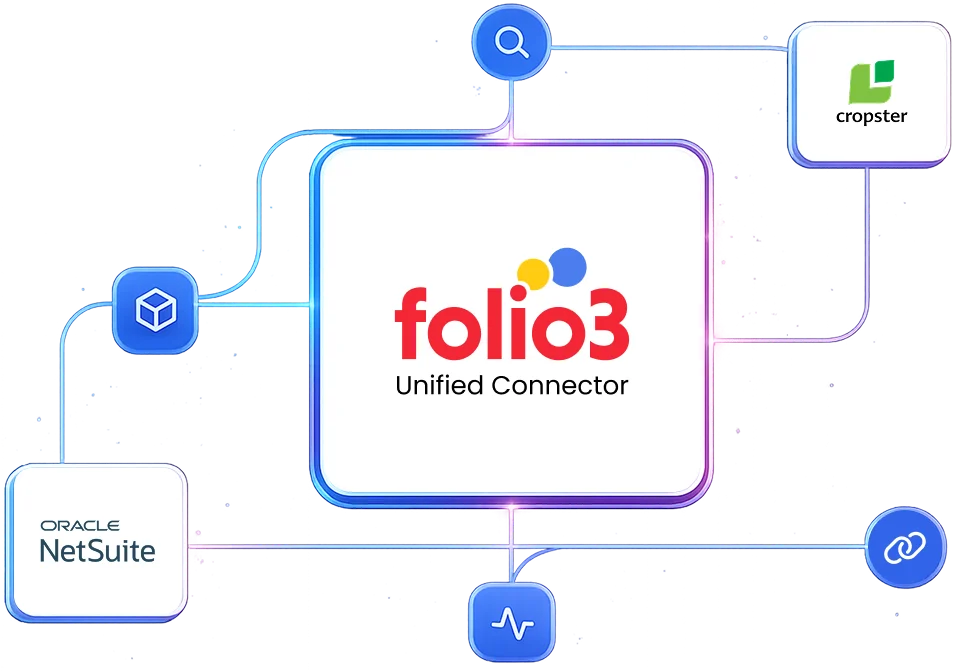
Yes. The Folio3 Cropster-NetSuite connector is purpose-built for green coffee, cocoa, and specialty food supply chains and is considered a robust, reliable connection for integrating production and quality data with financials.
When implemented correctly, it creates a seamless bridge between Cropster’s operational intelligence and NetSuite’s financial system of record. Its strength is in automating data flow for complex processes like inventory lot tracking, cost aggregation, and quality management.
This is a core architectural decision. In this model:
This creates a two-step process where Cropster manages the physical and qualitative lifecycle of inventory from intake to roasted output, while NetSuite manages the financial outcome. This model is ideal for scaling but requires discipline in data flow.
Possibly. If you are a single-site roaster with minimal lot tracking, manual quality recording, and simple costing, a direct point-to-point connector or manual entry might suffice. Cropster’s value, and the need for this integration, is unlocked when you manage complex green coffee inventories, require detailed production yield and cost tracking, need full lot traceability for quality control, or operate multiple production sites.
It makes sense when you outgrow manual spreadsheets and disjointed data. Specifically, when you:
Absolutely. This is a core strength. The connector seamlessly manages inventory transfers between locations (both in NetSuite and Cropster) in order to ensure lot traceability and cost data follow the physical goods. Whether you use external warehouses for green coffee or transfer roasted inventory between facilities, the integration maintains a single, accurate view across both systems.
The connector supports the following data flows:
Inventory is synchronized bi-directionally with a focus on lot integrity:
The connector maintains the link between NetSuite inventory detail records (lot-numbered items) and Cropster’s native lot system. This ensures that when a roast consumes Lot “A-123” in Cropster, it reduces the quantity of precisely that lot in NetSuite and preserves full traceability from purchase through production to sale for quality or recall purposes.
This is a key value driver. The Cropster-NetSuite integration automates cost aggregation:
Cupping sessions and quality data recorded in Cropster can be synchronized to custom fields on the corresponding Lot Numbered Inventory records in NetSuite. This allows sales, procurement, and management teams to view quality metrics directly within NetSuite for better decision-making without switching systems.
Planned production (e.g., Work Orders in NetSuite) can be exported to Cropster to inform the production schedule. Conversely, actual production sessions completed in Cropster can create or close Work Orders/Assembly Builds in NetSuite. This ensures financial records reflect real-world production.
Upon completing a production session, Cropster sends data on the finished products, quantities (net weight), and the specific green lots consumed. The Folio3 connector creates an Item Receipt or builds an Assembly in NetSuite for the finished goods by posting the accurate cost based on consumption.
Item/SKU information is automatically exported from NetSuite to Cropster. This ensures your production system always uses the correct, up-to-date product codes, descriptions, and specifications, which prevents errors in roast profiles or production logging.
Purchase Orders created in NetSuite can be exported to Cropster. This informs quality control and warehouse teams of expected arrivals. Upon physical receipt and quality check in Cropster, the data can flow back to create the Item Receipt in NetSuite.
The Folio3 Cropster-NetSuite connector employs end-to-end encryption (TLS 1.2+) for data in transit. For data at rest, encryption follows your existing NetSuite and Cropster security policies.
By maintaining an unbroken lot lineage between systems, the integration provides an audit trail from green coffee purchase (with origin data) through roasting to finished goods sale. This data structure is essential for compliance with food safety standards and enables rapid traceability in the event of a quality issue.
Folio3’s infrastructure and development processes are SOC 2 Type II compliant. The connector Cropster-NetSuite supports GDPR/CCPA requirements through:
Folio3 offers a preconfigured, adaptable connector built on deep experience with both platforms. It comes with standard, tested data models for core flows (inventory, production, costing). It is built on an extensible platform that allows data mappings, triggers, and logic (e.g., custom yield calculations) to be configured without starting from scratch.
Standard implementation of the Cropster-NetSuite integration takes 2-8 weeks, apart from the one-week BPQ and one-week UAT phases. All timelines depend on the customer providing all access and prerequisites in a timely manner.
The implementation process follows these steps:
If you do not have a sandbox account, the connector’s deployment will be done on your live production accounts. If you obtain a sandbox later, you will be additionally charged for migration of the connector’s deployment to the sandbox environment.
If your sandbox is refreshed, expired, or deleted, and Folio3 loses any work in progress once the connector’s deployment has started, additional charges will be applicable for re-implementing the solution.
Implementation and explicit testing of the integration against that new release are not included in the scope. Such requests will be treated as a Change Order and will be additionally charged.
Once the connector has been deployed after successful sign-off, if any issues emerge, Folio3 will charge separately for support as per their standard support rates.
Customers get five days of post-go-live support. If additional support is required beyond these hours, Folio3 will provide a separate statement of work (SOW). Dedicated support options (including 24/7 support) are also available at an additional cost for customers who need stricter SLAs.
The connector’s subscription includes regular updates to keep the product compliant with future releases for the standard feature set. But if the integration requires changes due to updates the customer has made in their accounts, or changes in customizations, these changes will be charged separately.
Minimal day-to-day skills are required. An administrator should:
The choice between Folio3’s prebuilt, configurable connector and a fully custom integration depends on your specific requirements for speed, budget, and uniqueness. Our prebuilt connector delivers 80-90% of the required functionality for most businesses at a fraction of the cost and time of custom development. However, our connector can be customized to meet your unique business requirements.
A prebuilt connector may become insufficient in scenarios requiring entirely novel data objects not found in standard NetSuite or Opayo, or when business logic deviates so fundamentally that no core synchronization concepts apply.
With Folio3, outgrowing the connector is not a dead end. Our solution is built on a scalable platform that allows for progressive enhancement. We offer roadmap-aligned development services to extend functionality. This ensures the integration evolves with your business rather than requiring a costly and disruptive rip-and-replace project.
While technically possible, building a reliable integration directly using NetSuite’s REST APIs requires significant development expertise and ongoing maintenance. The Folio3 Cropster-NetSuite connector abstracts this complexity by leveraging both REST and SOAP APIs appropriately based on the specific data operation. This provides a stable, optimized layer that handles authentication, error recovery, and performance optimization automatically.
With Folio3’s managed connector, versioning and upgrades are handled seamlessly by our team. We monitor both NetSuite and Opayo release schedules, test compatibility proactively, and deploy necessary updates during maintenance windows. This eliminates the typical pain points of API version deprecation, authentication methods that change, and other changes that break or burden internally maintained integrations.
Folio3 provides comprehensive long-term maintenance through our support agreements, including monitoring for compatibility issues, the application of necessary updates, performance optimization, and addressing any emerging requirements. This managed approach transfers the maintenance burden from your internal IT team to our specialized experts and ensures sustained reliability without draining your technical resources.
Folio3 typically charges a fixed annual license fee, a fixed one-time setup fee, variable customization charges, and variable on-demand support charges. The cost of the standard connector starts at around $300 per month.
TCO is typically lower than a fully custom build or an unwieldy iPaaS setup for this specific point-to-point integration. You avoid the ongoing developer cost of maintaining custom scripts and benefit from Folio3’s upgrades and support. The biggest cost saver is preventing operational inefficiencies and errors caused by not having the integration.
This connector is specifically optimized for coffee roasters, cocoa processors, and similar businesses where production yield, lot-level traceability, and accurate cost aggregation from raw material to finished goods are critical to operational and financial success. It excels where manual data transfer between production and finance is error-prone, slow, and unscalable.
Regret usually comes from:

By submitting the form you agree to terms & condition and privacy policy of Folio3
Meet the Folio3 team at the largest NetSuite community gathering.