These frequently asked questions (FAQs) are for businesses implementing the Folio3 Shopify-NetSuite Connector to synchronize their e-commerce operations with their financial and inventory systems. They are designed to clarify how the integration ensures accurate data flow for orders, inventory, and customers across both platforms. This guide helps ensure a seamless connection that supports growth while maintaining operational and financial integrity.
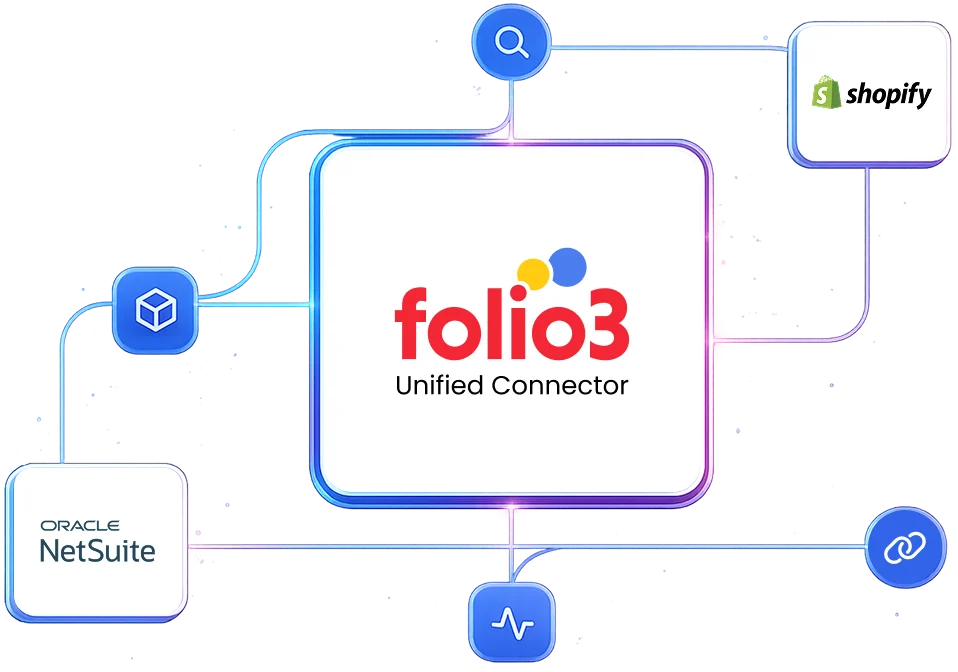
Yes, the Folio3 connector makes the integration robust and scalable. Shopify’s modern API and NetSuite’s flexibility, when connected through a purpose-built connector that runs inside your NetSuite environment, work exceptionally well for mid-market to enterprise businesses.
Challenges occur due to poor mapping logic, weak error handling, or attempting direct API calls, all of which the Folio3 connector is designed to solve.
NetSuite should unequivocally be the system of record for inventory, product master data, pricing, and customers. Shopify should be the source of truth for the customer-facing experience, cart, and session data.
The Folio3 Shopify-NetSuite connector is architected with this principle, ensuring bidirectional sync where appropriate in order to maintain clear system-of-record ownership and avoid conflicts
No. NetSuite’s “heaviness” is its strength for back-office operations. For a growing or established brand, the complexity of multi-channel sales, advanced inventory, and financial compliance makes NetSuite an asset. The Folio3 connector acts as a streamlined interpreter, allowing Shopify’s agility to coexist with NetSuite’s depth.
The Shopify and NetSuite integration makes sense at virtually any volume where financial and operational complexity exists. However, the ROI becomes very clear at >100 orders/month, where manual data entry becomes costly and error-prone. For businesses doing >500 orders/month or with multi-warehouse/3PL complexity, it’s essential.
It is an extremely common and proven pattern among scaling DTC brands and B2B companies. Thousands of businesses run on Shopify+NetSuite. The key to scalability is the robustness of the connector, not the concept itself. Folio3’s architecture is built on high-volume, fault-tolerant principles used by enterprise clients.
The following data flows between Shopify and NetSuite:
No. The integration is a data synchronizer. It does not perform any data validation or data cleansing operations. The customer must ensure that data input in one system meets the requirements of the other system. Efforts required to debug data-related errors caused by incorrect data input will be charged separately.
No. Syncing of historical data from NetSuite to the other system or vice versa is out of scope. The connector starts syncing data from the point of deployment forward.
Folio3 supports near-real-time inventory sync through webhooks and configurable intervals (e.g., every 15 minutes). For critical, fast-moving SKUs, you can trigger immediate updates post-purchase or fulfillment. “Real-time” is a trade-off with system load. We optimize for practical freshness that prevents overselling.
With proper configuration, the risk is minimal. The connector can enforce a safety stock buffer and set inventory thresholds. During high-volume events (Flash Sales), we recommend temporarily switching to a “sell from available” model where Shopify manages inventory within a predefined allocation to decouple from sync latency.
Yes. The Folio3 Shopify-NetSuite connector is designed for multi-store and multi-channel setups. Each store can map to different NetSuite subsidiaries, departments, classes, or locations. Orders, inventory, and items are tagged and segregated by origin.
This is a policy decision configured in the connector. The standard pattern is that when an item is out of stock in NetSuite, the connector can either set inventory to 0 in Shopify, allow backorders by passing the order to NetSuite as a backordered sales order, or show a pre-order message. Folio3 supports all workflows.
The connector can be configured to perform a final inventory reserve check when the order is placed. If inventory has dipped below the purchased quantity between cart and checkout, the customer can be notified. The order still flows to NetSuite, which reflects the true available inventory for fulfillment.
Returns initiated in Shopify (via a returns management app) can sync to NetSuite as Return Authorizations (RMAs) or Credit Memos. The connector syncs the return reason, items, quantities, and condition. Subsequent refunds processed in Shopify sync as customer refunds in NetSuite.
NetSuite should be the master. This ensures consistency with B2B price lists, customer-specific pricing, and volume tiers. The Folio3 connector syncs price lists from NetSuite to Shopify, overwriting any manual Shopify prices. Promotions and discounts (e.g., “BUY1GET1”) can be managed in Shopify.
Line-level discounts applied at checkout in Shopify are passed to NetSuite as discount items or reduced line amounts. Shipping discounts sync as a discount against the shipping charge. Whole-cart promotions are often best kept as Shopify logic, with the net order total syncing to NetSuite. The connector itemizes discounts for proper GL impact.
Yes, if using Shopify Plus. The connector can identify the customer via email or Shopify customer ID, fetch their specific NetSuite price list or currency, and apply it either at login (for B2B stores) or during cart/checkout via Shopify Scripts/API calls.
Shopify’s product variants map to NetSuite’s Matrix Items. The parent product in Shopify maps to the NetSuite Matrix Parent. Each variant (Size S, Color Red) maps to a specific Matrix Child item in NetSuite, with its own SKU, inventory, and price. The connector maintains this relationship during sync.
Upon first order, the connector creates a NetSuite customer record using Shopify’s checkout data (email, name, address). Duplicate detection is performed using email and/or Shopify ID. B2B customers from a portal can be pre-provisioned via a separate sync.
The connector creates a Sales Order in NetSuite upon order placement. Once payment is captured/settled, a Customer Deposit or Payment is recorded in NetSuite against that Sales Order. Daily settlement reports from Shopify/Payment Processor can be used for reconciliation.
Refunds initiated in Shopify sync to NetSuite as Customer Refund transactions, linked to the original deposit/payment and sales order. They can also generate a Credit Memo. Partial refunds are handled proportionally. The Folio3 connector ensures the GL accounts (Revenue, Tax, Fees) are correctly impacted.
Typically as Sales Orders. This provides the most flexibility for edits, holds, and integration with advanced fulfillment/WMS. Cash Sales can be used if your process is ultra-simple and payment is always captured immediately, but Sales Orders are recommended.
Yes. When an order is fulfilled in NetSuite (Item Fulfillment transaction), the connector pushes the fulfillment status, tracking numbers, and carrier info back to Shopify. This triggers Shopify’s notifications and updates the customer-facing order status.
Automatically from NetSuite Item Fulfillment to Shopify. If using a multi-carrier shipping solution integrated with NetSuite, tracking flows through the same path.
Yes. NetSuite supports multiple Item Fulfillments per Sales Order. Each fulfillment syncs independently to Shopify, updating the customer with partial shipment tracking.
The connector includes transaction state management. If a fulfillment sync fails, it goes into an error queue for review. The order in Shopify will not show as fulfilled until the sync succeeds after the error is resolved (e.g., fixing data in NetSuite).
Absolutely. Orders synced in near-real-time can be picked, packed, and shipped immediately in NetSuite. The key is ensuring your order cut-off times and shipping methods in Shopify align with NetSuite’s fulfillment scheduling.
Discover how the native NetSuite connector by Folio3 helps you connect with Shopify.
The Folio3 Shopify-NetSuite connector employs end-to-end encryption (TLS 1.2+) for data in transit. For data at rest, encryption follows your existing NetSuite and Shopify security policies. The connector can be configured to exclude sensitive fields (like full credit card numbers, SSNs) from synchronization entirely. This ensures only necessary contextual data is shared with support agents.
Folio3’s infrastructure and development processes are SOC 2 Type II compliant. The Shopify-NetSuite connector supports GDPR/CCPA requirements through:
A prebuilt connector like that of Folio3 is almost always the right choice. It offers lower risk, faster time-to-market, proven patterns, and ongoing support. Custom integration is only justified for highly unique business models where no connector can accommodate core processes.
When your business logic deviates radically from standard e-commerce patterns, for example, you need real-time, bi-directional inventory sync across 50+ warehouses with complex allocation rules that conflict with the connector’s architecture. Even then, an extensible connector like that of Folio3 can often be customized.
Yes, the Folio3 connector can be customized to handle your edge cases. We can customize the Shopify-NetSuite connector to fit your business needs and workflows. This way, you don’t have to learn new ways of doing things. Instead, the connector adapts to your business needs.
With Folio3, “outgrowing” the connector is not a dead end. Our solution is built on a scalable platform that allows for progressive enhancement. We offer roadmap-aligned development services to extend functionality. This ensures the integration evolves with your business rather than requiring a costly and disruptive rip-and-replace project.
You need an E-commerce Manager to define requirements, a NetSuite Admin to configure NetSuite, and a Technical Analyst to monitor the connector, handle basic errors, and liaise with Folio3 support. Deep developer skills are not required with a managed service.
Standard implementation of the Shopify-NetSuite integration takes 2-8 weeks, apart from the one-week BPQ and one-week UAT phases. All timelines depend on the customer providing all access and prerequisites in a timely manner.
The implementation process follows these steps:
If you do not have a sandbox account, the connector’s deployment will be done on your live production accounts. If you obtain a sandbox later, you will be additionally charged for migration of the connector’s deployment to the sandbox environment.
If your sandbox is refreshed, expired, or deleted, and Folio3 loses any work in progress once the connector’s deployment has started, additional charges will be applicable for re-implementing the solution.
Implementation and explicit testing of the integration against that new release are not included in the scope. Such requests will be treated as a Change Order and will be additionally charged.
Once the connector has been deployed after successful sign-off, if any issues emerge, Folio3 will charge separately for support as per their standard support rates.
A comprehensive test plan must cover:
Customers get five days of post-go-live support. If additional support is required beyond these hours, Folio3 will provide a separate statement of work (SOW). Dedicated support options (including 24/7 support) are also available at an additional cost for customers who need stricter SLAs.
The connector’s subscription includes regular updates to keep the product compliant with future releases for the standard feature set. But if the integration requires changes due to updates the customer has made in their accounts, or changes in customizations, these changes will be charged separately.
While technically possible, building a reliable integration directly using NetSuite’s REST APIs requires significant development expertise and ongoing maintenance. The Folio3 connector abstracts this complexity by leveraging both REST and SOAP APIs appropriately based on the specific data operation. This provides a stable, optimized layer that handles authentication, error recovery, and performance optimization automatically.
With Folio3’s managed connector, versioning and upgrades are handled seamlessly by our team. We monitor both NetSuite and Shopify release schedules, test compatibility proactively, and deploy necessary updates during maintenance windows. This eliminates the typical pain points of API version deprecation, authentication methods that change, and other changes that break or burden internally maintained integrations.
Folio3 provides comprehensive long-term maintenance through our support agreements, including monitoring for compatibility issues, applying necessary updates, optimizing performance, and addressing any emerging requirements. This managed approach transfers the maintenance burden from your internal IT team to our specialized experts, ensuring sustained reliability without draining your technical resources.
Folio3 typically charges a fixed annual license fee, a fixed one-time setup fee, variable customization charges, and variable on-demand support charges. The cost of the standard connector starts at around $300 per month.
TCO is typically lower than a fully custom build or an unwieldy iPaaS setup for this specific point-to-point integration. You avoid the ongoing developer cost of maintaining custom scripts and benefit from Folio3’s upgrades and support. The biggest cost saver is preventing operational inefficiencies and errors caused by not having the integration.
The Folio3 Shopify-NetSuite connector is best suited for:
Regret usually comes from:

By submitting the form you agree to terms & condition and privacy policy of Folio3
Meet the Folio3 team at the largest NetSuite community gathering.