Key Takeaways
- Inventory accuracy is the foundation of everything. Auto parts distributors managing tens of thousands of SKUs across multiple warehouses cannot afford stock discrepancies. One wrong number cascades into backorders, lost customers, and damaged margins.
- Multi-channel order management is non-negotiable. Whether orders come in through EDI, a B2B portal, a counter sale, or an e-commerce store, they all need to pull from one inventory number, not four separate systems.
- The automotive parts distribution ERP market is growing at 6.4% CAGR, reaching $1.22 billion by 2031. More distributors are moving off legacy tools, and the platforms competing for their business have never been stronger.
- NetSuite, configured by Folio3, is the strongest cloud ERP choice for mid-market auto parts distributors. It covers inventory, orders, logistics, financials, and e-commerce in one system, with automotive-specific configuration built around how distributors actually operate.
- Logistics integration separates good ERP from great ERP. Real-time carrier rate shopping, automated shipping label generation, and 3PL connectivity are not nice-to-haves for high-volume parts distributors. They are operational requirements.
- Choosing the right implementation partner is as important as choosing the right software. Automotive distribution has enough nuance that partner experience in this specific sector changes outcomes.
Here is a scenario that plays out more often than it should.
A regional auto parts distributor wins a new fleet account. It is a big one, i.e., 12 service centers, weekly replenishment orders, and tight delivery windows. The sales team celebrates. Then the operations manager realizes the problem. Their inventory system shows stock at their main warehouse. Their second warehouse runs on a different platform. Their e-commerce orders are processed through a third tool. And none of them updates each other in real time.
The first major order to the new account goes out partially. Two SKUs were marked available in the main system, but had already been committed to another customer. The fleet account calls. This marks the start of a bad relationship, which you definitely don’t want at any cost.
And it is exactly the kind of problem that ERP software for auto parts distributors is built to fix. This guide covers what to look for, what the top platforms offer, and how to make the right call for your business.
What Makes Distribution ERP Different for Auto Parts?
Distribution ERP is not the same across all industries. Auto parts distribution has specific requirements that a generic distribution ERP often does not handle well out of the box.
Here is what separates auto parts distribution from other wholesale distribution businesses:
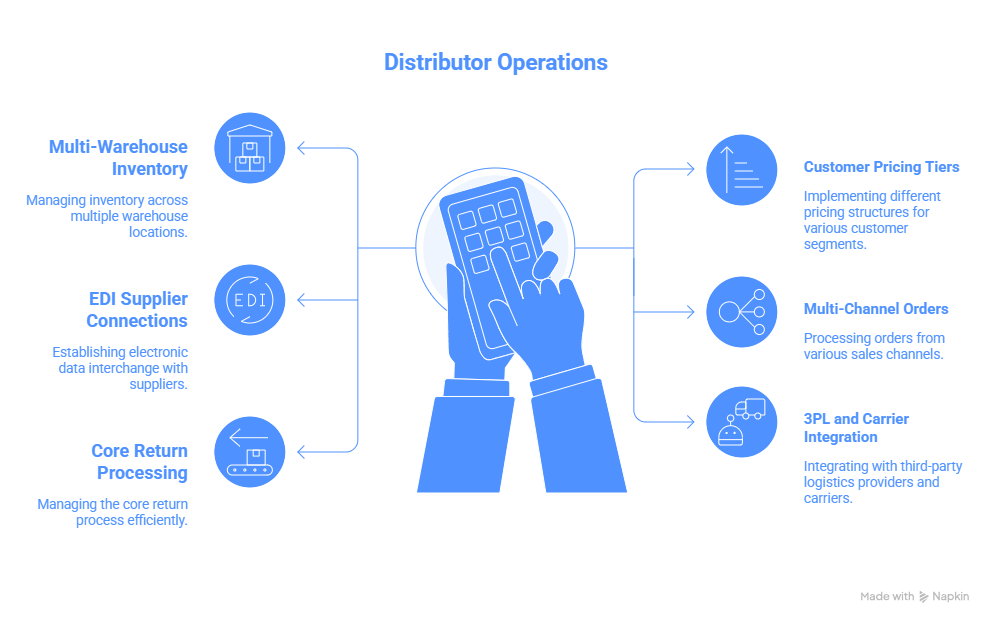
- SKU counts that run into the tens of thousands. A mid-sized auto parts distributor might stock 50,000 to 150,000 unique parts. Each SKU has its own vendor code, cross-reference number, compatibility profile, and reorder logic. Managing this in a system not built for high-SKU environments is painful.
- Customer-specific pricing at scale. Fleet accounts, independent repair shops, dealerships, and retail walk-in customers all buy at different prices. Tier pricing, volume discounts, contract pricing, and promotional pricing need to be maintained per customer without manual management.
- Returns and core charges. Auto parts distribution involves core return cycles for reman parts. Tracking core deposits, processing returns, and reconciling credits requires specific workflow support that generic distribution ERPs often miss.
- Multi-warehouse order sourcing. When an order comes in, the system needs to decide instantly which warehouse to fulfill from based on stock availability, shipping cost, and delivery time. Manual allocation decisions at high order volumes do not scale.
- EDI connectivity with OEM and aftermarket suppliers. Your top suppliers send purchase order acknowledgments, advance ship notices, and invoices via EDI. Your largest customers send purchase orders via EDI. Without ERP-level EDI handling, someone on your team is manually re-entering this data.
What Should ERP Do for Auto Parts Distributors?
Every ERP platform claims to handle distribution. The question is whether it handles auto parts distribution specifically. Here are the capabilities that matter most.
Real-Time Multi-Warehouse Inventory
Your inventory record needs to reflect every warehouse, every bin, every stock movement, in real time. Not end-of-day batch updates.
When an order is placed, the available quantity should reflect every pick already in progress, every inbound shipment expected today, and every inter-warehouse transfer in transit.
This is the capability that prevents the partial shipment scenario we described in the introduction. One number that is always accurate and always current.
Demand Planning and Replenishment Automation
Distributing auto parts is about managing thousands of SKUs, tracking inventory across multiple warehouses, processing high-volume orders, and delivering quickly to customers who expect precision. Manual reorder management at that scale is not sustainable.
A sophisticated ERP calculates reorder points dynamically based on sales velocity, lead time from suppliers, and seasonal patterns. When stock drops below the reorder point, a purchase order is generated automatically. The buyer reviews it, approves it, and it goes. The team focuses on exceptions, not routine replenishment tasks.
Customer-Specific Pricing and Order Management
A fleet account with 200 vehicles does not pay the same price as a walk-in counter customer. Your ERP needs to maintain pricing matrices per customer or customer group, apply the right price automatically on every order, and give your sales team visibility into the margin on each transaction before the order ships.
This also covers contract pricing updates. When your supplier raises prices on a product line, the ERP should let you see immediately which customer contracts are affected and what the margin impact looks like before you decide how to pass the change on.
Core Charge and Return Management
Core deposits are a unique workflow in auto parts distribution. When a customer buys a remanufactured alternator, they pay a core deposit. When they return the old core, the deposit is credited. Your ERP needs to track open core charges per customer, process returns against the original transaction, and reconcile credits without manual accounting.
Without this in your ERP, your finance team is maintaining a separate spreadsheet of open core deposits per customer. I hate to break it to you, but that spreadsheet is always wrong.
Multi-Channel Order Processing
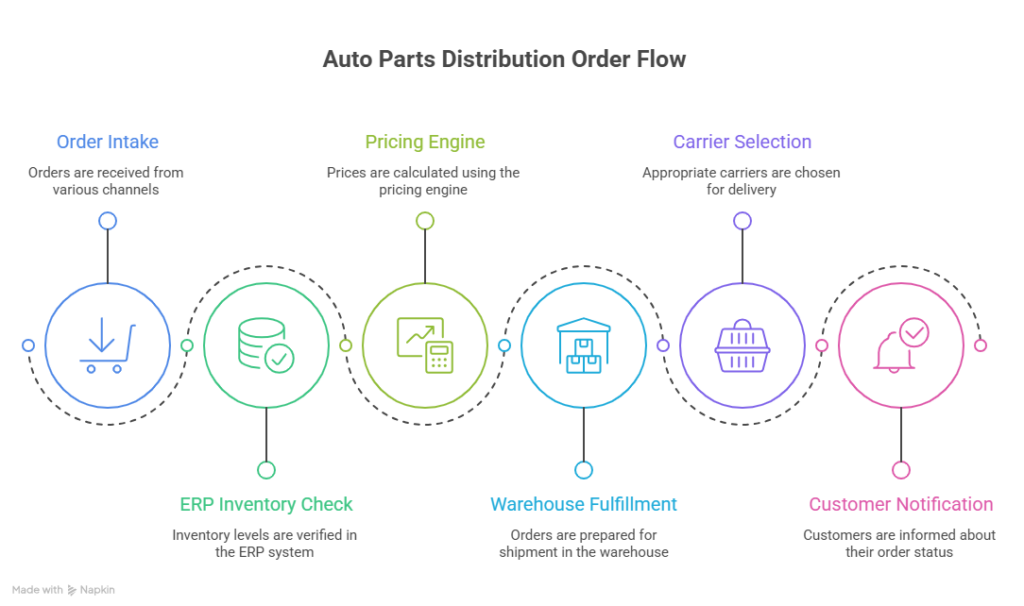
Auto parts distributors need to consolidate procurement, warehousing, order management, and analytics into a unified system to respond effectively to market demands. Orders should flow in from EDI, a B2B e-commerce portal, a phone/counter sale, and a marketplace like Amazon, all processing against the same inventory.
Each channel may have different fulfillment rules. An EDI customer may require advance ship notices and specific carton labeling. A B2C e-commerce order may go directly to a 3PL. Your ERP handles all of it through one order management workflow.
Logistics and Carrier Integration
Shipping is where margins live or die for parts distributors. Rate shopping across multiple carriers on every outbound shipment saves real money at volume. Automated label generation, tracking number updates back to the customer order, and 3PL connectivity all need to be part of the ERP, not a separate tool that requires manual reconciliation.
The 10 Best ERP Platforms for Auto Parts Distributors
We have reviewed the leading options for ERP platforms for auto parts distributors. Here is an honest breakdown of each.
Quick Comparison Overview
| 1 | NetSuite (via Folio3) | Mid-market auto parts distributors needing full business management | Cloud | ~$999/month + users |
| 2 | Acumatica | Aftermarket distributors wanting flexible, usage-based cloud ERP | Cloud | ~$7,000/month |
| 3 | SAP Business One | Small to mid-sized distributors in SAP-connected supply chains | Cloud / On-premises | Custom pricing |
| 4 | Epicor Prophet 21 | Wholesale parts distributors with complex pricing and order management | Cloud / On-premises | Custom pricing |
| 5 | Microsoft Dynamics 365 Business Central | Microsoft-ecosystem distributors needing solid financials and inventory | Cloud | From $80/user/month |
| 6 | SYSPRO | Mid-market manufacturers and distributors needing supply chain visibility | Cloud / On-premises | Custom pricing |
| 7 | VAI (S2K Enterprise) | Aftermarket distributors serving OEM programs with strict EDI requirements | Cloud / On-premises | Custom pricing |
| 8 | Autopart by Klipboard | Specialty aftermarket parts distributors wanting a purpose-built platform | Cloud | Custom pricing |
| 9 | Odoo | Small distributors needing affordable, modular ERP | Cloud / On-premises | From ~$38/user/month |
| 10 | DMS Automotive Parts Software | Distributors needing a parts-specific ERP with integrated POS and EDI | On-premises / Cloud | Custom pricing |
1. NetSuite (via Folio3) – Best for Mid-Market Auto Parts Distributors
NetSuite is a cloud-native ERP that covers every layer of a mid-market auto parts distribution business in one platform. Inventory, orders, procurement, logistics, financials, CRM, and e-commerce all connect without middleware.
For distributors running disconnected tools in such a way that an inventory system here, an accounting package there, an e-commerce platform that does not sync, moving to NetSuite removes the daily reconciliation work that nobody should be doing manually.
What makes NetSuite for automotive businesses different from a standard setup is how it’s configured to handle auto parts complexity. Auto parts companies deal with fitment data based on year, make, and model, large and fast-moving inventories, and frequent order matching from external systems. A standard setup doesn’t account for these requirements, so the system needs to be tailored to support accurate part selection, real-time inventory visibility, and integration with industry-specific platforms.
We understand multi-warehouse inventory sourcing logic, customer tier pricing, core charge workflows, and the EDI requirements that come with serving OEM accounts.
The system does not need to be rebuilt from the ground up for auto parts distribution. It needs to be configured correctly, which is exactly what we do.
Key strengths for auto parts distributors:
- Multi-warehouse inventory with real-time stock visibility, bin-level tracking, and automated inter-warehouse transfers
- Demand planning and replenishment automation that calculates reorder points dynamically based on sales velocity and lead time
- Customer-specific pricing matrices with volume tiers, contract pricing, and margin visibility per order
- Multi-channel order management handling EDI, e-commerce, counter sales, and B2B portal orders through one workflow
- Native e-commerce integrations for Shopify, Magento, BigCommerce, and Amazon — all updating the same inventory record
- 3PL and carrier integration for rate shopping, automated shipping label generation, and fulfillment routing
Best for: Auto parts distributors with 20 to 1,000 employees, multiple warehouses, multi-channel sales, and a need to consolidate disconnected systems.
What to know: NetSuite pricing is custom-based on modules and user count. The configuration scope matters significantly for auto parts distribution. Work with a Folio3 NetSuite consultant before committing to scope the right setup for your operation.
Proof from the field:
Voxx Wheels, a performance wheel business, moved to NetSuite with Folio3 to unify production and distribution operations that had grown too complex for their previous tools. Clean inventory data and accurate financial reporting across the business came from a single connected system.

2. Acumatica – Best for Aftermarket Distributors With Flexible Licensing
Acumatica is a cloud ERP platform with strong distribution capabilities and a licensing model that charges based on resource consumption rather than named users. For auto parts distributors with large teams where many users need occasional system access, this pricing approach often works out better than per-seat licensing.
Key strengths:
- Strong multi-warehouse distribution and inventory management
- Flexible, usage-based pricing that does not penalize you for adding users
- Good multi-channel order management capabilities
- Open API architecture for connecting to third-party tools and marketplaces
Best for: Aftermarket parts distributors that need a solid cloud ERP without per-user licensing constraints.
What to know: Acumatica’s core charge and automotive-specific workflows require configuration. Out of the box, it is a strong general distribution ERP. The automotive-specific depth comes through partner configuration.
3. SAP Business One – Best for Distributors in SAP-Connected Supply Chains
SAP Business One improves profitability for automotive aftermarket distributors by connecting inventory management, supply chain operations, and financial management in one platform. For distributors whose top customers or suppliers run SAP at the enterprise level, SAP Business One provides natural integration alignment.
Key strengths:
- Strong inventory management with multi-location support
- Good financial management and reporting
- Recognized in OEM and Tier-1 customer supply chain environments
- Proven track record in automotive aftermarket distribution
Best for: Small to mid-sized auto parts distributors managing multiple locations with SAP-connected supply chain partners.
What to know: SAP Business One is often deployed on-premises or through a hosted server, which adds infrastructure cost compared to fully cloud-native options. Advanced automotive workflows typically need add-on modules.
4. Epicor – Best for Complex Wholesale Parts Distribution
Epicor Prophet 21 is built specifically for wholesale distributors. Its order management, pricing, and customer-specific workflow capabilities are mature and well-suited to high-volume parts distribution environments where pricing complexity and order accuracy are daily operational priorities.
Key strengths:
- Designed for wholesale distribution from the ground up
- Strong customer-specific pricing, contract management, and discount handling
- Good EDI capabilities for managing supplier and customer electronic transactions
- Solid order management with counter sales, phone orders, and warehouse pick workflows
Best for: Wholesale auto parts distributors with complex customer pricing structures and high daily order volumes.
What to know: Prophet 21 is strong in distribution but does not cover manufacturing. For distributors that also do light assembly or kitting, the manufacturing-side functionality may require supplemental tools.
5. Microsoft Dynamics 365 Business Central – Best for Microsoft-Ecosystem Distributors
Dynamics 365 Business Central is a natural fit for auto parts distributors already running Microsoft 365, Teams, and Power BI. It reduces integration effort for companies embedded in the Microsoft ecosystem and offers solid financial management and inventory capabilities at a competitive per-user price point.
Key strengths:
- Native integration with Microsoft 365, Teams, and Power BI
- Strong financial management and basic inventory capabilities
- Familiar interface for teams already using Microsoft tools
- As distributors scale, warehouse challenges multiply.
Business Central’s integrated warehouse management addresses inventory inaccuracies and disconnected systems
Best for: Mid-market auto parts distributors primarily running in a Microsoft ecosystem with moderate operational complexity.
What to know: Business Central needs significant customization to handle the automotive-specific workflows that specialized platforms do out of the box. Core charge management, deep EDI integration, and parts-specific pricing logic all require custom development or third-party add-ons.
6. SYSPRO – Best for Supply Chain Visibility Across Distributor Networks
SYSPRO is flexible and well-suited for small to mid-sized businesses seeking robust functionality without overwhelming complexity. It covers production, inventory, sales, and financials with a relatively lightweight implementation footprint compared to enterprise platforms.
Key strengths:
- Strong supply chain and inventory planning tools
- Real-time visibility across multi-location distribution networks
- Good demand planning and purchasing automation
- Solid financial management for mid-market operations
Best for: Mid-market auto parts distributors needing strong supply chain visibility and solid core distribution capabilities.
What to know: SYSPRO has limited built-in automotive-specific features. Core charge management and deep EDI handling typically need custom configuration. E-commerce and CRM capabilities are not its strongest areas.
7. VAI S2K Enterprise – Best for Distributors Serving OEM Programs
VAI S2K fits automotive aftermarket environments where businesses manage thousands of SKUs, frequent replenishment cycles, and customer-specific ordering programs. It is particularly well-suited to distributors serving Honda and other OEM programs that require strict EDI, labeling, and quality compliance.
Key strengths:
- Precise inventory control with serialization, lot tracking, and core tracking
- Strong EDI capabilities for OEM-connected distributor programs
- Multi-warehouse distribution and logistics coordination built in
- Dynamic pricing with complex discounts and customer-specific rules
Best for: Automotive aftermarket distributors serving OEM supply programs with strict EDI, labeling, and compliance requirements.
What to know: VAI is less commonly chosen by distributors outside the OEM-connected aftermarket. For general wholesale parts distribution without OEM program requirements, the fit is less direct.
8. Autopart by Klipboard – Best for Specialty Aftermarket Distributors
Klipboard’s Autopart is built for aftermarket and specialty parts distributors, combining inventory accuracy, order tracking, and operational control in one platform. It integrates sales, inventory, accounting, and reporting, designed specifically for parts distribution workflows.
Key strengths:
- Purpose-built for automotive parts distribution
- Real-time inventory control across branches and warehouses
- Integrated order management from purchase through dispatch
- Good financial management designed for parts distribution operations
Best for: Specialty aftermarket parts distributors wanting an ERP built around their specific workflows rather than a generic platform configured to approximate them.
What to know: Klipboard is a smaller platform compared to NetSuite or Epicor. For larger multi-entity distributors with complex financial management needs or significant e-commerce volume, the scalability ceiling may become a limitation.
9. Odoo – Best for Small Distributors on a Tight Budget
Odoo is a modular, open-source ERP that lets smaller auto parts distributors build up their system as they grow. Low entry cost and a large app ecosystem make it an accessible starting point for businesses not yet ready for mid-market platform investment.
Key strengths:
- Very affordable pricing with a modular structure
- Covers inventory, procurement, sales, and financials in one system
- Large community and third-party app ecosystem
- Flexible cloud and on-premises deployment
Best for: Small auto parts distributors with under 50 employees needing structured ERP at a low cost.
What to know: Odoo’s automotive distribution capabilities are limited out of the box. Core charge management, complex EDI, and deep customer pricing matrices require customization. As your business grows, you may find yourself investing heavily in configuration work that approaches the cost of a mid-market platform.
10. DMS Automotive Parts Software — Best for Counter-Based Distributors With POS Needs
DMS Automotive Parts Software is an advanced distribution ERP solution covering automotive parts order management, inventory, financial management, and B2B/B2C e-commerce in one system. It handles counter sales, phone orders, EDI, and e-commerce through a unified order management interface built specifically for parts distribution.
Key strengths:
- Parts-specific order management covering counter, phone, EDI, and e-commerce
- Integrated POS for counter and phone sales operations
- Strong inventory management with RF scanning and physical count support
- Purchasing, forecasting, and integrated financials designed for distributors
Best for: Auto parts distributors with active counter sales operations needing POS and distribution ERP in one system.
What to know: DMS is a niche platform without the broader ERP breadth of NetSuite or Dynamics. For distributors needing strong CRM, advanced reporting, or tight e-commerce integration across multiple marketplaces, the platform may be limiting.

The Real Operational Problems ERP Solves for Auto Parts Distributors
Every parts distributor we work with describes their problems differently. The terminology changes. The platforms they blame change. But the root causes are always the same.
Stock Discrepancies That Cause Partial Shipments
Your order management system says you have 24 units of a part. But your warehouse team can only find 17. The discrepancy exists because returns came back and went into a staging area. A warehouse transfer was recorded in one system and not in another. A customer return was credited financially, but not physically receipted back to stock.
With ERP, every inventory movement, receipts, returns, adjustments, transfers, picks, and shipments, writes to the same record in real time. When an order is placed, the available quantity is accurate. Not approximate. Accurate.
Pricing Errors That Quietly Destroy Margins
A customer calls to dispute an invoice. They have a contract price of $14.20 for a filter, but they were just billed $18.50 for one. Your team investigates. The contract was in a spreadsheet. The order was entered manually in the system. Someone did not check the spreadsheet. The customer gets a credit, and the relationship takes a small hit.
A sophisticated ERP maintains every customer price rule in one place, applies it automatically on every order line, and flags exceptions before the order ships. The pricing error does not happen because there is no manual step between the contract and the invoice.
Carrier Costs That Nobody Is Managing
High-volume parts distributors ship hundreds of orders a day. If your team is selecting a carrier based on habit rather than current rate data, you are likely overspending on freight. Rate shopping across UPS, FedEx, USPS, and regional carriers on every order, based on dimensions, weight, destination, and service level, produces real savings at volume.
ERP with carrier integration does this automatically. The system selects the cheapest qualifying carrier, generates the label, and updates the order with the tracking number. No manual carrier selection. No missed savings.
EDI That Requires Manual Intervention
Your largest supplier sends a 940-item advance ship notice via EDI every time a delivery is on its way. Without an EDI-connected ERP, someone receives that file, cross-references it to open purchase orders, and manually receipts the delivery. For a business receiving multiple daily shipments from multiple EDI-enabled suppliers, this is hours of manual work every day.
With ERP-integrated EDI, the advance ship notice arrives and reconciles automatically against open purchase orders. The receiving team confirms receipt. The inventory is updated. The transaction is complete.
How to Choose the Right ERP for Your Distribution Business
We use this framework when helping auto parts distributors evaluate platforms. It shortens the process and helps clients avoid the mistake of evaluating software before they have defined what they actually need.
Step 1: Map Your Order Flow First
Before any platform demo, draw your order flow. Where do orders come in? EDI, e-commerce, phone, counter, B2B portal? Where does the order go next? Through what systems? Where does it break down today? This map tells you which ERP capabilities are non-negotiable for your business and which ones are secondary.
Step 2: Count Your Real User Types
Do not just count how many employees you have. Count how many people need full ERP access, how many need read-only visibility, and how many need occasional access for tasks like expense reports or order lookups. This shapes your platform shortlist because some platforms charge per named user and others charge on consumption. The right model depends on your headcount profile.
Step 3: Identify Your Integration Requirements
List every system your ERP needs to connect to. Your e-commerce platform. Your EDI network. Your 3PL. Your carriers. Your supplier portals. Each integration adds scope to the implementation. Knowing this list before you talk to vendors gives you a realistic cost picture and helps you evaluate which platforms have pre-built connectors versus which ones need custom API work.
Step 4: Evaluate the Partner, Not Just the Platform
The platform gets you 50% of the way. The ERP implementation partner gets you the rest. A partner who has configured ERP for auto parts distributors knows where the complexity lives, i.e., core charge workflows, customer pricing edge cases, EDI mapping for automotive supplier formats, and handles it correctly the first time.
When evaluating partners, ask specifically for references from auto parts distribution businesses. Ask how many distribution projects they have completed. Ask who will be on your project team.
Mosites Motorsports chose Folio3 for their NetSuite implementation because they needed a partner who understood their specific operational context, not a generic ERP configuration. The result was a structured, focused implementation that delivered what they needed without over-engineering the scope.

For a broader picture of how NetSuite delivers operational results for automotive businesses, our blog on operational efficiency with NetSuite ERP for automotive businesses covers real outcomes across the sector.
Final Thoughts
Running a successful auto parts distribution business in 2025 means managing more SKUs, more channels, more customers, and more complexity than it did five years ago. The distributors who grow profitably in this environment are the ones who get their systems right.
The right ERP for automotive does not just track what you have. It tells you what to order before you run out, routes each order to the right warehouse automatically, applies the correct price to every customer transaction, and connects to your carriers and 3PLs without manual intervention.
If you want to talk through what the right ERP setup looks like for your specific distribution operation, the Folio3 team works with auto parts businesses at every scale. Reach out for an honest conversation about what fits and what does not.
FAQs
What is the best ERP for auto parts distributors?
For most mid-market auto parts distributors, NetSuite configured by Folio3 is the strongest choice. It handles multi-warehouse inventory, customer pricing, multi-channel orders, logistics, and financials in one cloud system. For aftermarket distributors wanting flexible licensing, Acumatica is a strong alternative. For distributors in SAP-connected supply chains, SAP Business One is worth evaluating. For smaller operations on a tight budget, Odoo is a practical starting point.
How does ERP help with inventory accuracy for auto parts distributors?
ERP maintains one inventory record that every system writes to in real time. Every receipt, pick, return, transfer, and adjustment updates the same number. There are no end-of-day sync processes, no discrepancies between systems, and no situations where a part appears available in one system but has already been committed in another.
Can ERP handle core charge deposits and returns for reman parts?
Yes, but not all ERP platforms handle it well out of the box. NetSuite, configured by Folio3, handles core charge tracking, customer deposit management, and return credit processing as part of the distribution workflow. This is one of the areas where automotive-specific configuration matters most.
What does ERP implementation cost for an auto parts distributor?
For a mid-market auto parts distributor, expect total first-year investment, covering licensing, implementation, training, and data migration, to range from $45,000 to $110,000, depending on scope and complexity. Businesses with multiple warehouses, significant EDI requirements, or e-commerce integration on both ends of the supply chain will invest more.
How long does it take to implement NetSuite for an auto parts distribution business?
With clean data and a focused scope, most mid-sized auto parts distributors go live on NetSuite in 12 to 18 weeks. Folio3 typically structures this as a phased implementation, core inventory and order management first, then financials, integrations, and reporting in subsequent phases.