Key Takeaways
- Only 20% of companies capture more than half the projected benefits from their ERP systems. Most of that value loss does not happen at go-live. It happens in the months after, when nobody is actively managing the system.
- Picking the cheapest MSP is the most expensive mistake you can make. Low hourly rates mean nothing if the partner solves the same problem four times instead of once.
- Most businesses evaluate MSPs on the wrong criteria. They check certifications and compare pricing. They do not ask the questions that reveal how the partner actually works.
- A vague scope of work protects the partner, not you. If the contract does not specify what is included, assume the partner will charge for everything you expected to be covered.
- 70% of failed NetSuite implementations are linked to poor partner selection. The same principle applies to managed services. The partner you choose after go-live shapes how well the system serves your business for years.
- Folio3’s SmartCare managed services model is built around the specific failure points covered in this blog. Named consultants, fixed-fee pricing, and proactive release management come standard.
We were called in by a mid-market distribution company about 11 months into their NetSuite managed services contract. They had picked a well-known partner. Certified, mid-tier Oracle designation, positive sales presentation. The contract looked reasonable on paper.
By month four, the named consultant they had been promised was gone. Their tickets went into a general queue. The team handling their account had never seen their customizations. A NetSuite release had broken a critical approval workflow three months earlier. Nobody had caught it before go-live. The fix cost them six weeks of workarounds and a separate ad-hoc invoice.
When we asked what the selection process had looked like, the answer was familiar. They had compared proposals, checked the certification, and signed with the partner who came in most responsive during the sales process.
This blog covers the most common pitfalls we see in NetSuite MSP selection. Not the obvious ones. The specific mistakes that look fine during evaluation and only reveal themselves three months in.
What Is a NetSuite Managed Services Partner?
Before getting into the pitfalls, it is worth being clear on what an MSP actually is. Part of why businesses make poor selection decisions is that they are not sure what they are buying.
A NetSuite managed services partner takes ongoing, structured responsibility for the health, optimization, and evolution of your NetSuite instance after implementation.
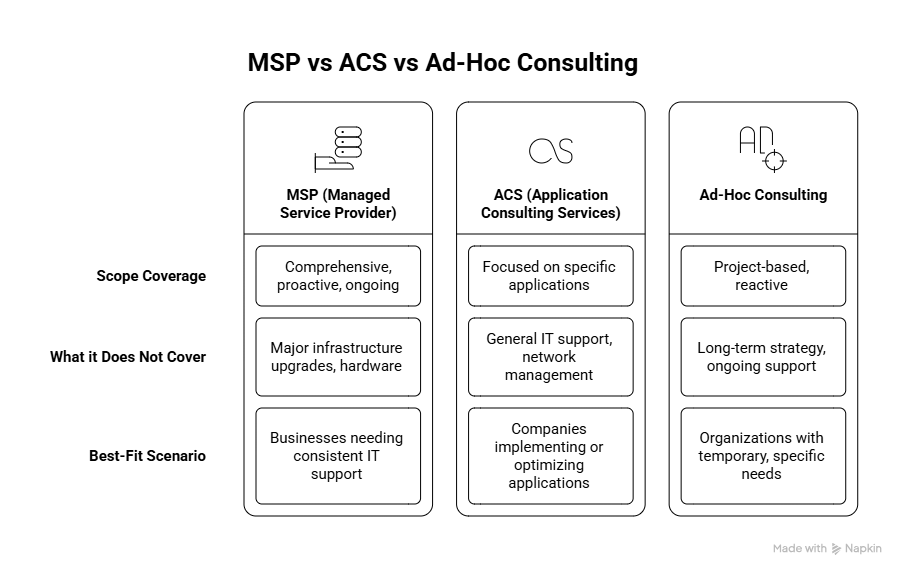
This is different from three things people regularly confuse it with:
- NetSuite’s own support (ACS): Oracle’s team handles product-level issues within the platform. Custom workflows, bespoke reporting, and third-party integration problems fall outside their scope.
- Ad-hoc consulting: Hourly work for specific needs as they arise. Useful for defined, one-off requirements. Does not provide ongoing accountability for system health.
- An internal NetSuite admin: A strong option for some businesses. The practical considerations are hiring cost, depth of coverage across all modules, and what happens when that person leaves.
A proper MSP engagement covers system administration, SuiteScript and workflow automation, report development, integration monitoring, user training, upgrade testing, and ongoing optimization.
Understanding that scope makes the pitfalls below much easier to spot before you sign.
For a broader breakdown of what good post-go-live support looks like, our blog on reasons to use NetSuite managed support after going live covers the operational situations where the right MSP pays for itself.
Pitfall 1: Selecting on Price Instead of Fit
This is the most common and the most costly mistake.
Low hourly rates look attractive in a proposal. They do not tell you whether the partner will solve your problems efficiently, whether they have seen your specific industry before, or whether they will assign a consultant who knows NetSuite well enough to fix a broken SuiteScript workflow without spending six hours reading documentation first.
The real cost of a cheap MSP is not the hourly rate. It is the hours spent on problems that an experienced team would resolve in a fraction of the time. A partner charging $100 per hour who takes 12 hours to fix something an expert resolves in 2 hours costs you three times as much. Add the operational downtime while you wait.
A practical way to evaluate cost honestly:
- Ask for a sample scenario. How long would it typically take to resolve a broken approval workflow after a NetSuite release?
- Ask for references from clients with similar environments. What was their average ticket resolution time in the first six months?
- Compare total cost of engagement, not hourly rate.
For context on what managed services actually cost across different pricing models, our guide managed services cost and pricing breaks down what drives the number up or down.
Pitfall 2: Confusing a Good Sales Process With a Good Engagement
The distribution company we described in the introduction chose its MSP because they were responsive during the sales process. Fast replies, knowledgeable sales consultant, polished presentation.
None of those qualities predicts how the engagement will run after the contract is signed.
The sales consultant is rarely the person who manages your account. In many firms, the person who won the deal hands off to a delivery team that had no involvement in the sales process. The commitments made during the proposal, such as consultant, fast response times, and proactive release management, may never make it into the contract. Once that happens, they become intentions rather than obligations.
What to do instead:
- Ask to meet the specific consultant who will manage your account before signing. Not the sales lead. The actual person.
- Ask whether that consultant has capacity for a new client right now, or whether you are being queued.
- Ask what happens to your account if that consultant leaves. Is there a documented handover process?
If the partner cannot introduce you to your future consultant before the contract is signed, that tells you something about how they structure their accounts.
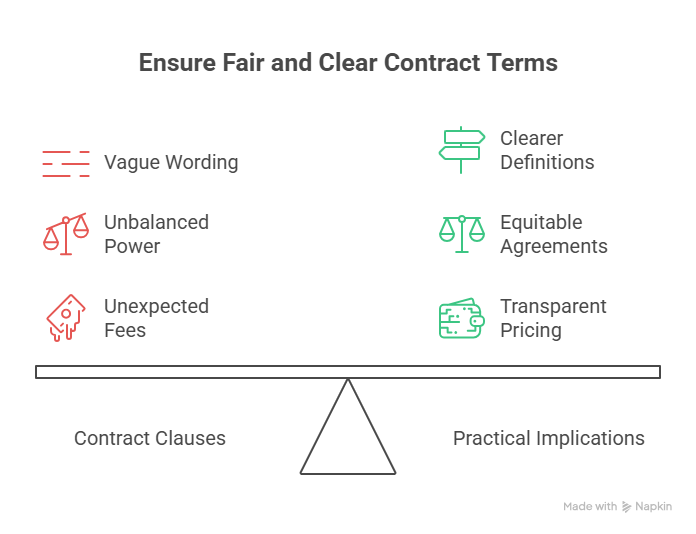
Pitfall 3: Signing a Vague Scope of Work
A proposal is a sales document. A scope of work is a legal document. Most businesses treat them as the same thing.
Vague scope language in an MSP contract is the most common cause of billing disputes. Here is what vague language looks like in practice:
| Vague Scope Language | What It Actually Means |
|---|---|
| “Ongoing NetSuite support” | We will respond to tickets. Everything else is extra. |
| “System optimization as needed” | We optimize when you ask. We do not look proactively. |
| “Release management support” | We will tell you about releases. Testing is your responsibility unless you pay more. |
| “Minor customizations included” | We define what counts as minor. You find out when the invoice arrives. |
| “Priority support for critical issues” | Priority is not defined. Neither is critical. |
Before signing any MSP contract, require specific answers to these questions in writing:
- What is the exact list of activities included in the monthly fee?
- What specifically triggers an out-of-scope charge?
- How is “minor customization” defined and measured?
- Is release management included or an add-on?
- What are the response times by priority level, in hours?
If the partner resists providing specific answers, the vagueness is deliberate. It protects them, not you.
Pitfall 4: Ignoring the Pricing Model
How an MSP charges you determines whether their financial interests are aligned with yours.
There are three main pricing models. The differences matter more than most businesses realize.
Time-and-materials (T&M): You pay for hours worked regardless of outcome. Every question, every extra call, every data quality issue is billable. The partner has no financial reason to work efficiently or prevent problems. Every problem that surfaces is revenue for them.
Retainer (fixed hours per month): Predictable cost. Better than T&M. But it still gives partners a reason to use up retainer hours rather than resolve root causes permanently. Unused hours are often lost. Overages bill at standard rates.
Fixed-fee managed services: A defined scope delivered for a defined monthly fee. The partner owns the outcome, not just the hours. An efficient partner who prevents problems spends less time on your account. This model aligns interests correctly.
Most businesses sign T&M contracts because the hourly rate looks lower than a fixed-fee engagement. Over 12 months, the majority of them spend more than a fixed-fee contract would have cost.
Ask every MSP you evaluate: “If you resolve an issue permanently so it never comes back, do you make less money than if it keeps recurring?” The honest answer to that question tells you everything about their pricing model.
Pitfall 5: Not Asking About Release Management Specifically
NetSuite releases two major platform updates per year. Each release can break custom scripts, saved searches, workflows, and third-party integrations. For businesses with significant customizations, this is not a hypothetical risk. It is a regular operational event.
Most MSP proposals mention release management. Very few MSPs do it systematically.
What release management actually requires:
- A sandbox environment that mirrors your production configuration
- Testing of every custom script and workflow against the upcoming release before it goes live
- A conflict identification process with documented findings
- Fixes applied and validated before the release reaches production
- Client communication on what changed and why
If a partner describes their release management as “we monitor the release notes and flag anything relevant,” they are not doing release management. They are doing release notification. Those are not the same thing.
The question to ask: “Walk me through exactly what happens in the six weeks before a NetSuite release for a client with 20 custom scripts. What does your process look like, step by step?”
A good answer is specific and sequential. A weak answer is vague and reassuring.
Pitfall 6: Skipping Reference Calls (Or Asking the Wrong Questions)
Most businesses do call references. Almost none ask the right questions.
The common mistake: asking “are you happy with the partner overall?” This produces a useless answer. Nobody refers you to a client who will say they are unhappy.
What to ask instead:
- Tell me about a time something went wrong. How did the partner respond and how long did it take to resolve?
- Has your named consultant changed since you started the engagement? How was that handled?
- How did the partner handle the last NetSuite release? Did anything break?
- If you were selecting a managed services partner again, would you choose this one? Why or why not?
The “what went wrong” question is the most revealing. Every MSP has handled a problem badly at least once. How they handled it tells you more than a list of successes.
Require references from businesses in your industry who have been on managed services with the partner for more than 18 months. A six-month reference is still in the early phase of the relationship. An 18-month reference has been through two NetSuite releases, staff turnover, and at least one system change. That relationship reflects the real engagement quality.
Pitfall 7: Treating the Implementation Handoff as Automatic
The moment an implementation partner hands off to a managed services team is the highest-risk point in a NetSuite engagement. Most businesses do not plan for it until it is already going badly.
Customization logic, integration architecture, and the reasoning behind configuration decisions either transfer in a structured way or disappear. When they disappear, the MSP team inherits an undocumented system and spends the first few months of the retainer figuring out how it was built, rather than improving it.
Good knowledge transfer looks like this:
- A formal system audit documenting every customization, script, workflow, and integration
- Notes on why specific configurations were made, not just what was configured
- A list of known issues and technical debt from the implementation
- A structured handover call between the implementation team and the MSP
If your implementation partner and your MSP are different firms, require a joint handover process. If your implementation partner is also becoming your MSP, require that the person managing your account post-go-live be involved in the implementation.
For businesses managing data through a support transition, our blog on best practices for NetSuite data migration covers how to protect data integrity and configuration knowledge through handover processes.
Pitfall 8: Not Testing the Partner Before Signing Long-Term
This is the pitfall most businesses discover in retrospect. They signed a 12 or 24-month contract based on a proposal and a reference call. They discovered the partner’s actual quality at month three.
The solution is a pilot engagement. Most businesses do not ask for one. Most partners will agree to one if asked.
A pilot typically runs 60 to 90 days. It covers a defined scope: a system audit, resolution of the top three or four open issues, and one optimization project. By the end of the pilot, you have real data on the partner’s responsiveness, communication quality, technical depth, and whether the consultant assigned to your account is actually competent.
A partner who refuses a pilot is communicating that their retention model depends on contract terms rather than performance quality. That is worth knowing before you commit to 12 months.
If a full pilot is not possible, ask for a 90-day trial with defined exit criteria. Specify what success looks like. If the partner meets the criteria, extend to a full contract. If they do not, you have not lost 12 months of fees to find that out.
Pitfall 9: Assuming the MSP and Your Internal Team Will Coordinate Themselves
MSP engagements need a point of contact on your side. Not a committee. One person who owns the relationship, attends check-in calls, approves work scope, and communicates priorities.
Without this, MSP engagements drift. The partner works from the ticket queue rather than your actual priorities. Issues your team considers urgent do not get escalated correctly because nobody formalized the escalation process. Work gets done, but it is not the work you needed most.
Before signing, define:
- Who internally owns the MSP relationship?
- What is the process for raising a new project or enhancement request?
- How often are formal check-ins scheduled?
- Who approves out-of-scope work before it begins?
A good MSP will ask these questions during onboarding. A partner who never asks how your internal team is structured has no plan for how to work with you.
Pitfall 10: Not Checking Whether the MSP Handles Your Specific Modules
NetSuite covers financials, inventory, order management, manufacturing, eCommerce, WMS, CRM, and project management. An MSP who is strong on financials and weak on warehouse management is not the right partner for a distribution business.
This matters more than most businesses realize. MSPs rarely volunteer their limitations during sales conversations. They present their capabilities. You have to ask specifically about the modules your business depends on.
Ask for case studies or references specifically tied to the modules you use most. If the partner cannot provide a reference from a business running a similar module configuration, they are either new to that module or have had outcomes that did not produce referenceable clients.
For a deeper understanding of what good support looks like across the full NetSuite module set, our NetSuite support partner guide covers what to expect from a partner across every major functional area.
How Folio3 SmartCare Is Built Around These Pitfalls
Every pitfall in this blog is something we have seen happen to businesses before they found us. The SmartCare program is designed specifically to prevent them.
- Named consultant from day one. Not a pool. The same person who onboards your account manages it.
- Fixed-fee pricing. Our financial interests are aligned with yours. Preventing problems costs us less time than fixing recurring ones.
- Structured 90-day onboarding. System audit, process review, documented customizations, and quick wins before we start billing for standard support.
- Release management as standard. Sandbox testing before every NetSuite release. Conflicts identified and fixed before they reach production.
- Written SLA. Specific response times by priority level. Committed hours, not aspiration language.
- Pilot option. We are confident enough in our delivery to offer a scoped trial before a long-term contract.
See how the right managed services partner can reduce your NetSuite operational costs by up to 40%. Schedule a Demo
Final Thoughts
Most of the businesses that call us after a bad MSP experience did not make obvious mistakes. They went through a reasonable evaluation, picked a credentialed partner, and signed a contract that looked fine.
The mistakes were in the details. A scope of work that was never specific enough. A named consultant’s commitment that was never written down. A release management process that turned out to be a release notification. A pricing model that made every problem profitable for the partner.
None of these things is hard to catch during evaluation if you know what to look for.
If you are evaluating NetSuite managed services and want an honest conversation about what the right engagement looks like, reach out today.
FAQs
What are the most common pitfalls when selecting a NetSuite managed services partner?
The ten most common pitfalls are: selecting on price instead of fit, confusing a good sales process with a good engagement, signing a vague scope of work, ignoring the pricing model structure, not asking specifically about release management, asking the wrong reference questions, not planning the implementation handoff, not running a pilot engagement, failing to define internal ownership of the MSP relationship, and not verifying module-specific expertise. The pitfalls that cost businesses the most money are the vague scope of work and the T&M pricing model.
How do I avoid picking the wrong NetSuite MSP?
Start with internal clarity on what you need before talking to any partner. Filter shortlisted partners on industry experience, named consultant model, and release management process. Ask for references from 18-month-plus clients in your industry. Review the contract for specific SLA commitments, scope definition, and exit terms. Run a 60 to 90-day pilot before committing to a long-term contract.
What should a NetSuite MSP contract include?
A well-structured contract includes a defined scope of included services, SLA response times by priority level in specific hours, escalation procedures, release management responsibilities, out-of-scope pricing, contract term and exit conditions, and a named account contact. If any of these are missing or written in vague language, request specifics before signing.
Q: Why is T&M pricing a problem for managed services?
Time-and-materials pricing means the partner bills for hours worked regardless of outcome. Every recurring problem is revenue. Every inefficiency is revenue. The partner has no financial incentive to prevent issues or resolve root causes permanently. Fixed-fee managed services align partner and client interests correctly because an efficient partner who prevents problems spends less time on your account.
What does good release management look like from an MSP?
Good release management includes sandbox environment setup, testing of every custom script and workflow against the upcoming release, conflict identification with documented findings, fixes applied before the release reaches production, and client communication on what changed. If a partner describes release management as “monitoring release notes,” they are providing notification, not management.