Key Takeaways
- Architecture Is the Real Difference: SuiteCommerce runs inside NetSuite. BigCommerce is a separate platform that connects to NetSuite via middleware. This shapes every other decision.
- SuiteCommerce Wins on Integration Depth: Real-time inventory, customer-specific pricing, and B2B workflows are native. No sync delays, no middleware to maintain.
- BigCommerce Wins on Storefront Flexibility: More pre-built themes, a larger app marketplace, modern APIs, headless support, and faster time-to-market.
- Total Cost of Ownership Is Similar: SuiteCommerce saves on integration middleware but costs more to implement. BigCommerce is faster to launch but carries ongoing integration fees.
- B2B Businesses Lean SuiteCommerce: Complex pricing, credit limits, and approval workflows are native in SuiteCommerce and require extra integration effort in BigCommerce.
Here is a question we get asked constantly: “We’re on NetSuite. Should we build our store on SuiteCommerce or BigCommerce?”
Every time, the answer is the same: it depends.
We have implemented both for NetSuite businesses across different industries, and we have seen SuiteCommerce deployments that were exactly right for the business and BigCommerce migrations that made complete sense.
What we rarely see is someone choosing the right platform for the right reasons on the first pass. Most businesses choose SuiteCommerce because “it’s already in NetSuite” or BigCommerce because “it looks better.” Both are incomplete reasons, and both lead to friction down the road.
This guide gives you the real comparison between SuiteCommerce vs BigCommerce: architecture, features, B2B capabilities, cost, performance, and a decision framework you can actually use. By the end, you will have a clear picture of which platform fits your business and why.
What Is the Core Difference Between SuiteCommerce and BigCommerce?
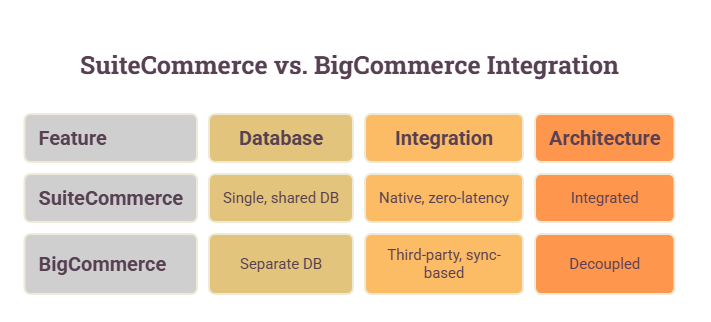
Before comparing any feature, you need to understand the architectural difference between the two platforms. Let’s get into it.
SuiteCommerce
SuiteCommerce is NetSuite’s own ecommerce module. It runs inside NetSuite and reads from the same database as the ERP, rather than connecting to it as a separate system. When a customer places an order on a SuiteCommerce store, that order exists as a NetSuite sales order from the moment it is created, with no second record to reconcile. When a warehouse team updates inventory in NetSuite, the storefront reflects it immediately. There is no sync process, no middleware, and no data translation between two systems, because the storefront and the ERP are one system.
BigCommerce
BigCommerce is a standalone ecommerce platform, built and hosted independently of NetSuite. To work together, the two systems are connected through a separate integration layer, middleware such as Celigo, Boomi, or a custom-built connector. Orders placed on BigCommerce move to NetSuite through that layer, typically syncing in near-real time. Inventory updates in NetSuite push back to BigCommerce on a schedule. Customer records, pricing, and fulfillment data all pass between the two systems through this same integration.
What “Native Integration” Actually Means in Practice
With SuiteCommerce, these things happen in real time:
- Customers see live inventory availability, not synced data from 10 minutes ago
- Customer-specific pricing from NetSuite price lists applies automatically
- Orders appear in NetSuite instantly and trigger fulfillment workflows
- Credit limits and payment terms from NetSuite are enforced at checkout
- Order status on the storefront reflects the actual ERP record
With BigCommerce plus a NetSuite integration, the picture is different:
- Inventory syncs on a schedule, typically every 5 to 15 minutes
- Pricing rules need to be maintained in BigCommerce or pushed from NetSuite
- Orders queue for sync to NetSuite, with near-real-time delivery when the integration is well-built
- Data transformations happen during sync, creating potential for mismatches
- Integration failures can cause inventory or order discrepancies that require manual cleanup
For some businesses, a 15-minute sync window on inventory is completely acceptable. For distributors managing thousands of SKUs or manufacturers with made-to-order products, it is a genuine operational problem. Knowing which category you are in is the first decision you need to make.
Head-to-Head Feature Comparison: SuiteCommerce vs BigCommerce
Here is how SuiteCommerce and BigCommerce compare across the areas that matter most to NetSuite businesses.
Ecommerce Features
Both platforms offer various features for eCommerce stores. Here is a quick table overview for you to fully understand how SuiteCommerce and BigCommerce provide a range of features.
| Feature | SuiteCommerce | BigCommerce |
|---|---|---|
| Product catalog management | Via NetSuite items | Native, plus sync from NetSuite |
| Product variants/matrix items | Native child items | Strong native support |
| Content management | Site Management Tools | Strong, with page builder |
| Multi-site / multi-brand | Supported (complex setup) | Native multi-storefront |
| Mobile responsiveness | Theme-dependent | All themes responsive |
| Checkout customization | Full control (complex) | Limited without Checkout SDK |
| Payment gateways | NetSuite payments + gateways | 65+ native integrations |
| Shipping options | NetSuite shipping + carriers | Extensive native options |
| App marketplace | SuiteApps (smaller catalog) | 1,000+ apps |
| Headless commerce | Not natively supported | Yes (Catalyst + headless APIs) |
BigCommerce has more ecommerce features out of the box. SuiteCommerce provides deeper NetSuite-specific functionality but fewer general storefront capabilities.
B2B Capabilities
If you run a B2B eCommerce business, it is important to understand the features that you can approach and implement in these two different platforms. Let’s take a look at the table below.
| Feature | SuiteCommerce | BigCommerce |
|---|---|---|
| Customer-specific pricing | Native from NetSuite | Via price lists (synced from NetSuite) |
| Quote management | Native NetSuite integration | Requires app or custom development |
| Account hierarchies | NetSuite subsidiaries | BigCommerce B2B Edition feature |
| Purchase order workflows | Native | BigCommerce B2B Edition feature |
| Credit limit enforcement | Real-time from NetSuite | Requires integration logic |
| Order approval workflows | Via the NetSuite workflow engine | Limited native support |
SuiteCommerce is the better fit for complex B2B scenarios. The native connection to NetSuite’s B2B features, including quotes, approvals, and credit management, is difficult to fully replicate through an integration layer.
SEO and Marketing Capabilities
For any business, SEO and marketing are the core processes. SuiteCommerce and BigCommerce offer features for SEO and marketing, however they differ in how you can implement and control them.
| Feature | SuiteCommerce | BigCommerce |
|---|---|---|
| Customizable URL structures | Configurable | Full control |
| Automatic sitemaps | Yes | Yes |
| Structured data/schema | Requires configuration | Better out of the box |
| Google Shopping integration | Via SuiteApp | Native |
| Email marketing tools | Limited native | Klaviyo, Mailchimp, and others native |
| Abandoned cart recovery | Via SuiteApp | Built in |
| A/B testing | Requires custom development | Via app marketplace |
| Page builder/landing pages | Site Management Tools | Full page builder |
BigCommerce is stronger for SEO and marketing, particularly for teams that need to launch campaigns and run experiments without developer support. SuiteCommerce requires more setup work in this area, and because product feeds pull directly from live NetSuite data, pricing and stock shown to search engines and shoppers is always current.
Development and Customization
As businesses start to scale, the requirement for development and customizations starts to increase. However, not every platform provides full control and access to customizations, depending on its backend, architecture, and tech stack. The table below shows the difference between SuiteCommerce vs BigCommerce development and customization capabilities.
| Aspect | SuiteCommerce | BigCommerce |
|---|---|---|
| Frontend framework | Backbone.js | Stencil or headless (React, Next.js) |
| Developer learning curve | Steep | Moderate |
| Theme customization | Full control, complex | Simpler with Stencil |
| REST API availability | Limited storefront API | Extensive, well-documented APIs |
| Headless architecture | Difficult | Native (Catalyst) |
| Developer documentation | Adequate | Excellent |
BigCommerce is a more familiar environment for developers coming from mainstream web work, and its developer pool is significantly larger. SuiteCommerce’s framework predates current front-end conventions and takes longer to learn, but it gives developers direct access to NetSuite’s data model without a separate API layer to build against.
Performance Comparison: Which Platform Is Faster?
This section compares SuiteCommerce and BigCommerce load times before and after optimization.
Out-of-the-Box Page Load Speed
The table below shows the page load speed of both platforms in SuiteCommerce vs BigCommerce.
| Metric | SuiteCommerce (unoptimized) | BigCommerce (unoptimized) |
|---|---|---|
| Average Largest Contentful Paint (LCP) | 3.5 – 5.0 seconds | 2.0 – 3.5 seconds |
| Time to Interactive | 4.0 – 7.0 seconds | 2.5 – 4.0 seconds |
| Core Web Vitals pass rate | ~30% of sites | ~60% of sites |
SuiteCommerce’s Backbone.js architecture and its reliance on NetSuite’s server-side rendering are tuned during implementation to reach optimal load times. As the table above shows, BigCommerce starts faster before that work is done.
After Optimization
After optimizing your platforms and making sure the Core Web Vitals and other essentials are fully completed, the page load speed becomes:
| Metric | Optimized SuiteCommerce | Optimized BigCommerce |
|---|---|---|
| LCP | 2.0 – 2.8 seconds | 1.8 – 2.5 seconds |
| Time to Interactive | 2.5 – 3.5 seconds | 2.0 – 3.0 seconds |
After optimization, the gap between platforms narrows substantially. BigCommerce load times commonly slow over time as more apps and third-party scripts are added to the storefront. Both platforms are worth budgeting performance work for, at implementation and afterward.
Scalability Under Traffic
SuiteCommerce scales with your NetSuite instance. During a traffic spike on a flash sale or a Black Friday event, the storefront and ERP are under pressure simultaneously. This can create governance limit issues in NetSuite that affect both the shopping experience and your back-office operations at the same time. This is typically managed through load testing and script optimization ahead of known peak events.
BigCommerce handles traffic independently of NetSuite, so the storefront absorbs a spike without affecting ERP performance, and the shopping experience stays smooth. The trade-off moves to the integration queue, which can back up during high volume, delaying order sync to NetSuite and widening the gap between storefront and actual inventory during the period when stock is moving fastest. This is typically managed by throttling sync frequency and monitoring queue depth during known peak events.
When Does SuiteCommerce Make More Sense?
SuiteCommerce makes more sense for NetSuite businesses whose ecommerce operation depends on pricing, inventory, and approval logic that is already built into the ERP. For these businesses, the question is not whether SuiteCommerce has enough features, it is whether a separate platform can replicate what NetSuite is already doing without adding a second system to maintain.
1. You Run a Complex B2B Operation
If your business depends on customer-specific pricing, credit limit enforcement at checkout, quote-to-order workflows, or order approval processes, SuiteCommerce delivers these natively. Every one of these features requires extra integration effort and ongoing maintenance in BigCommerce.
For some B2B businesses, the integration cost and complexity are manageable. For others, particularly those with many customer price levels or complex approval hierarchies, it becomes a significant ongoing burden.
2. Real-Time Inventory Accuracy Matters to Your Business
Distributors managing thousands of SKUs know what a 10-minute inventory sync window costs them in oversells, customer disappointment, and operational cleanup. If your business model requires customers to see live, accurate inventory at the moment they are shopping, only SuiteCommerce delivers this natively. BigCommerce with a well-configured integration can get close, but “close” is not the same as “native.”
3. Your Team Already Knows NetSuite
If you have SuiteScript developers and NetSuite administrators on staff, extending NetSuite to power your ecommerce store makes operational sense. The learning curve for SuiteCommerce is shorter for people who already understand NetSuite’s architecture and data model. You are working in a system they already know rather than adding a second system to support.
4. You Want to Minimize Integration Points
Every integration is a potential failure point, and every middleware subscription is an ongoing cost. If you want to reduce operational complexity and keep your ecommerce and ERP in a single system, SuiteCommerce removes the integration entirely.
When Does BigCommerce Make More Sense?
BigCommerce is the right choice when storefront flexibility, marketing capability, and time-to-market matter more than maximum integration depth with NetSuite.
1. You Need to Launch Quickly
BigCommerce implementations are typically faster for standard storefronts, since more developers know the platform and the pre-built theme ecosystem is larger. If you need a store launched in 6 to 8 weeks rather than 12 to 16, BigCommerce is the faster path for that timeline. This matters most for businesses responding to competitive pressure or seasonal deadlines, where SuiteCommerce’s longer implementation window (covered in the SuiteCommerce section) may not fit.
2. Your Marketing Team Needs Independence
f your marketing team wants to launch promotions, run A/B tests on product pages, install a reviews tool, or connect a loyalty program without involving a developer for every change, BigCommerce’s app marketplace is built for that kind of self-serve work. SuiteCommerce routes most storefront changes through a developer, which fits teams that already work that way but adds a step for teams used to self-serve tools.
3. You Are Building a Modern Tech Stack
BigCommerce’s Catalyst framework supports headless commerce, meaning you can build your frontend in Next.js or any modern React-based framework while BigCommerce handles the commerce backend. If your engineering team wants to build a custom frontend using a headless architecture, BigCommerce gives you that path natively, since SuiteCommerce does not currently support headless.
4. You Have Standard NetSuite Usage
If your NetSuite configuration is relatively standard, with no heavy SuiteScript customization or complex pricing models, the integration overhead between BigCommerce and NetSuite is manageable. You get BigCommerce’s stronger storefront features without paying a disproportionate integration cost.
5. Your ERP Situation Might Change
BigCommerce is platform-agnostic. If your business is growing through acquisition, considering an ERP change, or uncertain about its long-term NetSuite commitment, BigCommerce lets you switch ERPs without replacing your storefront. SuiteCommerce’s storefront and NetSuite are one system, which is an advantage for the integration reasons covered earlier and a constraint here specifically, if an ERP change is genuinely on the table.
The Decision Framework: How to Actually Choose
Do not choose a platform based on a blog post alone. Use this framework to evaluate your specific situation before committing.
Step 1: Score Your Integration Requirements
To assess which platform is better for you, it is important to understand your integration requirements. For this, rate each requirement from 1 (not important) to 5 (critical):
| Requirement | Your Score (1–5) |
|---|---|
| Customers must see real-time inventory levels | |
| Customer-specific pricing must be accurate at all times | |
| B2B features (quotes, approvals, credit limits) are core to our business | |
| Our NetSuite customizations need to extend to ecommerce | |
| We cannot tolerate any data sync delays between systems |
If your total is 20 or above, SuiteCommerce is likely the stronger fit. If it is 10 to 19, either platform can work, and the decision comes down to cost and implementation factors. If it is under 10, BigCommerce probably fits better.
Step 2: Assess Your Implementation Constraints
When choosing SuiteCommerce vs BigCommerce, understand the implementation limitations, and this will help you in decision-making.
| Factor | Points Toward SuiteCommerce | Points Toward BigCommerce |
|---|---|---|
| Launch timeline | 16+ weeks is acceptable | Need to launch in 8–12 weeks |
| Cost structure | Prefer more spend upfront, less ongoing | Prefer less spend upfront, more ongoing |
| Technical team | NetSuite developers on staff | General web developers |
| Risk tolerance | Comfortable with a longer build in exchange for fewer systems afterward | Comfortable with an integration layer in exchange for a faster launch |
Step 3: Map Your Growth Direction
In SuiteCommerce vs BigCommerce, see which growth direction your organization plans to take in the upcoming years.
| Where You Are Heading | Better Platform for You |
|---|---|
| Deeper NetSuite utilization and B2B complexity | SuiteCommerce |
| Complex B2B workflows and procurement portals | SuiteCommerce |
| Adding subsidiaries or entities under NetSuite OneWorld | SuiteCommerce |
| Tightening inventory accuracy across a growing SKU count | SuiteCommerce |
| Headless or composable storefront architecture | BigCommerce |
| Multi-channel expansion (Amazon, Instagram, marketplaces) | BigCommerce |
| International expansion with multi-language support | BigCommerce |
| Possible ERP change in the next 3-5 years | BigCommerce |
Step 4: Get Real Numbers
Get actual quotes for implementation from qualified partners for both platforms. Ask your NetSuite account manager for SuiteCommerce Advanced pricing. Get BigCommerce Enterprise pricing based on your projected GMV. Model the three-year TCO for your specific scope.
Are There Hybrid Approaches?
Yes, and they are worth knowing about, though they add operational complexity.
Some businesses launch on one platform to meet an immediate need, then move to the other as their requirements change. This happens in both directions.
A business might start on BigCommerce to launch quickly, then move to SuiteCommerce once its NetSuite usage and B2B complexity grow past what the integration layer comfortably supports. Another might start on SuiteCommerce, then move to BigCommerce if the priority shifts toward storefront speed and marketing independence, and NetSuite’s role becomes less central to daily operations.
Either direction is a full platform migration, not an upgrade. Theme, checkout logic, and integration work are largely rebuilt rather than carried over, regardless of which way you’re moving. Treat it as a deliberate, planned move tied to a real change in business requirements, not a way to defer the initial decision.
Summary: Which Platform Is Right for You?
SuiteCommerce is the right platform if your business model depends on deep NetSuite integration. If you are a B2B distributor with customer-specific pricing, a manufacturer with live inventory requirements, or a business with complex procurement workflows already running in NetSuite, SuiteCommerce gives you capabilities that BigCommerce can only approximate through integration. The tighter system, fewer failure points, and real-time data accuracy are worth the higher implementation cost and narrower developer ecosystem.
BigCommerce is the right platform if your business needs storefront flexibility, marketing team independence, or a faster path to launch. If your marketing team needs to run campaigns without a developer, if you want to experiment with headless architecture, or if you have a straightforward NetSuite configuration that integrates cleanly, BigCommerce’s stronger ecommerce features and larger developer pool will serve you better.
The real question is not which platform is better overall. It is which platform’s strengths and limitations line up with how your business actually operates. That answer is almost always clear once you work through the decision framework above and get real quotes for both paths.
If you need help evaluating your specific situation, including what your actual NetSuite configuration means for integration complexity, working with a partner who has built on both platforms is worth the time before you commit. Get in touch to talk through your options.
FAQs
Should a NetSuite company use SuiteCommerce or BigCommerce?
NetSuite companies that run complex B2B operations, need real-time inventory accuracy, or want to minimize integration overhead should evaluate SuiteCommerce. Companies that prioritize storefront flexibility, faster time-to-market, or a larger developer pool should evaluate BigCommerce. The total cost of ownership over three years is often similar, so the decision usually comes down to integration depth versus storefront capability.
Can BigCommerce match SuiteCommerce’s B2B capabilities?
BigCommerce B2B Edition covers many B2B requirements: customer group pricing, company account structures, quote workflows, and approval processes. However, features that depend on real-time NetSuite data, including credit limit enforcement, live pricing from complex NetSuite price lists, and native approval workflow integration, require additional integration work that SuiteCommerce provides natively. For complex B2B operations with many pricing tiers or procurement workflows, SuiteCommerce is generally the stronger choice.
Which platform is better for SEO in SuiteCommerce vs BigCommerce?
BigCommerce loads faster out of the box for most stores, with CrUX data putting median mobile load speed around 2.4 seconds and roughly half of BigCommerce stores passing Core Web Vitals without additional work. SuiteCommerce typically starts behind that baseline and closes the gap through implementation-stage optimization. Independent of load speed, SuiteCommerce has one structural SEO advantage: product data in feeds and listings comes directly from live NetSuite records, so pricing and stock shown to search engines and shoppers stays accurate without a separate sync step.
Which platform is cheaper: SuiteCommerce or BigCommerce?
The three-year total cost of ownership is often similar for mid-market businesses. SuiteCommerce has higher implementation costs but no integration middleware fees. BigCommerce has lower implementation costs but carries ongoing platform and integration subscription fees. The exact numbers depend heavily on scope, so getting real quotes for your specific requirements is the only reliable way to compare the two.
How long does a SuiteCommerce implementation take compared to BigCommerce?
Timelines vary based on complexity. A standard, out-of-the-box SuiteCommerce implementation can take 3 to 4 weeks. A highly customized SuiteCommerce Advanced project for large enterprises can take 9 to 12 weeks or slightly longer. BigCommerce follows a similar pattern by industry estimates, standard builds typically run 4 to 8 weeks, and complex enterprise projects with B2B and multiple integrations can extend to 20 weeks or more.
What happens to SuiteCommerce if we ever leave NetSuite?
SuiteCommerce is built on NetSuite, so replacing your ERP means replacing the storefront too. BigCommerce avoids that by connecting to any ERP through middleware, but the middleware carries its own maintenance risk, connectors break when either system changes its API or authentication requirements. Weigh this against how likely an ERP change actually is for your business.