Cosmetics manufacturing sits at an unusual intersection: it is regulated like a pharmaceutical business, sold like a consumer brand, and produced like a process operation. Most ERP platforms were designed for one of those realities. NetSuite handles all three in a single system.
Oracle classifies its cosmetics, personal care, and wellness vertical as Health and Beauty. The NetSuite SuiteSuccess H&B edition comes pre-configured for the compliance, production, and channel complexity that cosmetics manufacturers deal with daily. This guide covers what that looks like in practice and why NetSuite consistently leads the category for mid-market cosmetics manufacturers.
Key Takeaways
- Cosmetics manufacturing is process-based, regulated, and omnichannel. Generic ERP platforms consistently fall short on formulation management, batch traceability, and compliance.
- NetSuite ERP for cosmetics classifies its cosmetics and personal care vertical as Health and Beauty (H&B), with a SuiteSuccess edition pre-configured for this sector.
- Batch and lot traceability from raw ingredient receipt through finished goods to customer shipment is the most demanding technical requirement in cosmetics ERP.
- MoCRA introduced mandatory facility registration, adverse event reporting within 15 business days, and FDA recall authority. ERP systems that cannot automate traceability documentation create direct compliance exposure.
Why Cosmetics Manufacturing Needs a Specialised ERP
A cosmetics manufacturer does not just make products and ship them. Every batch is a regulated event. Every ingredient has a regulatory status. Every finished product carries label obligations that change by market.
Generic ERP systems were designed for discrete or repetitive production models. Cosmetics manufacturing is process-based: blending, emulsifying, and packaging in batches where yield factors, ingredient substitutions, and temperature-controlled sequences are part of normal operations. The data model is fundamentally different, and the compliance layer on top of it compounds that gap.
The Regulatory Environment Has Tightened Significantly
The Modernisation of Cosmetics Regulation Act (MoCRA) introduced the most significant change to US cosmetics oversight in decades. Key requirements include:
- Mandatory facility registration with the FDA, with re-registration every two years
- Mandatory product listing with the FDA for all cosmetics distributed in the US
- Adverse event reporting within 15 business days of receiving information about a serious adverse event
- FDA authority to mandate product recalls, replacing the voluntary recall system
- Safety substantiation requirements for every product on the market
- GMP compliance under Title 21 CFR Parts 700-740, covering recordkeeping, labelling, and product safety
For European markets, EU Cosmetics Regulation 1223/2009 requires a Cosmetic Product Safety Report, a Product Information File, an INCI ingredient listing, and responsible person registration. Brands operating across the UK, Australia (TGA), and Canada (Health Canada) face additional jurisdiction-specific requirements on top of this.
An ERP for cosmetics manufacturing that cannot automate compliance documentation does not just create operational friction. It creates legal exposure.
The Multi-Channel Complexity
Modern cosmetics brands rarely sell through a single channel. DTC ecommerce, wholesale, marketplace, and international distribution all run simultaneously. Each channel carries:
- Different pricing rules and promotional structures
- Different fulfilment lead times and retailer SLAs
- Different labelling requirements per destination market
- Different return and refund policies that affect inventory restocking
Managing allocation across these channels from disconnected systems means manual reconciliation, which creates overselling, stockouts, and delayed fulfilment. At scale, that damages retailer and customer relationships in ways that are difficult to recover from.
Core ERP Requirements for Cosmetics Manufacturers
These are the capabilities that separate ERP for cosmetics manufacturing systems that genuinely serve manufacturers from those that require add-ons, spreadsheets, and manual processes to cover the gaps.
Batch and Lot Traceability
Full forward and backward traceability is the most critical technical requirement in the cosmetics manufacturing stack.
- Forward traceability: track an ingredient lot from supplier receipt through every production batch and into the finished goods and customer shipments it contributed to
- Backward traceability: start from a finished product and trace back to every ingredient lot and process involved in its production
- Targeted recalls that affect only the batches containing the problem ingredient, preventing over-recall and unnecessary inventory destruction
- Adverse event investigation documentation produced from the ERP without manual data gathering across multiple systems
- Certificate of Analysis generation for wholesale and retail partners, linked to the specific batch record
Formula and Recipe Management
Cosmetics production uses formulas, not assembly BOMs. The ERP must reflect that from the ground up.
- Ingredient-level data, including INCI names, restricted ingredient flags, EU and US regulatory status, and allergen declarations
- Version control on formulas so production orders always reference the approved specification
- Recipe scaling for batch size changes without manual recalculation
- Formula change tracking tied to open production orders so no batch is produced to an outdated specification
Quality Management and GMP Documentation
GMP compliance in cosmetics spans the full production lifecycle, from incoming materials through to finished goods release.
- Incoming material inspection: ingredients held until tested against specifications; rejected lots quarantined with a full disposition record
- In-process QC at defined checkpoints covering pH, viscosity, colour, and microbiological testing
- Finished goods release: products held until QC sign-off, with the release record attached to the batch
- Non-conformance and CAPA records documenting root cause, corrective action, and verification
Shelf Life and Expiry Management
Every cosmetics ingredient and finished product has a shelf life, and the ERP must manage that automatically rather than relying on manual checks.
- Expiry dates assigned at receipt and tracked through all subsequent inventory movements
- FEFO (First Expiry, First Out) picking logic to prioritise lots approaching expiry before newer stock
- Automatic alerts when raw material lots approach their use-by date ahead of scheduled production
- Finished goods hold when expiry falls within a defined buffer period before shipment
Omnichannel Order Management
A unified inventory record feeding all sales channels is an operational requirement for any cosmetics brand running more than one channel simultaneously.
- Single inventory pool across DTC, wholesale, marketplace, and retail with configurable channel allocation rules
- Real-time inventory updates across every channel when any order ships or is returned
- Channel-specific pricing, promotional discounting, and fulfilment rules configured per channel without manual intervention
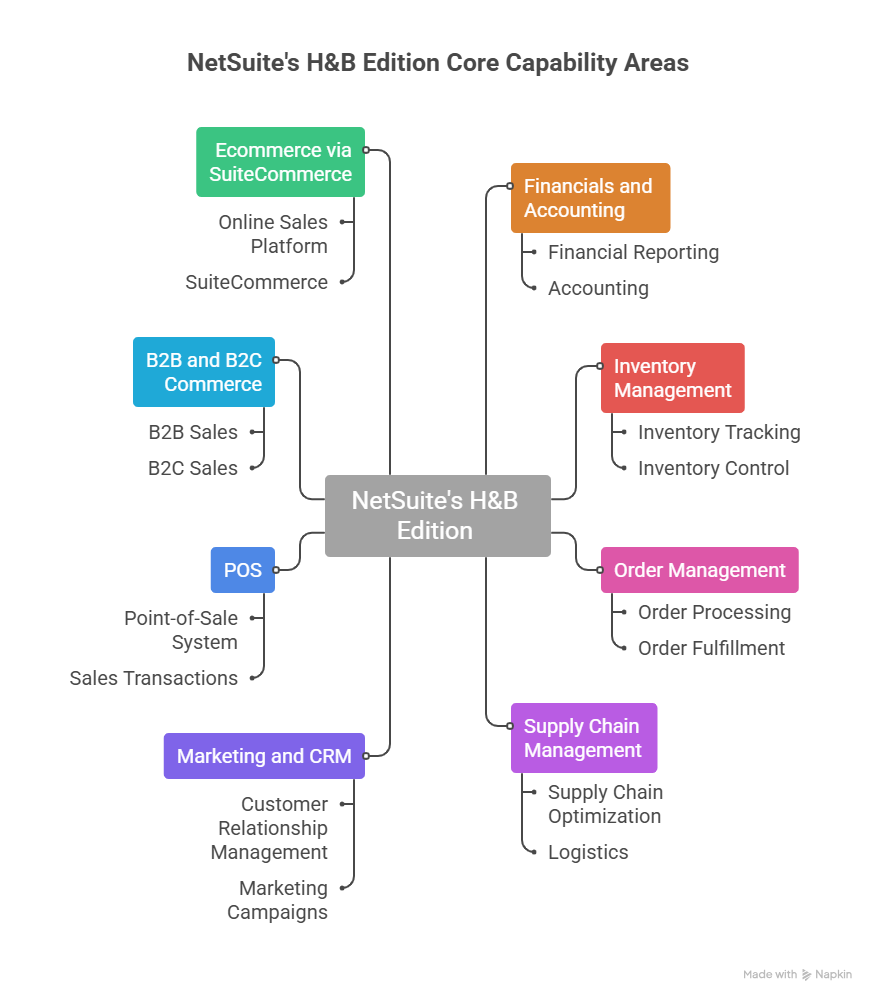
The Eight Core Capability Areas in NetSuite’s H&B Edition
Oracle NetSuite’s Health and Beauty edition covers eight product feature areas that address the full operational scope of a cosmetics manufacturer. These are the officially defined capabilities from the NetSuite H&B platform.
Financials and Accounting
NetSuite increases staff productivity, accelerates period close, and delivers real-time insight into financial performance through role-based reporting and dashboards.
For cosmetics manufacturers, this means:
- Production costs, landed costs, and revenue in the same financial system
- Real-time COGS visibility per batch and per SKU
- Consolidated financial reporting across multi-entity structures without a separate consolidation tool
- Faster month-end close without manual data imports from a separate manufacturing or inventory system
Inventory Management
NetSuite eliminates inventory silos between channels and delivers a unified instance of inventory data across the entire business.
For cosmetics brands, this means:
- Lot-tracked inventory with expiry dates visible across all warehouse locations and in-transit positions
- FEFO picking logic to manage shelf life and reduce write-offs
- Real-time stock visibility across DTC, wholesale, and marketplace channels from a single record
- Demand-driven replenishment that prevents stockouts and reduces overstock positions
Order Management
NetSuite accelerates the order-to-cash process and ties sales, finance, and order fulfilment to pricing, sales order management, and returns management in one workflow.
For cosmetics brands, this means:
- Retailer-specific pricing agreements, promotional discounts, and credit terms managed in the same system as the order
- Automated fulfilment workflows from order receipt through pick, pack, ship, and invoice
- Returns and credits managed within the same order record with automatic inventory disposition logic
- Reduced manual touchpoints in high-volume DTC and wholesale order cycles
Supply Chain Management
NetSuite increases supply chain efficiency, streamlines operations, and provides better visibility into bottom-line costs while maintaining the right inventory mix.
For cosmetics manufacturers, this means:
- Global supplier management with lead time tracking, performance records, and preferred supplier pricing
- Landed cost allocation on inbound raw materials for accurate COGS from the moment of receipt
- Distribution requirements planning (DRP) for multi-location inventory optimisation
- Real-time visibility into outsourced manufacturing positions alongside in-house production inventory
CRM and Marketing
NetSuite tracks campaign performance, manages sales incentive compensation, and provides a real-time view of customer interactions across all channels.
For cosmetics brands, this means:
- Wholesale account management and DTC customer records in a single CRM rather than separate tools
- Campaign attribution linked to actual order and revenue data, not just lead records
- Sales rep compensation tracking tied to actual closed revenue
- Customer interaction history visible to every team touching a customer account
Point of Sale
NetSuite arms sales associates with a 360-degree omnichannel view of inventory and customer information to drive more effective in-person selling.
For cosmetics brands with retail counters or salon channels, this means:
- Associates see real-time inventory availability across online and in-store stock simultaneously
- Customer purchase history and loyalty data are visible at the point of sale
- Order fulfilment options such as shipping from the warehouse or transferring from another location are available directly at the POS
- Sales data from POS feeds back to the central inventory and financial record in real time
Ecommerce via SuiteCommerce
NetSuite scales global wholesale, retail, and multi-brand ecommerce from a single commerce platform.
For cosmetics brands, this means:
- DTC ecommerce store connected directly to NetSuite without integration middleware
- Multi-brand or multi-market storefront management from a single ERP backend
- Product data, pricing, promotions, and inventory all managed in NetSuite and published to the storefront automatically
- Order and customer data flows from ecommerce into NetSuite without manual import or reconciliation
B2B and B2C Commerce
Whether a brand sells direct-to-consumer, to retail and salon wholesale accounts, or both, NetSuite’s omnichannel platform covers both models from a single unified system.
For cosmetics businesses with mixed channels, this means:
- B2B wholesale operations with account pricing, minimum order quantities, and credit terms managed natively
- B2C DTC operations with promotional pricing, loyalty programmes, and individual customer records
- Both models running within one system rather than two separate platforms requiring synchronisation
- A single view of total business performance across all channels through real-time financial reporting
Folio3 in Action: Real Cosmetics and Skincare Brands on NetSuite
Folio3 has implemented NetSuite for cosmetics, skincare, and beauty brands across multiple markets. Two case studies show what the platform delivers in a live production environment.
Pai Skincare: 6 Web Stores, 50+ Countries, One NetSuite Backend
Pai Skincare manufactures and distributes certified organic, premium skincare products exported to over 50 countries worldwide. They operated 6 Shopify-powered web stores without a unified back-office ERP integration. Managing customer data, inventory, pricing, and orders across 6 storefronts and the ERP manually was consuming operations capacity and introducing errors across the business.
Folio3 integrated all 6 Shopify stores with Pai Skincare’s NetSuite ERP using bidirectional synchronisation:
- Guest checkout orders, customer records, and item data sync automatically between NetSuite and each Shopify store
- Custom customer-specific pricing from NetSuite is pushed to each storefront
- Refund history and price levels synchronised bidirectionally across all stores
- The operations team moved from manual multi-store management to a single source of truth

Tropic Skincare: Factory Automation Integration in a Vegan Beauty Brand
Tropic Skincare is a leading UK skincare brand manufacturing and distributing vegan and cruelty-free skincare and makeup products. They needed their factory automation system integrated with NetSuite to remove manual data entry between production and the ERP.
Folio3 built a custom integration between NetSuite and the Marco TrackIT factory automation system:
- Order receipts and inventory management synchronise automatically between the factory floor and NetSuite
- Production data enters the ERP without manual re-entry at any stage
- Inventory accuracy following production runs improved from the point of integration
- Workflow automation handles standard production events without human intervention at each step

Why NetSuite Leads the Category for Mid-Market Cosmetics Manufacturers
The cosmetics ERP market includes purpose-built specialist tools and generic ERP platforms adapted for the sector. Here is where NetSuite sits in that comparison.
Specialist Cosmetics ERP vs NetSuite
Purpose-built tools like BatchMaster and Mar-Kov offer deep formulation and batch management. Their limitations become visible as the business grows:
- Multi-entity financial management is absent or requires add-ons
- Omnichannel ecommerce integration requires bolt-on connectors that carry ongoing maintenance overhead
- Consolidated financial reporting and revenue recognition are not core strengths
- Scalability limits become visible when adding subsidiaries, international markets, or complex channel structures
SAP Business One vs NetSuite for Cosmetics
SAP B1 works for small cosmetics operations with straightforward needs. Its limitations at mid-market scale include:
- Multi-entity management requires add-ons rather than native functionality
- True cloud architecture is not available; on-premises or hosted deployment carries IT overhead
- No equivalent to the SuiteSuccess H&B pre-configured edition for cosmetics
The NetSuite Advantage at Mid-Market Scale
For cosmetics manufacturers in the $10M to $200M revenue range, NetSuite’s combination of features represents the strongest unified platform at that price point:
| Capability | BatchMaster | SAP B1 | |
|---|---|---|---|
| Batch and lot traceability | Native | Native | Config required |
| Formula management | Native | Native | Add-on |
| GMP documentation and audit trail | Native | Native | Add-on |
| Multi-entity financials | Native | Limited | Add-on |
| Omnichannel order management | Native | Add-on | Limited |
| SuiteCommerce / DTC ecommerce | Native | Not available | Not available |
| True cloud architecture | Yes | Hybrid | Hybrid |
| Mid-market scalability | Strong | Limited | Moderate |
| MoCRA compliance support | Strong | Moderate | Limited |
How to Choose the Right ERP for Your Cosmetics Business
Platform selection for a cosmetics manufacturer is not a feature checklist exercise. These questions connect platform capabilities to the specific operational and regulatory realities of your business.
Is Your Traceability Chain Complete and Automatic?
If your current system cannot produce a complete lot genealogy from supplier batch through every production event to every customer shipment without manual data gathering, your traceability posture is not MoCRA-compliant. The ERP you select must close this gap natively at every transaction point, not through a bolt-on module that sits outside the core system.
Can Your ERP Handle Both Manufacturing and Finance Without a Separate System?
The most common operational failure in cosmetics businesses that have outgrown their initial setup is the split between a production or inventory system and a separate accounting package. Data moves manually between them, reconciliation is never clean, and financial reporting is always delayed. A unified ERP eliminates this at the cost of one implementation rather than two ongoing maintenance burdens.
Does Your Channel Mix Require Unified Inventory Allocation?
If you sell through DTC and wholesale simultaneously, your inventory must be managed from a single record with channel priority logic:
- Any system requiring separate DTC and wholesale inventory management will eventually produce overselling events
- Missed retailer commitments and customer complaints follow
- Manual reconciliation between systems compounds in cost and complexity as order volume grows
What Does Your Growth Plan Require?
If you plan to add a second manufacturing site, enter new international markets, or add retail or marketplace channels in the next three years, the ERP you select now must handle that scope without a re-implementation. NetSuite’s architecture scales from startup through to multi-hundred-million-dollar operations on the same platform.
Conclusion
Cosmetics manufacturing is not a good fit for a generic ERP. The regulatory requirements, the batch-based production model, and the complexity of omnichannel sales all demand a platform configured for this specific combination of needs.
NetSuite’s Health and Beauty edition covers that combination across all eight product areas: financials, inventory, order management, supply chain, CRM, POS, ecommerce, and unified B2B and B2C commerce. With the right implementation partner, these capabilities are configured accurately to your specific formulations, channels, and compliance obligations from day one.
If you are evaluating ERP for your cosmetics or personal care manufacturing business, the Folio3 NetSuite manufacturing implementation team has direct experience with cosmetics and skincare brands, including Pai Skincare and Tropic Skincare.
Book a call to get a scoped implementation plan built around your specific production model and regulatory requirements.
FAQs
What Is the Best ERP for Cosmetics Manufacturing?
For mid-market cosmetics manufacturers, Oracle NetSuite’s Health and Beauty edition is the strongest platform. It covers batch traceability, formula management, GMP compliance workflows, shelf life management, multi-entity financials, and omnichannel order management in a single cloud system. Purpose-built tools like BatchMaster suit smaller operations focused primarily on production but plateau when financial complexity and multi-channel commerce requirements grow.
What Does NetSuite Call Its Cosmetics ERP?
Oracle NetSuite classifies its cosmetics, personal care, and wellness manufacturing vertical as Health and Beauty (H&B). The SuiteSuccess Health and Beauty edition is the pre-configured deployment built for this sector, covering the operational and compliance requirements specific to cosmetics and personal care manufacturing.
How Does NetSuite Handle MoCRA Compliance for Cosmetics Manufacturers?
NetSuite addresses MoCRA compliance through native lot and batch traceability, quality management workflows, and audit trail capabilities. Manufacturers centralise ingredient, batch, and lot data in one system, maintain forward and backward traceability across suppliers, production, and distribution, document GMP compliance workflows, and generate the documentation required for FDA facility inspections and adverse event investigations.
Can NetSuite Handle Formula-Based Cosmetics Production?
Yes. NetSuite supports process manufacturing BOMs (formulas) with ingredient-level data including INCI names, regulatory status, allergen flags, and yield factors. Formula versions are controlled so production orders always reference the approved specification. Recipe scaling recalculates automatically when batch sizes change.
Does NetSuite Support Omnichannel Sales for Beauty Brands?
Yes. NetSuite’s order management module handles wholesale, DTC ecommerce, marketplace, and retail channels from a single inventory record. SuiteCommerce connects the brand’s own ecommerce store directly to NetSuite. Folio3 maintains connector-based integrations for Shopify, Magento, Amazon, and other platforms that synchronise inventory and order data bidirectionally.
How Long Does a NetSuite Health and Beauty Implementation Take?
A standard NetSuite Health and Beauty implementation for a single-entity cosmetics manufacturer with one production facility typically takes three to five months. Multi-entity structures, complex ecommerce integrations, or extensive data migration extend the timeline. Folio3 provides milestone-based implementation plans with defined scope and acceptance criteria for each phase.