Key Takeaways
- OTIF improves when demand, inventory, production, and fulfillment are managed from connected data.
- NetSuite MRP helps CPG manufacturers plan materials and production around demand. This reduces shortages and production delays.
- Real-time inventory and supply allocation help ensure customer orders have the right products available when needed.
- Production, warehouse, and order visibility help teams identify fulfillment risks before an order becomes late.
- OTIF reporting by root cause helps manufacturers pinpoint recurring issues across planning, procurement, production, and logistics.
On-time, in-full (OTIF) performance is one of the clearest indicators of whether a consumer packaged goods (CPG) manufacturer consistently meets retailer demand or not.
An order can miss its OTIF target because production finished late, the required inventory was allocated elsewhere, a shipment was incomplete, a retailer appointment was missed, or the order failed a retailer-specific compliance requirement.
This is why, for CPG manufacturers, improving OTIF requires more than optimizing transportation after an order is ready to ship. Demand planning, material availability, production scheduling, inventory accuracy, order allocation, warehouse execution, and retailer requirements all influence whether an order arrives on time and in full.
NetSuite connects these processes through demand and supply planning, MRP, inventory management, manufacturing, order management, and fulfillment. It results in a shared operational view that helps teams identify supply gaps and fulfillment risks early enough to take corrective action.
What Is OTIF and Why Does It Matter for CPG Manufacturers?
OTIF, or On-Time In-Full, measures whether an order reaches the customer within the required delivery window and with the complete quantity ordered. For CPG manufacturers, OTIF is closely tied to retailer service levels, product availability, chargebacks, and the ability to maintain reliable retail relationships.
The formula to calculate OTIF is:
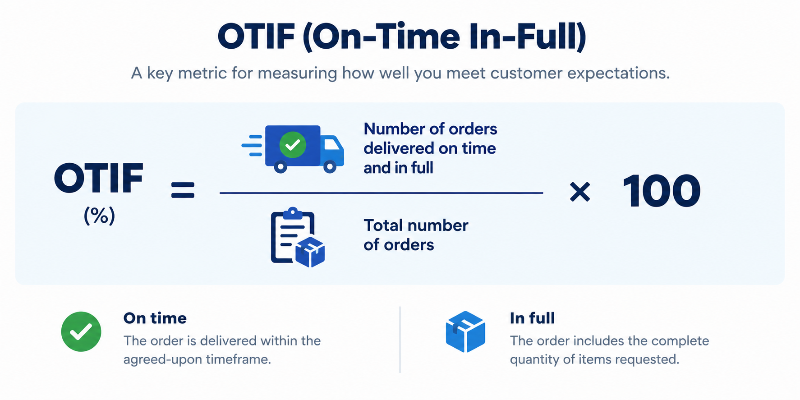
But the operational definition of “on time” and “in full” varies by retailer. Some programs are based on delivery windows, while others incorporate specific purchase-order requirements, quantities, appointments, documentation, labeling, or other compliance conditions. This is why CPG manufacturers need to understand the exact OTIF rules applied by each customer rather than relying on a single internal definition.
The impact extends beyond a retailer scorecard. A missed delivery window can result from a production or inventory problem several days earlier. An incomplete shipment can create downstream stock availability problems. Retail logistics specialists also point to missed delivery windows, incomplete orders, chargebacks, and out-of-stocks as interconnected consequences of OTIF failures.
For this reason, CPG manufacturers should treat OTIF as an end-to-end operational outcome rather than a metric owned only by logistics.
What Causes CPG Manufacturers to Miss OTIF Targets?
CPG manufacturers usually miss OTIF targets because problems accumulate across planning, production, inventory, fulfillment, and delivery. A late shipment is often the final symptom of an earlier supply or execution problem.
Common causes include:
- Forecasts that fail to account for seasonal demand, promotions, new products, or changing retailer demand
- Raw material or packaging shortages that prevent planned production
- Production bottlenecks, downtime, quality holds, or capacity constraints
- Inventory records that do not accurately reflect usable stock
- Inventory allocated to the wrong customer, location, or order
- Picking, packing, labeling, or documentation errors
- Delayed purchase orders or inbound shipments
- Missed retailer delivery windows or appointments
- Retailer-specific compliance failures involving ASNs, labels, barcodes, pallets, or routing
- Limited visibility into orders that are becoming at risk
The important connection is timing. By the time a customer service team sees that an order will miss its delivery date, the underlying problem might have started with a forecast, purchase order, production schedule, or inventory allocation much earlier in the process.
That is why OTIF improvement depends heavily on leading indicators. A manufacturer that only reviews the final OTIF percentage knows that it missed the target, but may not know whether the primary driver was material availability, production adherence, inventory accuracy, fulfillment execution, or transportation.
How Does NetSuite Help CPG Manufacturers Improve OTIF?
NetSuite improves OTIF by connecting demand planning, supply planning, MRP, inventory, procurement, manufacturing, order management, and fulfillment information in one ERP environment. This gives planners and operations teams a common view of the supply and demand conditions behind customer commitments.
NetSuite supply planning capabilities are specifically designed to balance supply and demand and generate recommended purchasing, manufacturing, and transfer activity based on demand, lead times, and inventory conditions. NetSuite’s Supply Planning Workbench also gives planners a way to review supply and demand and adjust plans to help ensure customer orders can be fulfilled completely and on time.
| OTIF risk | Relevant NetSuite capability | How it supports OTIF |
|---|---|---|
| Demand volatility | Demand Planning | Creates forecasts for future inventory requirements |
| Material shortages | MRP and Supply Planning | Identifies required materials and supply gaps |
| Inventory discrepancies | Inventory Management | Provides visibility into stock across locations |
| Production delays | Manufacturing and Production Planning | Connects work orders, materials, operations, and schedules |
| Supply allocation problems | Supply Allocation | Matches available or incoming supply to demand |
| Fulfillment delays | Order Management and WMS | Connects customer orders with warehouse execution |
| Multi-location constraints | Multi-Location Inventory | Shows inventory and supply across facilities |
| Retailer-specific execution | Order, inventory, fulfillment, and integration workflows | Helps teams coordinate order requirements and execution |
The key is how these capabilities are configured and connected to the manufacturer’s actual operating model. Simply enabling an ERP module does not automatically improve OTIF. The planning parameters, item master, lead times, inventory policies, production data, order dates, and retailer requirements still need to be accurate.
For a broader look at how NetSuite supports manufacturing operations, see How NetSuite Optimizes Operations of Manufacturing Industry.
1. Improve Demand Planning to Prevent Future OTIF Failures
Better OTIF performance starts before a sales order is placed. CPG manufacturers need to anticipate how much product will be required, where it will be required, and when that demand is likely to occur.
Demand planning is particularly important for CPG companies because demand can change quickly around promotions, holidays, seasonality, product launches, retailer programs, and changes in consumer purchasing behavior. A forecast that is accurate at the aggregate level still creates problems if demand is concentrated in specific SKUs, locations, or time periods.
NetSuite Demand Planning uses historical demand, seasonal patterns, sales forecasts, and other demand inputs to project future inventory requirements. Those projections can then feed supply planning and procurement decisions.
The OTIF connection is important. If a CPG manufacturer identifies a demand increase early, procurement has more time to secure materials, production has more time to schedule capacity, and distribution teams have more time to position finished goods.
If the demand signal arrives after production capacity or supplier lead times have already been consumed, the business may have few options other than expediting, reallocating inventory, or accepting a service failure.
2. Use MRP to Identify Material Shortages Before They Delay Production
Demand forecasts only improve OTIF when they translate into material availability. For manufacturers, the next question is whether enough raw materials, packaging, components, and subassemblies will be available when production needs them.
NetSuite MRP helps manufacturers determine material requirements from demand and bills of materials while considering existing inventory and supply.
This matters particularly for CPG manufacturers with multi-level BOMs or long supplier lead times. A finished product may appear adequately covered at the inventory level while a critical packaging component or ingredient is short. Without material-level planning, the shortage may only become visible when the production order is ready to run.
MRP provides planners with a way to see these requirements earlier and act on them through purchasing, production, or supply adjustments. NetSuite’s planning tools also surface exceptions and support what-if analysis. This allows planners to evaluate how changes to supply timing or inventory sources could affect the ability to meet demand.
That makes MRP particularly relevant to OTIF: the objective is not simply to maintain more raw materials, but to identify which materials are required, for which demand, and by what date.
3. Improve Inventory Accuracy Across Locations
A manufacturer cannot make a reliable delivery commitment if its inventory position is unreliable. This becomes more difficult as CPG businesses add warehouses, manufacturing sites, distribution centers, 3PLs, subsidiaries, or regional inventory pools.
Inventory accuracy affects both sides of OTIF. An inaccurate inventory balance causes a manufacturer to promise stock that is not physically available.
On the other hand, inventory that exists but is not visible or properly allocated can remain unused while another location experiences a shortage.
NetSuite provides inventory visibility across locations and supports inventory planning around reorder points, safety stock, lead times, and demand. Its broader inventory capabilities are designed to help businesses maintain stock availability while controlling excess inventory.
For CPG manufacturers, inventory accuracy should also be evaluated at the SKU-location level. A business may have 10,000 units in its network but still miss a retailer order if those units are at the wrong facility, committed to another customer, unavailable because of a quality hold, or not expected to reach the required fulfillment location in time.
4. Allocate the Right Supply to the Right Customer Order
Having inventory somewhere in the network does not necessarily mean that inventory can fulfill a specific customer commitment. CPG manufacturers need to know which supply is available for which demand and whether that supply will arrive before the order’s required date.
NetSuite Supply Allocation matches incoming supply with outgoing demand based on configured allocation rules. This includes supply from purchase orders, transfer orders, work orders, and existing inventory, giving teams visibility into which supply is expected to fulfill specific sales orders.
For CPG businesses with multiple distribution locations or competing customer orders, this distinction between inventory on hand and inventory capable of fulfilling a specific commitment is critical to OTIF performance.
5. Connect Production Planning With Customer Commitments
Production is one of the most important links between material availability and OTIF. A manufacturer might have sufficient raw materials and a strong sales forecast, yet still miss customer delivery dates if production capacity or scheduling does not align with demand.
NetSuite’s supply chain planning capabilities include capacity planning and production planning and scheduling. Capacity planning evaluates production demand against resource availability, while production scheduling helps arrange manufacturing workloads and evaluate when work can be completed.
For CPG manufacturers, this becomes particularly important when several high-volume SKUs compete for the same production lines or when promotions create short-term spikes in demand. A production schedule that looks feasible at the monthly level might still create a bottleneck at the work-center or day level.
For this reason, production planning should connect customer demand with the actual constraints of the manufacturing environment. Teams need to understand which work orders are required, whether the necessary materials are available, when production can start, what capacity is available, and when finished goods will be ready for fulfillment.
6. Reduce Fulfillment Delays With Better Warehouse Visibility
Even when production finishes on schedule, OTIF can still fail during fulfillment. Finished goods have to be available, allocated correctly, picked, packed, staged, documented, and shipped according to the customer’s requirements.
This is particularly important in CPG because retailers may impose detailed requirements around labels, barcodes, pallet configurations, advance shipping notices, routing, delivery appointments, and documentation. RJW notes that retailer requirements can vary significantly and that compliance needs to be built into daily execution rather than treated as a final inspection step.
NetSuite connects inventory and order information with fulfillment workflows, giving warehouse and operations teams a more consistent view of what needs to be shipped and when. Where NetSuite WMS is used, warehouse processes can be further structured around receiving, picking, packing, and shipping activities.
The important operational objective is to remove avoidable delays between “product is available” and “product has shipped.” If a finished order sits unpicked for two days because inventory status, order priority, or warehouse requirements are unclear, production performance alone will not protect the OTIF result.
7. Build Retailer Requirements Into Order Execution
Retailer compliance requires attention because an order can be physically complete and still fail the customer’s requirements.
A retailer may require a specific delivery appointment, routing method, ASN format, label structure, barcode, pallet configuration, or documentation. These requirements can also vary from one retailer to another, making manual processes increasingly difficult to manage as a CPG manufacturer expands its customer base.
This is why an effective ERP strategy should capture the information needed to execute customer orders correctly and make it accessible to the teams responsible for procurement, production, warehouse operations, customer service, and logistics.
This is also where integrations matter. Retailer orders, EDI transactions, warehouse systems, transportation systems, and external logistics providers may all participate in the fulfillment process. For manufacturers working with third-party logistics providers, a NetSuite-3PL integration helps connect order and fulfillment data across systems, reducing manual coordination between the internal team and external logistics partners.
8. Identify At-Risk Orders Before They Become OTIF Misses
The biggest opportunity in OTIF improvement is often the time between identifying a risk and the customer’s required delivery date. A manufacturer that identifies a shortage five days early has options. The same manufacturer discovering it after the shipping window has passed has very few.
NetSuite’s connected planning and transaction data helps teams investigate the conditions behind an at-risk order. A planner can look beyond the sales order to understand whether the required inventory exists, whether incoming supply is delayed, whether a work order is incomplete, or whether a transfer between locations is required.
For OTIF management, this supports an exception-based operating model. Instead of asking teams to manually inspect every order, manufacturers can focus attention on orders where the relationship between demand, supply, production, and fulfillment indicates a potential service failure.
9. Improve OTIF When CPG Manufacturing Is Outsourced
Outsourced manufacturing adds another layer of OTIF risk when production occurs outside the manufacturer’s own facilities. The brand still owns the customer commitment, but it does not directly control the production schedule, material availability, or finished-goods release process.
In this model, the ERP needs to provide visibility into what has been ordered from the contract manufacturer, what materials are expected, when production is scheduled, and when finished goods should become available for distribution.
NetSuite connects procurement, inventory, manufacturing-related transactions, and order fulfillment, so the business maintains a more consistent view of outsourced supply. The exact configuration depends on whether the company is managing contract manufacturing, subcontracted operations, drop shipments, or another external production model.
This is why for CPG companies relying heavily on third-party manufacturers, OTIF should be measured not only at the customer shipment level but also against upstream supplier and contract-manufacturer commitments. A missed production milestone is an early warning signal for a future retailer service failure.
10. Use OTIF Data to Find the Root Cause
A monthly OTIF percentage tells your leadership whether performance improved or deteriorated. But it does not explain why.
A useful OTIF analysis should connect the final delivery result to the operational events that preceded it. For example, if OTIF declines for a particular product category, management should be able to investigate whether the change corresponds with forecast error, supplier lead-time variation, raw material shortages, production schedule adherence, inventory accuracy, warehouse delays, or retailer compliance issues.
This is why a strong OTIF dashboard should support drill-down rather than simply display a percentage. Operations teams should be able to move from the overall OTIF result to customer, retailer, SKU, location, order, production, and fulfillment details.
What OTIF Metrics Should CPG Manufacturers Track?
CPG manufacturers should track OTIF alongside the operational metrics that explain its movement.
| KPI | What it helps identify |
|---|---|
| OTIF % | Overall customer delivery performance |
| On-Time % | Whether orders meet required delivery dates |
| In-Full % | Whether complete quantities are delivered |
| Fill Rate | How much customer demand is fulfilled from available supply |
| Inventory Accuracy | Whether system inventory reflects physical inventory |
| Forecast Accuracy | Whether demand planning is predicting demand reliably |
| Stockout Rate | Frequency of product shortages |
| Production Schedule Adherence | Whether manufacturing completes work as planned |
| Supplier On-Time Delivery | Whether incoming materials arrive when required |
| Order Cycle Time | Time required to move an order through fulfillment |
| On-Shelf Availability | Whether products are actually available for purchase |
| Chargebacks/Deductions | Financial impact of retailer service and compliance failures |
These metrics should also be segmented, because an overall OTIF percentage can conceal a serious problem affecting a specific retailer, product family, manufacturing site, or distribution center.
For example, a manufacturer could maintain a strong network-wide OTIF percentage while consistently missing a high-volume retailer’s delivery windows. Segmenting results by customer and SKU makes these patterns visible and gives operations teams a clearer basis for corrective action.
How Should CPG Manufacturers Build an OTIF Improvement Strategy With NetSuite?
An effective OTIF strategy starts by defining exactly what customers consider “on time” and “in full,” and then connecting those requirements to the planning, manufacturing, inventory, and fulfillment processes that determine whether the commitment can be met.
The first priority should be data quality. Item masters, bills of materials, supplier lead times, inventory balances, locations, units of measure, production data, and customer requirements all influence planning and fulfillment decisions. If these inputs are unreliable, the ERP produces technically correct calculations based on operationally incorrect information.
Once the foundation is reliable, CPG manufacturers can structure the improvement process around five areas:
- Define the OTIF standard by customer. Document delivery windows, quantity requirements, retailer compliance rules, and how exceptions are calculated.
- Improve demand and supply planning. Use demand history, seasonality, forecasts, lead times, safety stock, and supply constraints to establish realistic requirements.
- Connect planning with production and procurement. Make sure material requirements and production schedules reflect actual customer demand and manufacturing constraints.
- Improve inventory allocation and fulfillment. Ensure available supply is matched to the right demand and that warehouse processes can execute customer commitments on time.
- Monitor root-cause KPIs. Use OTIF together with forecast accuracy, inventory accuracy, production adherence, supplier performance, and fulfillment metrics to identify recurring problems.
The goal is not to increase inventory indiscriminately to protect the OTIF percentage. That can create excess stock, higher carrying costs, and obsolete inventory. The better objective is to improve the accuracy and timing of the decisions that determine where inventory is needed, when production should occur, and which customer demand should receive available supply.
How Does NetSuite Support End-to-End CPG Operations?
NetSuite provides the ERP foundation for connecting financial, inventory, supply chain, manufacturing, order, and customer data in one environment. For CPG manufacturers, that connected data model helps teams move from isolated operational decisions toward coordinated planning and execution.
For a deeper look at the manufacturing side, see How NetSuite Optimizes Operations of Manufacturing Industry.
Can NetSuite Alone Guarantee Better OTIF Performance?
NetSuite provides the data, planning, inventory, manufacturing, and fulfillment capabilities that support OTIF improvement, but it cannot guarantee a specific OTIF result on its own.
Performance still depends on supplier reliability, manufacturing execution, inventory accuracy, warehouse processes, transportation, retailer requirements, master-data quality, and how the system is configured. Integrations might also be necessary where retailer orders, EDI, WMS, transportation management, 3PL, or other external systems participate in the fulfillment process.
The strongest results come when NetSuite becomes part of a clearly defined operating process. Teams need agreed ownership of exceptions, reliable master data, realistic lead times, properly configured planning parameters, and regular review of the reasons behind OTIF failures.
In other words, NetSuite gives CPG manufacturers much better control and visibility over the factors driving OTIF, but the operating model determines how effectively that information is turned into action.
What Role Does Data Quality Play in CPG OTIF Performance?
Data quality is foundational to OTIF because planning and fulfillment decisions depend on the accuracy of the data behind them. A wrong supplier lead time causes a material shortage. An incorrect BOM distorts MRP requirements. An inaccurate inventory balance causes a manufacturer to promise stock that is not actually available.
CPG manufacturers should pay particular attention to item records, units of measure, BOMs, supplier lead times, reorder points, safety stock, location assignments, production calendars, customer delivery requirements, and historical demand data.
The issue becomes more significant as SKU counts increase. High SKU volumes, fragmented data sources, complex supply chains, and inconsistent data collection can make CPG KPI measurement difficult.
Before attempting to optimize OTIF through sophisticated dashboards or forecasting, manufacturers should establish confidence in the operational data feeding those systems.
Summarising it Up
Improving OTIF in CPG manufacturing requires control over the chain of decisions that leads to a customer shipment. Demand must be forecasted accurately enough to support procurement and production. Materials must arrive when required, production must complete against realistic schedules, inventory must be available and allocated correctly, and fulfillment must meet the customer’s delivery and compliance requirements.
NetSuite brings these processes together through demand planning, supply planning, MRP, inventory management, allocation, manufacturing, order management, and fulfillment. Its value for OTIF comes from connecting the information behind these processes so teams can identify shortages, production risks, allocation gaps, and fulfillment issues before they become missed customer commitments.
CPG manufacturers looking to improve OTIF should therefore start with the operational causes of missed orders, map those causes to the relevant NetSuite capabilities, and build an exception-driven process for acting on risks before the delivery window closes.
FAQs
What does OTIF mean in CPG manufacturing?
OTIF stands for On-Time, In-Full. It measures whether customer orders are delivered within the required timeframe and with the complete quantity ordered. Retailers may apply their own definitions for delivery windows, quantities, and compliance requirements.
How does NetSuite help improve OTIF?
NetSuite supports OTIF improvement by connecting demand planning, supply planning, MRP, procurement, inventory, manufacturing, order management, and fulfillment data. This helps teams identify supply and execution risks earlier and take corrective action before an order misses its required delivery date.
What causes CPG manufacturers to miss OTIF targets?
Common causes include inaccurate forecasts, raw material shortages, production delays, inventory inaccuracies, allocation problems, warehouse errors, transportation delays, and retailer-specific compliance failures.
Which NetSuite modules are most relevant to OTIF?
Demand Planning, Supply Planning/MRP, Inventory Management, Supply Allocation, manufacturing capabilities, Order Management, and NetSuite WMS can all contribute to OTIF improvement. The right combination depends on the manufacturer’s production model, distribution network, retailer requirements, and existing systems.
How should CPG companies measure OTIF?
Manufacturers should track OTIF alongside supporting metrics such as on-time delivery, in-full delivery, inventory accuracy, forecast accuracy, fill rate, production schedule adherence, supplier performance, stockout rate, and order cycle time. Segmenting these metrics by retailer, SKU, location, and product category can reveal problems hidden by an overall OTIF percentage.
Can NetSuite help CPG manufacturers manage multiple warehouses?
Yes. NetSuite supports multi-location inventory and supply planning, allowing manufacturers to view and plan inventory across locations. Supply allocation can also help match supply to demand according to configured business rules.
How can manufacturers reduce OTIF failures caused by material shortages?
Manufacturers can use demand planning and MRP to translate expected finished-goods demand into material requirements and identify shortages earlier. Planners can then act through purchasing, production, transfers, or other supply adjustments before the shortage prevents a customer order from being completed.
Does better OTIF always mean carrying more inventory?
No. Increasing inventory can protect against some shortages, but it can also increase carrying costs and the risk of obsolete or slow-moving stock. A more effective approach is to improve demand forecasting, supply planning, inventory accuracy, allocation, and exception management so inventory is positioned where and when it is needed.