Key Takeaways
- The auto parts ERP market hit $815 million in 2024 and is projected to reach $1.22 billion by 2031. More businesses are moving off legacy tools, and the software choices have never been wider.
- Not every auto parts business has the same needs. A manufacturer, a distributor, and a multi-channel retailer each need different things from an ERP. Picking without knowing your type is the most common mistake.
- NetSuite with Folio3 is the strongest choice for mid-market auto parts businesses. It covers inventory, production, financials, CRM, and e-commerce in one cloud platform, with automotive-specific configuration built in.
- Your implementation partner matters as much as the software. The best ERP configured poorly delivers worse results than an average ERP configured well.
- Cloud deployment is the right default. On-premise adds infrastructure cost and IT overhead with no meaningful advantage for most auto parts businesses.
The auto parts ERP market is growing fast, and so is the number of platforms competing for your attention. A quick search returns dozens of options with no clear guidance on which one fits your specific operation.
We have helped auto parts manufacturers, distributors, and retailers implement ERP across hundreds of projects. It is a buyer’s guide built around what actually works in automotive.
At a Glance: Top ERP Software for Auto Parts Businesses
| # | Platform | Best For | Deployment | Starting Price |
|---|---|---|---|---|
| 1 | NetSuite (via Folio3) | Mid-market auto parts: manufacturers, distributors, multi-channel retailers | Cloud | From ~$999/month + users |
| 2 | Acumatica | Aftermarket distributors and retailers needing flexible cloud ERP | Cloud | From ~$1,800/month |
| 3 | SAP S/4HANA | Large-scale manufacturers with global OEM supply chains | Cloud / On-premise | Custom (enterprise pricing) |
| 4 | Epicor Kinetic | Precision parts manufacturers and job shops | Cloud / On-premise | Custom pricing |
| 5 | QAD Adaptive ERP | OEM Tier-1 and Tier-2 suppliers needing compliance-heavy workflows | Cloud | Custom pricing |
| 6 | Plex Manufacturing Cloud | High-volume manufacturers needing shop floor and MES visibility | Cloud | Custom pricing |
| 7 | Microsoft Dynamics 365 Business Central | Microsoft-ecosystem businesses with moderate complexity | Cloud | From $70/user/month |
| 8 | SYSPRO | Manufacturers and distributors needing deep supply chain visibility | Cloud / On-premise | Custom pricing |
| 9 | Infor CloudSuite Automotive | Global OEM-connected manufacturers with multi-region operations | Cloud | Custom pricing |
| 10 | Cetec ERP | Small manufacturers looking for affordable cloud ERP | Cloud | From $50/user/month |
What Type of Auto Parts Business Are You?
Before you evaluate a single platform, get clear on your business type. It immediately narrows the field and stops you from spending time on tools built for someone else.
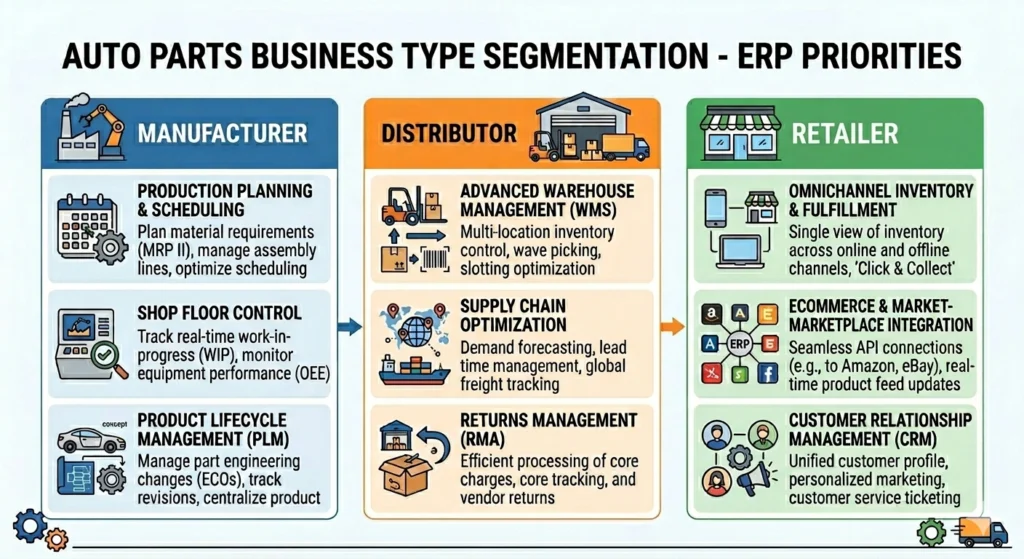
1. Auto Parts Manufacturer
You make parts. Your complexity lives in production: BOMs, work orders, shop floor execution, quality control, and supplier management. Your ERP must handle manufacturing operations first. Everything else is secondary.
2. Aftermarket Parts Distributor
You buy from manufacturers and sell to retailers, repair shops, or end consumers. You are managing thousands of SKUs across one or more warehouses, processing high order volumes, and handling customer-specific pricing. Your ERP must nail multi-warehouse inventory and order management above all else.
3. Auto Parts Retailer or E-Commerce Seller
You sell directly to end buyers, online or in-store or both. Your complexity is in multi-channel inventory accuracy and fast order processing. You need real-time stock counts that stay correct across all your sales channels without manual updates.
Most auto parts businesses fall between two of these. Knowing your primary type tells you which ERP capabilities to weigh most heavily during evaluation.
What Should You Look for in Auto Parts ERP?
Every automotive parts ERP system on this list covers the basics: inventory, orders, financials, and reporting. The differences show up in the details. Here is what separates genuinely good auto parts ERP from tools that almost work.
a. Multi-Warehouse Inventory Management
Auto parts businesses rarely operate from a single location. You need real-time stock visibility across every warehouse, branch, and retail counter simultaneously. The ERP must support location-specific reorder points, inter-warehouse transfers with full traceability, and consolidated inventory reporting at the company level.
b. Multi-Channel Order Management
If you sell through a website, a wholesale portal, Amazon, and over the counter, those four channels must pull from one inventory number. Not four. One. The moment your stock counts live in separate places, overselling and backorders follow. Good ERP keeps all channels synchronized automatically.
c. Supplier Management and Procurement
Auto parts businesses deal with dozens to hundreds of suppliers with varying lead times, quality records, and pricing structures. Your ERP should give you supplier performance data, automated purchase order generation triggered by reorder points, and visibility into which suppliers consistently deliver and which ones do not.
d. Financial Management Built for Automotive
Auto parts businesses deal with things like core charge deposits, warranty return credits, volume rebates, and customer-specific pricing matrices. Generic financial tools struggle with these. Your ERP should handle them natively without workarounds.
e. Cloud Deployment
Cloud ERP means no server to maintain, automatic updates, and access from any device. For most auto parts businesses in 2025, cloud-first deployment is the right default. On-premise adds infrastructure cost and IT overhead with diminishing returns unless you have specific security or compliance requirements that mandate it.
The 10 Best ERP Platforms for Auto Parts Businesses
1. Acumatica – Best for Aftermarket Distributors
Acumatica is a strong cloud ERP platform with a growing presence in the automotive aftermarket. Its flexible licensing model, which charges based on resources used rather than named users, makes it attractive for businesses with a lot of occasional or part-time system users.
Key strengths:
- Strong distribution and multi-warehouse inventory management
- Flexible pricing structure that does not penalize you for adding users
- Good e-commerce integration capabilities
- Open API architecture for connecting to third-party tools
Best for: Aftermarket parts distributors and retailers who need a solid cloud ERP without per-user fees limiting their access model.
What to know: Acumatica’s manufacturing capabilities are less deep than dedicated manufacturing platforms. If you both manufacture and distribute, the fit is less clean than for pure distributors.
2. Oracle NetSuite – Best for Mid-Market Auto Parts Businesses
NetSuite is cloud-native, built to run the full scope of a mid-market auto parts business in one system. Inventory, production, financials, CRM, and e-commerce all live in a single platform when you implement NetSuite for automotive. You do not need a separate accounting tool, a separate inventory system, and a separate sales tool that you then have to reconcile manually.
What separates a NetSuite from a generic setup is the automotive-specific configuration. We have implemented NetSuite for auto parts manufacturers, distributors, and multi-channel retailers. The result is a system built around how your operation actually works, not a default template.
Key strengths:
- Multi-warehouse inventory with real-time stock visibility across all locations
- Customer-specific pricing, payment terms, and order rules for wholesale and retail accounts
- Native integrations for Shopify, Magento, BigCommerce, and Amazon
- Multi-entity financials for businesses operating more than one legal entity
- Full production management for businesses that also manufacture or assemble parts
- CRM built in from day one, with customer history and sales pipeline in the same system
Best for: Aftermarket distributors, multi-channel auto parts retailers, and manufacturers with 20 to 500 employees.
What to know: NetSuite pricing is based on the modules you need plus user count. Custom quoting is required. Work with a Folio3 consultant to scope the right configuration before committing.
Real-world proof: Voxx Wheels, a performance wheel manufacturer, implemented NetSuite with Folio3 to unify their production, inventory, and financial operations after outgrowing their legacy systems. The result was cleaner data, faster reporting, and a single system that their whole team could work from. Read the full Voxx Wheels case study to see how the implementation was structured.

AutoRimShop, part of Alloy Capital Partners, is another strong example. Running a multi-brand auto parts retail operation across multiple e-commerce channels required a platform that could manage high SKU counts, channel-specific pricing, and consolidated financials. NetSuite handled all three. You can read the full details in the AutoRimShop success story.
3. SAP S/4HANA – Best for Large-Scale Manufacturers
SAP is the enterprise standard for large automotive operations. Its supply chain capabilities, compliance tools, and global manufacturing support are among the deepest available anywhere. For large auto parts manufacturers with multi-plant operations, global supplier networks, and direct OEM relationships, SAP handles scale that most platforms cannot match.
Key strengths:
- Deep supply chain and multi-plant manufacturing capabilities
- Strong OEM integration and EDI support
- Widely recognized in OEM audit environments
- Comprehensive financial management for complex corporate structures
Best for: Large auto parts manufacturers with 500+ employees, global operations, and direct OEM supply relationships.
What to know: SAP is expensive to implement and complex to operate. Total cost of ownership, including implementation, licensing, and ongoing support, is significantly higher than cloud-native alternatives. Implementation timelines are typically measured in years, not months.
4. Epicor Kinetic – Best for Precision Parts Manufacturers
Epicor has deep roots in discrete manufacturing and is widely used in automotive component production environments. Its shop floor execution tools, job costing, and routing capabilities are mature and well-suited to job shops making machined, stamped, or forged components.
Key strengths:
- Advanced shop floor scheduling and capacity planning
- Strong job costing and routing for make-to-order environments
- Good support for mixed-mode manufacturing
- Flexible cloud and on-premise deployment options
Best for: Precision parts manufacturers and job shops where shop floor execution is the primary operational challenge.
What to know: Epicor’s distribution and e-commerce capabilities are not as strong as its manufacturing tools. Businesses with significant wholesale distribution or online sales alongside manufacturing may need additional integrations.
5. QAD Adaptive ERP – Best for OEM Supplier Compliance
QAD has served automotive manufacturing for decades. Its automotive-specific workflows, including MMOG/LE supply chain evaluation, APQP, PPAP documentation, and IATF 16949 quality management, are built into the product natively rather than added as afterthoughts.
Key strengths:
- MMOG/LE, APQP, and PPAP processes built in from day one
- Strong OEM demand signal management and EDI capabilities
- Lean manufacturing and supplier collaboration tools
- Long history of automotive reference customers
Best for: Tier-1 and Tier-2 auto parts manufacturers with direct OEM relationships that require compliance-heavy documentation and traceability.
What to know: QAD is sized for larger operations and can be over-specified for smaller businesses. Pricing and implementation complexity tend to be higher than cloud-native mid-market options.
6. Plex Manufacturing Cloud – Best for Shop Floor Visibility
Plex sits at the intersection of ERP and Manufacturing Execution System (MES). Its real-time shop floor data capture, machine monitoring, and production quality tracking are among the strongest available in a cloud platform.
Key strengths:
- Real-time machine monitoring and OEE (Overall Equipment Effectiveness) tracking
- Production quality recording at the unit and lot level
- Strong automotive compliance and traceability tools
- Cloud-native with a solid North American automotive supplier reference base
Best for: High-volume auto parts manufacturers where shop floor visibility and real-time production quality data are the top priorities.
What to know: Plex’s financial management and CRM capabilities are less mature than dedicated financial ERP platforms. Multi-entity accounting alongside production management may require supplemental tools.
7. Microsoft Dynamics 365 Business Central – Best for Microsoft-Ecosystem Businesses
Microsoft Dynamics 365 Business Central is a solid mid-market ERP for auto parts businesses already deeply invested in Microsoft tools. It connects natively with Microsoft 365, Teams, and Power BI, which reduces the integration burden for companies already in that ecosystem.
Key strengths:
- Native integration with Microsoft 365, Teams, and Power BI
- Strong financial management and basic inventory capabilities
- Familiar interface for teams already using Microsoft tools
- Reasonable per-user pricing for mid-market businesses
Best for: Mid-market auto parts businesses that are primarily Microsoft ecosystem users and do not have heavy automotive manufacturing requirements.
What to know: Business Central requires significant customization to match the out-of-the-box automotive functionality available in more specialized platforms. For complex production or OEM compliance needs, customization costs can offset the lower base price quickly.
8. SYSPRO – Best for Supply Chain Visibility
SYSPRO is an end-to-end ERP platform with strong supply chain and manufacturing capabilities built for manufacturers and distributors. Its real-time supply chain visibility tools are particularly well regarded for businesses managing complex multi-supplier networks and high-SKU inventories.
Key strengths:
- Real-time supply chain visibility across the entire vendor network
- Strong inventory and demand planning tools
- Good manufacturing execution for discrete and mixed-mode manufacturers
- Integration capabilities for IoT and connected factory equipment
Best for: Auto parts manufacturers and distributors who need detailed supply chain visibility across a complex vendor network.
What to know: SYSPRO’s e-commerce and CRM capabilities are not its strongest features. Businesses with significant direct-to-consumer or online sales volume may need additional tools.
9. Infor CloudSuite Automotive – Best for Global OEM-Connected Manufacturers
Infor’s CloudSuite Automotive is purpose-built for automotive manufacturers, with specific support for OEM customer portals, EDI, production scheduling, and global supply chain coordination. Its multi-region and multi-currency capabilities are stronger than most competitors.
Key strengths:
- Purpose-built for automotive OEM supply chain environments
- Strong global operations support with multi-currency and multi-region capabilities
- EDI and OEM portal integration built in natively
- Good supplier collaboration and demand management tools
Best for: Mid-to-large auto parts manufacturers with international operations and direct OEM supply chain relationships.
What to know: Infor is best suited for manufacturers rather than distributors or retailers. Outside the OEM supply chain, its industry-specific features provide less value relative to cost.
10. Cetec ERP – Best for Small Manufacturers on a Budget
Cetec ERP is a cloud-based manufacturing ERP built for small to mid-sized manufacturers. At $50 per user per month with a 30-day free trial, it is one of the most accessible options for small auto parts businesses that need production management, inventory, and basic financials without a large upfront investment.
Key strengths:
- Very affordable pricing for small operations
- Cloud-based with no infrastructure required
- Covers core manufacturing needs, including work orders, BOM, inventory, and basic financials
- 30-day free trial available for evaluation
Best for: Small auto parts manufacturers with under 50 employees who need basic production and inventory management without a high-cost ERP commitment.
What to know: Cetec’s automotive-specific capabilities are limited. For businesses that need OEM compliance features or complex multi-warehouse distribution, Cetec will fall short quickly.
For automotive businesses considering NetSuite, our blog on operational efficiency with NetSuite ERP for automotive businesses covers the outcomes we have delivered for clients across the sector.
How to Narrow Down Your List When Selecting Automotive Parts ERP
Ten auto parts ERP system is a good starting point. But you need to get to two or three before you invest time in demos. Here is how we recommend doing it.
Step 1: Match Your Business Type to the Right Platforms
Go back to the three types we covered; manufacturer, distributor, or retailer. Your primary type immediately eliminates some options and elevates others. A precision parts manufacturer should weigh Epicor and Plex heavily. An aftermarket distributor should look at Acumatica and NetSuite. A multi-channel retailer should focus on NetSuite and Business Central.
Step 2: Set a Realistic Budget Including Implementation
Most buyers budget for licensing and forget implementation, training, and ongoing support. A realistic rule of thumb: implementation typically costs 1 to 2 times the first-year licensing fee for a mid-sized auto parts business. Be honest about your total budget before talking to vendors. It saves time for everyone.
Step 3: Build a Must-Have List Before Demos
Not every feature carries equal weight for your business. Write down your five non-negotiable capabilities and use them as a filter before agreeing to a demo. This keeps you from getting sold on features that look impressive but do not solve your actual problems.
Step 4: Ask to See Your Scenarios in the Demo
Generic demos show you software at its best. You want to see how it handles your specific situations. Before any demo, send the vendor two or three real scenarios from your business and ask them to walk through those. How does the system handle a backorder when a supplier is late? How does it manage a return with a core charge credit? The answers tell you more than any feature checklist.
Step 5: Evaluate the Implementation Partner, Not Just the Software
This is where most buyers underinvest. The platform is 50% of the outcome. The implementation partner is the other 50%.
A partner with automotive experience knows the configurations that work, the failure points to avoid, and the shortcuts that save time. A partner new to your industry learns those lessons on your time.
When evaluating partners, ask for references from auto parts businesses specifically. Ask how many automotive projects they have completed. Ask who will be on your project team.
Mosites Motorsports is a good example of why the partner matters. When they needed to move off their existing platform and consolidate financial operations, Folio3 implemented NetSuite SuiteSuccess Financials First, providing a clean, scalable financial foundation tailored to their motorsport operation. Read the Mosites Motorsports case study to see how the project was scoped and delivered.

Red Flags to Watch For During Evaluation for ERP Software Autoparts
We have seen auto parts businesses make costly ERP mistakes. These are the warning signs to watch for.
- The vendor cannot show a live demo without two weeks of setup. If they need that much prep time, the system is not as intuitive as they claim.
- The implementation timeline sounds too fast. A properly scoped ERP project for a mid-sized auto parts business takes at a minimum 3 to 6 months. Anyone promising 6 weeks is cutting corners.
- The contract requires a multi-year commitment before you have seen a live system. Ask for phased agreements tied to delivery milestones.
- The partner has no automotive references. Generic manufacturing experience is not the same thing. Ask for references and call them.
Final Thoughts
The right ERP for your auto parts business is not the one with the longest feature list. It is the one that fits your specific operation, gets implemented properly, and actually gets used by your team.
Start with your business type. Build your must-have list. Ask tough questions in demos. Evaluate your partner as carefully as you evaluate the software.
If you want to talk through your specific situation before you commit to a demo cycle, the Folio3 team works with auto parts businesses at every stage. Reach out and we will give you an honest read on whether NetSuite is the right fit for what you are trying to do.
FAQs
What is the best ERP software for auto parts businesses overall?
For most mid-market auto parts businesses, NetSuite configured by Folio3 is the strongest option. It covers inventory, production, financials, CRM, and e-commerce in one cloud system. For aftermarket distributors who need a flexible licensing model, Acumatica is a strong alternative. For large manufacturers with OEM compliance requirements, QAD or Infor are worth evaluating.
How much does ERP software cost for an auto parts business?
Licensing costs for mid-market ERP typically range from $2,000 to $8,000 per month depending on the platform and user count. Implementation costs are usually 1 to 2 times the first-year licensing fee. For a 30-person auto parts business, expect a total first-year investment of $40,000 to $100,000 covering licensing, implementation, and training.
How long does ERP implementation take for an auto parts company?
With good data preparation and a focused scope, a mid-sized auto parts business can go live in 3 to 6 months. Complex implementations with multiple integrations or significant data migration needs take 6 to 12 months.
Does NetSuite handle automotive parts inventory management?
Yes. NetSuite handles multi-warehouse inventory, customer-specific pricing, multi-channel order management, and demand planning natively. Folio3 configures these capabilities specifically for auto parts workflows during implementation.
How does Folio3 support auto parts businesses on NetSuite?
Folio3 is a NetSuite Alliance Partner with specific experience configuring NetSuite for auto parts manufacturers, distributors, and retailers. That means automotive-specific inventory structures, pricing configurations, and integration setups rather than a generic deployment. Our NetSuite consulting services covers how we approach the engagement.