
Key Takeaways
- UAE e-invoicing requires structured electronic invoices exchanged through accredited service providers, with prescribed tax data reported to the Federal Tax Authority (FTA).
- Mandatory implementation starts January 1, 2027, for businesses earning AED 50 million or more annually, followed by smaller businesses on July 1, 2027.
- B2B and B2G transactions fall within the mandate regardless of VAT registration, subject to specific exclusions.
- Businesses need accurate invoice data, PINT AE compliance, ASP connectivity, and tested processes for sending and receiving electronic invoices.
- The October 2026 amendments introduced VAT Tax Group relief, revised penalties, and changes to invoice-data storage requirements.
UAE e-invoicing is changing how businesses issue, exchange, receive, and report invoices. Starting January 1, 2027, businesses with annual revenue of AED 50 million or more must comply with the country’s mandatory electronic invoicing requirements, followed by smaller businesses in July 2027.
For B2B businesses, this changes the invoice process from exchanging PDFs and manually entering transaction information to using structured electronic documents transmitted through Accredited Service Providers (ASPs). Your accounting or ERP system must also provide the information required for invoice validation, VAT classification, and tax reporting.
This guide explains what e-invoicing in the UAE means, how the Peppol framework works, which businesses must comply, the latest regulations and penalties, and how to prepare your financial systems for implementation.
What Is E-Invoicing in the UAE?
E-invoicing in the UAE is the electronic issuance, exchange, and reporting of structured invoice data between businesses through an accredited service provider. The system uses the UAE’s PINT AE specification and Peppol-based network to enable automated invoice processing and the reporting of prescribed tax information to the FTA.
Under traditional invoicing, a supplier creates an invoice in its accounting system and emails a PDF to the buyer. The buyer then reviews the document and enters the information into its accounts payable system.
With e-invoicing, the supplier’s ERP sends structured invoice data to an ASP, which validates and exchanges the document with the buyer’s ASP. The buyer receives the structured invoice for processing, and the prescribed tax information is reported to the FTA through the regulated system.
How Is E-Invoicing Different From Traditional Invoicing?
UAE e-invoicing uses structured, machine-readable documents exchanged through accredited service providers and reported to the FTA. Traditional invoicing relies on PDFs, paper, or email, and errors surface during manual review.
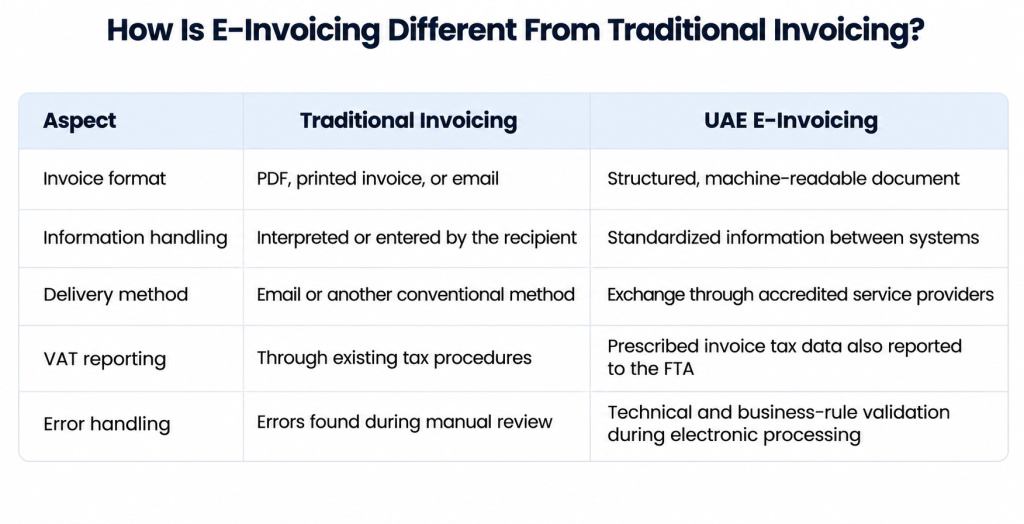
A PDF generated by an ERP does not qualify as an e-invoice under the UAE framework. The document must satisfy the prescribed structured-data and exchange requirements.
Is E-Invoicing Mandatory for B2B Businesses in UAE?
Yes. UAE e-invoicing is mandatory for businesses carrying out transactions within the system’s scope, beginning with the phased rollout in 2027. The requirements apply regardless of whether your business is registered for VAT, although specific transactions and activities are excluded.
The framework covers the following transaction categories:
| Transaction type | UAE e-invoicing treatment |
|---|---|
| Business to Business (B2B) | Included in the mandatory system |
| Business to Government (B2G) | Included in the mandatory system |
| Government to Business (G2B) | Included for applicable transactions |
| Government to Government (G2G) | Included for applicable transactions |
| Business to Consumer (B2C) | Excluded from mandatory electronic invoicing under the current framework |
Do Free Zone Businesses Need E-Invoicing?
Yes, businesses operating in UAE free zones must comply with e-invoicing requirements when they conduct in-scope transactions. This includes companies registered in DMCC (Dubai Multi Commodities Centre), JAFZA (Jebel Ali Free Zone), IFZA (International Free Zone Authority), ADGM (Abu Dhabi Global Market), DIFC (Dubai International Financial Centre), and RAKEZ (Ras Al Khaimah Economic Zone).
For instance, if a JAFZA-based distributor sells goods to a mainland UAE business, the transaction must be assessed under the applicable e-invoicing rules. The same applies to businesses operating in DMCC, IFZA, ADGM, DIFC, and RAKEZ. Certain free-zone transactions also require additional buyer or beneficiary information in the electronic invoice.
Your free-zone registration does not determine your exemption. The nature of the transaction and the applicable UAE e-invoicing rules do.
What Are the UAE E-Invoicing Deadlines for 2027?
The mandatory rollout begins in January 2027 and follows a phased schedule based on annual revenue and entity type. The pilot and voluntary implementation phase began on July 1, 2026.
| Business category | ASP appointment deadline | Mandatory implementation |
|---|---|---|
| Annual revenue of AED 50 million or more | October 30, 2026 | January 1, 2027 |
| Annual revenue below AED 50 million | March 31, 2027 | July 1, 2027 |
| Government entities | March 31, 2027 | October 1, 2027 |
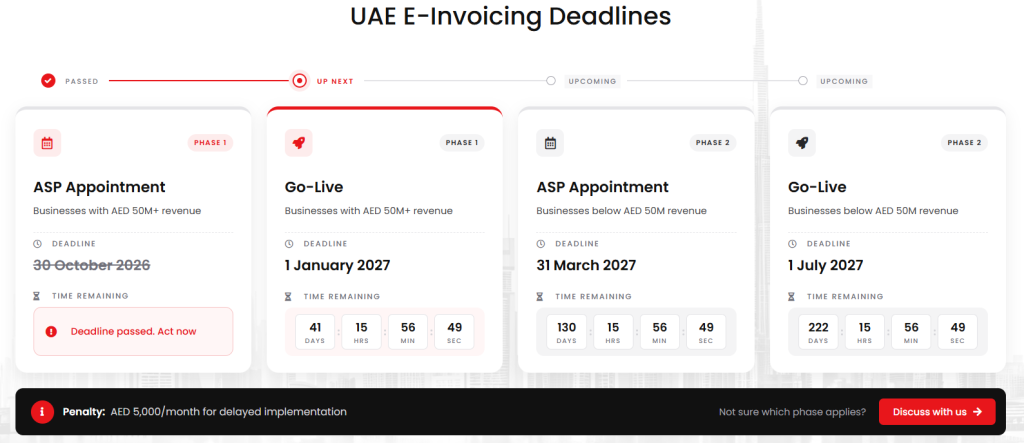
The AED 50 million threshold is based on gross income during the most recent accounting period, using the applicable financial statements or other accepted evidence. It is not restricted to revenue from B2B transactions.
Ministerial Decision No. 66 of 2026 extended the first-phase ASP appointment deadline from July 31 to October 30, 2026, without changing the January 2027 implementation date.
Newly established businesses within the mandatory scope must also address ASP appointment and onboarding before issuing their first invoice.
How Does E-Invoicing Work in UAE?
UAE e-invoicing operates through the Decentralized Continuous Transaction Control and Exchange (DCTCE) framework, commonly called the Peppol five-corner model. It connects suppliers, buyers, their accredited service providers, and the Federal Tax Authority.
Understanding the Five-Corner Model
| Corner | Participant | Responsibility |
|---|---|---|
| Corner 1 | Supplier | Creates and submits invoice information |
| Corner 2 | Supplier’s ASP | Validates, transforms, exchanges, and reports invoice data |
| Corner 3 | Buyer’s ASP | Receives and validates the invoice, delivers it to the buyer, and performs the required reporting |
| Corner 4 | Buyer | Receives the electronic invoice for business processing |
| Corner 5 | Federal Tax Authority | Receives prescribed tax data and provides reporting confirmations |
Example: A B2B Invoice in Dubai
Suppose your Dubai-based company supplies equipment worth AED 20,000 to another UAE business, with AED 1,000 in applicable VAT.
Your accounting system creates an invoice totaling AED 21,000. The electronic invoicing process then follows these stages:
- Your business submits the invoice information to its accredited service provider.
- The ASP validates the data and prepares the required PINT AE XML document.
- Your ASP exchanges the invoice with the buyer’s ASP through the Peppol network.
- The buyer’s ASP validates the document and delivers it to the buyer’s system.
- The ASPs perform the prescribed tax-data reporting to the FTA and return the relevant confirmations.
The exchange and reporting activities are separate. An invoice accepted by your service provider has not necessarily completed delivery to the buyer or tax reporting.
This is why your integration needs to track the document through the relevant processing stages rather than treating submission as final confirmation.
What Are the Technical Requirements for UAE E-Invoicing?
UAE e-invoices must follow the applicable PINT AE specification, use the prescribed structured electronic format, include required invoice information, and pass validation through an accredited service provider.
The technical requirements cover both the contents of the invoice and the way it moves between the participating systems.
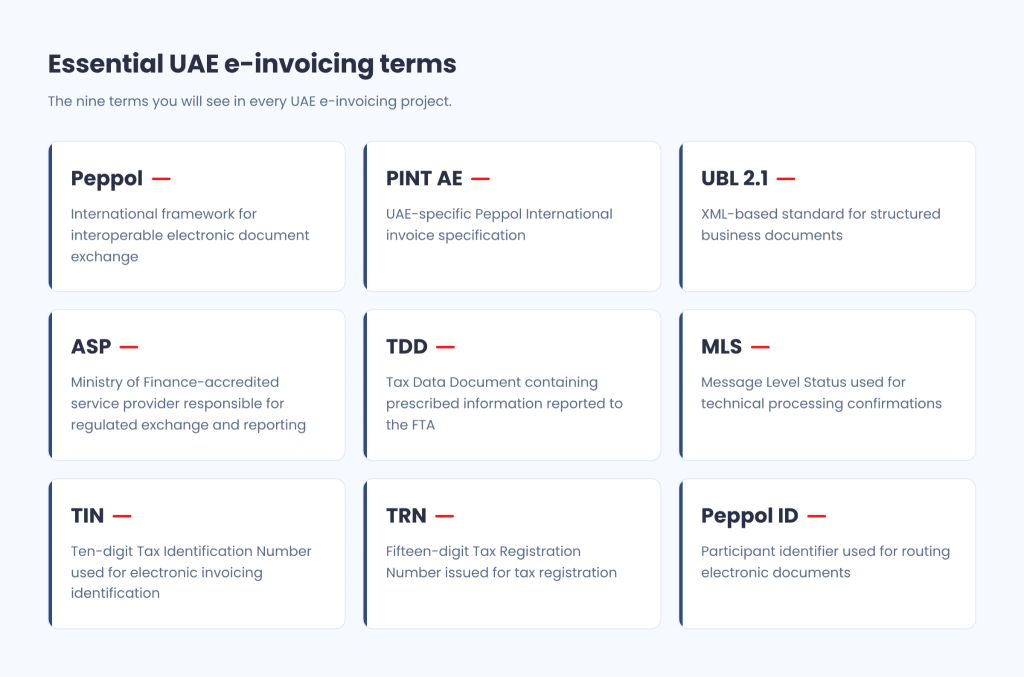
Essential UAE E-Invoicing Terms
Below are the important e-invoicing terms you must know.
What Information Must a UAE E-Invoice Contain?
The Ministry of Finance has published mandatory electronic invoice field requirements covering invoice identification, seller and buyer information, tax classification, document totals, and line-level transaction details.
The data requirements include:
- Invoice information: Invoice number, issue date, document type, and currency.
- Supplier and buyer information: Legal names, registration identifiers, electronic addresses, and applicable tax details.
- Transaction details: Item descriptions, quantities, unit prices, and payment information.
- VAT information: Taxable amounts, tax rates, tax categories, exemption reasons where applicable, and VAT totals.
- Document references: Relevant original invoice references for credit notes and other conditional information.
The exact mandatory and conditional fields depend on the document category and transaction scenario.
Under the UAE rules, a business’s Peppol Participant Identifier is based on its ten-digit TIN, with identifier scheme 0235. Businesses without an existing TIN need to obtain one through the FTA process.
The technical specification also covers foreign-currency transactions, including the appropriate AED tax information, and requires correct classification of standard-rated, zero-rated, exempt, and other applicable VAT scenarios.
Which Types of E-Invoices Are Supported in UAE?
The UAE framework recognizes six electronic invoice and credit-note categories, covering standard billing, commercial invoices, and qualifying self-billing arrangements.
| Document category | Business purpose |
|---|---|
| Electronic Tax Invoice | Records supplies requiring a VAT tax invoice |
| Electronic Tax Credit Note | Records an applicable reduction or adjustment to a tax invoice |
| Commercial Electronic Invoice | Covers transactions where a VAT tax invoice is not required |
| Commercial Electronic Credit Note | Adjusts a commercial electronic invoice |
| Self-Billed Electronic Tax Invoice | Buyer issues the tax invoice on behalf of the supplier under an eligible arrangement |
| Self-Billed Electronic Tax Credit Note | Records adjustments under qualifying self-billing arrangements |
A manufacturer returning defective materials or a distributor correcting an overcharged invoice must follow the appropriate credit-note requirements. The FTA also clarifies that credit notes are the standard correction mechanism rather than simply cancelling an exchanged electronic invoice.
The October 2026 guidelines address additional scenarios, including free-zone supplies, exports, advances, summary invoices, and transactions involving agents. Your ERP must identify the relevant scenario and provide the fields required for that type of electronic document.
How Does E-Invoicing Affect VAT Compliance in UAE?
E-invoicing introduces an additional electronic exchange and reporting requirement without replacing the existing UAE VAT obligations.
A VAT-registered business remains responsible for calculating the correct tax, issuing compliant tax invoices, maintaining the required records, and submitting VAT returns.
The electronic invoice must reflect the appropriate tax treatment of the underlying supply. For example, an invoice containing both standard-rated and zero-rated items requires the correct tax classification and amount breakdown.
Non-VAT-registered businesses with in-scope transactions also need to comply with e-invoicing requirements, even though their commercial invoices do not follow the same VAT treatment as tax invoices.
For businesses operating across multiple entities, the challenge is ensuring that the invoice issued through the electronic system agrees with the financial records and relevant tax treatment.
What Are the Benefits of UAE E-Invoicing for B2B Businesses?
Electronic invoicing helps businesses reduce manual document handling, improve invoice-data consistency, and strengthen visibility across accounts receivable and accounts payable.
Its practical value depends on how well the system connects with existing financial processes.
For accounts receivable, structured invoice exchange reduces reliance on email attachments and manual delivery. Validation checks identify missing information before documents proceed through electronic exchange, while processing statuses help teams investigate rejected invoices.
For accounts payable, incoming structured invoices provide data that finance systems can use for vendor identification, purchase-order matching, and approval processing. This reduces repetitive data entry, although commercial and accounting controls remain necessary.
For finance management, consistent electronic records create a clearer basis for reviewing invoice activity, transaction exceptions, and tax-reporting information.
The Ministry of Finance also identifies reduced processing costs, improved cash-flow opportunities, and stronger transparency as expected benefits of electronic invoicing. Actual outcomes depend on the business’s implementation and level of automation.
How Can B2B Businesses Prepare for UAE E-Invoicing?
Preparation starts with identifying the transactions covered by the mandate and ensuring your financial systems contain the information required for compliant electronic exchange.
1. Assess Your Compliance Scope
Determine which implementation phase applies to your business, identify the relevant legal entities, and review your B2B and B2G transactions. Include customer invoices, credit notes, supplier invoices, exports, and any qualifying special arrangements.
2. Select an Accredited Service Provider
Choose a provider from the Ministry of Finance’s official accredited ASP register. Your business must appoint one ASP for its sending and receiving obligations.
Evaluate the provider’s support for your accounting system, invoice volume, supported transaction types, error handling, and reporting confirmations. The business initiates the prescribed ASP onboarding through EmaraTax, but EmaraTax is not the platform used for exchanging invoices.
If you are still deciding how to connect NetSuite to an ASP, compare the available options first. Our guide to the top e-invoicing solutions for NetSuite in UAE covers the choices for NetSuite users ahead of the 2027 deadlines.
3. Prepare Your ERP and Invoice Data
Review customer and supplier identifiers, legal entity details, VAT classifications, currency values, and invoice fields against the PINT AE requirements. Identify missing information before configuring the connection.
For companies using Oracle NetSuite, this preparation also involves subsidiary configuration, transaction records, approval processes, and existing SuiteScript customizations.
Folio3’s NetSuite UAE e-invoicing services help businesses connect their existing NetSuite environment to their chosen accredited ASP. Its ASP-agnostic integration approach supports the technical requirements for electronic invoice processing, including field mapping, inbound and outbound transactions, testing, and exception handling.
4. Test Electronic Invoice Exchange
Test the complete process with your ASP before going live. Use real business scenarios, including standard invoices, credit notes, foreign-currency transactions, and incoming supplier invoices.
Your tests should also include missing identifiers, incorrect VAT classifications, rejected documents, and interrupted connections. The finance team needs to understand how these issues are identified and corrected.
5. Establish Monitoring and Record Retention
Assign responsibility for unresolved electronic invoices, processing exceptions, and changes to registered information.
Your business must retain electronic invoices, credit notes, and associated data for the applicable statutory period and make the records available to the FTA when requested.
What Are the UAE E-Invoicing Penalties in 2027?
Cabinet Decision No. 173 of 2026 establishes revised administrative penalties for violations of the UAE’s electronic invoicing requirements.
| Violation | Penalty |
|---|---|
| Failure to implement e-invoicing or appoint an ASP within the prescribed timeline | AED 5,000 initially, followed by AED 5,000 per month or part thereof while non-compliance continues, capped at AED 50,000 across 12 consecutive months |
| Failure to issue and transmit an electronic invoice | AED 100 per invoice, up to AED 5,000 per calendar month |
| Failure to issue and transmit an electronic credit note | AED 100 per credit note, up to AED 5,000 per calendar month |
| Failure to notify the ASP about changes to information registered with the FTA | AED 250 per day or part thereof, up to AED 5,000 per calendar month |
The revised decision replaces the earlier penalty framework under Cabinet Decision No. 106 of 2025. It also removes the previous e-invoicing-specific penalties related to system-failure notifications.
Mandatory e-invoicing penalties do not apply to voluntary implementation before the business’s applicable compliance date. Existing VAT-related penalties remain a separate consideration.
Prepare Your Business for UAE E-Invoicing in 2027
UAE e-invoicing requires businesses to connect their existing financial transactions with a regulated system for structured invoice exchange and tax reporting. Compliance depends on accurate source data, the correct document classifications, a functioning ASP connection, and reliable controls for processing errors.
If your company already uses an ERP, the priority is to evaluate how its customer, supplier, tax, and transaction records will support the new requirements. Completing the integration and testing before your mandatory date helps prevent invoice disruption and gives finance teams time to resolve data and configuration problems.
For NetSuite businesses, Folio3 provides Peppol-compliant e-invoicing integration and implementation support covering ASP connectivity, ERP configuration, testing, and post-go-live operations.
FAQs
Is E-Invoicing Mandatory in UAE From 2027?
Yes. Mandatory e-invoicing begins January 1, 2027, for in-scope businesses earning AED 50 million or more annually. Businesses below that threshold must implement the system by July 1, 2027, while covered government entities follow on October 1, 2027.
Do Small Businesses Need to Comply With UAE E-Invoicing?
Yes. Small businesses carrying out transactions within the mandatory scope must comply regardless of VAT registration. Businesses below the AED 50 million annual revenue threshold follow the July 1, 2027, implementation date, subject to the applicable rules for newly established businesses.
Can Businesses Continue Sending PDF Invoices in UAE?
A PDF alone does not qualify as a UAE electronic invoice. Businesses must exchange structured electronic invoice data through an accredited ASP. During the transition period, a buyer that has not yet onboarded may still require a conventional tax invoice alongside the structured electronic invoice.
Do UAE E-Invoices Need a QR Code or Digital Signature?
The UAE’s framework does not impose a general requirement for QR codes or digital signatures on electronic invoices. Compliance centers on the prescribed structured invoice format, validation, accredited exchange, and reporting requirements.
Does E-Invoicing Replace VAT Returns in UAE?
No. Electronic invoicing reports prescribed transaction tax data to the FTA, but it does not eliminate existing VAT obligations. Businesses must continue preparing and submitting their VAT returns and maintaining compliant accounting records.
