Key Takeaways
- 21 CFR Part 11 applies to certain electronic records and signatures governed by FDA requirements. It does not automatically apply to every electronic record in a CDMO’s ERP.
- Part 11 compliance depends on system controls, procedures, validation, user access, electronic signatures, record integrity, and the applicable predicate rules.
- CDMOs should map regulated records and workflows before configuring NetSuite, including quality inspections, batch records, approvals, inventory status, deviations, and other records relied on for regulated activities.
- NetSuite Quality Management centralizes inspection criteria, test results, quality workflows, and inventory controls within the ERP environment.
- A risk-based validation strategy should demonstrate that NetSuite and connected systems perform as intended for the processes that affect product quality, safety, and record integrity.
- CDMOs should design compliance controls around the complete system landscape, including integrations and external applications that create, modify, transmit, or rely on regulated records.
Contract development and manufacturing organizations (CDMOs) face a difficult combination of growth and regulatory control. As a CDMO takes on more clients, products, batches, facilities, and production activities, the volume of electronic records increases across quality, manufacturing, inventory, finance, and customer operations.
21 CFR Part 11 establishes requirements for electronic records and electronic signatures when those records are subject to FDA requirements and maintained electronically. For a growing CDMO, the challenge is larger than choosing software with compliance-related features.
The organization needs to determine which records fall within Part 11, configure appropriate access and electronic-signature controls, maintain reliable records, validate systems based on risk, and establish procedures that keep those controls effective throughout the system lifecycle.
NetSuite provides a centralized ERP environment for manufacturing, inventory, quality, financials, and supply chain operations. With the right configuration, validation approach, integrations, and operating procedures, it supports the controlled electronic workflows a CDMO needs as it scales. Folio3 implements NetSuite for biotech & pharma and process manufacturing organizations, including workflows for batch production, lot traceability, quality management, inventory, and compliance-oriented operations.
What Does 21 CFR Part 11 Require?
21 CFR Part 11 establishes criteria under which FDA considers electronic records and electronic signatures to be trustworthy, reliable, and generally equivalent to paper records and handwritten signatures. It applies to electronic records that are created, modified, maintained, archived, retrieved, or transmitted under FDA recordkeeping requirements, as well as certain electronic records submitted to the FDA.
The FDA’s Part 11 guidance recommends determining which specific records are subject to Part 11 based on the underlying predicate rules and documenting that determination. This is important for CDMOs because the ERP may contain thousands of records, but only some may qualify as Part 11 records depending on how they are used and the regulatory requirements governing them.
For a CDMO, the analysis involves records associated with manufacturing, quality, laboratory activities, batch release, inventory controls, approvals, and other regulated processes. The exact scope should be determined through a documented assessment of the applicable predicate rules and how the organization relies on electronic records.
Which Part 11 Controls Matter Most for a CDMO?
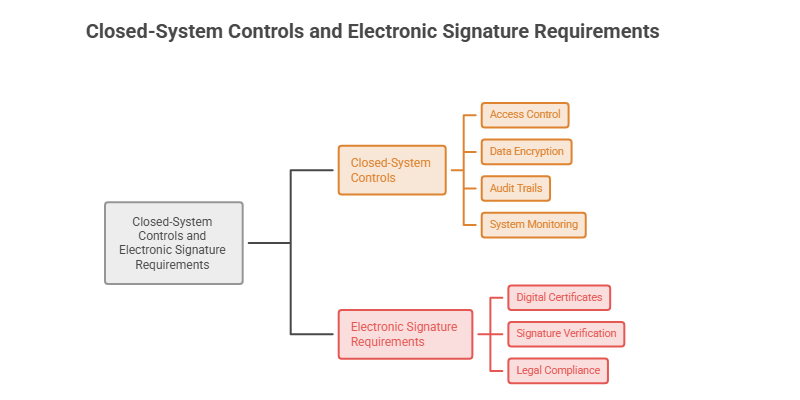
Part 11 covers a combination of technical and procedural controls. A CDMO implementing or expanding an ERP should pay particular attention to the controls that affect who can access records, perform regulated actions, how changes are recorded, and how electronic signatures are controlled.
Controlled System Access
Part 11 requires controls that limit system access to authorized individuals. It also includes authority checks to ensure that only authorized users perform specified operations, electronically sign records, alter records, or access system inputs and outputs.
For a CDMO, access should be designed around job responsibilities rather than convenience.
For example, production personnel may need to record manufacturing activity, while quality personnel may need to review inspection results or approve a disposition. Finance users may need access to financial transactions without having authority to approve quality records.
Role design should address:
- User identity
- Role permissions
- Segregation of duties
- Approval authority
- Administrative access
- Temporary access
- User termination
- Periodic access review
The goal is to make sure a user can perform the activities required by their role without receiving unnecessary access to regulated records or approval functions.
Audit Trails and Record Changes
Part 11 addresses secure, computer-generated, time-stamped audit trails for actions that create, modify, or delete electronic records. Changes should not obscure previously recorded information, and applicable audit-trail records must be retained and available for agency review.
The FDA’s Part 11 guidance takes a risk-based approach to audit trails and emphasizes the importance of maintaining reliable records and complying with the underlying predicate rules.
For a CDMO, audit-trail requirements should be considered for workflows where users can change information that affects regulated activities. Examples include quality results, specifications, approval information, inventory status, manufacturing records, and other controlled data.
A compliance review should therefore ask:
- What records can users change?
- Who can make those changes?
- Is the original information preserved?
- Can the organization identify who made the change?
- Is the date and time recorded?
- Can authorized personnel review the change history?
- Are retention requirements defined?
Electronic Signatures
Electronic signatures used in regulated processes need controls that establish the identity of the signer and link the signature to the associated record.
Under §11.50, signed electronic records must indicate the signer’s printed name, the date and time of signing, and the meaning associated with the signature, such as review, approval, responsibility, or authorship.
Part 11 also requires electronic signatures to be unique to one individual. Non-biometric electronic signatures generally use at least two identification components, such as an identification code and password, with additional controls governing their use.
For a CDMO, this becomes particularly relevant when electronic approval is used for activities such as:
- Quality review
- Batch-related approvals
- Specification approval
- Document approval
- Inventory disposition
- Deviation or corrective-action workflows
- Production-related approvals
The electronic signature should be part of a controlled workflow rather than simply a name field added to a transaction.
Does 21 CFR Part 11 Apply to Every NetSuite Record?
No. Part 11 does not automatically apply to every record stored in NetSuite.
FDA’s guidance explains that Part 11 applies to electronic records required under predicate rules when those records are maintained electronically in place of paper, as well as certain records maintained electronically alongside paper when the electronic version is relied upon for regulated activities. FDA recommends determining this scope record by record and documenting the decision.
This distinction matters for CDMOs because an ERP contains both regulated and ordinary business information.
A financial report used solely for internal management purposes has different regulatory implications from an electronic record that documents a regulated manufacturing or quality activity.
This is why the compliance assessment should start with the business process and applicable regulatory requirement rather than applying the same controls to every NetSuite record.
Where Does NetSuite Fit Into a CDMO’s Part 11 Strategy?
NetSuite serves as the central ERP layer connecting financial management, inventory, procurement, manufacturing, quality, and other operational processes. For pharmaceutical and biotech organizations, NetSuite capabilities include inventory, lot and expiration tracking, quality management, advanced manufacturing, financial management, and compliance-oriented operations.
For a CDMO, the value comes from connecting these functions so that regulated activities do not depend on disconnected spreadsheets and manually reconciled systems.
The implementation should map the organization’s actual processes before deciding which NetSuite modules and configurations are required.
Using NetSuite Quality Management for Regulated Workflows
NetSuite Quality Management supports standardized test definitions, receiving and in-process inspections, quality specifications, inspection workflows, mobile data collection, and quality reporting.
For a CDMO, quality workflows are connected to the inventory and manufacturing processes that generate the underlying records.
For example, an incoming raw material can be received against a controlled inspection process. If the material does not meet the defined criteria, it can be placed on hold rather than becoming available for production.
In-process inspections can then be performed at defined points, with the resulting quality information retained alongside the relevant production or inventory context.
This reduces the need to maintain inspection information separately from the operational transaction it relates to.
Test Definitions and Specifications
Quality teams define standardized inspection criteria rather than relying on individual inspectors to interpret requirements manually. NetSuite QMS documentation describes test definitions with acceptable ranges, measurements, and inspector requirements.
For a CDMO, these controls can support consistent execution across:
- Incoming raw materials
- In-process production
- Finished products
- Suppliers
- Manufacturing locations
- Different production runs
The implementation should still define which quality records are regulated and how those records are controlled, reviewed, retained, and validated.
Lot Traceability and Batch Genealogy
CDMOs need to know where materials came from, which batch consumed them, what was produced, and where the resulting product went.
Lot traceability connects supplier materials to production batches and finished products. This becomes particularly important when investigating quality events, responding to customer questions, managing recalls, or demonstrating the history of a batch.
Folio3’s process manufacturing implementation practice specifically covers batch production, lot traceability, quality control, inventory, and financial reporting for pharmaceutical and other process manufacturers.
A well-designed NetSuite environment should allow the organization to answer questions such as:
- Which supplier lot was used?
- Which production batch consumed it?
- Which finished lots resulted?
- Which customers received the finished product?
- What quality inspections were performed?
- What was the disposition of the batch?
- Which records support the final release decision?
Traceability should be tested using actual production scenarios rather than validated only by checking that lot numbers exist in the system.
Validation Should Be Risk-Based
Validation is one of the areas where Part 11 is frequently oversimplified.
FDA’s Part 11 guidance states that validation decisions should consider the impact of the computerized system on predicate-rule requirements and the accuracy, reliability, integrity, availability, and authenticity of required records. It recommends a justified and documented risk assessment.
FDA’s more recent Computer Software Assurance guidance similarly emphasizes a risk-based approach for software used in production and quality systems.
For a CDMO implementing NetSuite, validation should therefore focus attention on the functions that can affect regulated processes and record integrity.
A practical validation framework includes:
- Define intended use
Document what each NetSuite function or connected application is expected to do. - Identify regulated processes
Determine which processes create or rely on records governed by applicable regulations. - Perform a risk assessment
Identify where system failure, incorrect configuration, unauthorized changes, or inaccurate data could affect product quality, safety, or record integrity. - Define requirements
Translate those risks into functional and compliance requirements. - Configure and document the system
Maintain controlled records of the configuration and relevant design decisions. - Test critical workflows
Verify normal transactions, exceptions, permissions, approvals, and data flows. - Document results
Maintain evidence that the system performs as intended. - Control changes after go-live
Reassess and test significant changes rather than treating validation as a one-time project.
Design Compliance Across the Entire Technology Stack
NetSuite may be the ERP, but it is not the only system involved in a CDMO’s regulated workflow.
A CDMO could also use:
- Laboratory information systems
- Manufacturing execution systems
- Warehouse management systems
- Quality management applications
- Electronic document systems
- Customer portals
- EDI platforms
- Data analytics platforms
This is why the compliance assessment needs to follow the record across the technology landscape.
For example, if a laboratory system generates a test result that is transferred into NetSuite, the project team needs to determine which system is the authoritative record, how the data is transferred, how errors are handled, and which controls apply to each system.
The same principle applies to integrations that move inventory, batch, quality, or approval information between applications.
Data Integrity Should Be Designed Into the Workflow
FDA’s data integrity guidance emphasizes complete records, up-to-date documentation, attribution to specific individuals, authorized changes, review, and secure retention.
These principles affect how a CDMO should design its ERP workflows.
For example, if an operator records a production activity after the fact, the system and procedure should make it possible to distinguish when the activity occurred from when the record was entered. If a quality result is changed, the organization needs to understand who made the change, what was changed, and why.
The surrounding process must preserve the information needed to understand how the record was created and subsequently changed.
Common Part 11 Mistakes CDMOs Should Avoid
The following are some of the most common mistakes that CDMOs should avoid in Part 11:
Treating Part 11 as an ERP Feature
Part 11 compliance is not a checkbox on an ERP comparison sheet. The organization must determine which records are subject to Part 11 and implement the technical and procedural controls required for those records.
Applying the Same Controls to Every Record
Over-controlling every ERP record can add unnecessary complexity. FDA’s guidance recommends determining Part 11 applicability based on the predicate rules and how records are used.
Validating Only Before Go-Live
A validated system can change after implementation. Configuration changes, new integrations, workflows, scripts, and process changes should be evaluated through the organization’s change control process.
Ignoring User Access
A strong audit trail does not compensate for poorly designed permissions. Access should be limited according to responsibilities, with approval authority and administrative privileges clearly defined.
Treating Electronic Signatures as Simple Approvals
An electronic signature has regulatory requirements around identity, uniqueness, controls, and the information associated with the signature.
Leaving Quality Outside the ERP
When production, inventory, and quality records live in disconnected systems or spreadsheets, reconciliation becomes harder. Where appropriate, quality workflows should be connected to the inventory and manufacturing transactions they govern.
Forgetting Integrations During Validation
An ERP may perform correctly in isolation while a connected system introduces incomplete, duplicated, delayed, or incorrect data. Critical integrations should therefore be included in the relevant testing and validation strategy.
A Practical 21 CFR Part 11 Readiness Checklist for CDMOs
Before relying on NetSuite for regulated electronic records, review the following:
- ☐ Identify which electronic records are subject to Part 11
- ☐ Document the applicable predicate rules
- ☐ Define which system is authoritative for each regulated record
- ☐ Document intended use for regulated NetSuite workflows
- ☐ Complete a risk assessment
- ☐ Define user roles and access permissions
- ☐ Establish segregation of duties where required
- ☐ Configure appropriate approval workflows
- ☐ Define electronic-signature requirements
- ☐ Verify signer identity and signature controls
- ☐ Review audit-trail requirements
- ☐ Define record retention and retrieval requirements
- ☐ Validate critical workflows
- ☐ Test exception and failure scenarios
- ☐ Validate relevant integrations
- ☐ Document system configuration
- ☐ Establish change-control procedures
- ☐ Train users on regulated workflows and responsibilities
- ☐ Establish periodic access and control reviews
- ☐ Maintain evidence supporting the validation and compliance program
How NetSuite Supports CDMO Growth
A growing CDMO needs its ERP to support increasing production volume without creating a parallel increase in manual quality and compliance work.
NetSuite connects financial management, procurement, inventory, manufacturing, quality, and supply chain processes in one environment. For biotech and pharmaceutical organizations, Folio3’s NetSuite practice includes Advanced Manufacturing, Quality Management, inventory and lot tracking, demand planning, and financial management capabilities.
For process manufacturers specifically, Folio3’s NetSuite implementation practice covers formulation and recipe management, batch production, manufacturing routings, lot traceability, quality management, quarantine and release workflows, and financial reporting.
This gives a CDMO a stronger operational foundation as it adds customers, products, production capacity, and facilities. The key is to design the NetSuite environment around the organization’s regulated processes rather than treating compliance as a configuration task added near the end of implementation.
How Folio3 Helps CDMOs Implement NetSuite for Regulated Operations
A CDMO implementation requires more than configuring an ERP and importing master data. The implementation team must understand the manufacturing process, quality controls, batch and lot requirements, financial structure, integrations, and regulatory environment before deciding how to configure the system.
Folio3 is an Oracle NetSuite Alliance Partner with a dedicated manufacturing practice. Its process manufacturing team works with pharmaceutical and biotech, chemical, food and beverage, and other batch-oriented manufacturers on production, quality, traceability, inventory, and financial workflows.
For biotech and pharmaceutical organizations, Folio3 also works across NetSuite financial management, supply chain, inventory, quality management, Advanced Manufacturing, and related operational requirements.
That combination matters for CDMOs because compliance requirements rarely sit within one department. A batch record affects production, inventory, quality, customer commitments, and financial reporting at the same time.
Building a Scalable Compliance Framework With NetSuite
21 CFR Part 11 should be treated as part of the CDMO’s broader electronic-record and data-integrity strategy. The regulation establishes controls for electronic records and signatures, while the underlying FDA requirements determine which records must be maintained and how they must support regulated activities.
NetSuite provides the operational foundation for connecting manufacturing, quality, inventory, procurement, and financial processes, but compliance depends on how the system is configured, validated, controlled, and used.
For a CDMO planning to scale, the right time to address these requirements is during system design rather than after implementation. Mapping regulated workflows early allows the organization to build access controls, approval processes, quality checks, traceability, validation evidence, and change controls into the operating model from the beginning.
Folio3 helps CDMOs assess their current environment, design NetSuite around their manufacturing and quality processes, configure the required modules and workflows, and build a validation-ready implementation that supports growth without separating compliance from day-to-day operations.
Why CDMOs Choose Folio3 for NetSuite Compliance Implementations
For a CDMO, NetSuite implementation needs to account for both operational requirements and the controls surrounding regulated records. That means the implementation team needs to understand batch manufacturing, lot traceability, quality workflows, inventory controls, financial processes, user access, and the validation requirements that apply to the resulting system.
Folio3 has more than 20 years of experience in the NetSuite ecosystem, with 1,000+ completed projects and 150+ NetSuite certifications across its team. Its NetSuite for Biotech and Pharma addresses pharmaceutical and biotech requirements, including compliance tracking, audit trails, inventory and lot management, quality management, manufacturing resource planning, and multi-entity operations.
For CDMOs, that experience extends into the manufacturing processes behind regulated operations. Folio3’s NetSuite process manufacturing implementation practice covers batch production, lot genealogy, quality workflows, inventory controls, and traceability across process manufacturing environments.
The implementation itself can then bring those requirements together across NetSuite manufacturing, quality, inventory, and financial workflows. Folio3’s NetSuite manufacturing implementation team works across production management, inventory, supply chain, financials, shop-floor processes, and traceability.
For a regulated CDMO, this matters because compliance cannot be separated from the processes that generate the underlying records. Access controls, approvals, audit trails, quality checks, data flows, and validation requirements need to be considered during solution design and implementation rather than addressed as a final compliance exercise before go-live.
FAQs
Does 21 CFR Part 11 apply to every system a CDMO uses?
No. It applies to records required by a predicate rule, like CGMP or the Quality System regulation, that a company chooses to keep electronically in place of paper. A system that doesn’t hold records tied to a predicate rule generally falls outside Part 11’s scope.
Is NetSuite Part 11 compliant out of the box?
NetSuite’s native System Notes and audit trail functionality provide a real foundation for the audit trail and access control requirements. Electronic signature manifestation that meets Part 11’s specific requirements typically needs a validated third-party SuiteApp, and the overall system still needs documented validation for the records in scope.
What’s the difference between a predicate rule and Part 11?
A predicate rule is the underlying FDA regulation, like 21 CFR Part 211 for drug manufacturing, that requires a record to exist. Part 11 governs how that record has to be controlled if it’s kept electronically in place of paper.
Why does CDMO growth increase Part 11 compliance risk specifically?
ach new sponsor client typically runs its own vendor qualification audit against the same underlying electronic records. A validation approach that satisfied one sponsor’s review doesn’t automatically satisfy the next one’s, and production volume growth without revisiting validation carries risk forward that an audit will eventually surface.
Does Folio3 have documented experience with Part 11 validation specifically for CDMO clients?
Folio3’s Biotech and Pharma practice is built around FDA, HIPAA, and GxP compliance requirements as a stated area of focus, and its manufacturing implementation team configures the quality and audit trail elements this guide covers as standard practice. A CDMO should ask directly about recent Part 11 validation engagements during scoping, since the specific proof points available depend on current project history.