Key Takeaways
- ECOs provide controlled change records for BOM modifications, including component additions, removals, and replacements.
- BOM revisions establish which component structure applies during a specific effective period, giving production a defined version to build.
- ECO management connects engineering changes with downstream activities such as purchasing, inventory planning, production, and product costing.
- Effective dates help manufacturers control when a new BOM revision becomes applicable and prevent different product versions from being treated as the same assembly.
- A disciplined ECO process reduces the risk of obsolete components, incorrect builds, uncontrolled substitutions, and production using outdated engineering information.
Engineering changes are routine in high-tech manufacturing. As products move through design, qualification, production, and ongoing support, their components and manufacturing requirements change. Parts become obsolete, suppliers revise specifications, designs evolve, and production teams identify changes that improve reliability, manufacturability, or performance.
These changes need to be evaluated in the context of the product they belong to. In particular, engineering teams look at form, fit, and function (FFF) when assessing whether a component remains suitable for an existing product configuration. A replacement part that appears equivalent on paper still needs to meet the physical, interface, and performance requirements of the original.
That is where engineering change control becomes important. A component change can affect the BOM, approved part list, inventory, product cost, testing requirements, purchasing commitments, and the product configuration released to production.
Form, Fit, and Function: What Does a Component Change Affect?
Form relates to the physical characteristics of the component. Fit addresses whether it interfaces correctly with the surrounding assembly. Function covers whether it performs the required technical role within the product.
| Component Change | Form | Fit | Function |
|---|---|---|---|
| Capacitor package change | Package dimensions change | PCB footprint or mounting could change | Electrical characteristics could change |
| Connector replacement | Housing dimensions or configuration change | Pin layout, mounting, or mating interface could change | Electrical ratings or signal performance could change |
| Processor replacement | Package and thermal characteristics could change | Pinout or board interface could change | Processing, power, firmware, or system behavior could change |
| Resistor value change | — | — | Resistance value changes circuit behavior |
| Heat sink replacement | Size, weight, or geometry could change | Mounting interface could change | Thermal performance must remain within requirements |
The impact does not need to appear in all three areas. A resistor with the same physical package and footprint, for instance, still represents a functional change if its resistance value changes.
This assessment helps engineering determine whether a proposed component remains interchangeable with the existing configuration and what level of change control the modification requires. When the approved product definition changes, the ECO provides the formal record for reviewing, approving, implementing, and tracing that change.
NetSuite Engineering Change Orders (ECOs)
NetSuite Engineering Change Orders (ECOs) provide a structured way to document and approve changes to bills of materials and process information. ECO records identify the affected BOM and revision, define the change, establish effective dates, and support approval and implementation workflows. Once implemented, the resulting BOM revision provides the production team with a defined version of the assembly to build.
For high-tech manufacturers managing frequent product revisions, the objective is to make sure an approved engineering change reaches production at the right time and that the correct product revision is used for each build.
What Is an Engineering Change Order and Why Do You Need One?
An Engineering Change Order is a formal record used to document a change to a product or its manufacturing process. For an electronics manufacturer, an ECO covers:
- Replacing an obsolete IC with an approved alternative
- Changing a resistor, capacitor, connector, or other component
- Adding or removing a component from a PCB assembly
- Changing component quantities
- Updating an assembly’s BOM revision
- Changing a manufacturing or assembly process
- Introducing a new product revision
- Correcting an engineering specification
- Implementing a design improvement
- Updating documentation associated with a product
The ECO provides a controlled record of what is changing, why it is changing, which product or BOM is affected, when the change takes effect, and whether the change has been approved for implementation.
In NetSuite ECO, you can easily capture and track change requests, document the proposed changes, automate the ECO Approval routing with the SuiteApprovals Workflow solution, and automatically make all accepted BOM changes upon implementation.
What an ECO Record Captures
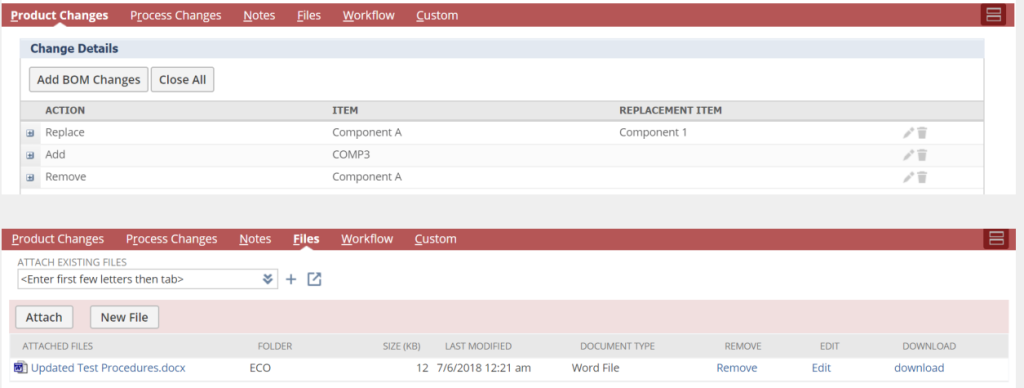
An ECO needs to capture the actual product change. In NetSuite, the Product Changes section lets you define whether an item should be added, replaced, or removed and associate that change with the relevant assembly, BOM, and revision. Multiple product changes can be recorded within the same ECO, which is useful when one engineering decision affects several components or assemblies.
For example, a PCB revision might require removing an obsolete capacitor, adding a replacement capacitor, and substituting another component. Rather than maintaining those changes as separate informal instructions, the ECO provides a single record of the proposed material changes.
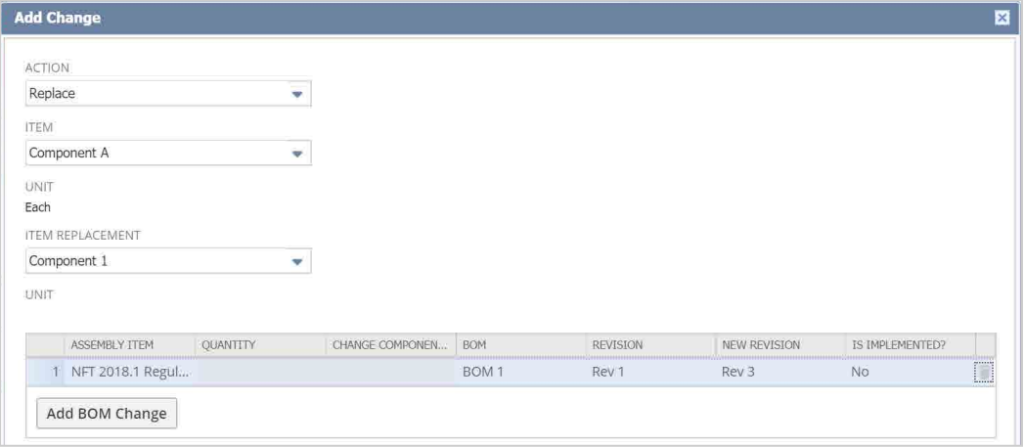
The ECO also captures process changes separately from material changes. This is important when a component replacement affects more than the BOM. For example, when the new component requires a different assembly, testing, inspection, or manufacturing procedure. Process details can be documented on the Process Changes tab alongside the material changes.
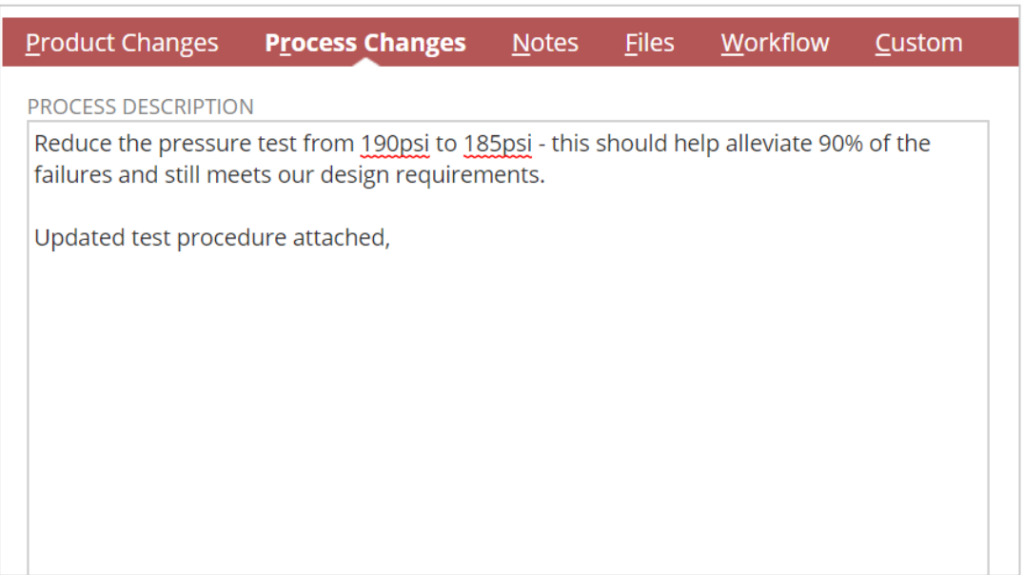
Supporting documentation can be attached directly to the ECO as well. Engineering teams can use the Notes and Files areas to provide additional context and attach documents such as updated procedures or other change-related files. This keeps the supporting information associated with the change record rather than separating it into unrelated files or communication threads.
Why This Matters for Electronics Manufacturers
For a high-tech manufacturer, the value is in bringing the material change, process impact, and supporting documentation into the same change record.
A component replacement, for instance, can be documented with:
- The original component being replaced
- The approved replacement item
- The affected assembly and BOM revision
- Any additional component changes
- The manufacturing or testing process affected
- Supporting engineering documentation
- The information required for review and approval
That gives engineering, manufacturing, quality, and other affected teams a common record of what is changing before the revised product moves into production.
Why ECO Management is Important in High-Tech Electronics Manufacturing
We’ve already discussed in the opening paragraphs that high-tech manufacturers have to deal with frequent engineering changes and complex product structures.
A single finished product might contain several assemblies, subassemblies, PCBs, firmware-dependent components, mechanical parts, and purchased components. This is why a change at one level of the product structure affects several downstream manufacturing activities.
Consider a PCB assembly where an obsolete memory component must be replaced.
The engineering team approves the replacement component. Procurement needs to know which part should be purchased going forward. Inventory needs visibility into existing and replacement components. Manufacturing needs to know when the new component becomes mandatory. Quality needs a clear record of the approved change. Production documentation might also need updating.
Without controlled change management, these teams end up working from different versions of the product definition.
An ECO creates a central change record that gives those teams a common reference point.
What Changes Should Trigger an ECO?
Not every minor administrative update requires the same level of engineering control. The threshold depends on the manufacturer’s change-management process, but changes affecting the product definition or manufacturing process deserve formal review. Common examples include:
Component substitutions
A supplier might discontinue a component or introduce a replacement with different specifications. The replacement needs engineering review before it becomes part of the standard product configuration.
Component Additions or Removals
Adding or removing a component changes the structure of the product and therefore the BOM. The change needs engineering review when it affects product performance, assembly requirements, material requirements, or the approved configuration.
The ECO records the affected component, reason for the change, updated BOM, required approvals, and revision that moves into production.
Quantity Changes
A change in component quantity affects more than the BOM. It also changes material requirements, product costing, inventory planning, and potentially the way an assembly is built.
Even a small quantity adjustment deserves controlled revision when it changes the approved manufacturing configuration. Production and purchasing need a clear indication of when the new quantity takes effect.
Product and BOM Revisions
Design changes that alter the product definition usually require a new revision rather than modifying the existing configuration without a traceable record.
This creates a clear distinction between what was previously manufactured and what production should build going forward. Revision history also gives engineering and quality teams a reliable record when investigating older products or production issues.
Manufacturing Process Changes
An engineering change does not always involve a new component or a different BOM. Changes to assembly methods, production sequences, testing procedures, tooling, or inspection requirements also require control when they affect the approved manufacturing process.
The ECO connects the process change to the relevant product or revision and ensures updated work instructions reach the teams responsible for production.
Obsolescence and Component Replacements
Component obsolescence creates a more complex engineering change because the replacement needs to be evaluated before it enters production. Electrical specifications, physical dimensions, compatibility, supplier status, qualification requirements, and existing inventory all factor into the decision.
The ECO establishes which component is being replaced, which products and BOMs are affected, and when the approved replacement becomes effective. This prevents an informal substitution from becoming the new production standard without engineering approval.
Approved Alternative Components
Supply constraints do not automatically justify replacing one component with another. An alternative part needs to meet the requirements of the existing design and receive the appropriate engineering approval before production adopts it.
The change record also needs to distinguish between a temporary approved substitute and a permanent BOM change. That distinction matters when managing inventory, purchasing commitments, and future production.
Changes to Testing and Quality Requirements
Testing and inspection requirements form part of the controlled manufacturing process. Adding a test, changing an acceptance criterion, or modifying an inspection procedure therefore deserves an ECO when it changes how the product is verified.
Keeping these changes under the same revision-control process gives quality and production teams a defined point at which the new requirement becomes effective
How ECOs Work With BOM Revisions in NetSuite
The BOM is the foundation for manufacturing because it defines the components and quantities required to build an assembly. When an engineering change modifies that structure, the change needs to be represented through a new or updated BOM revision.
NetSuite BOM revisions include effective start and end dates. This allows different versions of a BOM to apply during defined periods. Work orders and assembly transactions use BOM revision information to determine the component structure associated with the build.
This relationship is particularly important for high-tech products because manufacturers often need to maintain multiple product revisions over the product lifecycle.
For example:
| Product Revision | Component Change | Effective Date |
|---|---|---|
| Rev A | Original memory IC | Jan. 1 |
| Rev B | Replacement memory IC | Apr. 1 |
| Rev C | New processor + memory IC | Aug. 1 |
The manufacturer can retain the earlier revisions while establishing the appropriate effective period for each version.
That historical structure becomes important when investigating older builds, responding to quality issues, determining which component was used in a shipment, or reproducing a previous product configuration.
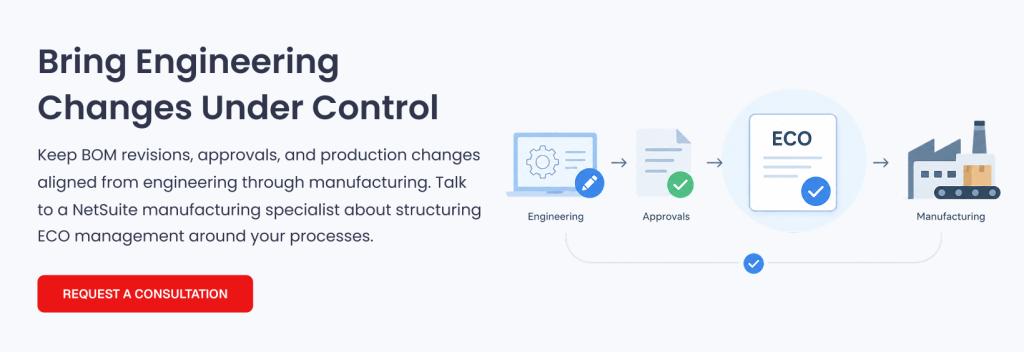
Connecting ECOs With the Bill of Materials
The BOM is where the product definition becomes a manufacturing requirement. It identifies the components and quantities required to build an assembly, so changes approved through an ECO ultimately need to be reflected in the appropriate BOM revision.
Each stage has a different purpose.
1. Engineering Defines the Change
Engineering determines what needs to change in the product. This could be a component substitution, quantity change, new component, removed component, or broader product redesign.
2. The Impact Is Reviewed
The proposed change is assessed against inventory, purchasing, production, costing, quality, and customer requirements.
3. The ECO Is Approved
The appropriate stakeholders review the proposed configuration and authorize the change according to the organization’s change-control process.
4. The BOM Revision Is Updated
The approved component structure is reflected in the appropriate BOM revision. The old revision remains available as historical product information rather than being overwritten without context.
5. The Effective Date Is Established
The manufacturer determines when the new revision becomes applicable to production.
6. Production Uses the Applicable Revision
Once the revision is effective, manufacturing uses the appropriate product structure for new builds according to the organization’s production process.
This relationship between ECOs and BOM revisions is important because the ECO explains why the product changed, while the BOM revision establishes what the product should contain for a given production period.
For a deeper explanation of how BOM structures support manufacturing, see this guide to managing bills of materials in NetSuite.
Connecting Engineering BOMs With Manufacturing BOMs
The ECO process becomes more complex when engineering and manufacturing use different views of the product.
An Engineering BOM (EBOM) describes the product from a design perspective. It typically reflects how engineering organizes the components and relationships that make up the product.
A Manufacturing BOM (MBOM) translates that product structure into the form required to manufacture and assemble it.
This is why an engineering change starts with a design decision but still requires manufacturing analysis before it reaches the production floor.
For example, engineering might replace a PCB component with a functionally equivalent part. Manufacturing then needs to determine whether:
- The replacement uses the same footprint
- Assembly equipment can handle it
- Placement instructions change
- Soldering requirements change
- Inspection requirements change
- Existing material needs to be segregated
- Work instructions need updating
- Product costing changes
This is why the engineering change needs to make its way from the product definition into the manufacturing structure.
A clear understanding of the difference between an EBOM and MBOM helps manufacturers define where engineering responsibility ends, and manufacturing preparation begins.
ECO Approval and Change Control
An ECO should pass through an appropriate review process before implementation. The people involved depend on the organization and the type of change, but may include:
- Engineering
- Manufacturing engineering
- Quality
- Procurement
- Supply chain
- Operations
- Product management
- Regulatory or compliance teams
- Finance
The approval requirements should reflect the potential impact of the change.
An approved equivalent follows a controlled substitution path: verify form, fit, and function, confirm testing and inventory impact, then update the BOM and release the change.
A major PCB redesign requires a broader engineering review, including design verification, testing, cost and manufacturing impact, and approval of a new product revision before production.
NetSuite ECO records support approval workflows and implementation tracking, allowing manufacturers to establish a defined process around engineering changes.
Implementing an Approved ECO
An approved ECO establishes authorization to make the change. Implementation applies the approved change to the affected product structure.
This helps prevent a common problem in engineering change management of treating approval as if the operational change has already occurred.
The implementation stage should confirm:
- The correct BOM revision was created or updated
- Component additions were applied
- Component removals were applied
- Replacements use the correct item
- Effective dates are correct
- Supporting documentation is available
- Relevant production processes have been updated
- Affected teams have been notified
NetSuite supports manual implementation of approved ECOs as well as automatic implementation when the relevant configuration is enabled.
Managing Open Work Orders During an ECO
Open work orders require particular attention when a new BOM revision becomes effective.
Consider a manufacturer with 500 units of a PCB assembly already scheduled for production when an ECO changes one of the components.
The manufacturer needs to determine whether those 500 units should:
- Continue using the existing revision
- Move to the new revision
- Complete using existing inventory
- Be split between revisions
- Require engineering or quality review
The correct answer depends on the effective date, production status, customer requirements, inventory position, and the manufacturer’s change-control process.
NetSuite work orders contain BOM revision information, and the applicable revision is determined based on the effective date. A selected revision also determines the top-level assembly components used on the work order.
That makes revision control particularly important when engineering changes occur while production is already underway.
Managing Component Obsolescence Through ECOs
Component obsolescence is a major concern for electronics manufacturers. A manufacturer may receive an end-of-life (EOL) notice for a processor, memory device, connector, or other component. The replacement decision won’t be straightforward, as it will involve engineering qualification, supplier evaluation, inventory analysis, cost review, and production planning.
An ECO provides a controlled mechanism for moving the product from the old component to the replacement.
The process might look like:
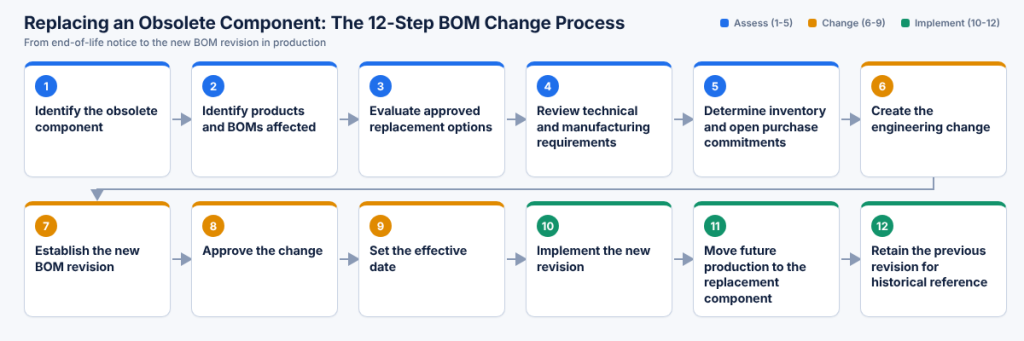
This approach gives engineering and operations teams a shared process for managing the transition instead of treating component obsolescence as a purchasing issue alone.
Summing It Up
Engineering changes are inevitable in high-tech manufacturing. The risk comes from allowing those changes to move through engineering, purchasing, inventory, and production without a controlled product revision.
NetSuite’s ECO and BOM revision capabilities provide the framework for documenting changes, establishing effective dates, routing approvals, implementing revisions, and connecting the resulting product structure to manufacturing transactions.
For electronics manufacturers, the most important outcome is consistency. Engineering should approve one product definition, manufacturing should build against the applicable revision, and purchasing and inventory should understand which components support that revision.
When ECO management is connected to disciplined BOM and revision control, manufacturers have a clearer way to move product changes from engineering approval into production without losing visibility into what changed, why it changed, or when the new configuration became effective.
FAQs
Can an ECO be used for new item or product requests?
Yes. An ECO workflow can be used to control new item requests when the change requires engineering review, a new item configuration, or a new BOM before release. The process should define what needs approval, who reviews the request, and when the new item or configuration becomes available for use.
For high-tech manufacturers, this is particularly useful when a new product variant introduces changes to components, assemblies, or manufacturing processes that need to be reviewed before production.
What happens if an ECO fails during implementation?
An ECO can encounter errors while its approved changes are being implemented. Individual changes may show different implementation statuses, so the ECO should be reviewed after implementation to confirm that all intended BOM and item changes were successfully applied.
For complex electronics BOMs, this check should include the affected assemblies, components, revisions, and implementation status before production or purchasing teams begin working from the revised configuration.
How do you manage a BOM revision when the current revision is still in production?
The manufacturer needs a defined transition point between the existing and revised BOM. Production may continue against the current revision while engineering prepares the new revision, provided the effective date and applicable production activity are clearly defined.
Using effective dates and revision control helps establish when the new configuration takes effect and prevents production from switching to a revised BOM before the change is ready.
Should BOM changes go through a second review before production?
For changes that affect production, purchasing, inventory, costing, or quality, an additional review provides a way to identify downstream issues before the revised BOM is released. The review can cover component availability, existing inventory, open purchase orders, production requirements, work instructions, and quality implications.
This is especially important when a component is being replaced or removed. Engineering may approve the technical change, while purchasing or operations still need to determine how existing stock and open orders should be handled.