Key Takeaways
- Shop floor and supply chain must work as one. Disconnected systems between production, procurement, and finance are the top cause of delays and cost overruns in auto parts manufacturing.
- The automotive parts market is enormous and growing. Global automotive parts revenue hit $2.36 trillion in 2024 and is projected to reach $3.34 trillion by 2033. The businesses that scale in this environment will be those with the tightest operational control.
- ERP connects every layer of your operation. From BOM management and work orders on the shop floor to supplier coordination and customer invoicing, one system replaces five disconnected tools.
- NetSuite, configured by Folio3, is the strongest choice for mid-market auto parts and component manufacturers. Real clients like Voxx Wheels and AutoRimShop have used it to unify operations and grow without adding headcount.
- Your implementation partner shapes your outcome. The same software, configured by two different partners, delivers two very different results.
- Cloud ERP removes the infrastructure barrier. No servers, no IT overhead, no version lag. You get enterprise-grade capability without enterprise-grade IT costs.
It was a Wednesday morning when a production manager we work with realized his team had built 200 brackets to the wrong spec. The engineering change had come through email two weeks prior. Someone saw it. Nobody updated the work order. The parts shipped. Three days later, the chargeback arrived.
That single event cost more than a full year of ERP licensing. And it happened not because the team was careless, but because their systems were not connected. The engineering update is in the email. The BOM lived in a spreadsheet. The work orders lived in a separate tool.
That is the problem ERP for auto parts manufacturing solves. And this guide breaks down exactly how.
What Makes Auto Parts Manufacturing Different From Other Industries?
Auto parts manufacturing is not generic manufacturing. It runs under pressures that most other industries do not face at the same intensity.
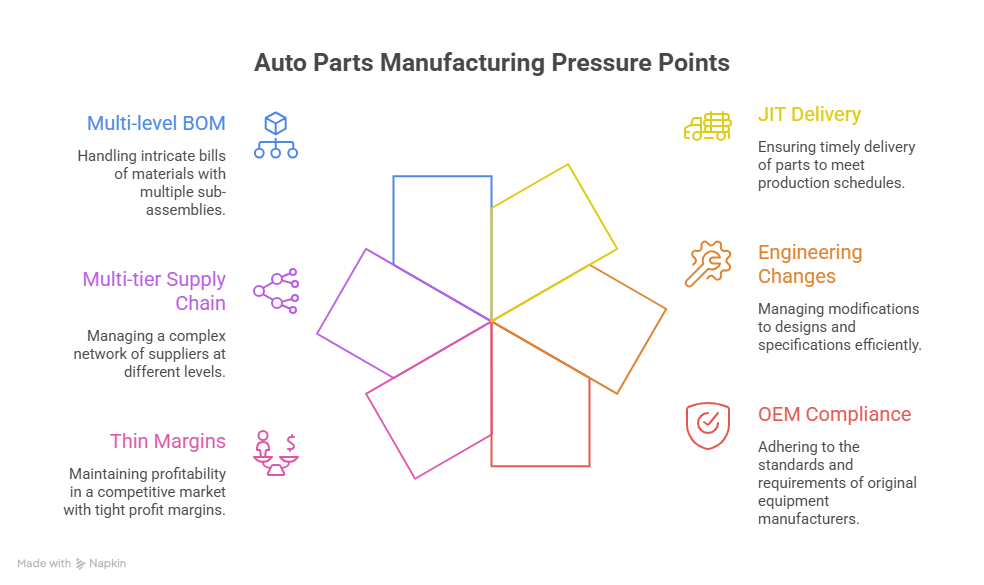
Think about what a typical auto component manufacturer deals with daily:
- JIT delivery windows with zero tolerance. Your Tier-1 customer does not buffer. If your parts are not at their dock on time, their production line stops. That conversation does not go well.
- Multi-level BOMs with frequent engineering changes. A single finished component can have 30 to 50 sub-components across multiple levels. An OEM changes a spec, and the change has to move correctly through every affected work order and purchase order.
- OEM compliance requirements. IATF 16949, PPAP submissions, MMOG/LE assessments. These are not optional checkboxes. Failing an audit means getting delisted.
- Thin margins with high volume. Auto parts businesses run on efficiency. A 1% improvement in material yield or scrap rate across a high-volume production run moves the P&L in a meaningful way.
- Multi-tier supply chain dependencies. You depend on your suppliers the way your customers depend on you. One late raw material delivery cascades into a missed JIT window upstream.
Generic ERP handles some of these. The right automotive ERP handles all of them in one system without workarounds.
What Should Automotive Part Manufacturing Software Do for Auto Parts and Component Manufacturers?
Before we get into platforms, let us be clear on what “good” looks like for auto parts manufacturing ERP. Every platform on the market claims to handle this industry. The differences show up when you push on specifics.
1. Multi-Level BOM Management With Engineering Change Control
Your BOM is the foundation of everything. Every production order, every materials requirement, every cost calculation runs from it. The ERP for auto components manufacturing needs to support multi-level BOM structures, where a finished part has sub-assemblies that have their own sub-components. And when a spec changes, the system must enforce the change across every impacted work order before production starts, not after a batch has already shipped.
2. Production Scheduling Tied to Real Capacity
Production plans that do not account for actual machine availability and labor capacity are fiction. A sophisticated auto parts manufacturing ERP builds the production schedule against real constraints. If a work center is already loaded, the system tells you before you promise a delivery date you cannot hit.
3. Shop Floor Execution and WIP Tracking
Work-in-process visibility means knowing exactly where every job is on the floor at any moment i.e., which operations are complete, which are in progress, what has been scrapped, and what is waiting for inspection. Without this, production managers are walking the floor to gather information they should be seeing on a screen.
4. Quality Management Linked to Production
Quality records need to live in the same system as production records. Incoming inspection results, in-process quality checks, final inspection sign-off, non-conformance reports, and corrective actions, all tied to specific production lots and traceable on demand. When an OEM audits you, you pull this data in minutes, not days.
5. Supply Chain and Procurement Visibility
Your ERP should tell you, right now, what materials are on order, when they are due, which suppliers are running late, and what that means for your production schedule next week. This is the connection between the shop floor and the supply chain that most businesses try to manage in spreadsheets and fail at consistently.
6. Integrated Financials for Job Costing and Margin Visibility
Every production job has a cost: labor, materials, machine time, and overhead. The ERP for auto components manufacturing should calculate the actual cost of every job and compare it against the standard. When actual cost exceeds standard, you know immediately, not at month’s end.
The 10 Best ERP Platforms for Auto Parts and Component Manufacturing
We have reviewed the leading ERP platforms serving this industry. Here is an honest look at each one.
Quick Comparison Overview
| # | Platform | Best For | Deployment | Pricing |
|---|---|---|---|---|
| 1 | NetSuite (via Folio3) | Mid-market auto parts manufacturers, distributors, and multi-channel sellers | Cloud | From ~$999/month + users |
| 2 | SAP S/4HANA | Large OEM-connected manufacturers with global operations | Cloud / On-premise | Enterprise (custom) |
| 3 | Epicor Kinetic | Discrete parts manufacturers and job shops | Cloud / On-premise | Custom pricing |
| 4 | QAD Adaptive ERP | Tier-1 and Tier-2 OEM suppliers with compliance-heavy workflows | Cloud | Custom pricing |
| 5 | Plex Manufacturing Cloud | High-volume manufacturers needing shop floor and MES in one system | Cloud | Custom pricing |
| 6 | Infor CloudSuite Automotive | Global OEM-connected manufacturers with multi-region operations | Cloud | From ~$200/user/month |
| 7 | Microsoft Dynamics 365 | Microsoft-ecosystem businesses with moderate manufacturing complexity | Cloud | From $70/user/month |
| 8 | SYSPRO | Manufacturers and distributors needing deep supply chain visibility | Cloud / On-premise | Custom pricing |
| 9 | DELMIAWorks (IQMS) | Automotive parts manufacturers focused on plant-floor-first ERP | Cloud / On-premise | Custom pricing |
| 10 | Odoo | Small manufacturers needing affordable, flexible, modular ERP | Cloud / On-premise | From ~$38/user/month |
1. Oracle NetSuite – Best for Mid-Market Auto Parts Manufacturers
NetSuite is a cloud-native ERP that covers the full scope of a mid-market auto parts business in one system. Production, inventory, procurement, quality, financials, CRM, and e-commerce all live together. You do not need a separate accounting tool, a separate quality system, and a separate inventory platform that your team reconciles manually at month’s end.
We have implemented NetSuite for auto parts manufacturers, Tier-2 component suppliers, performance parts distributors, and multi-channel aftermarket retailers. The system is built around how your operation actually runs, not how a demo environment makes it look.
Key strengths for auto parts and component manufacturers:
- Multi-level BOM management with engineering change control and version locking
- Work order and WIP tracking for real-time shop floor visibility
- Quality management with inspection plans, non-conformance tracking, and corrective action workflows
- Multi-warehouse inventory with real-time stock counts across all locations
- Customer-specific pricing and order rules for wholesale, retail, and OEM accounts
- Native e-commerce integrations for Shopify, Magento, BigCommerce, and Amazon
- Multi-entity financials for businesses operating more than one legal entity
- Job costing that tracks actual vs. standard cost at the production order level
Best for: Auto parts manufacturers, Tier-2 and Tier-3 component suppliers, and multi-channel parts distributors with 20 to 500 employees.
What to know: NetSuite requires custom quoting based on modules and user count. The configuration scope matters significantly; therefore, we suggest you automobile ERP consulting to scope the right setup before signing anything.
Real proof from our real clients:
Voxx Wheels, a performance wheel manufacturer, came to Folio3 with disconnected systems across production, inventory, and finance. After implementing NetSuite, they had a single platform their entire team operated from, with clean production data, accurate inventory, and faster financial reporting. If you want to see how the project was structured, read the full Voxx Wheels success story.

AutoRimShop, operating under Alloy Capital Partners, runs a multi-brand auto parts retail business across multiple e-commerce channels. Managing high SKU counts, channel-specific pricing, and consolidated financials across brands required a platform that could hold it all together. NetSuite handled every layer. The full details are in the AutoRimShop case study.
2. SAP S/4HANA – Best for Large OEM-Connected Manufacturers
SAP is the enterprise standard for large automotive operations. Its supply chain capabilities, compliance tooling, and global manufacturing support set the benchmark at scale. BMW Group, Ford Motor Company, and General Motors all run in this tier, which tells you a lot about the size of operation SAP is built for.
Key strengths:
- Deep multi-plant manufacturing and supply chain capabilities
- Strong OEM portal integration and EDI support
- Recognized by OEM audit teams worldwide
- Comprehensive financial management for complex corporate structures
Best for: Large auto parts manufacturers with 500+ employees, global operations, and direct OEM supply relationships.
What to know: SAP’s total cost of ownership is significantly higher than cloud-native alternatives. Implementation timelines run in years, not months. For mid-market manufacturers, the investment rarely returns proportional value.
3. Epicor Kinetic – Best for Discrete Parts Manufacturers and Job Shops
Epicor has built its name in discrete manufacturing. Its shop floor scheduling, job costing, and routing capabilities are mature and work well for manufacturers running machined, stamped, cast, or forged components. Epicor’s IoT integration brings real-time shop floor control to manufacturers investing in connected equipment.
Key strengths:
- Advanced shop floor scheduling with capacity planning and routing
- Strong job costing for make-to-order and engineer-to-order environments
- Good mixed-mode manufacturing support
- Flexible cloud and on-premise deployment options
Best for: Precision parts manufacturers and job shops where shop floor execution is the primary operational priority.
What to know: Epicor’s distribution and multi-channel sales capabilities are less mature than its manufacturing tools. Businesses with significant wholesale or online sales alongside manufacturing will likely need additional integrations.
4. QAD Adaptive ERP – Best for OEM Supplier Compliance
QAD has served the automotive industry for decades. Its compliance tooling is built in from day one, not added later as a module. MMOG/LE, APQP, PPAP, and IATF 16949 workflows are native to the platform. For Tier-1 and Tier-2 suppliers whose OEM customers run quarterly compliance audits, that matters enormously.
Key strengths:
- MMOG/LE compliance assessment and automotive-native workflows
- APQP and PPAP documentation management built in
- Strong demand management and supplier collaboration tools
- Lean manufacturing process support
Best for: Tier-1 and Tier-2 auto parts manufacturers with direct OEM supply relationships requiring compliance-heavy documentation.
What to know: QAD is built for larger operations. For Tier-3 manufacturers and smaller component suppliers, the cost and implementation complexity may not match the business need.
5. Plex Manufacturing Cloud – Best for Shop Floor Visibility
Plex has long focused on the automotive sector, sitting right at the intersection of ERP and Manufacturing Execution System (MES). Its real-time machine monitoring, production counting, and in-line quality recording give high-volume manufacturers a level of shop floor visibility that most ERP platforms do not come close to.
Key strengths:
- Real-time machine monitoring and OEE tracking
- In-line quality recording at the unit and lot level
- Strong automotive compliance and traceability tools
- Cloud-native with a solid North American automotive supplier base
Best for: High-volume auto parts manufacturers where real-time shop floor data is the primary operational need.
What to know: Plex’s financial management and CRM capabilities are less mature. Businesses needing sophisticated multi-entity accounting alongside production management may need supplemental tools.
6. Infor CloudSuite Automotive – Best for Global OEM-Connected Manufacturers
Infor CloudSuite comes with pre-built templates for automotive manufacturing, covering assembly sequence control, just-in-time production scheduling, and multi-mode manufacturing without heavy customization. For automotive manufacturers with international operations, its multi-currency and multi-region capabilities are among the strongest on the market.
Key strengths:
- Built for OEM automotive supply chain environments
- Strong multi-currency and multi-region support
- EDI and OEM portal integration built in natively
- Good supplier collaboration and demand management tools
Best for: Mid-to-large auto parts manufacturers with international operations and direct OEM supply chain relationships.
What to know: Infor’s strength lies in manufacturing, not distribution or retail. Outside OEM supply chain environments, the automotive-specific features provide less return on cost.
7. Microsoft Dynamics 365 Business Central – Best for Microsoft-Ecosystem Manufacturers
Dynamics 365 Business Central is a solid mid-market ERP for auto parts businesses already deeply embedded in Microsoft tools. It connects natively with Microsoft 365, Teams, and Power BI, which reduces integration effort for companies already running in that ecosystem.
Key strengths:
- Native integration with Microsoft 365, Teams, and Power BI
- Strong financial management and reporting capabilities
- Familiar interface for teams already using Microsoft products
- Accessible per-user pricing for mid-market businesses
Best for: Mid-market auto parts manufacturers and distributors that are primarily Microsoft ecosystem users with moderate manufacturing complexity.
What to know: Business Central requires meaningful customization to match the automotive manufacturing functionality available in more specialized platforms. For complex production or OEM-facing workflows, those customization costs add up quickly.
8. SYSPRO – Best for Supply Chain Visibility
SYSPRO is an ERP built specifically for manufacturers and distributors. Its MRP module helps automotive parts companies manage supply and demand, plan production, and optimize stock holdings with real-time visibility across the supply chain.
Key strengths:
- Real-time supply chain visibility across the entire vendor network
- Strong inventory and demand planning tools
- Good discrete and mixed-mode manufacturing execution
- Integration capabilities for IoT-connected factory equipment
Best for: Auto parts manufacturers and distributors needing detailed supply chain visibility across complex multi-supplier networks.
What to know: SYSPRO’s e-commerce and CRM features are not its primary strengths. Businesses with significant direct-to-consumer or online sales volume will likely need additional tools alongside it.
9. DELMIAWorks (formerly IQMS) – Best for Plant-Floor-First Manufacturers
DELMIAWorks has consistently appeared in top automotive ERP lists since its acquisition by Dassault Systèmes. It combines production management, quality control, and supply chain integration with real-time monitoring that keeps manufacturers grounded in what is happening on the plant floor right now.
Key strengths:
- Real-time production monitoring with strong quality control tools
- Well-suited to plastics, injection molding, and precision component manufacturers
- Supply chain integration with traceability from raw material to finished part
- Strong performance in automotive-specific compliance workflows
Best for: Automotive parts manufacturers in plastics, molding, and precision machining who need plant-floor-first ERP with strong real-time monitoring.
What to know: DELMIAWorks is rarely chosen for distribution or multi-channel retail operations. Its strength is squarely in manufacturing execution.

10. Odoo – Best for Small Manufacturers on a Tight Budget
Odoo is a modular, open-source ERP that lets smaller auto parts manufacturers start with what they need and add more as they grow. Its low entry cost and flexible architecture make it accessible for businesses that are not yet ready for the investment that mid-market platforms require.
Key strengths:
- Very affordable pricing with a modular structure
- Covers manufacturing, inventory, procurement, and financials in one system
- Strong community and third-party app ecosystem
- Cloud and on-premise deployment options
Best for: Small auto parts manufacturers with under 50 employees who need an affordable starting point without enterprise-level cost.
What to know: Odoo’s automotive-specific capabilities are limited out of the box. OEM compliance tools, advanced shop floor execution, and complex BOM management require customization that can offset the low base price. As your business grows, you may outgrow Odoo faster than you expect.
The Challenges Auto Parts Manufacturers Face Without ERP
Every manufacturer we speak to can describe their problems without any prompting. The names and part numbers change, but the patterns are consistent.
a. Engineering Changes That Arrive Too Late
A spec change comes through email. Three people see it. One person updates the BOM. Nobody updates the open work orders already in production. Parts ship to the wrong spec. The chargeback follows.
ERP solves this with controlled engineering change workflows. The new BOM version is uploaded, linked to affected orders, reviewed, approved, and locked. No production order can start against a superseded spec. The process is enforced by the system, not dependent on someone remembering to update a file.
b. Inventory That Never Matches Reality
Your system says you have 500 units of a component. Your warehouse physically has 430. The discrepancy exists because returns were processed in one system, adjustments were made in another, and a scrapped batch never got recorded anywhere.
With ERP, every inventory movement, such as receipts, issues to production, scraps, transfers, returns, writes to the same record in real time. The number in the system matches the number on the shelf. This sounds basic. For most manufacturers operating without an integrated ERP, it is anything but.
c. Job Costs That Only Appear at Month End
You finish a production run. The parts ship. Six weeks later, your accountant reconciles the job and tells you the actual cost was 18% over standard. By then, you have already quoted the next order at the wrong price and accepted a contract you will lose money on.
ERP surfaces job cost variance the moment a job closes. You see labor overruns, material usage above BOM, and machine time exceptions in real time. That information changes how you quote the next job before it costs you.
d. Supplier Delays That Catch You Off Guard
Your raw material supplier is four days late on a shipment. You do not know this until Tuesday morning, when the warehouse team tells you the delivery did not show up on Friday. Your production schedule starts Monday. You have a JIT window to hit on Thursday.
With integrated procurement and production planning, your ERP shows you the expected delivery date of every open purchase order and flags it the moment a supplier confirms they are running late. You have days to react, not hours.
What Does ERP Implementation Actually Look Like for Auto Parts Manufacturers?
This is the question most blogs skip entirely. They give you a platform list and leave you to figure out the rest. Here is the honest version.
1. Scoping Comes First, Not Software
Before you evaluate platforms, define your requirements. Which processes cause the most operational pain right now? Where is data falling between systems? What does your team spend time on that should be automated? The answers define your ERP scope. The scope defines which platform fits best.
2. Data Preparation Takes Longer Than You Expect
Your item master, BOM structures, supplier data, and customer records need to be cleaned before migration. Bringing messy data into a new system just gives you messy data in a better-looking interface. Budget at least four to six weeks for data cleanup before implementation begins.
3. Implementation Takes Three to Six Months for Mid-Market Manufacturers
With a focused scope and good data preparation, a mid-sized auto parts manufacturer can go live in 12 to 20 weeks. Complex implementations with multiple sites, custom integrations, and large data migration needs take longer. Anyone promising six weeks for a full implementation is cutting corners that will show up after go-live.
4. The Partner You Choose Shapes the Outcome
Mosites Motorsports needed to move off its existing platform and build a clean financial foundation that could support its growing motorsport operation. Folio3 implemented NetSuite SuiteSuccess Financials First, giving them structured, scalable financial management without over-engineering the scope.
The right partner knows when to add complexity and when to keep it simple. Read the Mosites Motorsports case study to see how a focused implementation delivers a clean outcome.
How to Choose the Right ERP for Your Auto Parts Business
Here is a practical framework we use with clients before they commit to automotive part manufacturing software.
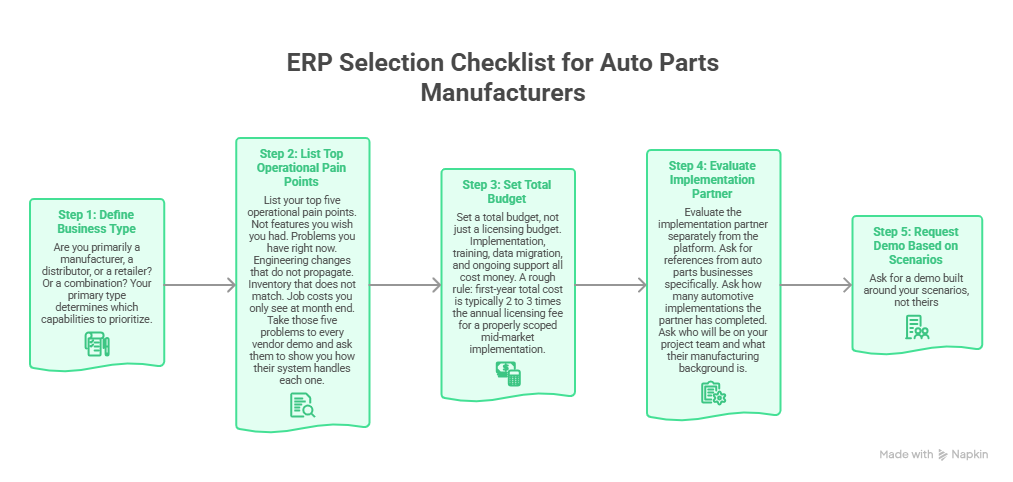
Step 1: Define your business type. Are you primarily a manufacturer, a distributor, or a retailer? Or a combination? Your primary type determines which capabilities to prioritize.
Step 2: List your top five operational pain points. Not features you wish you had. Problems you have right now. Engineering changes that do not propagate. Inventory that does not match. Job costs you only see at the month’s end. Take those five problems to every vendor demo and ask them to show you how their system handles each one.
Step 3: Set a total budget, not just a licensing budget. Implementation, training, data migration, and ongoing support all cost money. A rough rule: first-year total cost is typically 2 to 3 times the annual licensing fee for a properly scoped mid-market implementation.
Step 4: Evaluate the implementation partner separately from the platform. Ask for references from auto parts businesses specifically. Ask how many automotive implementations the partner has completed. Ask who will be on your project team and what their manufacturing background is.
Step 5: Ask for a demo built around your scenarios, not theirs. Give the vendor three to four real scenarios from your business before the demo. Watch how the system handles them, not how the sales team narrates around them.
For auto parts and component manufacturers, thinking through the operational efficiency gains that come from a well-configured NetSuite, our blog on operational efficiency with NetSuite ERP for automotive businesses covers the real outcomes we have seen across clients.
Final Thoughts
Running an auto parts and component manufacturing business is operationally complex. JIT delivery windows, engineering change management, OEM compliance, multi-tier supplier dependencies, and tight margins all demand systems that work together, not five separate tools your team reconciles manually.
The right ERP handles all of it, from the shop floor through the supply chain, in one connected system.
If you are evaluating ERP options for your auto parts business and want an honest conversation about whether NetSuite is the right fit, the Folio3 team works with manufacturers at every stage of this decision. Reach out, and we will give you a solution that fits your business.
FAQs
What is the best ERP for auto parts manufacturing?
For most mid-market auto parts and component manufacturers, NetSuite configured by Folio3 is the strongest choice. It covers production, inventory, quality, procurement, and financials in one cloud system, with automotive-specific configuration rather than a generic setup. For larger OEM-connected manufacturers, QAD and SAP are worth evaluating. For smaller operations on a tight budget, Odoo or Cetec ERP are accessible starting points.
How does ERP improve shop floor operations in auto parts manufacturing?
ERP connects shop floor execution directly to production planning, inventory, and quality management. Work orders come from production plans. Material requirements are checked against live inventory before a job starts. Quality inspections are tied to specific production lots. Job cost variances are visible the moment a job closes. The shop floor stops operating in isolation from the rest of the business.
What does ERP implementation cost for an auto parts manufacturer?
For a mid-sized auto parts manufacturer, expect total first-year investment, covering licensing, implementation, and training, to range from $50,000 to $120,000, depending on scope and complexity. Larger operations with multiple sites or significant custom integration needs will invest more.
How long does it take to implement NetSuite for an auto parts business?
With a focused scope and clean data, most mid-sized auto parts businesses go live on NetSuite in 12 to 20 weeks. Folio3 typically structures this as a phased implementation, starting with production and inventory, then adding financials and integrations in subsequent phases.
Can NetSuite handle both manufacturing and distribution for auto parts?
Yes. NetSuite handles production management, multi-warehouse inventory, multi-channel order management, and integrated financials in a single platform. For businesses that both manufacture components and distribute finished goods, this combined capability is one of NetSuite’s strongest advantages over platforms that specialize in only one side of the operation.