Key Takeaways
- A full-time NetSuite administrator costs $110,000 to $130,000 in base salary in the US. Add benefits, PTO, training, and overhead and the real annual cost exceeds $150,000.
- NetSuite managed services typically range from $3,000 to $10,000 per month. For most mid-market businesses, that is $36,000 to $120,000 annually. Most businesses pay less for managed services than for a single in-house hire.
- One admin cannot cover every NetSuite module. Financials, SuiteScript development, WMS, integrations, and reporting are different skill sets. Managed services gives you a team across all of them.
- The single-admin dependency is the biggest operational risk. When that person leaves, institutional knowledge leaves with them. Managed services distributes knowledge across a team with documented handovers.
- The decision depends on your environment, not your headcount. A stable, lightly customized NetSuite setup may not need managed services. A complex, multi-entity, heavily integrated system almost certainly does.
- Folio3’s SmartCare program gives you a dedicated team at a fraction of full-time hiring cost. Named consultants, SLA-backed support, release management, and optimization under one predictable monthly fee.
A finance director at a distribution company called us last year. Her company had hired a NetSuite administrator 18 months earlier. Good hire. Certified, experienced, and well-regarded by the team. Then he was poached by a larger company offering a 30% salary increase.
The company had two weeks to transition. The documentation was sparse. The custom scripts were commented in the previous admin’s shorthand. One workflow had logic that only one person understood.
Six weeks after the admin left, a quarterly close took four extra days because nobody could locate the source of an anomaly in the revenue recognition report. By the time they found it, it had already been corrected the previous quarter in a way that was never documented.
That is the risk that comes with building your NetSuite support model around one person. This blog compares the two main options, i.e., managed services and a full-time internal hire, on cost, coverage, risk, and fit. Not to push you toward one answer, but to help you make the right call for where your business actually is.
What Does a NetSuite Administrator Actually Do?
A NetSuite administrator keeps the system running and aligned with how the business operates. The day-to-day responsibilities include:
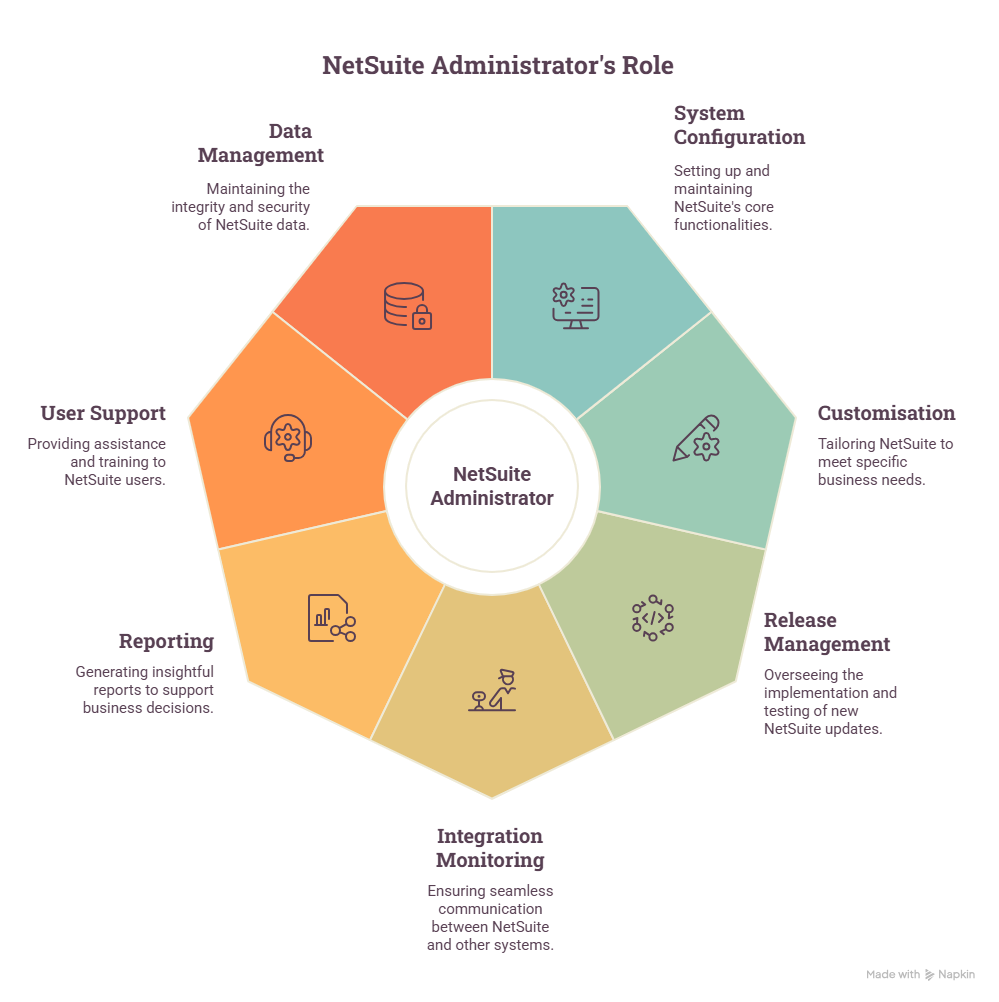
- System configuration and maintenance: User management, roles and permissions, module settings, workflow updates, saved search maintenance
- Customization support: SuiteScript troubleshooting, minor script changes, workflow logic updates
- Release management: Testing customizations before each bi-annual NetSuite update, applying patches, managing compatibility
- Integration monitoring: Watching for failures in third-party integrations, coordinating fixes with integration partners
- Reporting and dashboards: Building and maintaining saved searches, KPI dashboards, financial reports
- User training and support: Onboarding new users, fielding questions, resolving access and permission issues
- Data management: Maintaining data quality, supporting data imports, managing item and customer records
For a closer look at the specific permissions and role structures a NetSuite admin manages daily, our guide on NetSuite roles and permissions covers the configuration in detail.
The Full-Time Administrator Model: What It Costs and What You Get
Hiring a dedicated NetSuite administrator gives you direct oversight of the system. Your admin understands your business context, your team, and your specific workflows. For businesses with stable, predictable support needs, this is a viable model.
The Real Cost Numbers
As of late, hiring an in-house NetSuite administrator in the US costs between $110,000 and $130,000 in base salary. When you add benefits, PTO, onboarding, and overhead, the total cost often exceeds $150,000 annually.
The full cost breakdown:
| Cost Component | Annual Estimate |
|---|---|
| Base salary | $110,000 to $130,000 |
| Benefits (health, dental, vision) | $15,000 to $25,000 |
| Employer payroll taxes | $8,000 to $12,000 |
| PTO and holidays (15 to 20 days) | $6,000 to $10,000 |
| NetSuite certification and training | $2,000 to $5,000 |
| Recruitment and onboarding | $10,000 to $20,000 (one-time) |
| Total year one | $151,000 to $202,000 |
This is for one person. One skill set. One availability window. One point of failure.
What One Admin Can and Cannot Cover
A strong NetSuite administrator covers day-to-day administration well. Here is where single-admin models typically fall short:
- SuiteScript development: Advanced customization requires SuiteScript expertise. Not every administrator has this. When a custom script breaks or needs changes, a functional admin without scripting skills cannot fix it.
- Integration troubleshooting: Monitoring and debugging integrations between NetSuite and eCommerce, EDI, 3PL, or payment platforms often requires expertise beyond what a generalist admin holds.
- Module depth: A NetSuite environment covering financials, WMS, manufacturing, and CRM requires deep knowledge across all four. One person rarely covers all of them at the same level.
- Release management: Two major NetSuite updates per year require structured sandbox testing of every custom script and workflow. This competes directly with day-to-day support work.
The Single-Admin Risk
In-house NetSuite support is expensive, so if companies do choose to hire additional personnel, they may only be able to hire a single NetSuite administrator, who lacks the knowledge that a full NetSuite team brings to a project.
Salaries for skilled NetSuite administrators are competitive. The market is tight. When a better offer comes, administrators leave. When they do, the institutional knowledge they hold, undocumented scripts, workflow logic, configuration history, leaves with them.
The finance director’s story in the introduction is not rare. It is a predictable outcome when a complex system depends on one person with no documentation discipline built into the role.
The in-house model works well when:
- Your NetSuite environment is stable with minimal customizations
- Your support needs are consistent and predictable
- You have a plan for knowledge documentation and succession
- You can attract and retain qualified talent in your market
- You have budget for a genuine senior hire, not a junior admin filling a senior role
The Managed Services Model: What It Costs and What You Get
A NetSuite managed services provider takes ongoing responsibility for the administration, optimisation, and evolution of your NetSuite environment. Instead of one employee, you get a team of certified specialists covering every area of NetSuite support.
The Real Cost Numbers
NetSuite managed services typically range from $2,500 to $10,000 per month for most mid-market businesses. The cost depends on the scope of the engagement: the number of modules covered, the level of customisation in the environment, the SLA tier, and whether release management and optimisation are included.
| Business Profile | Typical Monthly Cost | Annual Cost |
|---|---|---|
| Stable environment, light customizations | $3,000 to $5,000 | $36,000 to $60,000 |
| Mid-complexity, active development | $5,000 to $8,000 | $60,000 to $96,000 |
| Complex, multi-entity, multiple integrations | $8,000 to $12,000 | $96,000 to $144,000 |
For most businesses, managed services cost less than a full-time hire and gives you a team rather than an individual.
What a Managed Services Team Covers
A strong managed services engagement covers everything a full-time admin would cover, and the areas where one person typically falls short:
- Named dedicated consultant who knows your specific configuration and business context
- SuiteScript and workflow development by certified NetSuite developers
- Release management with structured sandbox testing before every NetSuite update
- Integration monitoring and troubleshooting across all connected platforms
- System health reviews that identify issues before they affect operations
- User training and onboarding for new staff and new feature rollouts
- Minor customizations within the monthly scope without additional billing
- Scalability: when your needs increase, the team scales. When they decrease, you do not pay for idle headcount.
The Coverage Advantage
Managed services plans give companies access to a whole team of certified and experienced NetSuite administrators, developers, and consultants, without the cost of hiring that level of service in-house. The team collectively holds every NetSuite certification. No single admin can say the same.
The managed services model also removes the single-point-of-failure risk. When your primary consultant changes, knowledge transfers through a documented handover process. System documentation lives with the partner, not with one person’s memory.
The managed services model works well when:
- Your NetSuite environment has significant customisations or integrations
- Your support needs fluctuate: busy periods and quiet periods
- You cannot justify the recruitment cost and salary for a senior NetSuite hire
- You have experienced admin turnover and want to remove that risk
- You want release management handled systematically, not reactively
- You need module depth across financials, WMS, eCommerce, and manufacturing simultaneously
For a broader context on why post-go-live support matters and what the right structure looks like, our blog on reasons to use NetSuite managed support after going live covers the situations where managed services pay for themselves.
Direct Comparison: Managed Services vs. Full-Time Admin
| Factor | Full-Time Admin | Managed Services |
|---|---|---|
| Annual cost | $150,000 to $202,000 (year one) | $36,000 to $144,000 |
| Coverage breadth | One person’s skill set | Full team across all modules |
| SuiteScript development | Depends on individual skill | Included |
| Release management | Often missed or rushed | Systematic, sandbox-tested |
| Response time | Depends on workload | SLA-backed by priority |
| Coverage when ill or on leave | None | Continuous |
| Knowledge retention | Leaves when the admin leaves | Documented, team-held |
| Scalability | Limited to one person | Scales with your needs |
| Business context | Deep, built over time | Built during onboarding |
| Control | Direct oversight | Partner-mediated |
| Recruitment risk | High; market is competitive | None |
| Best for | Stable, light-customization environments | Complex, evolving environments |
The Hidden Costs Nobody Mentions
The salary comparison is the starting point. It is not the full picture.
Recruitment Cost and Time
Finding a qualified NetSuite administrator typically takes two to four months. Recruitment fees, if you use a recruiter, run 15 to 25% of first-year salary. For a $120,000 hire, that is $18,000 to $30,000 in placement fees. Add internal HR time and manager time spent on interviews.
After you hire, there is a three to six-month ramp period before a new admin is fully productive. During that time, you are paying full salary for partial output.
Turnover Cost
When a skilled NetSuite admin leaves, the costs compound: recruitment fees again, knowledge transfer time, productivity loss during the gap, and the ramp time for whoever comes next.
For a business that cycles through two admins in three years, the true cost of the in-house model becomes significant.
Coverage Gaps
Business hours administration means nobody is actively monitoring your NetSuite environment during a Saturday night batch run or a Sunday morning close. For businesses with weekend operations or global time zones, this gap is real.
The “One Person Is Maxed Out” Problem
A single admin managing daily tickets, a development backlog, an upcoming NetSuite release, and new user onboarding simultaneously is not handling any of those things well. Managed services give you a team where each of those tasks has a dedicated resource.
When to Choose NetSuite Managed Services vs NetSuite Administrator
When hiring a NetSuite administrator vs NetSuite managed services, there are certain business factors that help make the decision. See what suits you from the information below:
Choose a Full-Time Admin When:
- Your NetSuite environment has been stable for more than two years with minimal new development
- Your support volume is consistent and predictable
- You are in a market where you can attract and retain a senior NetSuite hire at competitive compensation
- You have a budget for proper documentation systems and knowledge management from day one
- Your team values direct oversight and deep business context over response time guarantees
Choose Managed Services When:
- Your environment is actively evolving: new modules, new integrations, new subsidiaries
- Your support volume fluctuates: busy periods around closes, implementations, and releases, with quieter periods in between
- You have had an admin leave and felt the operational impact of that knowledge dependency
- You need SuiteScript development and integration support alongside administration
- You want a predictable monthly cost without the overhead of a full-time hire
- You want release management handled before something breaks, not after
Consider a Hybrid Model When:
- You are a large enterprise with a complex, multi-entity, multi-country NetSuite environment
- You have an internal admin who handles business-facing tasks and direct oversight, combined with a managed services team covering technical development, release management, and complex troubleshooting
For guidance on building the right post-go-live support structure, our NetSuite support partner guide covers the full range of support models and what each one is suited for.
What Folio3 SmartCare Provides vs. a Full-Time Hire
Folio3’s SmartCare managed services program covers every responsibility a full-time admin would handle, and the responsibilities where one person typically falls short.
| Responsibility | Full-Time Admin | SmartCare |
|---|---|---|
| Daily administration and user support | Yes | Yes |
| SuiteScript development and troubleshooting | Depends on the individual | Yes |
| Release management with sandbox testing | Often missed | Yes, standard |
| Integration monitoring | Yes, but limited to their experience | Yes |
| System health reviews | Rarely scheduled | Monthly |
| Knowledge retention during staff changes | High risk | Documented handover protocol |
| After-hours availability | No | Depends on SLA tier |
| Minor customizations | Yes | Yes, within the monthly scope |
| Cost | $150,000+ annually | $36,000 to $144,000 annually |
For the full SmartCare scope, SLA structure, and pricing, our NetSuite managed services covers the program in detail.
See how SmartCare gives you a full NetSuite team at a fraction of the cost of a single hire. Schedule a Demo
What to Do If You Already Have an Internal Admin
Having an internal admin and using managed services are not mutually exclusive. Many businesses run a hybrid model.
The internal admin handles business-facing tasks: gathering requirements, communicating with departments, managing priorities, and acting as the liaison between the business and the MSP. The managed services team handles technical execution: SuiteScript development, release management, integration troubleshooting, and complex configuration work.
This works well when:
- Your internal admin has strong functional NetSuite knowledge but limited technical depth
- Your admin’s time is better spent on business process improvements than on maintenance tasks
- You want your admin focused on what your business needs, with technical backup available on demand
For businesses transitioning their data management or support model, our blog on best practices for NetSuite data migration covers how to protect data integrity through any support model change.
Final Thoughts
The question is not whether managed services is better than a full-time hire as an abstract principle. The question is which model fits your NetSuite environment, your budget, and your risk tolerance right now.
For businesses with stable, well-documented NetSuite environments and reliable access to senior talent, a full-time admin is a reasonable choice. For businesses with complex, evolving systems, managed services give you broader coverage, lower risk, and typically lower cost.
The most expensive outcome is neither option. It is the wrong option: a junior admin in a senior role, or a managed services partner that does not deliver. The right model, chosen carefully, pays for itself quickly.
If you want to work through which model fits your specific environment, the Folio3 team gives you a straight answer.
Not sure which model is right for your business? Let’s talk through it. Book a 20-Minute Call
FAQ s
Should I hire a full-time NetSuite administrator or use managed services?
It depends on your environment. If your NetSuite setup is stable, lightly customized, and your support needs are predictable, a full-time hire gives you direct oversight and business context. If your environment has significant customizations, active development, or integration complexity, managed services give you a team with broader coverage at typically lower total cost. Most mid-market businesses with evolving NetSuite environments find that managed services are the better fit.
How much does a full-time NetSuite administrator cost?
As of late 2025, base salary for a NetSuite administrator in the US ranges from $110,000 to $130,000. With benefits, payroll taxes, PTO, training, and recruitment, total year-one cost exceeds $150,000 for most businesses.
How much do NetSuite managed services cost compared to an in-house hire?
Managed services for mid-market businesses typically range from $3,000 to $10,000 per month, or $36,000 to $120,000 annually. For most businesses, this is 40 to 60% of the cost of a full-time hire, and gives you a team rather than one person.
What are the risks of relying on one internal NetSuite admin?
The main risks are knowledge dependency, limited module coverage, and turnover. When one person holds all the institutional knowledge about your NetSuite configuration and they leave, that knowledge leaves with them. One admin also cannot cover SuiteScript development, integration troubleshooting, WMS, financials, and release management all at the same depth simultaneously.
What does a NetSuite managed services team cover that one admin cannot?
A managed services team covers every area an admin would cover, and also provides SuiteScript development expertise, cross-module specialization, release management with structured sandbox testing, after-hours availability, and documented knowledge retention across personnel changes. Individual admins typically lack depth in at least two of these areas.
Can I use both an internal admin and a managed services partner?
Yes. A hybrid model works well when your internal admin handles business-facing tasks and requirements gathering while the managed services team handles technical development, release management, and complex troubleshooting. This is common in large enterprise environments and in businesses where the internal admin’s time is better spent on strategic work than maintenance.