Learn what Magento eCommerce with NetSuite Synchronization is, how it works, and how it automates order sync, inventory updates, and customer data to streamline ecommerce operations.
Key Takeaways
- Magento NetSuite ERP connects your online store with your ERP, eliminating manual data entry.
- Orders, inventory, customers, and financial data stay synchronized automatically.
- Real-time data improves inventory accuracy and order fulfillment.
- Automation reduces overselling, stock discrepancies, and processing delays.
- A well-planned integration scales with your ecommerce business as order volumes grow.
Running an Ecommerce Store Is Easy, Keeping Every System Updated Isn’t
Selling online is only one part of running an ecommerce business. Every order placed on your website also affects inventory, customer records, invoices, shipping, and financial reporting. When these updates happen manually, mistakes become almost inevitable.
Imagine selling the last pair of shoes on your Magento store while your ERP still shows stock available. Or updating prices in one system but forgetting the other. These small mismatches can quickly lead to delayed shipments, unhappy customers, and hours spent correcting records.
That’s exactly what Magento NetSuite Integration is designed to solve. Instead of treating your ecommerce store and ERP as separate systems, the integration keeps them connected so information flows automatically between both platforms.
Let’s start by understanding what that connection actually looks like.
What Is NetSuite Magento Middleware Hub?
NetSuite Magento Middleware Hub connects your Magento ecommerce store with Oracle NetSuite ERP, allowing both systems to exchange information automatically. Instead of entering the same data twice, orders, customers, inventory, products, and financial records stay synchronized as transactions happen.
For example, when a customer places an order on Magento, the integration can automatically create a sales order in NetSuite, update inventory levels, and trigger fulfillment workflows.
Likewise, when inventory changes inside NetSuite, those updates can be reflected on your Magento storefront to help prevent overselling.
This automated exchange of information reduces manual work while giving every team access to accurate, real-time business data.
What Data Is Usually Synchronized Between Magento and NetSuite?
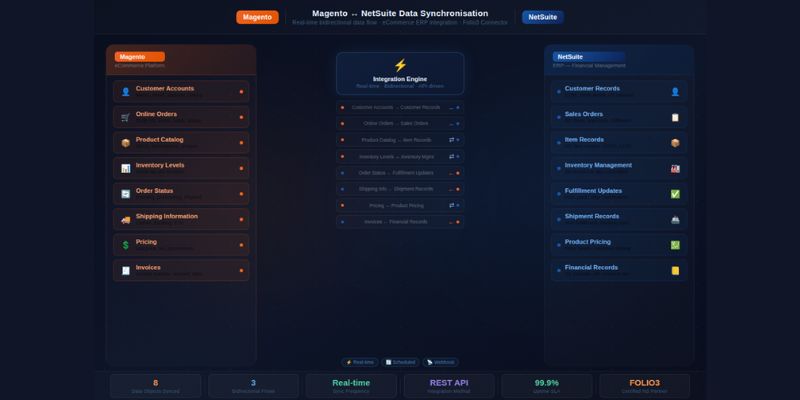
Not every business synchronizes the same information, but most Magento to NetSuite ERP links include the following data.
Keeping these records synchronized ensures every department works from the same information instead of maintaining separate versions of the truth.
This naturally leads to the next question: how does the Magento NetSuite Plugin work behind the scenes?
How Does Magento NetSuite Plugin Work?
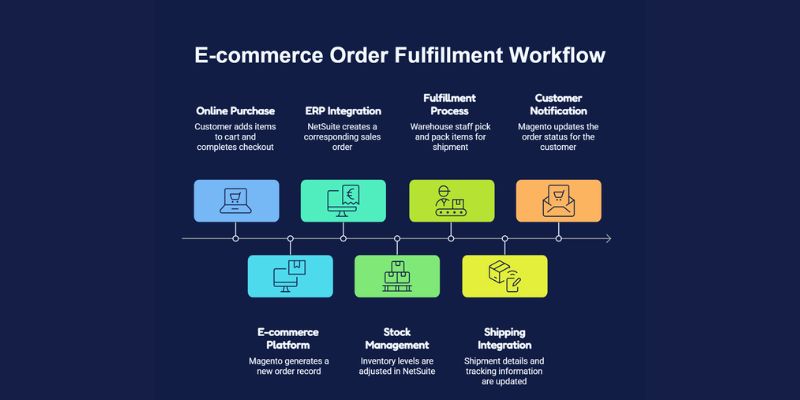
Once the integration is configured, Magento and NetSuite continuously exchange information without requiring manual updates.
Every completed action in one system automatically triggers the next step in the other, creating a connected workflow from order placement to fulfillment.
Depending on your business requirements, this synchronization can happen in real time, at scheduled intervals, or when specific events occur.
Understanding this workflow also makes it easier to decide which information should move between the two systems.
What Should You Sync Between Magento and NetSuite?
Not every piece of information needs to be synchronized. Sending unnecessary data can slow down integrations and make troubleshooting more difficult. Focus on the records that support your daily business operations.
- Customer Data
- Product Data
- Order Data
- Inventory Data
- Financial Data
The Biggest Benefits of Magento NetSuite API Connection
The biggest advantage of connecting Magento and NetSuite isn’t simply automation. It’s creating one reliable source of business data that every department can trust.
✔ Faster Order Processing
Orders move automatically from Magento to NetSuite, reducing manual entry and fulfillment delays.
✔ Accurate Inventory Levels
Real-time inventory synchronization helps prevent overselling and keeps online stock levels accurate.
✔ Better Customer Experience
Customers receive accurate product availability, order updates, and shipping information without delays.
✔ More Reliable Financial Reporting
Sales, payments, taxes, and invoices remain synchronized, making reconciliation much easier.
✔ Scales With Business Growth
Whether you’re processing dozens or thousands of orders each day, the integration grows alongside your business without increasing manual work.
Businesses in different industries can benefit in different ways. For example, NetSuite for apparel and Footwear helps manage seasonal inventory. Even NetSuite for manufacturing businesses selling directly online can keep production, inventory, and ecommerce operations connected through a single ERP.
Common Magento NetSuite API Connection Challenges (And How to Avoid Them)
Even the best integrations need proper planning. Most issues don’t happen because of Magento or NetSuite, but because important decisions weren’t made before implementation.
| Challenge | How to Avoid It |
| Incorrect field mapping | Map and test every field before go-live. |
| Duplicate customer records | Assign one system as the source of truth. |
| Inventory mismatches | Enable regular inventory synchronization. |
| Slow synchronization | Sync only the data your business actually needs. |
| Failed integrations | Set up monitoring and error notifications. |
A successful integration isn’t measured by whether the systems connect. It’s measured by whether your teams can trust the information flowing between them.
Taking the time to plan mappings, define ownership rules, and test real business scenarios will save far more time than fixing issues after launch.
Is NetSuite Magento Sync Solution Right for Your Business?
Not every ecommerce business needs an ERP integration on day one. However, as order volumes increase and operations become more complex, manually managing data across multiple systems quickly becomes unsustainable.
You’re Ready If…
- Your team manually enters Magento orders into NetSuite.
- Inventory differences frequently lead to overselling.
- Customer, product, or pricing data exists in multiple systems.
- Financial reconciliation takes longer than it should.
- You sell through multiple channels and need centralized reporting.
- Order volumes continue to grow every month.
- Your business needs real-time visibility into inventory and sales.
Why the Right Integration Partner Matters?
Every business has different workflows, approval processes, fulfillment rules, and reporting requirements. That’s why a successful integration or migration involves more than simply connecting two platforms.
An experienced implementation partner helps you:
- Design a scalable integration architecture.
- Configure Magento NetSuite mappings that match your business processes.
- Map products, customers, orders, and financial records correctly.
- Integrate third-party shipping, CRM, or payment platforms where needed.
- Test synchronization before going live.
- Monitor and optimize the integration as your business grows.
A well-designed integration should require very little manual intervention, allowing your teams to focus on serving customers instead of correcting data.
Why Choose Folio3 for Magento NetSuite Synchronization?
Whether you’re launching a new Magento store or optimizing an existing ecommerce operation, Folio3 helps you build integrations that are reliable, scalable, and tailored to your business.
From NetSuite implementation and integration to customization, data migration, and ongoing support, our experts ensure Magento and NetSuite work together as one connected platform.
Final Thoughts
Magento eCommerce With NetSuite Synchronization is about much more than connecting an online store to an ERP. It creates a reliable flow of information between sales, inventory, fulfillment, and finance, helping every department work from the same real-time data.
Contrary to popular misconception, the most successful integrations aren’t necessarily the most complex. They’re the ones built around clear workflows, accurate data mapping, and business processes that can grow over time. When those pieces come together, the integration becomes a long-term advantage rather than another system to manage.
Frequently Asked Questions
Can Magento NetSuite link support multiple Magento stores?
Yes. A single NetSuite account can integrate with multiple Magento storefronts, allowing businesses to manage orders, inventory, and financial data from one centralized ERP.
Can Magento NetSuite synchronize historical orders?
Yes. Historical orders can be imported during implementation, provided they’re mapped correctly to avoid duplicate records and maintain reporting accuracy.
Do I need custom development for Magento NetSuite connection?
Not always. Standard integrations work well for many businesses, but custom development may be required if you have unique workflows, third-party applications, or specialized reporting requirements.
Can Magento NetSuite data flow work with third-party shipping providers?
Yes. Magento and NetSuite can integrate with shipping platforms like UPS, FedEx, DHL, and ShipStation, allowing shipping details and tracking information to flow automatically between systems.
How long does it typically take to implement Magento NetSuite eCommerce Integration?
The implementation timeline depends on your business requirements, customizations, and data complexity. Standard integrations can often be completed within a few weeks, while more complex projects involving multiple stores or custom workflows may take longer.
For any further queries, you can also visit the Magento Connector FAQs.