Key Takeaways
- Manufacturing traceability lets you track a product back to its source or forward through the production and distribution process.
- Backward traceability starts from a finished product and traces back to the raw materials and lots used. On the other hand, forward traceability starts from a material or lot and traces forward to every product and customer it reached.
- Lot traceability groups items under one shared identifier. Serial traceability tracks individual units. Most manufacturers use both, at different points in the process.
- Lot splits, merges, and rework break a simple straight-line trace. Real traceability has to hold a parent-child structure rather than a single chain.
- A traceability system that can’t identify every affected lot and customer within a few hours during a mock recall isn’t actually working, no matter how good it looks on paper.
- Every trace eventually leads back to the BOM and production record that built the item. The BOM shows what should go into the product, while traceability shows what actually went into it and where it went.
But the cost is not only in the products being recalled. It also depends on how quickly a manufacturer can identify exactly what is affected and where it went.
A recalled batch needs to be traced back to the BOM and production records behind it. The faster that connection can be made, the faster the affected products can be identified and removed from the field.
That is the real purpose of manufacturing traceability: being able to determine what went into a product and where that product ended up, without having to piece the answer together manually.
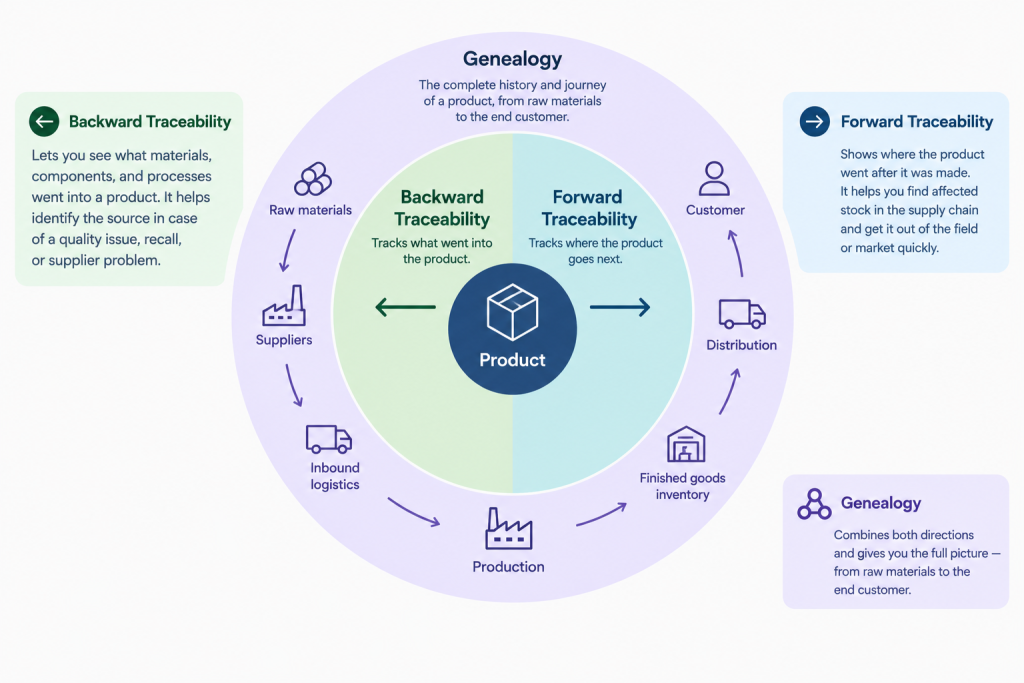
Traceability isn’t just one capability. In fact, it’s multi-dimensional. It’s backward traceability (what’s in this), forward traceability (where did this go), and genealogy (how do lots, splits, and rework connect underneath both of those).
All of these work together across raw materials, work in process, and finished goods. They only work if the underlying production data is structured well enough to support traceability, which is the same structural discipline covered in Folio3’s guide to manufacturing BOMs. After all, a trace is only as good as the BOM and work order records it’s built on.
This guide covers what traceability means, the types that get confused most often, why both regulated and unregulated manufacturers depend on it, and how it works inside an ERP like NetSuite.
What Is Manufacturing Traceability?
Manufacturing traceability is the ability to identify and reconstruct a product’s full material and production history at any point after it’s made, along with everywhere it went after it shipped. It covers raw materials at intake, work in process as it moves through production, and finished goods after they leave the building. All of them are tied together by identifiers, usually lot, batch, or serial numbers.
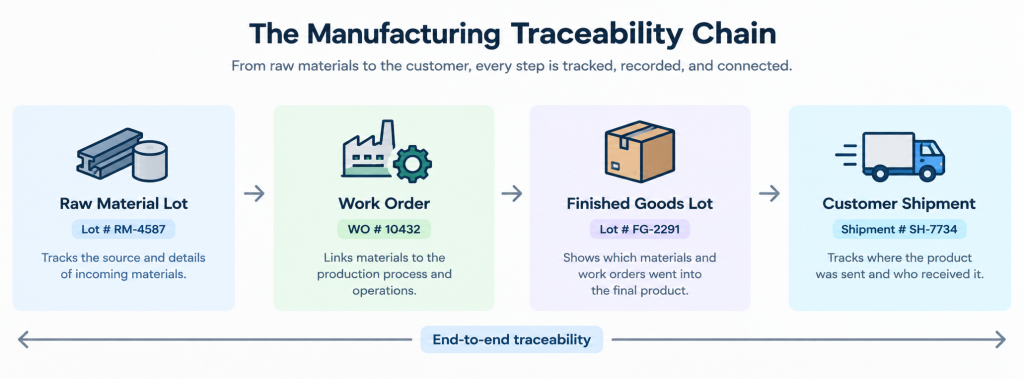
A system that tracks quantity on hand doesn’t necessarily know that the 400 units in a given lot were built from a specific raw material shipment, on a specific date, using a specific work order. Traceability requires that link to exist and to be queryable in both directions rather than just recorded somewhere for the sake of having a record.
What’s the Difference Between Forward and Backward Traceability?
Backward traceability starts from a finished goods lot and traces back to every raw material lot, supplier, and production step that went into it. This is the direction you need when a customer reports a defect, and you need to know what actually went into that specific unit, whether it’s an isolated issue or something that touched a much larger batch.
Forward traceability starts from a raw material or component lot and traces forward to every finished product, and every customer, that received something built from it. This is the direction that matters the moment a supplier flags a contaminated or out-of-spec material after the fact. You already know what’s wrong. What you need immediately is every place it ended up.
A traceability system that only supports one direction well is only half-built. Recall response depends on being able to move fluently in both directions, often within the same investigation.
What’s the Difference Between Lot Traceability, Serial Traceability, and Genealogy?
Granularity is a real design decision, not a default setting, and it shapes everything about how a traceability system actually works.
Lot traceability groups a quantity of material or product under one shared identifier, assigned either at receipt (a raw material lot) or at production (a batch or lot number for what was made). Everything in that lot is treated as equivalent for traceability purposes. This is the right granularity for most bulk, chemical, food, and process manufacturing, where tracking every individual unit would be both impossible and pointless.
Serial traceability tracks a single unit with its own unique identifier, independent of everything else built alongside it. This is the right granularity for high-value, safety-critical, or individually warrantied products, aerospace components, medical devices, and firearms, where knowing the exact history of one specific unit matters more than the cost of tracking it that closely.
Genealogy is what holds both of these together once real production gets involved. A single raw material lot doesn’t always flow into one finished lot in a straight line. Lots get split across multiple work orders. Multiple lots get merged into one batch. Rework pulls a partially built unit back into an earlier stage and reintroduces it into a different production run than the one it started in.
Any of those events breaks a simple linear trace, which is why real traceability has to maintain a parent-child structure that can branch and rejoin, rather than just a single chain from material to customer.
This is also where the one-up-one-down principle, common in food and regulated supply chains, comes in. No single company in a supply chain is expected to trace a product all the way from raw material to final consumer on its own.
Each link only has to reliably know its immediate supplier and its immediate customer. The full chain gets reconstructed by connecting those individual links together, rather than by just any one company holding the entire picture.
Why Does Traceability Matter in Manufacturing?
The lack of traceability in a manufacturing business has far-reaching consequences for an organization. It shows up as cost, speed, and liability the moment something goes wrong.
1. Recall Speed and Cost Containment
A recall that takes days to scope, because nobody can say with confidence which lots or customers are actually affected, costs far more than one that takes hours.
A good practice worth adopting directly is to run a mock recall drill and measure how long it actually takes to identify every affected lot and customer. Our guide to chemical manufacturing batch and lot traceability sets a real benchmark for this. We have recommended drills that complete in 2 to 4 hours. If your system can’t hit something close to that, you’re in for a realization.
2. Regulatory Compliance
Traceability requirements vary by industry, but they’re rarely optional once they apply. Food producers and growers fall under the FDA’s Food Safety Modernization Act, which requires maintaining records that trace covered produce from the field to the first point of sale.
Defense manufacturers work under standards like MIL-STD-130 for part marking and identification.
Pharmaceutical, medical device, and automotive manufacturers all carry their own versions of the same underlying requirement: prove what went into this, and prove where it went.
3. Root Cause Analysis and Quality
When a defect shows up, traceability is what turns “something’s wrong with this product line” into “this specific raw material lot, used across these specific work orders, is the actual cause.” That precision is the difference between scrapping a targeted quantity of material and second-guessing an entire production run.
4. Supply Chain Accountability
Traceability increasingly isn’t just a company’s own choice. Large buyers and retailers now treat traceability capability as a supplier qualification requirement rather than a nice-to-have. Growers selling into wholesale channels feel this directly. Complete lot records, harvest data, quality inspections, and temperature logs are what protect a supplier when a buyer dispute or audit happens.
What Technologies and Identifiers Make Traceability Work?
Traceability depends on identifiers that are unique, consistent, and captured the same way every time, which is harder to guarantee than it sounds.
Globally unique identifiers, built on standards like GS1, encode a lot number, manufacturing location, and expiration date into a single scannable code. So, the same identifier means the same thing whether it’s read by your system or a customer’s.
Barcode and RFID capture replace manual data entry at each handoff point, which matters because manual entry is where traceability chains actually break. A mistyped lot number or a skipped scan is invisible until someone needs the record it was supposed to create.
For manufacturers tracking inventory at a level above individual lots, license plating- tracking inventory at the pallet, bin, or container level, adds another layer of traceable granularity without requiring serial tracking on every unit inside.
Folio3’s NetSuite manufacturing implementation builds this kind of license plating directly into a manufacturer’s inventory structure. When a customer asks about a lot, the answer is available in seconds instead of requiring someone to dig through paper records.
How Does Manufacturing Traceability Work Inside an ERP Like NetSuite?
Traceability only works at scale when it’s built into the same system that’s already running production, rather than in isolation.
Lot and Serial Records With Attributes
A lot or serial record needs to carry more than an ID number. Expiration dates, potency or concentration for chemical and pharmaceutical products, and a direct link to a Certificate of Analysis all need to live on the record itself. This is needed so anyone pulling up a lot gets the full picture in one place instead of cross-referencing three different systems.
Quality Holds and Quarantine
A lot under investigation needs to be blockable from shipping or further production immediately, rather than just flagged in a report someone might or might not read later. Quality holds tied directly to lot records are what actually prevent a suspect lot from reaching a customer while it’s being evaluated.
FEFO Over FIFO for Perishable and Regulated Materials
Standard First In, First Out inventory logic assumes the oldest stock by receipt date should move first. For anything with an expiration date, that’s the wrong rule.
First Expired, First Out prioritizes by actual expiration rather than receipt order, which matters the moment two lots received on the same day have very different shelf lives.
Genealogy That Ties Back to the BOM
The production record behind a finished lot isn’t a standalone document. In fact, it ties directly back to the MBOM that drove the build in regulated or engineered products, back further still to the released engineering BOM revision that design approved in the first place. A trace that can only show what happened in production, without connecting to which BOM revision actually authorized that build, is missing half the picture.
Traceability Across Non-Standard Production, Like Agriculture
Not every industry traces a product through a conventional work order. Growers and packing operations need lot data assigned at harvest intake, tied to field, block, and quality metrics, then carried through cooling, packing, and shipment.
Our guide to batch traceability for growers covers how that harvest-to-sale chain gets built inside NetSuite, which looks structurally different from a discrete manufacturing work order but solves the same underlying problem.
What Are Common Traceability Gaps That Break the Chain?
Traceability is only useful when a manufacturer follows a material or finished product through every relevant stage of its lifecycle. Gaps usually appear when records are maintained in disconnected systems, production events are not captured at the right level, or the traceability model does not reflect how materials actually move through manufacturing.
Relying on Paper or Spreadsheets for Traceability
Paper records and spreadsheets can capture individual events, but they make it difficult to maintain a consistent relationship between material receipts, production, inventory movements, and shipments. They also make historical investigation dependent on locating and reconciling records from multiple sources.
A traceability process should allow the organization to identify the relevant lot or serial number and follow its associated transactions without manually reconstructing the history.
Losing Genealogy During Splits, Merges, or Rework
A simple material-to-product chain does not account for what happens when production changes the original material relationship.
A single lot may be split across multiple work orders. Multiple component lots may be consumed into one finished assembly. A product may then be returned for rework and receive additional material before being completed again.
If these events are not captured as part of the item’s genealogy, the resulting trace can be incomplete or misleading. The traceability model needs to preserve the relationship between the original material, each production event, rework activity, and the resulting inventory.
Using the Wrong Level of Traceability
Traceability should be configured around the actual risk and control requirements of the product.
Some materials are appropriately controlled at the lot level, while individually identifiable products or components may require serial-level tracking.
Applying a finer level of tracking than the process requires is an overkill, as it adds unnecessary transaction and data-management overhead. Using a surface level can leave the organization without enough information to isolate affected inventory.
The important question is whether the selected tracking level allows the business to identify the material or product population that would actually need to be investigated, quarantined, or recalled.
Keeping Traceability Data Separate From Inventory and Production Records
Traceability becomes difficult when lot, serial, quality, production, inventory, and shipping information are maintained in separate systems without a reliable link between them.
For example, identifying an affected material lot may require one system to determine where the material was received, another to determine which work orders consumed it, and another to identify the customers that received the resulting products.
Keeping these relationships connected to the transactions that create them makes forward and backward tracing substantially easier to perform and verify.
Never Testing the Traceability Process
A traceability process should be tested before an actual quality event or recall requires it.
A practical test is to select a finished product or material lot and determine whether the team can trace it through the relevant production and inventory transactions, then identify the affected downstream or upstream records using the available system data.
The test should record how long the trace took, which records were available, where manual investigation was required, and whether the resulting population could be independently verified. Those findings show whether the traceability process works in practice, rather than simply existing as a documented procedure.
Conclusion
Traceability isn’t a bolt-on report. In fact, it’s what a manufacturer’s BOM, work order, and lot data add up to when they’re structured well enough to answer backward and forward questions with confidence. Get the underlying production records right, and traceability stops being a separate project and becomes something the system already does.
If your team hasn’t run a mock recall drill recently, or isn’t confident in the answer, that’s worth a conversation before it becomes an urgent one. Talk to Folio3’s NetSuite manufacturing consultants about what your current setup can actually answer today.
FAQs
Is traceability the same as track and trace?
They’re closely related but not identical. “Track and trace” often emphasizes real-time location and status as a product moves through the supply chain. Traceability is broader: it includes that, plus the historical record needed to answer backward and forward questions after the fact.
What’s the difference between a lot and a batch?
In most manufacturing contexts, the terms are used interchangeably to mean a quantity of material or product produced or received together and assigned one shared identifier. Some industries draw a finer distinction, using “lot” for raw material received together and “batch” for what’s produced from it in a single production run.
Do all manufacturers need serial-level traceability?
No. Serial traceability makes sense for high-value, safety-critical, or individually warrantied products. Most bulk, process, and high-volume discrete manufacturing runs efficiently on lot-level traceability instead.
What does FSMA require for food traceability?
The FDA’s Food Safety Modernization Act requires growers and facilities handling covered produce to maintain records tracing that produce from the field to the first point of sale, with specific data points required at each critical tracking event.
What is the one-up-one-down principle?
It’s the traceability standard used across most regulated supply chains, where each participant only needs to reliably identify their immediate supplier and immediate customer. The full end-to-end chain is reconstructed by connecting those individual links, not by any single company tracking the entire journey alone.
How fast should a recall trace actually take?
There’s no universal legal standard, but a commonly used benchmark for a well-built system is identifying every affected lot and customer within 2 to 4 hours during a tested mock recall. Slower than that usually points to a gap in how lot data is linked, not a gap in effort.
Does NetSuite handle traceability natively, or does it need an add-on?
NetSuite’s manufacturing functionality includes native lot and serial tracking, and Folio3 builds on that with license plating and industry-specific configurations for chemical, food, and agricultural traceability needs that go beyond the out-of-the-box setup.