

Key Takeaways
- NetSuite is a full-suite ERP, while Campfire focuses primarily on accounting, financial management, and revenue operations.
- Campfire is a strong fit for fast-growing SaaS and technology companies that prioritize finance automation and a faster implementation.
- NetSuite is better suited to businesses that need inventory, manufacturing, supply chain, CRM, ecommerce, or broader operational management.
- Campfire offers a faster path to value, while NetSuite provides greater functional depth and a broader ERP ecosystem.
- The right choice depends on business complexity. Campfire fits finance-led companies, while NetSuite fits businesses that need one system to manage finance and operations.
Campfire is an AI-native financial ledger, built specifically for revenue recognition and financial close in venture-backed SaaS companies. NetSuite is a full operational ERP running finance, inventory, CRM, and multi-entity operations for companies across nearly every industry and size. That difference in scope is the reason this comparison exists, and it’s the lens worth applying to every feature below rather than any single number.
Both platforms have real traction behind them. Campfire has raised roughly $103 million since its 2023 founding. NetSuite has been running production finance operations since the early 2000s, and 61% of technology companies that have gone public since 2011 were running on it when they did. Below is a verdict on each platform, feature by feature, from core accounting and revenue recognition to multi-entity operations, inventory, CRM, project accounting, AI, and compliance, along with what each one costs to implement.
What is NetSuite?
NetSuite is a full-suite cloud ERP covering core financials, CRM, inventory and warehouse management, project accounting, and global multi-entity consolidation in one platform. It’s been in commercial production since the early 2000s, runs in 190-plus currencies across 100-plus countries, and holds ISO/IEC 42001 certification for AI governance
This compliance marker that matters increasingly to enterprise buyers and auditors evaluating how a vendor manages its AI systems.
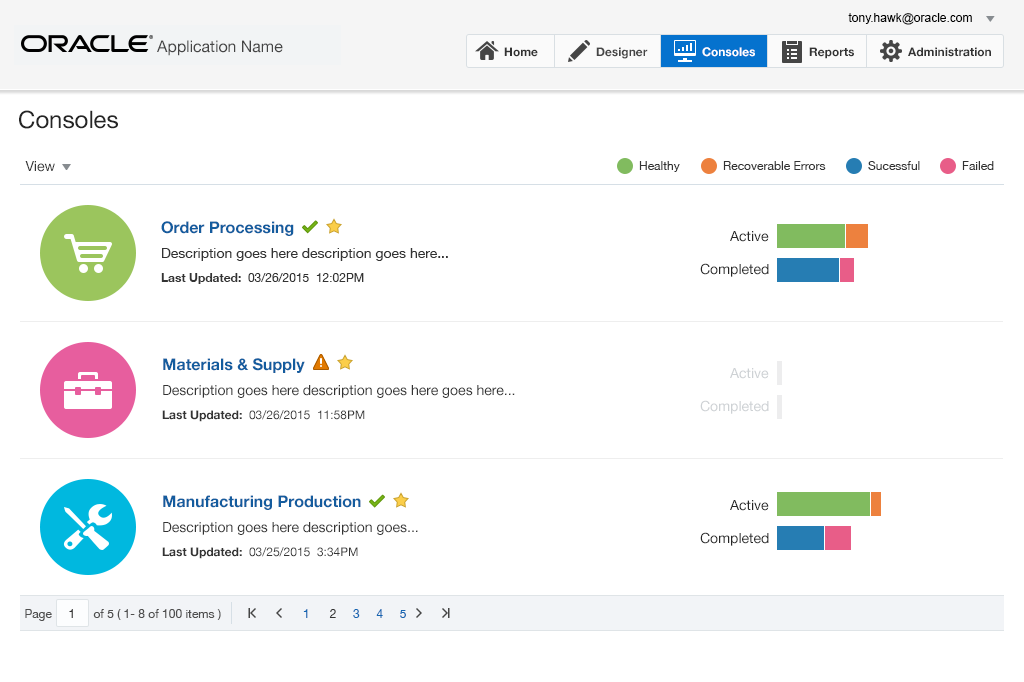
That breadth is the entire value proposition. A company running manufacturing, services delivery, and multi-entity finance operations does all of it inside one system of record, with one audit trail and one source of truth, rather than stitching together point solutions as each new business line comes online.
What is Campfire?
Campfire is an AI-native financial ledger built specifically for venture-backed SaaS and subscription companies, founded in 2023. Its scope is intentionally narrow: general ledger, revenue recognition, and financial close, powered by an AI assistant called Ember and a proprietary Large Accounting Model the company says hits 95% accuracy on reconciliation and variance detection. This figure comes from Campfire itself rather than a third-party audit.
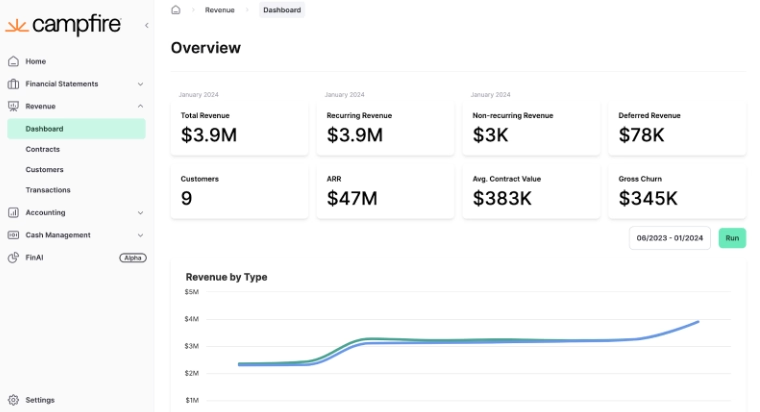
Campfire has no inventory module, no manufacturing capability, no CRM, and no multibook accounting beyond a single adjusting entity. None of that is a flaw in what Campfire set out to build. It’s a direct reflection of the narrower job the product was designed to do.
Feature-by-Feature Comparison: NetSuite vs Campfire
Let’s compare the two ERP software solutions based on their capabilities and how well they suit your business.
| Capability | NetSuite | Campfire |
|---|---|---|
| Core accounting and close | Full multibook accounting, automated close workflows, role-based controls | Single-entity ledger with one adjusting entity, AI-assisted close |
| Revenue recognition | ASC 606 and IFRS 15 compliant, configurable allocation rules and contract modifications | Native subscription, usage-based, and milestone revenue recognition |
| Multi-entity and global operations | Native consolidation across 190-plus currencies and 100-plus countries | Limited, finance-led consolidation only |
| Inventory and operations | Native inventory, warehouse management, and manufacturing | Not supported |
| CRM and front office | Built-in CRM module | Not supported |
| Project accounting and PSA | Native, through SuiteProjects | Limited to none |
| AI and automation | AI spread across finance, inventory, and operations, plus an AI Connector Service for outside models | AI concentrated in the general ledger and close, via the Ember assistant |
| Customization, security, and compliance | SuiteCloud platform, ISO/IEC 42001 AI governance certification, two decades of audit history | API-first, less mature governance track record, thin public audit history |
Core Accounting and Financial Close
NetSuite supports full multibook accounting, letting a company keep parallel books for different accounting standards or entities, backed by role-based controls built for audit scrutiny.
Campfire’s ledger covers one entity with one adjusting entity rather than true multibook support, which is a real constraint the moment a company operates under more than one accounting standard or needs entity-level books that don’t collapse into a single set of records.
Verdict: NetSuite wins on depth and audit readiness. Campfire wins on simplicity for a single-entity business that doesn’t need multibook accounting yet.
Revenue Recognition and Subscription Billing
This is Campfire’s strongest ground. Its revenue engine handles subscription, usage-based, and milestone billing models natively, purpose-fit for how modern SaaS companies actually price their products.
NetSuite’s Advanced Revenue Management covers the same ASC 606 and IFRS 15 requirements with configurable allocation rules for multi-element and modified contracts, a more enterprise-oriented approach built for complexity beyond pure subscription revenue.
Verdict: Campfire wins for a pure-subscription SaaS business. NetSuite wins the moment revenue involves multi-element contracts, professional services, or anything beyond a subscription line item.
Multi-Entity and Global Operations
NetSuite consolidates across 190-plus currencies and more than 100 countries natively, with intercompany eliminations built into the platform. Campfire’s consolidation is finance-led rather than system-native, which independent reviewers describe as a real limitation once a company operates more than a couple of entities.
Verdict: NetSuite wins decisively here. This isn’t close.
Inventory and Operations
Campfire has no inventory, warehouse, or manufacturing capability, and doesn’t claim otherwise. NetSuite runs all three natively, including production scheduling and mobile warehouse operations.
Verdict: NetSuite wins by default, since Campfire was never built to compete in this category.
CRM and Front-Office Integration
NetSuite includes a built-in CRM module connecting sales, service, and finance data in one system. Campfire has no front-office capability at all, since its entire scope sits inside the finance function.
Verdict: NetSuite wins by default. A company that needs CRM and financial data in the same system doesn’t have a real choice here.
Project Accounting and Professional Services
NetSuite handles project accounting and professional services delivery natively through SuiteProjects, covering resource management, bids-to-bill workflows, and project-level margin tracking. Campfire’s project accounting is limited to none, per both NetSuite’s own comparison and independent third-party scoring.
Verdict: NetSuite wins clearly. A services-driven business, or one with any project-based billing, needs this natively rather than bolted on.
AI and Automation
Campfire’s AI is genuinely central to the product. Ember drafts journal entries, flags anomalies, and automates reconciliation work, and G2 reviewers consistently rate Campfire’s usability well above NetSuite’s. NetSuite’s AI capabilities span a wider surface.
An Intelligent Close Manager, a Bill Capture feature for vendor invoices, a SuiteAnalytics Assistant for natural-language reporting, and an AI Connector Service that plugs in outside models like ChatGPT or Claude, extending across inventory and operations as well as finance.
Verdict: Campfire wins in depth in one workflow and ease of use. NetSuite wins on breadth, and it’s also the only one of the two with ISO/IEC 42001 AI governance certification, which matters for enterprise buyers evaluating AI risk formally.
Customization, Security, and Compliance
NetSuite’s SuiteCloud platform, open APIs, and two decades of audit history give it a customization and compliance depth Campfire hasn’t had time to build. Campfire is API-first and modern, but independent reviewers describe its public audit and compliance track record as still thin relative to its funding level.
Verdict: NetSuite wins on maturity. Campfire is building toward this, but isn’t there yet by its own reviewers’ account.
What Do Independent Reviews Say?
For reference, here’s how the two platforms score on G2:
| Metric | Campfire | NetSuite |
|---|---|---|
| Overall rating | 4.7 out of 5 | 4.1 out of 5 |
| Review count | Roughly 40 | Nearly 4,900 |
| Ease of use | 9.6 | 7.5 |
| Quality of support | 9.8 | 7.0 |
Implementation and Pricing
Independent research puts Campfire’s typical implementation at 3 to 10 weeks. NetSuite’s full multi-entity rollout runs 4 to 6 months, though its startup-focused SuiteSuccess edition can reach go-live in under 70 days, which narrows the practical gap for the kind of company actually choosing between these two platforms.
Neither company publishes a full rate card. NetSuite’s startup pricing starts near $999 a month, scaling with edition and modules. Campfire doesn’t publish pricing at all, and one independent estimate puts the likely annual cost in the $30,000 to $55,000 range, explicitly flagged by that source as a low-confidence estimate rather than a confirmed figure.
Choose NetSuite If…
- Your business includes inventory, manufacturing, project delivery, or CRM needs alongside finance
- You operate, or plan to operate, more than one entity or currency
- You need an audited, two-decade track record behind your system of record, especially ahead of a public offering
- Your revenue model includes multi-element contracts or services billing beyond straight subscriptions
Choose Campfire If…
- Your operations are purely finance and revenue recognition, with no inventory or physical operations on the roadmap
- Your revenue model is subscription or usage-based and unlikely to add complexity soon
- Speed to go-live and day-to-day ease of use matter more than operational breadth
- You’re comfortable with a newer vendor’s shorter audit history at this stage of the business
Final Verdict
Campfire wins clearly on two things: ease of use and depth of subscription-specific revenue recognition, both backed by real review data. NetSuite wins on almost everything else, inventory, CRM, project accounting, multi-entity operations, AI governance certification, and audit history, because it was built to cover all of that ground and Campfire was deliberately built not to.
That doesn’t make Campfire the wrong choice for every buyer. A single-entity SaaS company with no physical operations, no services billing, and no near-term plan to add either one can genuinely run well on Campfire today. But for any business that expects to add inventory, services, multiple entities, or a public offering to its roadmap, the feature gaps documented above aren’t minor. They’re exactly the gaps that turn into a forced migration later, at a much higher cost than choosing the platform with that scope already built in.
If you’re trying to figure out which category your business actually falls into, Folio3’s NetSuite implementation services can map out a realistic scope, timeline, and cost against where your business is actually headed.
FAQs
Does Campfire have any operational or CRM capability at all?
No. Campfire’s scope is deliberately limited to general ledger, revenue recognition, and close management. It has no inventory, manufacturing, or CRM functionality, and the company doesn’t market itself as having any.
Is Campfire’s 95% AI accuracy claim independently verified?
That figure comes from Campfire’s own announcement of its Large Accounting Model, not a third-party audit, so it’s worth treating as a vendor claim rather than a validated benchmark.
Can a company switch from Campfire to NetSuite later without losing data?
It’s possible, but it’s a genuine migration project rather than an upgrade, since it means building out inventory, CRM, and project accounting modules Campfire never had.
Which platform is safer for a company planning to go public eventually?
NetSuite has the stronger case here. Its own data cites 61% of technology companies that have gone public since 2011 as NetSuite customers, and Campfire’s own reviewers describe its compliance and audit track record as still developing.