Key Takeaways
- Process manufacturing ERP systems manage production around formulas, recipes, batches, yields, and process variables rather than relying only on traditional bills of materials.
- Formula and recipe management provides version control over ingredients, quantities, processing requirements, and approved formulations.
- Batch and lot traceability connects raw materials to production batches and finished products, supporting recalls, quality investigations, and regulatory requirements.
- Quality management needs to work inside production, with inspections, quality holds, test results, and release decisions tied to the relevant materials and batches.
- NetSuite provides native lot tracking and multi-UOM capabilities, while FEFO lot assignment is delivered through a dedicated SuiteApp.
- Process manufacturers also need ERP capabilities for variable yields, shelf life, co-products and by-products, batch costing, and production planning.
Congress just moved the compliance deadline for FSMA 204, the FDA’s food traceability rule, from January 2026 to July 20, 2028. The FDA’s food traceability rule focuses on specific events across the supply chain, including the transformation of ingredients into finished products. For manufacturers, that means being able to connect incoming materials and their lots to the batches and products created from them.
The same operational requirements appear across food and beverage, pharmaceutical, chemical, nutraceutical, cosmetics, paints, coatings, and other formulated-product industries. Production may involve controlled formulas, variable yields, material losses, multiple outputs, quality testing, expiration dates, and batch-specific traceability.
A process manufacturing ERP brings these requirements into the production and inventory system. The 10 features below cover the capabilities manufacturers should evaluate, from formula and batch management through traceability, quality, costing, planning, and regulatory controls. The article also distinguishes between capabilities available natively in NetSuite and functionality that may require an additional SuiteApp.
What Is a Process Manufacturing ERP? And How Does It Differ From Discrete Manufacturing?
A process manufacturing ERP is designed for manufacturers that transform ingredients or raw materials into products using formulas, recipes, controlled processes, and batches. Common examples include food and beverage, pharmaceutical, chemical, nutraceutical, cosmetics, paints and coatings, and specialty chemical manufacturers.
Unlike discrete manufacturing, where a product can generally be described as a collection of components assembled into a finished item, process manufacturing combines or transforms materials in ways that cannot simply be reversed. Production can also produce variable yields, co-products, by-products, or quality variations depending on the materials and process conditions.
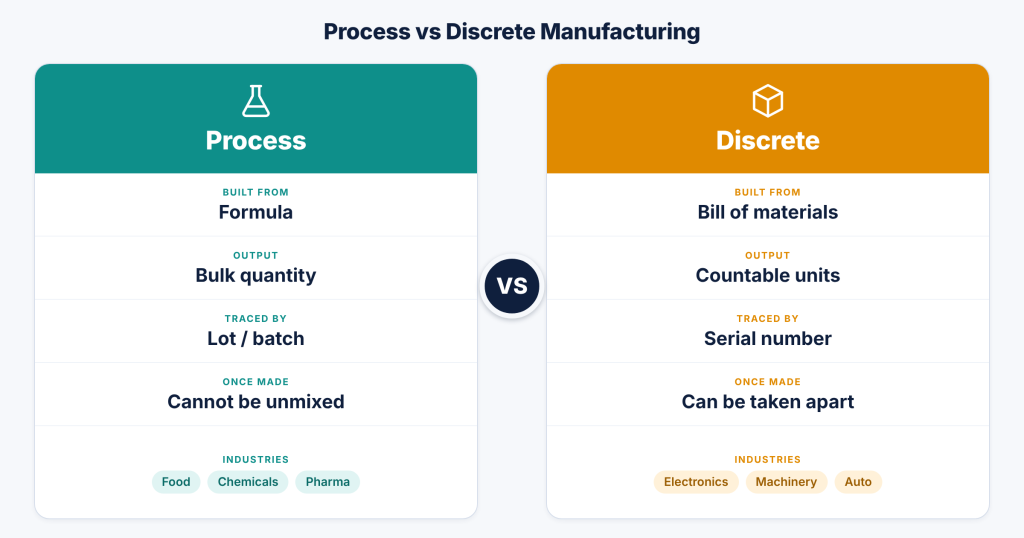
That changes what the ERP needs to track. The system has to know which formula was used, which lots went into a batch, what quantity was produced, what was lost or produced alongside it, whether the batch passed quality checks, and where the resulting inventory went.
Features of Process Manufacturing ERP You Must Have For Your Business
The list below breaks down the features you must have in a process manufacturing ERP to scale.
1. Formula and Recipe Management
For process manufacturers, the ERP needs to define the materials, quantities, units of measure, and expected yields required to produce a finished item. In NetSuite, this product structure is managed through Bills of Materials (BOMs), which specify the components required to manufacture an item and support multiple BOM revisions and location-specific BOMs.
NetSuite also supports component-level yield, allowing manufacturers to account for expected material loss during production. For example, if a production process normally loses 5% of a particular ingredient, the BOM can account for that yield when determining the quantity required.
BOM revisions provide control over changes to the materials or quantities used to produce an item. Manufacturers can maintain different revisions and define when a revision becomes effective, helping production teams use the appropriate version for a given manufacturing period.
For manufacturers with more complex process requirements, it is important to distinguish NetSuite’s native BOM and manufacturing capabilities from specialized formula-management functionality that may require additional configuration or SuiteApps. The right setup depends on whether the operation primarily needs component and yield control or more advanced requirements such as formulation management, batch-specific processing, and specialized process manufacturing workflows.
2. Batch Management and Production Control
Process manufacturers generally produce defined quantities in batches rather than simply assembling a fixed number of identical units.
Batch management gives each production run its own identity and allows the ERP to capture the materials, quantities, dates, production results, and other information associated with that run. SAP describes batch management as particularly important in process industries where materials need to be distinguished by characteristics, quality requirements, expiration dates, or production and legal requirements.
A process manufacturing ERP should therefore support:
- Batch creation and numbering
- Planned versus actual batch quantities
- Ingredient and material consumption
- Production quantities
- Scrap and production losses
- Batch status and release
- Expiration or retest dates
- Batch-specific quality information
This creates a production record that can be followed from raw material consumption through finished-goods inventory.
3. Lot Genealogy and End-to-End Traceability
Lot traceability answers a practical question: where did a particular batch come from, and where did it go?
A process manufacturing ERP should provide both backward and forward traceability. Backward traceability identifies the raw-material lots and suppliers used to make a finished batch. Forward traceability shows which finished products, customers, shipments, or subsequent production batches were affected by a particular input lot.
Oracle NetSuite’s Lot and Serial Number Trace SuiteApp traces lot-numbered materials from suppliers through manufacturing inputs and outputs to customers. It also shows quality information when the Quality Management SuiteApp is installed.
This capability becomes critical when a raw-material problem is discovered after production. Instead of searching through purchasing, inventory, production, and shipping records separately, the manufacturer can use the lot relationship to determine which finished goods may be affected.
4. Catch Weight and Variable Quantity Management
Catch weight is important when an item has both a standard quantity and an actual variable weight. A food manufacturer might sell a case of meat as one case for inventory and order purposes, while the actual quantity delivered could be 18.6 kg. The ERP needs to preserve both measurements so inventory, purchasing, sales, and costing reflect what was physically received or shipped.
This is particularly relevant for meat, seafood, dairy, produce, and other products where individual units or batches naturally vary in weight. Without catch-weight handling, companies may have to maintain separate spreadsheets or manually reconcile the difference between the nominal quantity and the actual weight.
NetSuite captures item weights during warehouse receiving when weighing scale support is enabled. Its WMS receiving process records the weight per quantity and calculates the total weight of the received quantity, while NetSuite’s weighing-scale support connects supported scales to the mobile receiving process.
However, weight capture should not automatically be treated as full catch-weight management. Manufacturers should evaluate whether their NetSuite configuration or an additional SuiteApp can manage the complete workflow they need, including dual-unit inventory, variable quantities, pricing by actual weight, purchasing, sales, production, and inventory valuation. SuiteApps extend NetSuite for industry-specific requirements beyond its core capabilities.
Our catch-weight solution extends NetSuite to handle dual-unit tracking, variable-weight inventory, and case-break logic as an add-on layered on top of the core platform
5. Quality Management and Batch Release
Quality checks may be required when raw materials arrive, during production, or before a finished batch is released. The ERP should allow manufacturers to define inspections and record results against the relevant material, batch, operation, or finished product.
Oracle NetSuite’s Quality Management SuiteApp provides tools for associating quality data with business records and workflows. Its lot-trace functionality displays quality data alongside trace information when the Quality Management SuiteApp is installed.
Depending on the industry, this includes:
- Incoming material inspections
- In-process testing
- Finished-product testing
- Specification limits
- Quality holds
- Nonconformance records
- Corrective actions
- Batch release decisions
- Certificates of analysis
The important point is that the quality result should remain connected to the batch and material it describes.
6. Shelf-Life, Expiration, and FEFO Control
Many process-manufactured products cannot be managed effectively using quantity alone.
Food, beverages, pharmaceuticals, chemicals, cosmetics, and other products may have expiration dates, retest dates, storage requirements, or limited usable life. The ERP therefore needs to know not only how much inventory exists, but also which lots are available, how long they remain usable, and which lots should be consumed or shipped first.
FEFO, or first-expired, first-out, is particularly important where inventory should be consumed based on expiration rather than simply receipt date. Process manufacturing ERP research commonly identifies shelf-life and FEFO as important capabilities alongside formula management and lot genealogy.
A capable system should be able to account for:
- Lot expiration dates
- Retest dates
- Remaining shelf life
- Inventory status
- Storage conditions where applicable
- FEFO picking or allocation
- Expired or blocked inventory
This reduces the risk of shipping material that has insufficient remaining shelf life or allowing usable inventory to become obsolete.
7. Co-Product and By-Product Management
Some production processes create more than one output. A primary product may be produced alongside a co-product that has commercial value, while a by-product may be generated as a secondary output or production residue. The ERP needs to account for these outputs rather than treating everything other than the primary finished product as unexplained waste.
This capability affects both inventory and costing. When one production process generates several outputs, the ERP needs a defined method for recording those quantities and allocating the relevant production costs.
That matters in industries such as food processing, chemicals, refining, and other operations where secondary outputs are part of normal production rather than an exception.
8. Process-Specific Costing
Standard product costing becomes more complicated when actual material consumption, yield, production loss, and multiple outputs vary from batch to batch.
A process manufacturing ERP should therefore connect production activity with costing. Manufacturers need visibility into the actual cost of producing a batch, including raw materials, labor, overhead, losses, and relevant variances.
For example, two batches using the same formula may have different actual costs if one consumes more material, produces a lower yield, requires additional processing time, or generates a different quantity of secondary outputs.
Batch-level costing helps manufacturers compare planned versus actual production economics rather than relying solely on a theoretical formula cost. Process-manufacturing ERP research specifically identifies batch-level actual costing and co-product allocation as important capabilities for process operations.
9. Production Planning and Batch Scheduling
Process manufacturers have to plan around more than available raw materials.
Production may depend on tank or vessel availability, production capacity, cleaning requirements, ingredient availability, campaign sequencing, labor, and customer demand. A production schedule that ignores these constraints can create unnecessary changeovers, idle equipment, or material shortages.
Modern ERP systems therefore connect demand, inventory, production orders, capacity, and shop-floor activity. SAP, for example, describes process manufacturing management around process orders and master recipes, while also providing real-time production updates and production monitoring.
Useful planning capabilities include:
- Batch sizing
- Material availability checks
- Production scheduling
- Capacity planning
- Resource availability
- Production sequencing
- Planned versus actual production
- Exception management
The value is greater when production planning and inventory planning use the same underlying data.
10. Regulatory Compliance and Audit Trails
For many process manufacturers, compliance is part of the production process itself.
Food manufacturers may need controls around allergens, food safety, and traceability. Pharmaceutical manufacturers operate under highly controlled quality and documentation requirements. Chemical manufacturers may need documentation for hazardous materials, labeling, and environmental regulations.
An ERP should therefore provide controls such as:
- Controlled formula versions
- Approval workflows
- Audit trails
- Electronic records and signatures where required
- Quality documentation
- Lot genealogy
- Controlled access
- Document retention
- Regulatory reporting and labeling support
However, there is an important distinction between ERP functionality that supports compliance and the ERP itself being “compliant.” For example, ERP Research notes that software can provide technical controls relevant to regulations such as 21 CFR Part 11, but compliance ultimately depends on validation, configuration, procedures, and how the system is operated.
That distinction is worth making because simply purchasing an ERP does not make a manufacturer compliant.
Which of These Features Are Native to NetSuite, and Which Need an Add-On?
NetSuite covers many of the core requirements for manufacturing and inventory management, but process manufacturers should not assume that every capability discussed above is part of the base platform. Some functions are native features, while others are delivered through SuiteApps or require additional configuration.
| Process manufacturing capability | NetSuite availability |
|---|---|
| BOM management and revisions | Native |
| Component-level yield | Native with Advanced BOM |
| Lot tracking | Native |
| Multiple units of measure | Native |
| Batch and work order management | Native manufacturing functionality |
| WIP and Routing | Native manufacturing functionality |
| Advanced manufacturing work instructions and shop-floor data collection | Advanced Manufacturing SuiteApp |
| Lot and serial number trace reporting | Lot and Serial Number Trace SuiteApp |
| FEFO lot assignment | FEFO Lot Assignments SuiteApp |
| Catch-weight management | Additional solution may be required, depending on requirements |
| Quality management and inspections | Quality Management SuiteApp |
| Specialized process-manufacturing functionality | May require SuiteApps or customization |
NetSuite’s Advanced BOM supports multiple BOMs, revisions with effective dates, location-specific BOMs, and component-level yield. The yield functionality accounts for expected material loss during ordering and planning.
Lot tracking itself is part of NetSuite’s inventory capabilities, but manufacturers should distinguish that from dedicated trace reporting. The Lot and Serial Number Trace SuiteApp provides historical traceability from raw-material suppliers through manufacturing inputs and outputs to customers.
FEFO is another example where the distinction matters. NetSuite provides a dedicated FEFO Lot Assignments SuiteApp that assigns lots based on expiry dates and customer shelf-life requirements. It validates expiry dates during fulfillment as well
Advanced Manufacturing is also delivered as a SuiteApp. It extends NetSuite manufacturing with capabilities such as work instructions, material usage, resource supply and demand planning, and planned production start and end times.
For process manufacturers, the practical question is therefore not simply whether NetSuite can support a requirement. It is which part of the requirement is covered by the core platform, which requires a SuiteApp, and which may need configuration or customization. That distinction should be established during ERP evaluation so the implementation scope reflects the actual production and compliance requirements.
How These Process Manufacturing ERP Features Work Together
The biggest advantage of a process manufacturing ERP comes from connecting these capabilities rather than operating each one separately.
Consider a pharmaceutical manufacturer producing a batch of a finished product.
The process starts with an approved formula that specifies the required ingredients. The ERP allocates the required raw-material lots and creates the batch record. Production consumes those materials while recording the actual output and any losses. Quality checks are recorded against the batch before it is released.
If the batch passes, the finished inventory receives its appropriate lot and expiration information. When that inventory is later shipped, the system maintains the connection between the customer, finished batch, and original raw-material lots.
If a supplier later reports a problem with one ingredient lot, the manufacturer can trace that lot forward to determine which production batches and customers may be affected.
That is the real difference between a process manufacturing ERP and a generic system with basic manufacturing functionality: the production, inventory, quality, costing, and traceability records are connected around the batch. Oracle’s NetSuite documentation demonstrates this kind of connection through its manufacturing, quality-management, and lot-trace capabilities.
What to Look for When Evaluating a Process Manufacturing ERP
A feature checklist alone is not enough when evaluating process manufacturing software. Ask vendors to demonstrate how the system handles an actual production scenario from formulation through shipment.
At minimum, test whether the system can:
- Create and approve multiple formula versions.
- Scale a formula to different batch quantities.
- Record actual material consumption.
- Capture production loss and yield variance.
- Track raw-material lots into finished batches.
- Trace a finished batch back to its ingredients.
- Trace a problematic ingredient lot forward to affected products.
- Place material or finished batches on quality hold.
- Record and approve quality results.
- Manage expiration and shelf-life rules.
- Handle co-products and by-products where relevant.
- Calculate actual production costs.
- Plan production based on material and capacity constraints.
- Maintain an audit history of important changes.
The strongest test is to use one complete batch scenario rather than asking for a feature-by-feature demonstration. Start with a raw-material receipt, move through formula selection and production, introduce a quality failure or yield variance, release the batch, ship it, and then perform a mock recall. That exposes gaps between modules that a standard product demo can easily hide.
Choosing the Right Process Manufacturing ERP
The right ERP depends on the type of process manufacturing being performed and the controls surrounding it.
A food manufacturer may prioritize allergen management, shelf life, lot traceability, recipe control, and food-safety workflows. A pharmaceutical manufacturer may place greater emphasis on controlled formulas, batch records, quality systems, validation, and audit trails. A chemical manufacturer may need different capabilities around hazardous materials, SDS documentation, formulation, yield, and regulatory reporting.
The ten capabilities above provide a useful starting point, but the evaluation should ultimately be based on the manufacturer’s actual production process, regulatory requirements, batch complexity, number of facilities, integrations, and growth plans.
Choosing a process manufacturing ERP requires looking beyond basic production and inventory features. If you’re evaluating NetSuite for formulas, batch traceability, quality, costing, or other process-specific requirements, connect with NetSuite manufacturing consultants to discuss your requirements and implementation options.