I have been in the NetSuite ecosystem long enough to remember when “cloud ERP” was still a pitch that raised eyebrows in boardrooms. I have watched the product evolve through SuiteWorld keynotes, through the shift to OneWorld, through the AI hype cycle that finally produced what I believe is substantial.
I have also watched hundreds of startups take the same path. QuickBooks. Then a controller. Then a migration project that everyone hated.
For 20 years, NetSuite’s growth depended on a customer failing somewhere else first. That dependency has now become a liability.
NetSuite’s classic go-to-market has a built-in awkwardness. The best time to sell NetSuite is when a company’s current system has broken. That means NetSuite’s revenue has always been downstream of someone else’s pain. Be it QuickBooks, a spreadsheet, or an industry-specific tool that couldn’t scale.
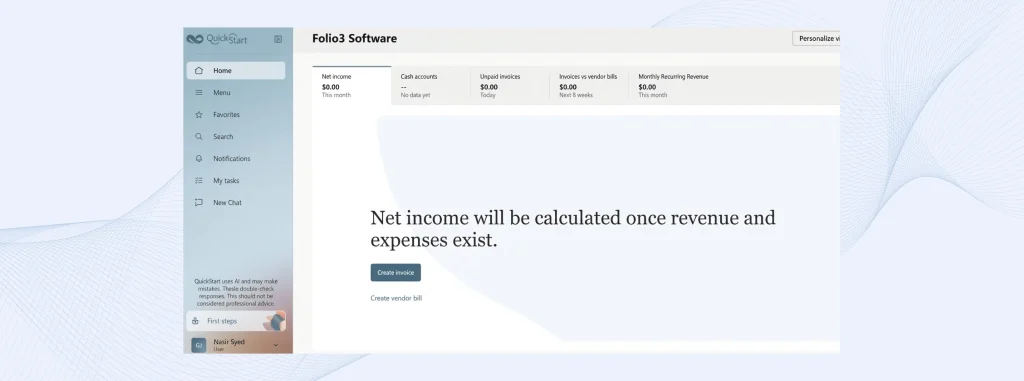
In October, before SuiteWorld 2026, Oracle NetSuite launched QuickStart, a free, AI-first financial platform for early-stage US tech startups. The obvious read is that this is Oracle’s answer to QuickBooks, or a defensive move against AI-native ERPs like Campfire, Lensing.ai, and DualEntry. I do not think that is right.

I’m willing to die on the hill that QuickStart is less about winning a fight with QuickBooks and more about making the migration itself irrelevant.
Oracle is not trying to beat Intuit at the low end. What it’s doing is far superior to what one might think. It is trying to remove the moment when a growing company has to stop, rip out its books, and start over. This is a different game entirely.
If you prefer reading a shorter version of this, I would recommend reading this LinkedIn article.
What NetSuite QuickStart Does
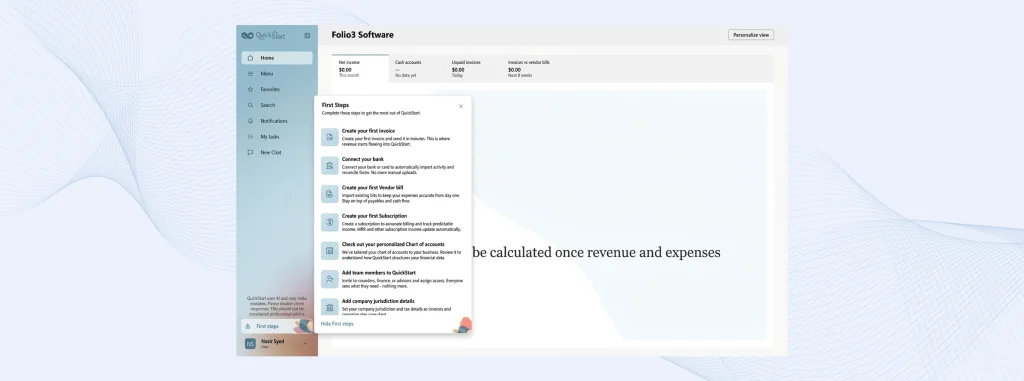
NetSuite QuickStart is narrower than NetSuite ERP but wider than basic bookkeeping. It covers accounting, banking with AI-assisted reconciliation, accounts receivable, accounts payable, subscription billing, and basic inventory with ShipStation integration. The dashboard leads with metrics a founder checks, like cash, MRR, burn, and runway.
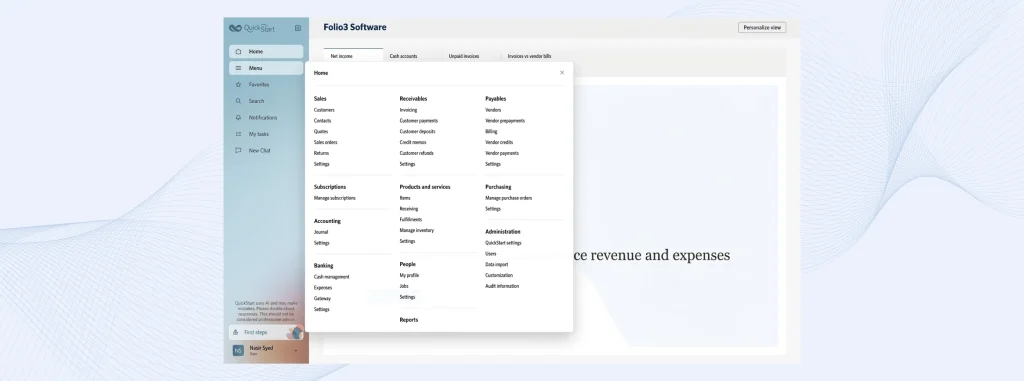
The setup is the part that should get more attention. Oracle says you can connect a bank, send an invoice, and see financials in under 10 minutes. There is no implementation partner, no sales call, and no statement of work (SOW). Customer support consists of email plus an AI help agent.
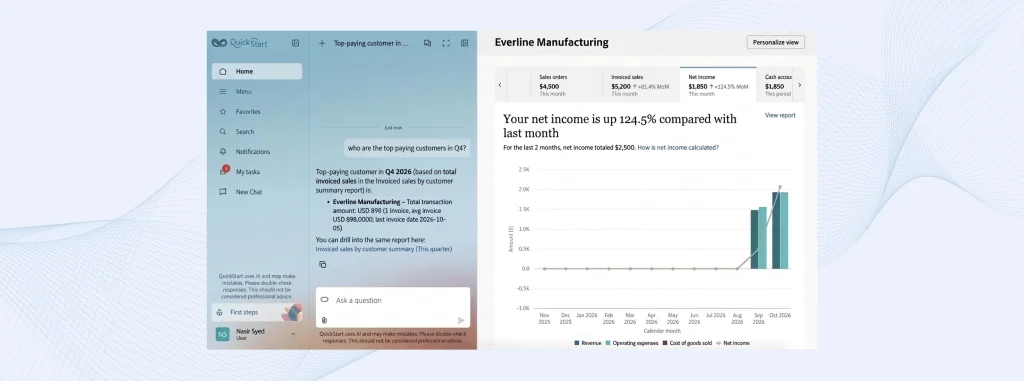
The AI layer is the part Oracle cares most about. Everyone saw it coming from a hundred miles away. Ask Oracle answers questions about your financials in plain language, and it executes tasks with approval where approval is needed.
Through Model Context Protocol (MCP), the same data is reachable from Claude, ChatGPT, or Qwen. The interaction model assumes a founder who would rather ask a question than navigate a menu, which is the founder Oracle is trying to reach.
The free plan caps out at five users, 2,500 new business records per month, 800 emails, 175 documents, 20 GB of storage, four connected bank accounts, and two concurrent integration requests. Unused capacity does not roll over.
Despite being a free product, I’d still call it a steal for early-stage founders.
Oracle NetSuite’s Strategic Bet
The “migration moment” has always been NetSuite’s friend and enemy. It was a point when a company outgrew QuickBooks and NetSuite became the default next step.
But it was also the point when that company, which was bleeding from a painful month-end close and frustrated with spreadsheet consolidations, started taking meetings with anyone who promised a faster path.
QuickStart changes the starting condition. Just think about it. If a founder’s first ledger is a NetSuite ledger, then the upgrade to full ERP is not a migration. It becomes a commercial conversation.
Oracle’s announcement uses the phrase “without starting over” deliberately. It’s not a marketing gimmick. The data model, the subscription history, the workflow logic, all of it is supposed to carry forward.
This is why the QuickBooks comparison misses the point. QuickStart is not competing for the small business that needs invoicing and a P&L statement. It is competing for the founder who, three years from now, will need multi-entity consolidation, revenue recognition, and approval workflows.
Oracle is trying to make sure that the founder never has a reason to evaluate a competitor at the moment of graduation. That’s a genius move on their part.
The analyst take of Keith Kirkpatrick of the Futurum Group gets close to this. He says that QuickStart targets the “switching cost, not the ledger.” But I would push it further. Switching cost assumes the customer is already evaluating alternatives. QuickStart aims to prevent the evaluation from happening at all.
What the Free Tier Limits Signal
I have configured enough NetSuite instances for 1,000+ businesses to know that the feature list is rarely the problem.
QuickStart is built for a single legal entity, five or fewer users, and US tech startups. If you have a subsidiary, a foreign currency, or a controller who wants approval hierarchies, Oracle points you to full NetSuite. That is fine. The product is honest about its boundaries.
Most of the caps are sensible for a seed-stage company. Five users cover a founder, a co-founder, a bookkeeper, and a fractional CFO with room to spare. 20 GB of storage is generous. Four bank connections are workable if you are disciplined about which accounts you link.
The 175-document monthly cap deserves a closer look, because it is easier to misread than the others. At first glance, six documents a day sounds tight. But the case applies to new documents uploaded, not to transactions.
QuickStart is designed so that most transactions flow through bank feeds and AI-assisted matching, without needing a supporting document for each one.
A lean five-person startup, a handful of SaaS receipts, a few contractor invoices, the occasional vendor bill, a bank statement, the odd signed contract, can comfortably sit well under 175 uploads in a month without thinking about it.
So, the right way to read the document cap is as a signal. It tells you how Oracle expects QuickStart to be used. Let the AI reconcile, attach documents where they genuinely matter, and do not turn the upload folder into a second filing cabinet. Founders who work that way will rarely notice the number.
What This Means for Early-stage Founders and Businesses
This is the section that matters most if you are the person QuickStart was built for.
You can stop treating your books as disposable. The old advice to “use a basic tool, keep burn low, worry about ERP later” was never good advice.
It was a bet that your data debt would not catch up with you before your next funding round. Most of the time, it caught up.
QuickStart lets you start with a data model that is designed to survive an audit, a Series A, and the eventual conversation with a controller who wants to see clean historicals. This is not a small thing.
The setup is yours, and that is both the gift and the risk. No implementation partner means no six-week scoping process and no invoice. It also means no one is checking your work.
If you treat the 10-minute setup as a formality, you will recreate the exact data debt QuickStart was built to prevent. My advice is that you spend the time to review the account structure with an accountant before you start entering transactions. That hour is the difference between a foundation and a mess.
The upgrade trigger becomes a business decision. Since the data model carries forward, you move to full NetSuite when you need multi-entity consolidation, advanced revenue recognition, or deeper customization. That is a healthier trigger because you will be buying something you need.
The AI is useful, but it is not a substitute for understanding your own numbers. Ask Oracle and MCP access through Claude or ChatGPT are genuinely useful for querying financials without logging in. But if you do not know what your gross margin should look like, or why your deferred revenue is moving the way it is, the chatbot will not save you.
The limits are your planning horizon. Five users are fine until you hire a part-time bookkeeper and a fractional CFO. Four bank accounts are fine until you add a second payment processor and a credit line. 2,500 records a month is fine until you are processing high invoice volume. Know where the edges are before you hit them.
The bottom line for a founder is that QuickStart is the first free financial system I have seen that does not force you to choose between speed today and rigor tomorrow. It is also worth configuring with care, because the value of the product depends entirely on whether the data model underneath is clean.
The Thing I Keep Coming Back to
I have watched NetSuite grow alongside its customers for two decades. The pitch was always the same that you have outgrown your starter system, and we are the serious next step. It worked because NetSuite is genuinely better at scale with better controls, better consolidation, better reporting, and a platform that could carry a company from its million to its IPO.
QuickStart is Oracle recognizing that the best time to earn a founder’s trust is before they have outgrown anything at all. The company is moving upstream, to the founder who has not yet chosen a ledger, and offering to be a ledger for free.
The bet that a clean, scalable data model from day one is more valuable than any contract. That is a generous bet, and it is the right one.
I believe the strategy is smart. Oracle is giving founders something genuinely useful, that is an enterprise-grade financial foundation at zero cost, and trusting that the relationship will grow from there. The intent is clear, and in my experience, NetSuite has always been at its best when it is building for the long term.
If Oracle gets the economics right, the migration moment starts to disappear. Not because QuickStart beat QuickBooks, but because the founder never had a reason to leave in the first place. They will have started on a system that replaced their speed today and their rigor tomorrow, and they will have grown into the full platform when the business was ready for it.
This is the kind of outcome the NetSuite ecosystem has always been good at delivering, and it is the one worth watching.