
A bill of materials for a printed circuit board (PCB) is fundamentally different from a simple assembly BOM. A single board can contain hundreds or thousands of components, multiple subassemblies, approved alternates, revision-specific parts, component attributes, and manufacturing requirements. When that product structure changes, the impact can reach engineering, procurement, inventory, production, quality, costing, and customer commitments at the same time.
For high-tech electronics manufacturers, BOM management is therefore a control problem, not simply a data-entry task. The ERP needs to preserve the correct product definition, apply revisions at the right time, identify component availability, support material planning, connect the BOM to production, and maintain traceability from components through finished assemblies.
NetSuite provides that foundation through multi-level BOMs, BOM revisions, work orders, inventory management, MRP, routing, costing, and lot or serial tracking. For manufacturers with more sophisticated production environments, NetSuite Advanced Manufacturing adds capabilities around planning, shop-floor execution, work centers, routings, and real-time production data. Folio3 specifically configures NetSuite for high-tech manufacturers around BOMs, engineering changes, MRP, work orders, traceability, costing, and shop-floor execution.
Why Are PCB and Electronic Assembly BOMs So Difficult to Manage?
Operational challenges for electronic manufacturers are inevitable. PCB and electronic assembly BOMs are difficult to manage because the product structure changes frequently, contains deep component dependencies, and must remain synchronized with engineering, purchasing, inventory, and production.
An electronics BOM contains individual resistors, capacitors, integrated circuits, connectors, sensors, processors, memory devices, mechanical hardware, cables, subassemblies, and other components. Many of those components may have approved alternates, supplier-specific part numbers, lifecycle constraints, minimum order quantities, long lead times, or strict traceability requirements.
The problem becomes more serious when the BOM is managed separately from the systems responsible for purchasing and manufacturing. Engineering may approve a component change while procurement is still buying the previous part. Production may have inventory from multiple revisions on hand. Finance may be costing the product against an outdated component price. Customer service may be quoting delivery dates without knowing that a critical component has become constrained.
That is why a high-tech manufacturer needs the BOM to function as a controlled product structure that drives downstream processes rather than as a static engineering document.
What Makes an Electronics BOM Different From a Standard Manufacturing BOM?
An electronics BOM usually has deeper component structures, tighter revision dependencies, more frequent substitutions, and greater exposure to component availability and lifecycle issues than a simple manufactured assembly.
A PCB assembly may contain the PCB itself, hundreds of component lines, subassemblies, programming requirements, mechanical components, labels, packaging, and manufacturing consumables. Some components may also be installed at different stages of production or associated with specific operations.
The BOM therefore needs to answer more than “What parts go into this product?”
It needs to establish:
- Which exact component or approved alternative is required
- Which revision of the product the component belongs to
- How many units are required
- Which subassembly the component belongs to
- When the revision becomes effective
- Whether the component is purchased or manufactured
- Whether the component is lot- or serial-controlled
- Which manufacturing operation consumes it
- What inventory is available
- What supply is already committed or on order
- What the component contributes to the finished-product cost
NetSuite’s BOM supports multi-level product structures and connects those structures to manufacturing, inventory, and work-order processes. Folio3’s discrete manufacturing implementation practice specifically addresses multi-level BOMs, subassemblies, BOM revisions, engineering changes, and component traceability.
Engineering BOM vs. Manufacturing BOM for Electronics
Engineering and manufacturing need the same product definition to remain aligned, but they do not necessarily use the BOM for the same purpose.
An Engineering BOM (EBOM) describes the product from the design perspective. It reflects the components and relationships engineering considers necessary to achieve the product’s intended function. A Manufacturing BOM (MBOM) translates that product definition into the structure required to build, test, and complete the product on the shop floor.
For electronics manufacturers, the distinction becomes important when a PCB design moves into production. Engineering may define a circuit using a particular component, while manufacturing may need additional assembly information, consumables, packaging, test requirements, or production-specific subassemblies.
The ERP should not become a dumping ground for every piece of engineering information. Instead, it should contain the product and manufacturing information that downstream business processes actually depend on, with controlled synchronization between engineering systems and NetSuite where a PLM, CAD, or MES platform remains the system of record for other data.
Folio3’s high-tech manufacturing focuses on connecting engineering changes to purchasing, inventory, production, costing, and customer commitments through controlled item, part-number, BOM, and engineering-change workflows.
How Should Electronics Manufacturers Structure Multi-Level BOMs in NetSuite?
A complex electronics product should generally be represented as a structured hierarchy rather than one oversized flat list of every component.
For example, a finished electronic device might be structured as:
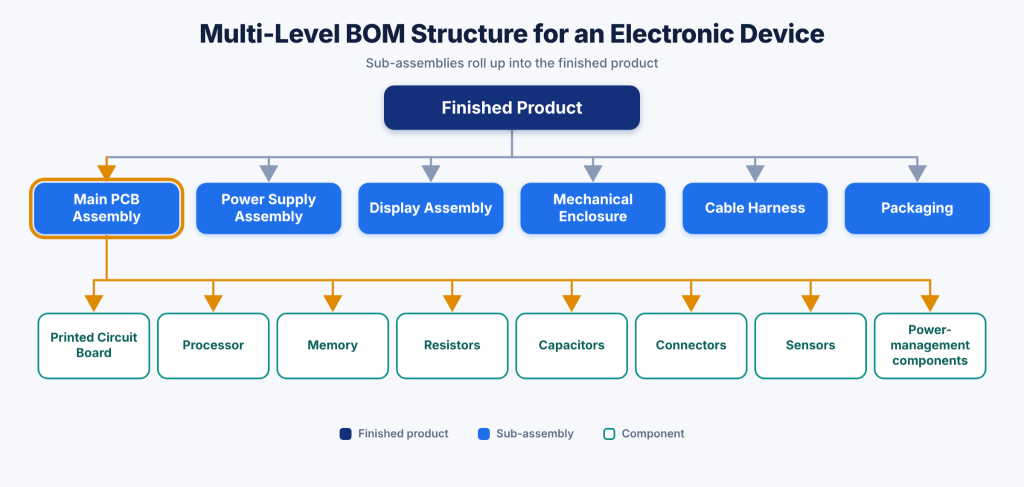
This hierarchy matters because the same subassembly may appear in multiple finished products. If the subassembly is independently managed, its BOM, revision, inventory, costing, and production history can be controlled without duplicating the entire component structure across every finished product.
NetSuite supports multi-level BOMs and subassembly structures, while work orders can be connected to those assemblies for production execution. Folio3’s discrete manufacturing implementation underlines multi-level BOM management, subassemblies, revisions, and work-order control as core requirements for complex discrete manufacturers.
How Does BOM Revision Control Work for Electronics Manufacturing?
BOM revision control determines which product definition production, procurement, and costing should use at a specific point in time.
This is one of the most important controls in electronics manufacturing because component changes are routine. A processor may become obsolete. A capacitor may be replaced by an approved equivalent. A connector may change because of supplier availability. Engineering may improve a circuit or change a component specification. Each change affects purchasing, inventory, production, testing, and product cost.
A revision-controlled BOM should establish the exact relationship between the product version and its component structure. It should also make the effective date or production applicability clear so that teams do not accidentally build a new revision using an outdated component list.
A high-tech manufacturing implementation approach specifically calls out BOM revisions, effective dates, component substitutions, and engineering change control as part of connecting engineering with downstream operations.
The objective is simple: production should never have to guess which BOM is correct.
What Happens When an Engineering Change Is Made?
An engineering change becomes an operational event as soon as it affects a component, assembly, production method, or product requirement.
Suppose an engineering team replaces an integrated circuit because the original component has entered end-of-life status. The change may require a new approved component, a new BOM revision, updated procurement rules, revised component costs, updated inventory decisions, and potentially a change to the work instruction or test process.
If those changes remain in an engineering system while procurement and manufacturing continue using an older BOM, the business can end up with two different versions of the product being built simultaneously.
A controlled NetSuite environment helps propagate the relevant product-structure change into the downstream processes that depend on it.
How Should Manufacturers Manage Component Substitutions and Approved Alternates?
Component substitution is a major BOM issue in electronics because the lowest-cost or original component is not always the component that will be available when production needs it.
An alternate component may have similar specifications but still require engineering approval, qualification, or customer approval depending on the product and industry. Manufacturers therefore need to distinguish between an approved alternate and an arbitrary replacement.
The ERP should preserve the relationship between the primary component, approved alternatives, inventory availability, procurement sources, and the BOM revision under which the alternative can be used.
This becomes particularly important during component shortages. If a critical processor has a long lead time, planners need to know whether an approved alternative exists before they delay production, place an expensive expedite order, or make an engineering change.
For high-tech manufacturers, component availability should therefore be considered part of product-structure management rather than an issue that procurement discovers after production has already been scheduled.
How Does MRP Use the BOM to Plan Electronics Production?
MRP turns the BOM from a product definition into a planning structure.
When demand exists for a finished electronic assembly, MRP can explode the BOM to determine the components and subassemblies required to build it. The planning process then considers inventory, existing supply, demand, lead times, and other planning parameters to identify what needs to be purchased or manufactured.
This is particularly important for electronics because a single missing component can prevent completion of the entire assembly. Having 99% of the required components available does not make the production order 99% shippable if the missing component is a critical processor, connector, or power-management device.
NetSuite MRP is designed to translate demand into purchasing and production recommendations while considering current inventory, open purchase orders, lead times, and safety stock..
How Can NetSuite BOM Management Improve Component Availability?
A properly structured BOM gives procurement and planning teams a direct connection between finished-goods demand and component requirements.
Instead of purchasing based on spreadsheets or manually reviewing thousands of component lines, planners can use demand, BOM, inventory, supply, and lead-time information to identify upcoming requirements.
For electronics manufacturers, this should also account for component-specific purchasing realities. Some parts have long lead times. Others are subject to minimum order quantities, supplier allocations, price breaks, lifecycle changes, or volatile availability. The BOM and planning structure must therefore work together with procurement rules rather than treating every component as interchangeable inventory.
That is the level of planning required when a component shortage can stop an otherwise complete production build.
How Should PCB BOMs Connect to Work Orders and Production?
A BOM becomes operationally useful when it drives the actual work required to build the product.
In NetSuite, assembly items and BOMs are connected to work orders, allowing manufacturers to issue or backflush components, record production, capture labor, and track the resulting finished assembly.
For electronics manufacturing, this connection should also reflect the actual production flow. A PCB may move through component placement, soldering, inspection, programming, functional testing, final assembly, and packaging. Depending on the operation, some of these activities may be represented through routings and work centers, while detailed execution may occur in a separate MES.
The ERP should therefore provide the commercial and manufacturing control layer without attempting to replace specialized production systems where those systems are necessary.
Where Does MES Integration Fit Into Electronics BOM Management?
MES integration becomes important when the shop floor needs more detailed production execution than the ERP alone is designed to provide.
An electronics manufacturer may use an MES to capture machine-level production data, component consumption, test results, production quantities, scrap, rework, or detailed process execution.
If NetSuite contains the approved BOM while the MES runs production against a different version, the integration has failed at the point where accuracy matters most. BOMs, work orders, routings, production completions, and relevant inventory transactions need clearly defined ownership and synchronization rules.
How Should Electronics Manufacturers Handle PCB Traceability?
Traceability becomes essential when manufacturers need to identify which components were used in a finished product or determine which finished products contain a particular component lot or serial number.
For high-value electronics, medical devices, aerospace products, defense equipment, and other quality-sensitive products, a manufacturer may need to trace a component from supplier receipt through production consumption and ultimately to the finished assembly shipped to a customer.
A complete traceability structure should allow the manufacturer to answer questions such as:
Which component lot went into this finished unit?
Which finished units contain this component lot?
Which supplier supplied the component?
Which work order consumed it?
Which customer received the affected finished product?
Those answers can materially reduce the time required to investigate quality issues or execute targeted corrective action.
How Does BOM Accuracy Affect Electronics Manufacturing Cost?
BOM accuracy directly affects product costing because the component structure is one of the primary inputs to determining what a finished assembly should cost.
In electronics, component prices can change significantly, particularly for specialized or constrained parts. A BOM that contains an outdated component cost can make a product appear more profitable than it actually is.
Costing also needs to account for labor, machine time, subcontracting, overhead, scrap, and other production costs where applicable. For high-tech products, even a small component-cost change can materially affect gross margin when the product is manufactured at high volume.
NetSuite connects BOMs and production activity with manufacturing costing and WIP, allowing manufacturers to compare expected and actual costs. Folio3’s high-tech manufacturing practice specifically focuses on visibility into material, labor, machine, subcontracting, overhead, WIP, and production variances.
This gives finance and operations teams a much stronger basis for pricing, margin analysis, and engineering trade-off decisions.
When Should Electronics Manufacturers Use NetSuite Discrete Manufacturing?
NetSuite discrete manufacturing is the natural fit when the core product is built as a collection of individual components and assemblies.
That describes most PCB and electronic assembly operations. The manufacturing model centers on discrete components, multi-level BOMs, work orders, assembly builds, routings, inventory consumption, and finished-unit tracking.
Folio3’s NetSuite Discrete Manufacturing ERP Implementation specifically lists electronics and electronic components among the industries it supports. Its implementation approach covers BOM management, engineering changes, work orders, WIP, production routings, costing, inventory, and traceability.
For a PCB manufacturer, this is generally the starting point for determining the NetSuite manufacturing architecture.
Where Do Batch and Process Manufacturing Capabilities Fit Into Electronics?
Batch and process manufacturing capabilities become relevant when an electronics manufacturer’s operation includes production stages that behave like processes rather than discrete assemblies.
PCB and electronic assembly production itself is generally discrete. However, some high-tech manufacturers may also operate processes involving coatings, encapsulation, potting compounds, chemical treatments, adhesives, or other materials that are mixed, formulated, or consumed in batches.
In those cases, forcing every production activity into a purely discrete structure can create unnecessary complexity. NetSuite Advanced Manufacturing supports both discrete/assembly and batch/process manufacturing environments, while process manufacturing covers recipes, batches, yields, co-products, lot genealogy, and quality processes.
This is particularly relevant for manufacturers operating a mixed-mode environment. The objective should be to model each production process according to how it actually works rather than selecting a manufacturing model simply because the finished product is electronic.
Can NetSuite Support Mixed Discrete and Process Manufacturing?
Yes. NetSuite supports organizations operating different manufacturing models when the implementation is designed around the actual production processes rather than forcing everything into one structure.
A high-tech manufacturer might use discrete manufacturing for PCB assemblies and finished devices while using process-oriented workflows for coatings, chemical treatments, adhesives, or other batch-controlled materials.
NetSuite Advanced Manufacturing is designed to support both discrete/assembly and batch/process manufacturing capabilities, including production scheduling, manufacturing workbench functions, routings, shop-floor data collection, and batch-specific processes.
The important implementation decision is where the boundary between those models sits. The BOM, routing, item type, inventory controls, quality requirements, and production transactions should reflect the physical manufacturing process.
How Does Advanced Manufacturing Extend NetSuite for High-Tech Electronics?
Advanced Manufacturing becomes relevant when a manufacturer needs more sophisticated production planning and shop-floor control than basic work orders and assemblies provide.
For electronics manufacturers, that can include finite capacity scheduling, manufacturing workbench functionality, detailed routings, labor and machine requirements, shop-floor data capture, and barcode-enabled production processes.
This distinction matters because not every electronics manufacturer needs Advanced Manufacturing on day one. A relatively straightforward assembly operation may be well served by Work Orders & Assemblies, BOMs, inventory, MRP, and appropriate integrations. A high-volume or highly engineered manufacturer with constrained resources, complex routings, and detailed shop-floor execution may require the additional controls.
The right question is therefore how complex is the production operation, rather than simply whether the company manufactures electronics.
What Should Electronics Manufacturers Audit Before Implementing NetSuite BOMs?
BOM implementation should start with the product data, not with the software configuration.
Before loading thousands of PCB components into NetSuite, manufacturers should establish how item numbers, revisions, units of measure, approved alternatives, subassemblies, sourcing, inventory locations, and engineering changes are governed.
At minimum, the audit should address:
- Duplicate or obsolete component records
- Inconsistent manufacturer and supplier part numbers
- Incorrect units of measure
- Incomplete or outdated BOMs
- Missing subassembly relationships
- BOM revisions without effective dates
- Components with no approved sourcing strategy
- Incorrect lead times or purchasing parameters
- Inventory that cannot be reconciled to the correct component revision
- Production routings that do not match actual shop-floor processes
- Unclear ownership of engineering changes
- MES, PLM, CAD, or other systems that contain overlapping product data
This is one area where implementation discipline matters more than adding another feature. You should prioritize item masters, BOMs, routings, and quality plans before enabling advanced scheduling because manufacturing functionality can expose and amplify existing data problems.
How Janco Electronics Used NetSuite to Connect BOMs, MRP, and Shop-Floor Execution
Janco is an electronics manufacturing services provider serving defense, medical, and industrial sectors. Before its NetSuite implementation, the company relied on an outdated legacy system, spreadsheets, and disconnected processes that limited visibility into WIP, inventory, production, costing, and order status.
Folio3 implemented NetSuite SuiteSuccess Manufacturing Premium and integrated it with Factory Logix, Janco’s manufacturing execution system. The integration connected inventory items, assembly items, BOMs, and work orders in NetSuite with the shop-floor system. Work-order completions, finished goods, and labor-time consumption also flowed back into NetSuite.
The implementation gave Janco a connected manufacturing environment rather than treating the ERP and shop floor as separate systems. This resulted in 100% visibility across manufacturing operations, lot-controlled tracking from supplier to finished goods, accurate WIP and job costing, reduced stockouts and excess inventory, and improved alignment between procurement and production schedules.
What Should a NetSuite BOM Architecture Look Like for a High-Tech Electronics Manufacturer?
A strong BOM architecture should create a controlled path from product definition to procurement, production, inventory, costing, and fulfillment.
For a typical electronics manufacturer, that architecture may include:
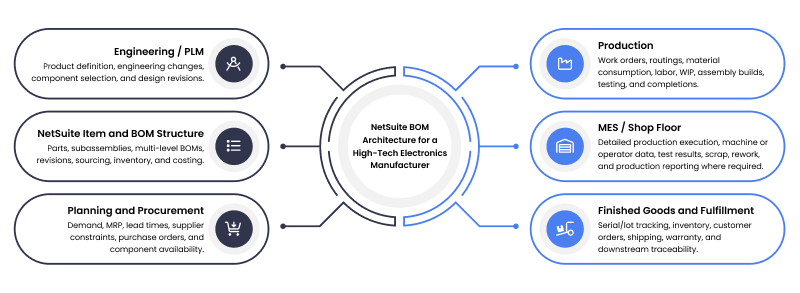
This prevents the BOM from becoming an isolated engineering artifact. Instead, it becomes the controlled product structure that downstream processes use to execute the business.
What Are the Most Important NetSuite BOM Controls for Electronics Manufacturers?
The most important controls are the ones that prevent the wrong product from being purchased, built, costed, or shipped.
For a high-tech electronics manufacturer, those controls typically include:
| Control | Why it matters |
|---|---|
| Multi-level BOMs | Represents PCB assemblies, subassemblies, and component dependencies |
| BOM revisions | Ensures production uses the correct product definition |
| Effective dates | Controls when a revision becomes applicable |
| Component substitutions | Manages approved alternatives during supply constraints |
| Item master governance | Prevents duplicate or ambiguous component records |
| MRP integration | Converts finished-goods demand into component requirements |
| Work-order integration | Connects the BOM to actual production |
| Lot/serial tracking | Enables component and finished-product genealogy |
| Routing integration | Connects material requirements with production operations |
| Cost rollups | Provides visibility into material and manufacturing cost |
| Engineering change control | Prevents uncontrolled changes from reaching production |
| MES integration | Keeps ERP product and production data aligned with shop-floor execution |
The value comes from how these controls work together. A manufacturer with perfect revision control but inaccurate inventory still cannot plan reliably. A manufacturer with accurate BOMs but disconnected shop-floor execution still lacks visibility into actual consumption and production status.
The Bottom Line
Complex PCB and electronic assembly BOMs require more than a system that can store component lists. They require controlled product structures that connect engineering changes to procurement, MRP, inventory, production, costing, quality, and customer fulfillment.
NetSuite provides the core building blocks for that model through multi-level BOMs, revisions, work orders, inventory, MRP, manufacturing costing, and lot and serial tracking. Advanced Manufacturing extends the environment with more sophisticated scheduling, routings, workbench capabilities, and shop-floor data collection where production complexity warrants it.
For electronics manufacturers, the implementation should be designed around the actual product and production architecture. Discrete manufacturing is the natural foundation for PCB and electronic assemblies, while batch/process capabilities may be appropriate for specific process-driven stages within a mixed manufacturing environment.
If complex PCB structures, revisions, and assembly BOMs are making production harder to manage, NetSuite can help bring them into one system. Talk to our NetSuite manufacturing experts to see how.
FAQs
Can NetSuite manage complex PCB BOMs?
Yes. NetSuite supports multi-level BOMs and assembly structures that can represent complex electronic products with subassemblies and component relationships. The implementation should also establish revision control, item governance, inventory rules, and production workflows appropriate for the manufacturer’s product structure.
Can NetSuite manage BOM revisions for electronics?
Yes. BOM revisions can be used to control changes to product structures and establish which version applies to production. For electronics manufacturers, revision governance should also define how approved engineering changes flow into procurement, inventory, production, costing, and other downstream processes.
Can NetSuite handle thousands of PCB components?
NetSuite manages complex multi-level product structures, but the success of a large electronics BOM environment depends heavily on item-master quality, BOM architecture, data governance, and integration design. High-volume electronics manufacturers should establish clear rules for part numbers, revisions, alternatives, subassemblies, and system ownership before migrating large BOM datasets.
Does NetSuite support electronic component traceability?
Yes. NetSuite supports lot and serial tracking, which can be configured to trace components through production and finished goods. The exact traceability model depends on the manufacturer’s product, regulatory requirements, and production processes.
Can NetSuite integrate with an electronics MES?
Yes, you can integrate NetSuite with MES platforms to exchange information such as BOMs, work orders, production activity, completions, and inventory transactions. Folio3’s Janco Electronics implementation is an example of a NetSuite and Factory Logix integration connecting ERP and shop-floor execution.
Should electronics manufacturers use discrete or process manufacturing in NetSuite?
PCB and electronic assembly production generally fits the discrete manufacturing model because products are built from identifiable components and assemblies. Process manufacturing becomes relevant when part of the operation involves formula-, batch-, or process-driven production. NetSuite Advanced Manufacturing supports both discrete/assembly and batch/process manufacturing environments.
Does every electronics manufacturer need NetSuite Advanced Manufacturing?
No. The appropriate configuration depends on production complexity. A manufacturer with straightforward assembly may only need BOMs, Work Orders & Assemblies, MRP, inventory, and related manufacturing capabilities. More complex operations with finite capacity constraints, detailed routings, advanced shop-floor execution, or mixed manufacturing models may benefit from Advanced Manufacturing.
How should an electronics manufacturer prepare BOM data for NetSuite implementation?
Start by cleaning item masters and establishing governance for part numbers, units of measure, subassemblies, revisions, approved alternatives, sourcing, lead times, and BOM ownership. Then validate BOM structures and routings against actual production before loading the data into NetSuite. Folio3 recommends prioritizing item masters, BOMs, routings, and quality plans before enabling advanced manufacturing planning.
