Key Takeaways
- NetSuite Advanced Manufacturing is the highest manufacturing tier. It adds finite scheduling, mobile shop floor data collection, and batch/process manufacturing.
- Tactical equipment manufacturers often need Advanced Manufacturing sooner due to mixed production, configured orders, and defense-related requirements.
- Folio3’s work with Skydio shows how NetSuite can unify fragmented systems for a defense and public-safety drone manufacturer.
- Choosing the right manufacturing tier depends on production complexity and operational needs, not simply company growth.
As tactical equipment manufacturers scale production, spreadsheets and entry-level ERP systems can quickly become limiting when operations require detailed quality controls, multi-step production, and real-time cost visibility. NetSuite Advanced Manufacturing provides the planning, scheduling, and shop floor capabilities needed to manage that complexity.
This guide explains what Advanced Manufacturing includes, why tactical equipment manufacturers need it earlier than other manufacturers, and how to determine when an upgrade makes sense.
What Is NetSuite Advanced Manufacturing?
NetSuite Advanced Manufacturing is a SuiteApp that adds production planning, finite-capacity scheduling, resource planning, work instructions, and shop floor data collection to NetSuite Manufacturing. It helps manufacturers plan and manage production based on available labor, machines, materials, and work center capacity.
NetSuite’s manufacturing capabilities range from basic work orders and assemblies to advanced production planning and execution. Advanced Manufacturing is designed for manufacturers with more complex scheduling, capacity, and shop floor requirements.
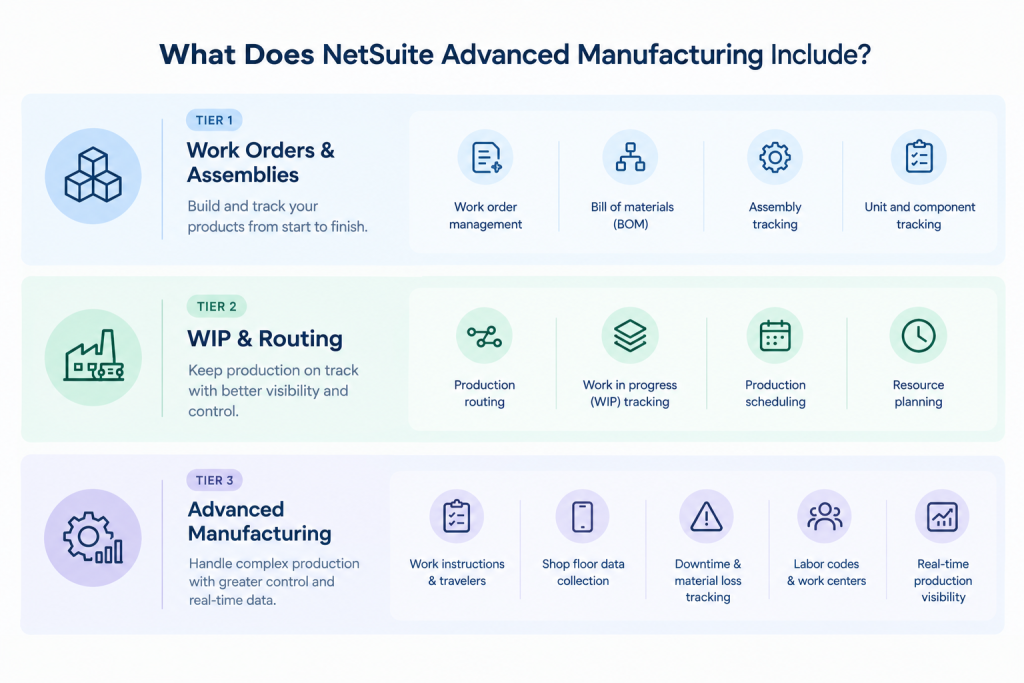
It includes three main tiers as follows:
Tier 1: Work Orders and Assemblies
This is the base license tier, included with most NetSuite manufacturing editions. It covers creating work orders, building assemblies, and tracking components against a bill of materials. It’s enough for a company producing standard SKUs in predictable batches with a single production step.
Tier 2: WIP and Routing
The mid-tier adds work-in-process tracking and multi-step routing, It lets you follow a unit through several operations instead of treating assembly as one flat step. The mid-tier adds work-in-process tracking and multi-step routing. It allows manufacturers to track production across individual operations and work centers. NetSuite WIP and routing also improve visibility into material consumption, production progress, labor, and manufacturing costs.
Tier 3: Advanced Manufacturing
It’s built for operations where production is complex enough that spreadsheets and manual scheduling can’t keep up anymore, which is exactly the point most tactical equipment manufacturers reach once demand outpaces their original setup.
What Does NetSuite Advanced Manufacturing Include?
The main features in NetSuite for equipment manufacturers are finite capacity scheduling, workbench, mobile data collection, batch and process manufacturing, and quality management.
Finite Capacity Scheduling
This optimizes job sequencing across multiple work centers based on real machine and labor availability, not theoretical capacity. For a manufacturer running mixed production lines, sewing stations alongside molding or coating equipment, this is the difference between a schedule that looks correct on paper and one that reflects what the floor can produce that week.
Advanced Manufacturing Work Bench
The Work Bench is a visual, drag-and-drop scheduling console where planners can see every job, work center, and constraint in one view and adjust the sequence in real time. Without it, rescheduling a rush defense order around existing production usually means a spreadsheet, a phone call, and a guess.
Mobile Data Collection
Barcode scanning on the shop floor lets operators log labor, material consumption, and completed steps as they happen instead of at end of shift. For a manufacturer that needs to prove exactly when a batch was inspected or which operator handled a specific unit, this is also where a real-time audit trail starts.
Work Instructions and Shop Floor Data Collection
Advanced Manufacturing gives production teams detailed work instructions for each operation and lets operators record production activity directly from the shop floor. Tablet and mobile interfaces can capture production results, labor, downtime, and material loss as work progresses.
For tactical equipment manufacturers, this can be useful when production involves multiple work centers or detailed assembly steps. Operators can work from defined instructions while production data is captured against the work order, giving planners and managers better visibility into what is happening on the floor.
Quality Management Integration
Advanced Manufacturing connects directly into NetSuite’s Quality Management module. It routes failed inspections to hold locations and ties test results to the specific batch or serial number that produced them. For gear that has to meet a durability or MIL-SPEC standard (Military Specification) before it ships, this connection turns quality control from a manual checklist into a system record.
For a walkthrough of how these modules fit together inside NetSuite, our explainer video on NetSuite’s manufacturing modules breaks down which tier handles which job.
It’s useful context before deciding whether Advanced Manufacturing is the level a growing operation needs, or whether WIP & Routing will do the job well enough for another year or two.
Why Do Tactical Equipment Manufacturers Outgrow Base NetSuite Sooner?
A generic discrete manufacturer producing one product line in one facility can run on WIP & Routing for years. Tactical equipment manufacturers tend to run into structural pressure that pushes them into Advanced Manufacturing much earlier, and it usually comes from four directions at once.
Mixed Discrete and Process Production
A single product line, a plate carrier, for example, can combine cut-and-sew assembly, foam or ballistic panel molding, and a water-repellent or IR-reflective coating step. That’s discrete and process manufacturing running side by side on the same order, and base modules built around simple assembly tracking don’t handle recipe-based steps without workarounds that break down at volume.
Defense Contract Documentation Requirements
Government and defense contracts frequently require DCAA-compliant cost segregation and documented audit trails, and a batch that fails inspection has to be traceable back to the exact materials, operator, and process step behind it
Janco Electronics, an electronics manufacturing services provider serving defense, medical, and industrial clients, hit exactly this wall on a legacy system that couldn’t track component lots across production runs.
Folio3’s implementation paired NetSuite with a manufacturing execution system to restore lot-controlled inventory and the compliance audit trail defense clients require, the same combination a tactical gear manufacturer needs once a contract starts asking hard questions about traceability.
Configured Orders at Production Volume
Military and tactical buyers rarely order one standard configuration. A single contract might call for the same base gear in multiple colorways, sizes, and mounting configurations, each requiring its own bill of materials variant tracked and produced without turning every order into a manual one-off project.
Civil Clothing ran into a version of this problem once monthly sales passed $10 million: dozens of size and color combinations overwhelmed NetSuite’s standard production order structure. Folio3’s fix, a custom production order engine built for high-variance items, is the same pattern a tactical gear manufacturer needs when one contract spans multiple sizes, colorways, and mounting configurations at once.
Facility and Team Growth Outpacing Visibility
Adding a second or third production facility, or scaling from a small prototype shop to a full production floor, exposes gaps in inventory location tracking and real-time cost visibility that a single-facility setup never had to solve. This is precisely where a scheduling console and mobile floor data replace guesswork with a system of record.
What Does an Advanced-Manufacturing-Tier Implementation Look Like?
Skydio, a US drone manufacturer building autonomous flight systems used across defense and public safety, is a useful reference point even though it isn’t a gear manufacturer specifically.
Before its NetSuite implementation, Skydio ran on Odoo alongside disconnected manufacturing and testing platforms. Work orders and assembly builds weren’t managed efficiently; there was no integration between vehicle testing and the ERP, quality management for testing wasn’t unified, and inventory location tracking across facilities was unreliable.
Folio3 implemented NetSuite SuiteSuccess Manufacturing Standard with Advanced Financials and Quality Management. We connected Skydio’s vehicle testing system to NetSuite with bi-directional data flow so work orders sync automatically.
Serial number tracking now follows individual component assemblies, inventory bin management works across multiple facilities, and landed cost calculations include shipment charges accurately. The full Skydio case study covers the complete scope of what changed.
The pattern holds for gear manufacturers specifically too. Matbock, which manufactures military equipment under DCAA oversight, and its sister company Cardomax needed compliance and traceability built into their NetSuite structure without forcing one business’s regulatory requirements onto the other’s data, a version of the same mixed-complexity problem Advanced Manufacturing is built to solve.
How Do You Know You Need Advanced Manufacturing?
You may be ready for NetSuite Advanced Manufacturing if you can check two or more of the following:
- ☐ Mixed production processes: The same order combines discrete assembly with batch, chemical, coating, or other process manufacturing steps.
- ☐ Scheduling conflicts: Production scheduling is managed in spreadsheets, and sequencing problems are discovered after production starts.
- ☐ Traceability requirements: Customers or contracts require inspection records tied to specific lots or serial numbers, but those records are managed manually.
- ☐ Limited cost visibility: You cannot quickly calculate unit costs across materials, labor, and overhead.
- ☐ Multiple facilities: Operations have expanded across multiple facilities, but inventory and production visibility remain fragmented.
If two or more apply, your operation may have outgrown basic WIP and Routing capabilities and should be evaluated for Advanced Manufacturing.
What Does NetSuite Advanced Manufacturing Implementation Cost and How Long Does It Take?
Cost and timeline for Advanced Manufacturing depend heavily on how much of the base NetSuite structure, item records, BOMs, and routing is already clean going in.
Check our detailed NetSuite manufacturing pricing guide that covers the licensing and implementation cost factors in detail. For defense contractors specifically, Folio3’s government and defense implementations typically run 70 to 90 days for a standard deployment that can extend to 6 to 8 months.
The single biggest driver of timeline overrun isn’t the software configuration itself. It’s data migration, specifically making sure existing BOMs, routing, and any batch or recipe records move over without losing the structure that made them useful in the first place.
What Are Common Mistakes When Scaling Into Advanced Manufacturing?
The most common mistakes are poor production data, weak shop floor adoption, underestimating process manufacturing requirements, and planning only for current production volume. These gaps can limit the value of Advanced Manufacturing and create problems after go-live.
Treating It as a Software Upgrade Instead of a Process Change
Advanced Manufacturing requires accurate routing, work center, scheduling, and production data before configuration begins. Poor data will produce unreliable schedules and costing.
Skipping Mobile Data Collection Because It Feels Optional
Real-time shop floor data collection keeps production, labor, and quality records accurate and traceable. Delayed manual entries can create gaps in production and audit records.
Scoping for Current Volume Instead of the Next Two Years
The implementation should account for expected production volume, facilities, products, and contract requirements. Designing only for current operations can leave the system underpowered soon after go-live.
No Mock Run Before Go-Live
A full production simulation can reveal scheduling, shop floor, costing, and quality gaps before the system goes live. Testing with realistic production scenarios provides a stronger validation of the implementation.
NetSuite Advanced Manufacturing for Your Business
NetSuite Advanced Manufacturing is built for manufacturers dealing with more complex production requirements. This can include mixed discrete and batch processes, documentation tied to defense contracts, configured orders at scale, or multiple facilities that need to be managed together. Tactical equipment manufacturers hit that complexity earlier than most, which is why the base modules that worked at launch stop being enough.
If your production has already crossed two or more of the signals covered above, that’s worth a direct conversation before the next contract makes the gap harder to close. Folio3’s NetSuite for Manufacturing team has done exactly this kind of implementation for defense-adjacent hardware manufacturers, and can walk through what Advanced Manufacturing would look like for your specific production mix.
FAQs
Is NetSuite Advanced Manufacturing a separate product from NetSuite?
No. It’s a module tier within NetSuite’s manufacturing edition, sitting above Work Orders & Assemblies and WIP & Routing. It isn’t a standalone product and isn’t purchased separately from a NetSuite manufacturing license.
Do tactical equipment manufacturers need Advanced Manufacturing from day one?
Not necessarily. Smaller operations producing standard SKUs with simple assembly can run on WIP & Routing for a while. Advanced Manufacturing becomes necessary once production mixes discrete and process steps, documentation requirements tighten, or facility count grows past one.
What’s the difference between WIP & Routing and Advanced Manufacturing?
WIP & Routing tracks a unit through multiple production steps and gives cost visibility across them. Advanced Manufacturing adds finite capacity scheduling, mobile shop floor data collection, batch and process manufacturing, and direct quality management integration on top of that.
Does Advanced Manufacturing help with DCAA compliance for defense contracts?
It supports the traceability and cost tracking DCAA compliance depends on, batch and serial tracking, real-time labor and material logging, and quality records tied to specific production runs, but DCAA compliance itself is handled through dedicated SuiteApps and governance built on top of that foundation.
How is this different from a generic manufacturing ERP guide?
Most published guides on NetSuite Advanced Manufacturing are written for discrete manufacturers in general. Tactical and defense-adjacent gear manufacturers deal with a specific combination of mixed production types, contract documentation requirements, and configured order volume that generic guides don’t address directly.