
Key Takeaways
- NetSuite supports batch manufacturing through work orders, BOMs, WIP, lot tracking, Advanced Manufacturing, and quality management, while connecting production with financial operations.
- Industry-specific ERP platforms such as BatchMaster, Deacom, and Datacor provide dedicated functionality for formulation, batch execution, and regulatory documentation.
- ERP selection should account for actual material consumption, yield variance, quality holds, batch costing, and forward and backward lot traceability.
- Manufacturers should evaluate the full operating model, including procurement, production, inventory, fulfillment, and financial management, rather than focusing only on recipe functionality.
Batch manufacturing ERP software manages formula-based production, material consumption, batch scheduling, quality inspections, lot traceability, and manufacturing costs. The right system connects these processes with procurement, inventory, financial management, and order fulfillment so manufacturers retain visibility from raw material receipt through finished product delivery.
Manufacturers in food and beverage, chemicals, pharmaceuticals, cosmetics, and other process industries face additional requirements involving ingredient specifications, variable yields, expiration dates, product quality, and regulatory documentation.
NetSuite, SAP S/4HANA, Infor CloudSuite, Microsoft Dynamics 365, and specialized platforms such as BatchMaster and Deacom fulfill these requirements through different combinations of manufacturing functionality and enterprise management capabilities.
NetSuite stands out for mid-sized businesses seeking to manage batch production alongside their financial and commercial operations. Its manufacturing capabilities include work orders, BOM revisions, WIP and routings, lot-controlled inventory, and manufacturing costing. Advanced Manufacturing extends these functions with batch travelers, recipe/formulation work instructions, production scheduling, and shop-floor data collection.
This guide compares 10 batch manufacturing ERP solutions based on their production capabilities, traceability, quality management, and ability to support the rest of a manufacturer’s business.
What Features Should Batch Manufacturing ERP Software Include?
Batch manufacturing ERP software should control how a product is formulated, manufactured, tested, costed, and traced through the supply chain.
The requirements differ from conventional assembly manufacturing because the inputs and outputs are not always fixed. Ingredients have different characteristics, actual production yields vary, and the finished product may require quality testing before becoming available for sale.
The most important capabilities include:
- Formula and recipe management: Maintain approved ingredient quantities, formula revisions, batch sizes, production instructions, and substitutions.
- Batch production and scheduling: Create production orders, allocate materials, schedule equipment, and record actual material and labor usage.
- Lot tracking and genealogy: Trace supplier lots through production to finished goods and customer shipments.
- Quality management: Record inspections, enforce quality holds, and maintain evidence supporting batch release decisions.
- Manufacturing costing: Calculate material, labor, and overhead costs while identifying yield losses and production variances.
- Inventory and shelf-life management: Monitor lot availability, expiration dates, inventory status, and warehouse movements.
The ERP should also connect these processes with purchasing, demand planning, financial reporting, and customer orders. Without that connection, manufacturers end up reconciling production costs and inventory movements across separate applications.
Quick Comparison of the Top 10 Batch Manufacturing ERP Systems
Check out the top 10 batch manufacturing ERP systems, their capabilities, components, and which one suits you best.
| ERP software | Best suited for | Batch manufacturing capabilities | Traceability and quality |
|---|---|---|---|
| NetSuite | Food, beverage, pharmaceutical, chemical, agricultural, and multi-entity manufacturers needing connected business operations | Work orders, BOM revisions, WIP, routings, batch travelers, production scheduling, material issuance, and shop-floor data collection | Native lot tracking, batch genealogy, inventory status, and Quality Management SuiteApp |
| Infor CloudSuite | Food, beverage, dairy, ingredient, and complex process manufacturers | Industry-specific formulation, production planning, yield analysis, and supply chain processes | Lot traceability, product specifications, quality inspection, and recall-related processes |
| SAP S/4HANA | Large process manufacturers managing complex production across multiple plants | Master recipes, process orders, operations, phases, resources, and co-product costing | Batch management, batch characteristics, quality processes, and material genealogy |
| Microsoft Dynamics 365 | Process manufacturers requiring formula-based production and connected supply chain management | Formula versions, batch orders, batch balancing, catch weight, co-products, and by-products | Batch tracking, quality orders, inventory status, and warehouse controls |
| BatchMaster ERP | Food, chemicals, cosmetics, nutraceuticals, and pharmaceutical manufacturers | Formula scaling, potency adjustments, packaging specifications, batch jobs, and production scheduling | Lot genealogy, quality testing, approval workflows, and compliance documentation |
| Aptean Process Manufacturing ERP | Food, beverage, nutraceutical, and formula-based manufacturers | Recipe management, ingredient dependencies, potency calculations, batch sizing, and yield analysis | Lot traceability, quality testing, supplier-to-customer tracking, and recall support |
| Deacom ERP | Batch manufacturers requiring integrated formulation, production, and compliance | Batch tickets, formula control, catch-weight handling, substitutions, and manufacturing costing | Embedded quality controls, strict lot tracking, COAs, SDSs, and compliance documentation |
| Datacor ERP | Chemical, coatings, adhesives, and specialty formulation manufacturers | Version-controlled formulas, batch scaling, co-products, production scheduling, and electronic batch records | Lot genealogy, laboratory quality testing, COAs, SDSs, and regulatory reporting |
| Sage X3 | Food, beverage, chemical, and mixed-mode manufacturers | Recipe management, batch production, production planning, and manufacturing BOMs | Batch and sub-batch tracking, expiry management, inspections, and recall tracing |
| SYSPRO | Manufacturers combining assembly, production, and lot-controlled inventory | BOMs, work orders, WIP, production planning, and manufacturing operations | Lot traceability, shelf-life management, inspections, and quality control |
Capabilities vary by product edition, licensed modules, and configured industry functionality. Manufacturers should verify the exact solution scope during evaluation rather than assuming every listed feature is included in the base subscription.
1. NetSuite
Best suited for: Food and beverage, chemical, pharmaceutical, agricultural, and growing multi-entity manufacturers that need batch production connected with financial management, procurement, inventory, and commercial operations.
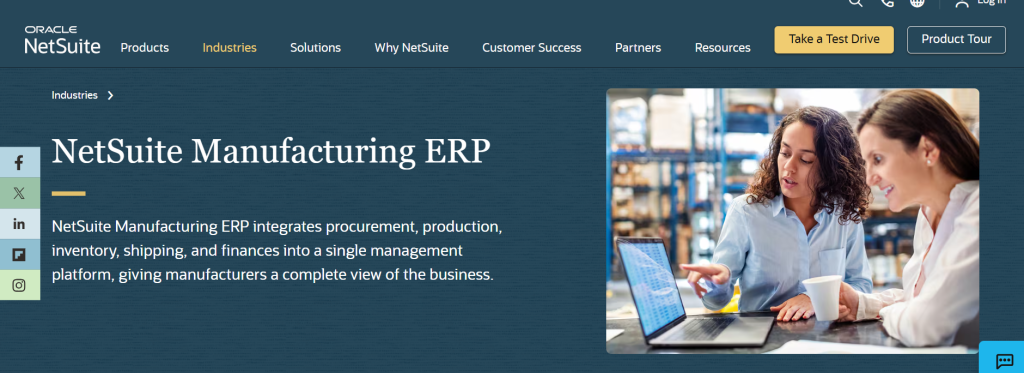
NetSuite is a comprehensive cloud business management platform that connects manufacturing with the financial and operational processes supporting it. Manufacturers manage production activities alongside purchasing, inventory, order management, customer records, accounting, and reporting within one ERP environment.
Its manufacturing functionality supports both discrete and batch production. NetSuite Advanced Manufacturing expands production execution for process manufacturers that need detailed material tracking, work instructions, capacity planning, and batch-level visibility.
Batch Production and Manufacturing Execution
NetSuite manages manufacturing through work orders, assembly items, advanced BOMs, WIP, and manufacturing routings.
The Advanced BOM functionality supports multiple BOMs for an item, location-specific structures, effective-dated revisions, and component yield calculations.
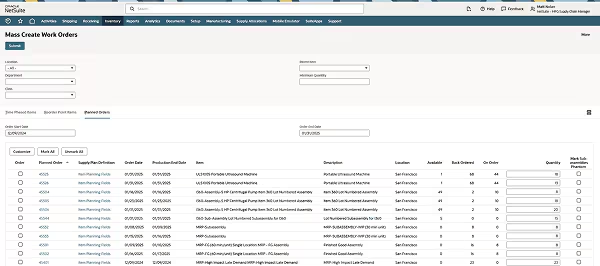
Manufacturers use these capabilities to maintain approved material requirements and account for production differences when planning component consumption.
The NetSuite Advanced Manufacturing functionality extends the process with:
- Batch-specific work orders and travelers containing material requirements and production instructions.
- Resource and equipment planning, including alternate production assets.
- Finite production scheduling and shop-floor execution.
- Material issuance for lot-controlled raw materials.
- Barcode-enabled production tracking and mobile data collection.
- Downtime, loss, labor, and production performance recording.
These capabilities allow operations teams to monitor what materials were issued, which production activities were completed, and how actual production compares with the planned requirements.
Lot Traceability and Quality Management
NetSuite’s native lot-numbered inventory tracks materials through inventory transactions, while manufacturing records connect component consumption with production activity.
Advanced Manufacturing adds batch travelers and batch lot identification to support traceability during production.
The NetSuite Quality Management SuiteApp supports receiving and in-process inspections, defined test parameters, result collection, and workflows for handling nonconforming materials.
Manufacturers configure quality checks and inventory controls according to their operating requirements, including whether failed materials should be moved to a hold location.
This is especially relevant to food manufacturers tracking ingredient lots and expiration dates, or pharmaceutical businesses that require controlled inspection and batch records.
Formula Management and Manufacturing Costing
NetSuite Advanced Manufacturing supports recipe/formulation work instructions, material requirements, batch execution, and related shop-floor processes.
Advanced BOM and Assembly functionality manages component quantities and revisions, while work orders and WIP records capture production activity for costing.
For requirements involving potency-based reformulation, complex co-product cost allocation, specialized catch-weight transactions, or regulatory batch records, the implementation team should establish the required functionality and confirm the necessary modules or extensions.
NetSuite’s strength is that manufacturing costs flow into the wider financial management environment. Finance teams analyze material costs, WIP, production variances, inventory values, and product profitability without maintaining a separate manufacturing ledger.
Industry Applications and Business Management
NetSuite supports manufacturers that operate across production, distribution, ecommerce, and multiple subsidiaries.
Its OneWorld functionality provides multi-entity financial management, while NetSuite’s procurement, inventory, and order management capabilities connect production to purchasing and fulfillment.
Folio3’s NetSuite process manufacturing implementation services address recipe and BOM management, batch production, quality management, and lot traceability for food, chemical, pharmaceutical, cosmetic, and other formulated-product manufacturers.
For food and beverage businesses, Folio3 configures processes including forward and backward lot traceability, quality holds, recipe revisions, expiry-based inventory handling, and production yield reporting.
When to choose NetSuite: Choose NetSuite when your manufacturing business needs batch-level production control within a platform that also manages purchasing, warehouse operations, sales, financial reporting, and multi-entity requirements.
2. Infor CloudSuite
Best suited for: Food and beverage manufacturers, including dairy, meat processing, ingredients, and beverage production businesses with extensive process requirements.

Infor provides industry-specific CloudSuite solutions built around manufacturing processes rather than relying on one general configuration for every industry.
Infor CloudSuite Food & Beverage combines production planning, inventory, quality, traceability, and supply chain management with industry-focused capabilities.
For beverage producers, formulation management includes ingredient specifications, nutritional properties, allergens, and related product information. Dairy manufacturers benefit from capabilities addressing shelf life, variable raw materials, and yield management.
Infor’s product lifecycle management functionality also supports formulation changes and product development activities.
Production and supply chain teams use connected information to coordinate material availability, manufacturing requirements, and finished-product distribution.
Quality and traceability capabilities help manufacturers document ingredient origins, production activity, and relevant product information when investigating quality issues or preparing for recalls.
Infor also provides manufacturing analytics for identifying yield losses and changes in production performance.
When to choose Infor: Infor is relevant when your manufacturing operations require extensive industry-specific functionality, particularly in food processing, beverages, and other sectors where ingredient characteristics and production variability influence daily operations.
3. SAP S/4HANA
Best suited for: Large process manufacturers managing complex production requirements across multiple facilities, legal entities, and international operations.
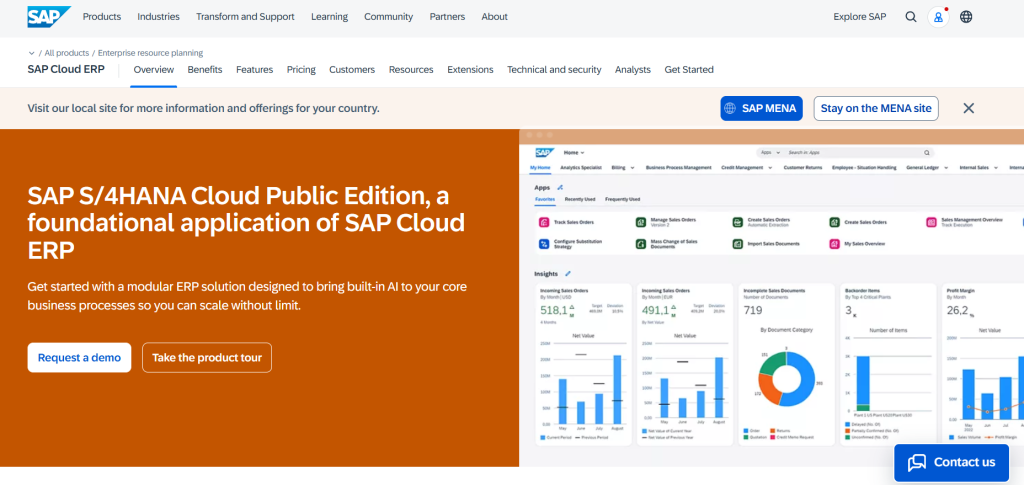
SAP S/4HANA supports process manufacturing through master recipes, process orders, batch management, and integrated production planning.
Master recipes define the sequence of operations and phases required to manufacture a product. These are connected with material requirements, production resources, and the relevant production version.
For chemical manufacturers, this allows production teams to manage activities such as mixing, reaction, filling, and packaging within a defined process.
Process orders record material consumption, production confirmations, actual yields, and completed output.
SAP also supports co-product production and the allocation of relevant manufacturing costs across outputs using configured costing structures.
Batch management tracks raw materials, intermediate products, and finished goods throughout the production process. Batch characteristics help manufacturers distinguish material properties, while quality processes support investigation and controlled disposition.
These capabilities are relevant where ingredient properties and batch characteristics influence which materials are suitable for a production run.
SAP’s financial and management accounting functionality also connects manufacturing costs with enterprise reporting.
When to choose SAP S/4HANA: SAP is suited to organizations with complex global process operations requiring detailed production execution, sophisticated material management, and extensive enterprise control.
4. Microsoft Dynamics 365 Supply Chain Management
Best suited for: Mid-market and enterprise manufacturers requiring dedicated formula-based production alongside financial and supply chain processes.

Microsoft Dynamics 365 Supply Chain Management includes process manufacturing functionality built around formulas, formula versions, and batch orders.
Unlike a conventional assembly BOM, a production formula defines ingredients and quantities associated with a particular process.
Formula lines support raw materials, intermediate products, catch-weight items, co-products, and by-products.
Manufacturers maintain formula versions according to effective dates and applicable production quantities. The system uses the approved formula and route information when generating a batch order.
Batch orders move through estimation, scheduling, release, execution, and completion. Production teams record material consumption and relevant outputs as the order progresses.
Dynamics 365 also supports batch balancing, which is useful when actual ingredient characteristics differ from the expected formulation.
Catch-weight handling addresses products measured using a variable secondary quantity, although compatibility with other warehouse and production functions must be checked.
This capability is particularly relevant to food, chemicals, and other process industries where recipe scaling and multiple production outputs are important.
When to choose Dynamics 365: Select Dynamics 365 when formula versions, batch balancing, catch-weight processing, and co-product management are central to the manufacturing process.
5. BatchMaster ERP
Best suited for: Food, beverage, chemical, pharmaceutical, cosmetic, and nutraceutical manufacturers whose production depends heavily on controlled formulations.
BatchMaster ERP focuses on formula-based manufacturing and the relationship between product development, batch execution, quality control, and compliance.
Its formula management functionality supports recipe revisions, ingredient substitutions, batch resizing, potency adjustments, and cost estimation.
Manufacturers also maintain packaging specifications separately from the product formulation. This is useful when the same bulk formula is packaged into different sizes or formats.
BatchMaster connects production orders with material requirements, inventory lots, and manufacturing instructions.
Quality management supports inspections at receiving, during production, and before shipment. Test results influence inventory status and the release or rejection of materials.
The platform also supports traceability and documentation such as certificates of analysis and applicable regulatory records.
When to choose BatchMaster: BatchMaster suits businesses where formula development, batch scaling, laboratory quality control, and regulated production processes are central requirements.
6. Aptean Process Manufacturing ERP
Best suited for: Formula-driven manufacturers in food, beverage, nutraceuticals, and other process industries.
Aptean offers several industry-specific ERP products. For this comparison, the relevant offering is Aptean Process Manufacturing ERP Ross Edition. It supports recipe and formula management, ingredient dependencies, batch sizing, potency calculations, and yield analysis.
These capabilities are important when raw-material characteristics affect the quantities required to achieve the desired finished-product specification.
Production teams manage formula-based manufacturing activities alongside inventory and costing.
Aptean also provides quality management and traceability from raw-material receipt through production and shipment.
Its Trace Express functionality supports forward and backward lot investigation, helping manufacturers identify which materials contributed to an affected finished product and where the resulting inventory moved.
When to choose Aptean: Aptean Ross is relevant for manufacturers with complex recipes, variable ingredient characteristics, and quality requirements that require a process-focused ERP.
7. Deacom ERP
Best suited for: Food, chemical, pharmaceutical, and other batch manufacturers seeking integrated formulation, production, quality, and compliance processes.
Deacom, part of ECI Software Solutions, is designed around batch and process manufacturing.
Its batch manufacturing capabilities support formula management, production scheduling, catch weight, quality checks, and lot-controlled inventory.
The platform uses batch tickets to provide production personnel with the materials, instructions, and activities required to complete a manufacturing run.
Quality checks are embedded into manufacturing operations so production teams work against the relevant specifications.
Deacom also connects lot controls with inventory movements and manufacturing execution. Warehouse scanning can prevent materials on quality hold from being issued into production.
The platform supports documentation such as certificates of analysis, safety data sheets, product labels, and other records used in regulated operations.
When to choose Deacom: Deacom is suitable when detailed batch production, formulation, quality enforcement, and compliance documentation are core requirements.
8. Datacor ERP
Best suited for: Chemical manufacturers producing coatings, adhesives, specialty chemicals, and other formulated products.
Datacor ERP focuses on process manufacturing requirements involving formulas, material characteristics, regulatory documentation, and production costs.
Its formula management supports version control and scalable batch sizes, while production scheduling coordinates equipment capacity and manufacturing requirements.
The platform also supports co-product production and detailed material usage records.
Lot genealogy links raw materials with work in progress and finished products. This information supports quality investigations, customer requests, and recalls.
Datacor’s quality functionality includes laboratory testing, lot-level results, and documentation such as certificates of analysis. Chemical manufacturers also benefit from functionality involving safety data sheets, hazardous material information, and relevant regulatory reporting.
Production costing captures material usage, labor, equipment, and overhead information to support yield and profitability analysis.
When to choose Datacor: Datacor is particularly relevant to chemical and formulated-product businesses requiring integrated production, formulation, laboratory quality, and regulatory controls.
9. Sage X3
Best suited for: Mid-market food, chemical, beverage, and mixed-mode manufacturers requiring process management alongside financial and distribution operations.
Sage X3 supports recipe management, batch production, inventory management, purchasing, manufacturing planning, and financial reporting.
Its process manufacturing functionality includes recipe scaling, version control, and the ability to manage production variations.
Manufacturers use batch and sub-batch identifiers to track materials during production and inventory movements.
Sage X3 also supports expiry dates, stock statuses, quality inspections, and upstream and downstream traceability.
These capabilities help manufacturers manage products that require shelf-life controls and recorded quality results.
Its broader business functionality connects manufacturing with procurement, sales, finance, and multi-site operations.
When to choose Sage X3: Sage X3 suits manufacturers seeking process manufacturing functionality combined with integrated financial management and supply chain operations.
10. SYSPRO
Best suited for: Small and mid-sized manufacturers combining production planning, assembly, lot-controlled inventory, and quality requirements.
SYSPRO provides manufacturing and distribution functionality covering BOMs, work orders, work in progress, inventory, purchasing, and financial management.
Its lot traceability functionality is particularly relevant to manufacturers that need to identify material origins and follow inventory through production.
The system supports tracing materials from suppliers through manufacturing, inspection, inventory storage, and final distribution.
It also provides lot expiry tracking, quality inspection information, and forward and backward traceability.
These capabilities support manufacturers dealing with regulated inventory or products requiring controlled material identification.
For operations heavily dependent on complex formula calculations, potency adjustments, or multiple co-products, the evaluation should establish how the selected SYSPRO configuration handles the complete process.
When to choose SYSPRO: SYSPRO is relevant to mixed-mode manufacturers requiring connected production, inventory, lot tracking, and financial management.
How Should You Compare Batch Manufacturing ERP Systems?
The most reliable comparison uses the same production scenario across every shortlisted ERP.
Feature lists are useful for establishing an initial shortlist, but they do not prove that a system handles a manufacturer’s actual production process.
A food manufacturer producing a 5,000 kg batch provides a useful test case.
The process begins with ingredients received from several suppliers. Production uses an approved recipe revision and records the actual quantities consumed. The completed batch produces less than its theoretical yield and requires quality testing before release.
After shipment, a supplier identifies a possible quality problem with one ingredient lot.
The ERP should provide sufficient records to identify the affected manufacturing batches and the customers who received the finished product.
Test the Complete Batch Lifecycle
Use the following sequence during vendor demonstrations:
| Production stage | What the ERP should demonstrate |
|---|---|
| Raw material receipt | Record supplier lots, quantities, expiration dates, and inspection status |
| Formula selection | Select the correct approved recipe or BOM revision |
| Batch planning | Calculate material requirements and schedule the relevant equipment |
| Production execution | Record actual component lots, material consumption, labor, and output |
| Yield analysis | Compare expected production output with actual completed quantity |
| Quality control | Record inspection results and prevent restricted lots from being released |
| Finished-goods inventory | Identify completed lots, quantities, locations, and inventory status |
| Customer fulfillment | Record which finished lots were shipped against customer orders |
| Recall investigation | Trace an affected ingredient lot forward to all relevant finished goods and shipments |
For NetSuite, this evaluation should include Advanced Manufacturing, lot-controlled inventory, WIP and Routings, and the configured quality management process.
The same scenario should be repeated for each competing system using the modules and functionality included in its proposed implementation.
Additional Requirements to Validate
Some manufacturers need capabilities that are not equally important in every process industry.
- Formula scaling and potency-based ingredient adjustments.
- Co-product and by-product production and cost allocation.
- Catch-weight inventory and transaction processing.
- FEFO inventory selection and expiration management.
- Electronic batch records and regulated approvals.
- Certificates of analysis and product quality documentation.
These requirements should be evaluated separately from general manufacturing functionality.
A system may support batch-level lot traceability while requiring additional configuration for advanced formula calculations or regulatory documentation.
Specialist Batch ERP vs. Integrated Business Management Platforms
The main ERP decision concerns how much of the manufacturer’s business the selected system needs to support.
Specialist systems such as BatchMaster, Deacom, and Datacor place substantial emphasis on formula development, production execution, laboratory testing, and industry-specific documentation.
These capabilities are important when formulation complexity and regulatory requirements define most of the manufacturing process.
Integrated ERP platforms such as NetSuite, SAP S/4HANA, and Microsoft Dynamics 365 support manufacturing alongside other enterprise functions.
The distinction is not that specialist systems lack accounting or purchasing functionality. Several offer integrated financial and operational modules.
The difference lies in the scope of the implementation and the capabilities the manufacturer prioritizes.
Why NetSuite’s Business Management Scope Matters
NetSuite connects manufacturing with the transactions that occur before and after production.
A purchase order records the acquisition of raw materials. Receiving updates inventory, while manufacturing records material consumption and completed output. The resulting finished goods become available for order fulfillment, and the related activity updates financial records.
This connected process gives finance and operations teams a consistent basis for investigating production costs and inventory valuation.
For manufacturers running multiple legal entities, NetSuite OneWorld also supports consolidated financial management.
The platform extends into CRM, order management, ecommerce, and other business activities without requiring a separate ERP for each department.
This makes NetSuite particularly relevant to manufacturers operating through several sales channels or managing production and distribution across multiple facilities.
How Folio3 Implements NetSuite for Batch and Process Manufacturing
Folio3’s NetSuite process manufacturing practice focuses on configuring NetSuite around the manufacturer’s actual production requirements.
Its implementation scope includes formula and BOM management, manufacturing execution, lot traceability, inventory, quality management, and financial reporting.
For food and beverage companies, this includes connecting ingredient purchasing with production requirements and finished-goods distribution.
Chemical manufacturers require additional attention to formulation and material characteristics, while pharmaceutical and nutraceutical businesses need controlled quality processes and detailed traceability.
The implementation begins by establishing how the business manages:
- Approved recipes, revisions, and production quantities.
- Material lots and actual ingredient consumption.
- Manufacturing work orders and operational instructions.
- Quality testing, inventory holds, and release.
- Production costs, yield differences, and financial reporting.
The resulting configuration should support the manufacturer’s production requirements while keeping purchasing, inventory, and accounting transactions connected.
Which Batch Manufacturing ERP Should You Choose?
NetSuite is a strong choice for manufacturers that need reliable batch execution and traceability alongside connected financial and operational management.
It supports manufacturing work orders, lot-controlled inventory, BOM revisions, WIP, production scheduling, batch travelers, and quality management through the relevant features and modules.
For manufacturers operating several locations or legal entities, its connected business management functionality adds significant value.
Other platforms address particular production requirements through different approaches.
- NetSuite fits businesses connecting batch production with financial management, procurement, inventory, distribution, and multi-entity operations.
- Infor CloudSuite addresses industry-specific manufacturing processes, particularly in food and beverage.
- SAP S/4HANA supports large enterprises with complex process orders and detailed manufacturing requirements.
- Microsoft Dynamics 365 provides formula-based production with batch balancing, catch weight, and co-product functionality.
- BatchMaster, Aptean, Deacom, and Datacor focus on specialized formulation and process manufacturing requirements.
- Sage X3 and SYSPRO provide manufacturing, inventory, traceability, and financial management for different operating models.
The final decision should be based on the complete production process and the systems needed to support the business.
An ERP demonstration should establish which activities are supported through the proposed modules and where additional implementation work is necessary.
Final Takeaway
Batch manufacturing ERP software should connect recipe and material requirements with production execution, lot traceability, quality control, and financial results.
NetSuite provides these manufacturing foundations while giving businesses a connected platform for procurement, inventory, order management, and financial reporting.
For manufacturers expanding production facilities, introducing new products, or managing multiple subsidiaries, this integrated approach reduces the need to maintain separate systems for manufacturing and enterprise management.
Businesses with advanced formulation or regulatory requirements should validate the specific capabilities required for their processes before selecting a platform.
FAQs
Does NetSuite Support Batch Manufacturing?
Yes. NetSuite supports batch manufacturing through work orders, lot-numbered inventory, manufacturing routings, WIP, and Advanced Manufacturing. Its batch capabilities include travelers, lot-controlled material issuance, production scheduling, and shop-floor data capture. Additional modules and configuration support quality management and specialized process requirements.
What Is the Difference Between Batch Manufacturing and Process Manufacturing?
Batch manufacturing produces defined quantities during individual production runs. Process manufacturing describes production that transforms materials through activities such as mixing, blending, heating, or chemical reactions. Process manufacturing includes both batch-based and continuous production.
Does NetSuite Support Recipe and Formula Management?
NetSuite supports BOM-based material definitions, revisions, component quantities, and recipe/formulation work instructions through its manufacturing functionality. Folio3 also implements recipe-oriented processes for food, chemical, pharmaceutical, and other process manufacturers. Advanced requirements such as potency adjustments and specialized formulation calculations should be mapped to the appropriate modules or extensions.
Can NetSuite Track Raw Material Lots Through Finished Goods?
NetSuite supports lot-numbered inventory and manufacturing transaction records that connect material consumption with production activity. Advanced Manufacturing adds batch-specific production tracking. Manufacturers should validate the complete forward and backward traceability process, including the movement of finished goods to customer shipments.
Which ERP Is Best for Food and Beverage Batch Manufacturing?
NetSuite, Infor CloudSuite Food & Beverage, BatchMaster, Aptean, Deacom, and Sage X3 all offer relevant capabilities for food manufacturers. NetSuite is particularly suitable when businesses need batch manufacturing integrated with purchasing, inventory, financial management, and multi-entity operations.
