
Key Takeaways
- Peppol is an international framework for exchanging structured electronic business documents between different systems.
- The standard Peppol network uses four corners. The UAE adds a fifth corner for tax-data reporting to the FTA.
- Access Points, Peppol IDs, SMP, SML, and AS4 work together to identify recipients and securely exchange documents.
- UAE businesses must use accredited service providers (ASPs) and the PINT AE specification for electronic invoices.
- ERP integration should account for invoice validation, delivery confirmations, tax reporting, and incoming supplier documents.
Your business already has an invoicing process. You generate invoices, send them to customers, record VAT, and follow up on payments. But what happens when your customer uses a different accounting system, or the government requires invoice information to be exchanged and reported in a specific electronic format?
That’s the problem the Peppol e-invoicing network addresses. It allows businesses using different ERP and accounting systems to exchange structured electronic documents through an interoperable network of service providers.
The UAE has adopted Peppol as the foundation of its mandatory e-invoicing system, with an additional reporting connection to the Federal Tax Authority (FTA). For businesses preparing for the 2027 mandate, understanding this network is essential to choosing a service provider, preparing invoice data, and integrating existing financial systems.
This guide explains how Peppol works, the difference between its four-corner and UAE five-corner models, the technical standards behind electronic invoice exchange, and what your business needs to get connected.
What Is the Peppol E-Invoicing Network?
The Peppol e-invoicing network is a standardized electronic document exchange system that connects businesses through certified service providers. It allows suppliers and buyers to send and receive structured invoices without using the same ERP, accounting software, or invoicing platform.
Peppol stands for Pan-European Public Procurement Online. Although it originated from European electronic procurement initiatives, it now supports international business document exchange across numerous jurisdictions.
The network is governed by OpenPeppol, an international nonprofit association responsible for maintaining the technical specifications, operating rules, and interoperability framework.
Here’s an example. Your company uses Oracle NetSuite, and a customer uses Microsoft Dynamics 365. Under a conventional invoicing process, you might email a PDF that the customer’s accounts payable team must review and enter into its system.
With Peppol, your service provider transfers the invoice in a standardized electronic format to the customer’s service provider. The receiving system obtains structured information that it can use for invoice processing.
You don’t need to change ERP systems to exchange invoices with customers using different software. You need a properly configured connection to a service provider and support for the required document standards.
Is Peppol a Software Platform or a Network?
Peppol is an interoperability framework and network, not an accounting application or a single government invoicing portal.
OpenPeppol develops and manages the Peppol Interoperability Framework in collaboration with Peppol Authorities and service providers worldwide. It oversees essential network components, including the Service Metadata Locator (SML) and Public Key Infrastructure (PKI). Formal agreements with Peppol Authorities and service providers establish common operating rules, security standards, and responsibilities to maintain a trusted electronic document exchange network.
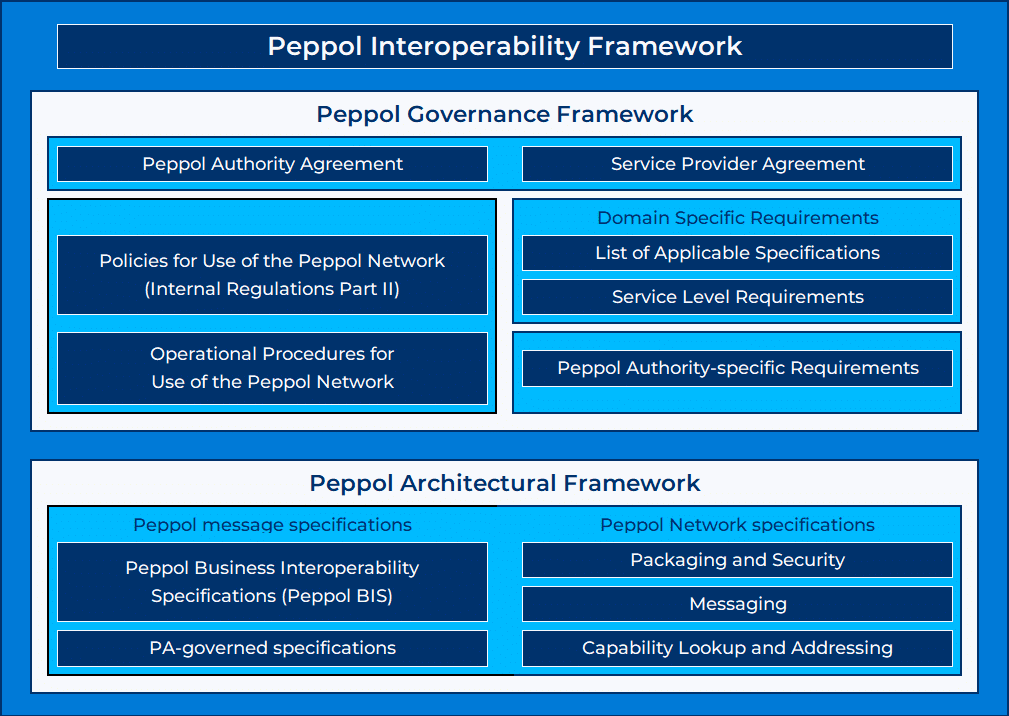
Your ERP remains responsible for creating and recording business transactions. Peppol provides the standards and network infrastructure through which service providers exchange electronic documents.
For example, NetSuite records the customer invoice, but the connected e-invoicing service handles the prescribed document exchange. The customer then receives the electronic invoice through its own provider.
How Does the Peppol E-Invoicing Network Work?
Peppol works by connecting businesses through certified Access Points. Each business exchanges electronic documents through its service provider, which identifies the recipient, validates the message, and sends it securely to the recipient’s provider. The standard network follows a four-corner model.
Understanding the Peppol Four-Corner Model
| Corner | Participant | Function |
|---|---|---|
| Corner 1 | Supplier | Creates an invoice using its accounting or ERP system |
| Corner 2 | Supplier’s Access Point | Validates and transmits the electronic document |
| Corner 3 | Buyer’s Access Point | Receives the electronic invoice through the Peppol network |
| Corner 4 | Buyer | Receives the document for accounts payable processing |
The supplier and buyer don’t need to subscribe to the same service provider. Their Access Points communicate through Peppol’s standardized network infrastructure.
Suppose your NetSuite account generates an invoice for a customer using another accounting platform. Your Access Point verifies the customer’s electronic address and supported document format before transmitting the invoice to the customer’s Access Point.
The receiving provider then delivers the document to the customer’s system in the agreed format.
This approach removes the need for every supplier to build a separate integration with every customer’s accounting software. You connect to a provider that communicates with other participating providers.
What Is the 5-Corner Model for E-Invoicing in UAE?
The 5-corner model for e-invoicing in the UAE extends Peppol’s standard four-corner exchange by adding the Federal Tax Authority as Corner 5. This additional connection allows prescribed invoice tax data to be reported to the government alongside electronic document exchange between businesses.
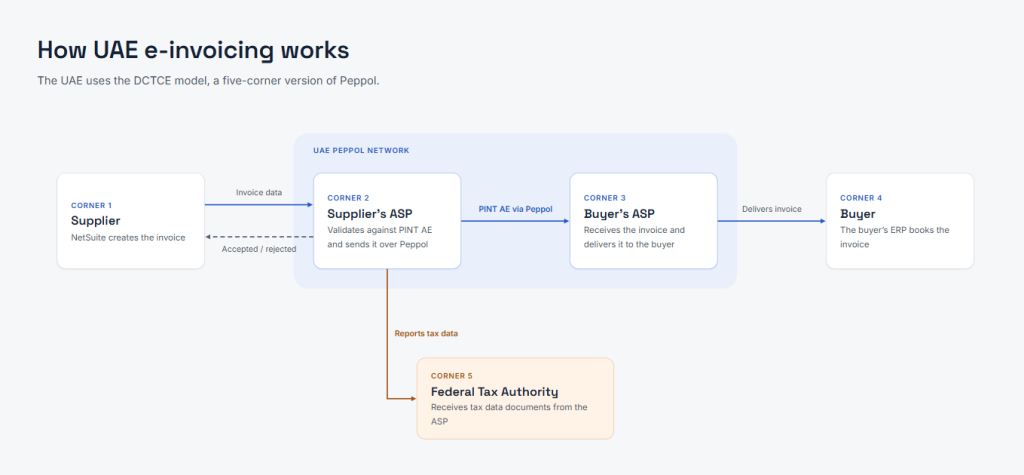
The UAE calls this approach the Decentralized Continuous Transaction Control and Exchange (DCTCE) model.
The five participants are:
| Corner | Participant | Responsibility |
|---|---|---|
| Corner 1 | Supplier | Creates invoice information and sends it to its ASP |
| Corner 2 | Supplier’s Accredited Service Provider | Validates and transmits the invoice and reports tax data |
| Corner 3 | Buyer’s Accredited Service Provider | Receives, validates, and delivers the invoice and performs the required reporting |
| Corner 4 | Buyer | Receives and processes the electronic invoice |
| Corner 5 | Federal Tax Authority | Receives prescribed tax data and issues reporting confirmations |
How an Invoice Moves Through the UAE Five-Corner Model
Let’s say your company supplies AED 40,000 worth of equipment to another UAE business, excluding VAT. You generate an invoice for AED 42,000, including AED 2,000 in applicable VAT.
Once the invoice is ready for electronic exchange, the process follows these stages:
- Invoice creation: Your ERP creates the transaction and submits the required information to your accredited service provider.
- Validation and conversion: Your ASP checks the data and prepares the structured PINT AE XML invoice.
- Recipient identification: Your ASP identifies the buyer’s registered electronic endpoint and receiving provider.
- Electronic exchange: The supplier’s ASP transmits the invoice to the buyer’s ASP, which validates it and provides the relevant technical response.
- Tax-data reporting: The supplier’s ASP reports the prescribed Tax Data Document (TDD) to Corner 5. Following successful invoice validation, the buyer’s ASP also performs its required tax-data reporting.
- Document delivery and confirmations: The buyer receives the invoice, and the relevant exchange and reporting confirmations are communicated to the supplier through its ASP.
The FTA receives prescribed tax information; it is not the central delivery service for the full commercial invoice.
How Does the 4-Corner Model Differ From the UAE 5-Corner Model?
The main difference between the Peppol 4-corner model and the UAE 5-corner model is tax reporting to the government. The standard Peppol model connects suppliers and buyers through their respective Access Points to exchange electronic invoices. The UAE adds the Federal Tax Authority (FTA) as a fifth corner, which requires accredited service providers (ASPs) to report prescribed invoice tax data alongside the electronic exchange process.
| Feature | Standard Peppol 4-corner model | UAE 5-corner model |
|---|---|---|
| Primary purpose | Electronic business document exchange | Electronic invoice exchange and FTA tax reporting |
| Participants | Supplier, supplier Access Point, buyer Access Point, buyer | Same four participants, with the FTA as Corner 5 |
| Government reporting | Depends on the jurisdiction’s requirements | Integrated into the UAE’s DCTCE framework |
| Document requirements | Applicable Peppol specifications | UAE-specific PINT AE specifications |
| Provider requirements | Peppol-certified service providers | UAE Ministry of Finance-accredited ASPs |
For your business, this means tracking two separate outcomes. First, whether the buyer received the electronic invoice. Second, whether the required tax data was successfully reported to the FTA. An invoice delivered to the buyer does not automatically confirm that tax reporting is complete.
What Technologies Make the Peppol Network Work?
Peppol uses several interconnected technical components to identify businesses, discover their receiving systems, validate documents, and transmit messages securely. You don’t need to operate this infrastructure yourself, but understanding its purpose helps when evaluating a service provider or planning an ERP integration.
Peppol Access Points
An Access Point is the certified service that connects a business to the Peppol network.
Think of it as the secure delivery connection between your financial system and your trading partners’ systems. Your Access Point handles the network exchange, while the recipient’s Access Point receives the document.
In the UAE, a provider must meet the Ministry of Finance’s accreditation requirements to deliver regulated e-invoicing services. General Peppol certification alone does not establish UAE ASP accreditation.
Peppol Participant ID
A Peppol Participant ID identifies a business on the network so electronic documents reach the correct recipient.
For UAE businesses, the identifier uses the scheme 0235 with the business’s 10-digit Tax Identification Number (TIN).
A company operating multiple legal entities needs to identify the appropriate participating entity. This is especially important when your ERP manages several subsidiaries with different tax registrations.
SMP and SML
Two services help Peppol determine where to deliver an electronic document:
- Service Metadata Locator (SML): Identifies where the receiving business’s service metadata is published.
- Service Metadata Publisher (SMP): Provides the supported document types, business processes, and receiving endpoint details.
Consider what happens when you send an email. The sending system needs to identify the destination server before delivering the message. Peppol’s discovery services perform a comparable task for electronic business documents.
If the recipient does not support the required document type, the sending provider needs to identify that limitation before attempting exchange.
AS4 and PKI Security
Peppol uses the AS4 messaging protocol for secure document transmission between Access Points. Public Key Infrastructure (PKI) certificates help establish trust between participating service providers and protect message security and integrity.
This means your ERP does not need to establish a separate secure messaging relationship with every customer or supplier. The network’s certified service providers handle the applicable communication requirements.
What Is PINT AE, and How Does It Relate to Peppol?
PINT AE is the UAE-specific implementation of the Peppol International invoice specification. It defines the electronic invoice information and validation rules required for covered UAE transactions.
Peppol establishes the exchange framework. PINT AE defines the structure and business rules that the UAE invoice must satisfy.
The standards work together as follows:
| Standard or component | Purpose |
|---|---|
| Peppol | Defines the interoperable document exchange framework |
| PINT | Provides an international model for invoice specifications |
| PINT AE | Applies UAE-specific invoice requirements and validation rules |
| UBL 2.1 XML | Provides the structured document representation |
| AS4 | Handles secure messaging between network participants |
| TDD | Contains the prescribed tax information reported to the FTA |
| MLS | Communicates technical processing and reporting statuses |
What Happens When an Invoice Fails PINT AE Validation?
An electronic document could have valid XML syntax but still contain incorrect business information. Missing buyer identifiers, inconsistent VAT totals, unsupported classifications, or incorrect mandatory fields could cause validation to fail.
For example, your ERP might generate a customer invoice with the correct accounting amount but an incomplete electronic buyer address. The invoice is valid as an internal accounting record, yet the electronic exchange process cannot route it correctly.
Your integration needs to return the error to the appropriate transaction, allow the underlying information to be corrected, and support controlled resubmission.
This is why translating an invoice into XML is only one part of e-invoicing implementation.
Does Peppol Confirm That an Invoice Has Been Delivered and Reported?
Peppol and the UAE e-invoicing process provide technical responses that help businesses track document processing. But an invoice accepted by a service provider has not necessarily reached the buyer or completed FTA reporting.
For example, your integration might submit a document to an ASP and receive confirmation that the request was accepted. That confirms an initial processing stage, not the complete invoice lifecycle.
In the UAE model, Message Level Status (MLS) responses communicate relevant exchange and tax-reporting outcomes between participants.
Your finance team should distinguish three situations:
- Validation failure: The document contains data or classification errors that need correction.
- Exchange failure: The document has not completed the required delivery process.
- Reporting issue: The prescribed tax-data reporting has not completed successfully.
There is also a commercial difference worth understanding. A buyer might dispute an invoice because the goods were damaged or the amount is incorrect, even though the electronic document passed technical validation. That dispute follows the parties’ normal business process; a correction requiring an electronic credit note must follow the applicable rules.
How Does Peppol Support Cross-Border E-Invoicing?
Peppol supports electronic document exchange between participating organizations in different countries. However, international interoperability does not mean every country uses identical invoice specifications or tax-reporting rules.
A business operating in the UAE and Europe, for example, must apply the requirements of the jurisdiction responsible for each transaction. The same Peppol network infrastructure supports document exchange, but the relevant invoice format and regulatory obligations still need to be satisfied.
There is also a practical exception for UAE exports.
If your overseas customer is already registered on Peppol, your ASP uses the customer’s electronic endpoint to exchange the invoice. If the customer is not registered, the UAE’s prescribed fallback identification process applies. The supplier’s ASP still performs the required FTA reporting, but the invoice must be delivered to the overseas customer through an appropriate method outside the Peppol network.
This is an important consideration for UAE exporters that invoice customers using different countries’ financial systems.
What Does Your Business Need to Connect to Peppol?
To participate in UAE Peppol e-invoicing, your business needs an accredited service provider, the appropriate participant identification, compliant invoice data, and an operational connection between its ERP or accounting system and the provider.
The steps are straightforward to describe, but each requires proper configuration and testing.
1. Choose an Accredited Service Provider
Start with the Ministry of Finance’s official ASP register to identify approved providers. Compare their ERP integration capabilities, supported invoice types, validation processes, pricing, and ability to handle both outgoing customer invoices and incoming supplier invoices. Under the UAE framework, each business entity must use the same appointed ASP for sending and receiving electronic invoices.
If you’re already using NetSuite, you don’t need to change your ERP or switch from an ASP you’ve already selected. Folio3’s NetSuite UAE e-invoicing services help connect your existing financial processes with your chosen accredited provider, including the field mapping, integration configuration, and testing required for electronic invoice exchange.
For a comparison of available providers and their NetSuite connectivity, see our guide to Top E-Invoicing Solutions for NetSuite in 2027.
2. Complete Onboarding and Participant Identification
Your business must follow the prescribed ASP onboarding process through EmaraTax and obtain or establish the required electronic identification.
EmaraTax is used for administrative onboarding. Your ASP handles the applicable Peppol network registration and connectivity activities as part of the onboarding arrangement.
3. Prepare Your Invoice Data
Your accounting system needs to supply the fields required by PINT AE, including buyer and seller identifiers, transaction classifications, VAT information, document totals, and invoice-line details.
For instance, a business that has implemented NetSuite OneWorld needs to ensure that the electronic invoice uses the correct issuing subsidiary. A company generating invoices in foreign currencies must also prepare the required currency and tax information.
4. Connect and Test Your ERP
Your implementation route depends on your ERP and selected service provider. Businesses use supported SuiteApps, APIs, or middleware to exchange transaction information with their ASP.
Folio3’s NetSuite UAE e-invoicing services support the connection between NetSuite and the customer’s chosen accredited ASP, including PINT AE data mapping, inbound and outbound invoice processing, testing, and exception management.
If your business already has an ASP agreement, the integration should be planned around that provider’s technical interfaces and your existing financial processes.
Testing should include successful invoices, rejected documents, credit notes, receiving supplier invoices, and reporting confirmations. Otherwise, your business risks discovering integration gaps when actual invoices begin moving through the network.
What Are the Benefits and Limitations of Peppol E-Invoicing?
Peppol reduces the need for separate document exchange connections between every trading partner and provides standardized, secure communication between business systems. Its value becomes clearer when businesses automate both sending and receiving invoices.
| Benefit | Business outcome |
|---|---|
| Interoperability | Exchange electronic documents with businesses using different ERP systems |
| Structured information | Reduce manual re-entry of invoice details |
| Electronic validation | Identify technical and business-rule errors during processing |
| Secure communication | Exchange documents through a trusted provider network |
| International connectivity | Support document exchange across participating jurisdictions |
| AP and AR integration | Connect electronic invoices with existing financial processing |
Peppol doesn’t automatically guarantee correct invoice data, payment approval, or compliance with every country’s tax legislation.
If your customer records contain incorrect identifiers or your tax mappings are inconsistent, electronic validation will expose those problems rather than fix the source records. Similarly, receiving a supplier invoice electronically does not replace purchase-order matching, invoice approvals, or commercial dispute resolution.
Your implementation needs to address the underlying finance processes, rather than just establishing a network connection.
Peppol E-Invoicing and the UAE’s 2027 Requirements
UAE Peppol e-invoicing becomes mandatory in phases during 2027. Businesses with annual revenue of AED 50 million or more must implement the system from January 1, 2027. Businesses below that threshold follow on July 1, 2027, and covered government entities on October 1, 2027.
The scope includes applicable B2B and B2G transactions, with specific exclusions. The October 2026 amendments also introduce temporary relief for transactions between members of the same VAT Tax Group and remove the previous requirement to store electronic invoice data physically inside the UAE.
For a detailed explanation of eligibility, transaction exclusions, penalties, and compliance dates, our guide What Is E-Invoicing in UAE? A Comprehensive Guide for B2B Businesses covers the current regulations.
Preparing Your Business for Peppol
Peppol provides the technical foundation for electronic document exchange, while the UAE’s five-corner model introduces the country’s mandatory tax-reporting requirements.
Your immediate priorities are to understand which invoices fall within scope, verify the accuracy of the financial information in your ERP, appoint an accredited service provider, and test the entire exchange and reporting process.
Getting connected to Peppol is an important milestone. Making sure your invoices move accurately from creation through validation, delivery, reporting, and financial reconciliation is what turns that connection into a reliable business process.
FAQs
Is Peppol mandatory for all businesses in UAE?
Peppol-based electronic invoicing is mandatory for businesses and transactions covered by the UAE’s phased 2027 requirements. The obligation includes relevant B2B and B2G transactions regardless of VAT registration, subject to the applicable exclusions.
Is Peppol the same as the UAE Federal Tax Authority?
No. Peppol provides the interoperable document exchange framework. The FTA is the UAE tax authority and acts as Corner 5 in the national e-invoicing model, receiving prescribed tax information through accredited service providers.
Do both businesses need the same Peppol access point?
No. Suppliers and buyers use their respective service providers, which communicate through Peppol. In the UAE, each business entity must use its appointed accredited ASP for both sending and receiving electronic invoices.
What is the difference between Peppol BIS and PINT AE?
Peppol BIS defines standardized business document specifications used across Peppol. PINT provides an international invoice model, and PINT AE applies the UAE-specific electronic invoice requirements and validation rules. For covered UAE transactions, the applicable PINT AE specification governs the exchanged invoice.
Does Peppol automatically integrate with NetSuite?
No. NetSuite requires supported electronic invoicing functionality and an appropriately configured connection to the relevant provider. The setup must address transaction data, buyer identifiers, PINT AE mapping, processing statuses, and inbound document handling.
