
Key Takeaways
- Your consultant should understand NetSuite records, SuiteTalk APIs, permissions, transaction dependencies, and MuleSoft development.
- Business processes should drive integration design. Customer orders, inventory updates, and financial transactions each require appropriate mappings, validation, and error handling.
- MuleSoft can help you reuse integration components across applications, but there should be a purpose for that, and the design should reflect your actual requirements.
- Security, testing, monitoring, duplicate prevention, and recovery procedures should be part of the original project scope to map production readiness.
- Your consultant should help you evaluate requirements, resolve ERP-specific issues, document the solution, and plan ongoing support.
When you connect NetSuite to your CRM, ecommerce platform, warehouse management system, or other business applications, you need more than someone who can configure an API. Your integration must align with how your business operates, how NetSuite processes transactions, and how the system handles missing, delayed, or rejected information.
MuleSoft provides tools for API development, data transformation, application connectivity, and integration management. But the success of your NetSuite integration depends on how well your consultant applies those capabilities to your ERP environment.
The right consultant should understand both platforms, map your business processes before development begins, and build integrations your team can maintain after launch. Here is what to look for when evaluating a MuleSoft NetSuite integration consultant.
1. Find a Consultant Who Understands Both NetSuite and MuleSoft
MuleSoft expertise alone does not guarantee that someone can deliver a reliable NetSuite integration. Your consultant also needs to understand how NetSuite stores information, validates transactions, applies permissions, and connects records across business processes.
Consider your ecommerce operation. When a customer places an order, your integration might need to identify the customer, validate item references, apply the correct subsidiary and location, and create a sales order with the appropriate shipping, tax, and payment details. If an item is inactive or a required field is missing, NetSuite may reject the transaction. Your consultant needs to anticipate these scenarios and decide how the integration should respond.
Look for hands-on experience with MuleSoft Anypoint Platform, DataWeave, API development, and NetSuite’s SuiteTalk APIs. Your consultant should also understand custom fields, custom records, roles and permissions, subsidiaries, and the SuiteScript logic that might affect transactions.
Ask about previous projects involving similar systems and business processes. Rather than accepting a list of certifications, ask the consultant to explain how they handled a failed transaction, resolved a data-mapping problem, or prevented duplicate records in a live integration.
The distinction matters because your integration needs to work with the NetSuite account you actually operate, including its customizations and business rules, rather than an assumed standard configuration.
2. Evaluate How They Approach API Design
When you hire a MuleSoft NetSuite integration consultant, you should expect them to explain how your applications will communicate before recommending a specific integration design.
MuleSoft’s API-led connectivity approach separates integration responsibilities into system APIs, process APIs, and experience APIs. System APIs expose application data and functionality, process APIs coordinate business workflows, and experience APIs shape information for particular applications or users when needed.
Suppose your business uses NetSuite for finance and inventory, Salesforce for customer relationships, and a warehouse management system for fulfillment. If every application requires its own custom connection to NetSuite, you could end up maintaining duplicated mappings, authentication settings, and error-handling logic.
Your consultant might propose a reusable NetSuite system API for customer, order, and inventory data, with process APIs coordinating the workflows between applications. This could make future integrations easier to extend because new workflows can reuse existing components.
But you should not pay for unnecessary complexity. A business connecting two applications through a small number of straightforward data flows might not need every API layer. Your consultant should explain which components your requirements justify and which would add maintenance overhead without a clear benefit.
Ask how the proposed design will accommodate additional systems, changing business rules, and growing transaction volumes. The answer should connect the technical approach to your business plans rather than rely on API-led connectivity as a selling point by itself.
3. Check Their NetSuite Data Mapping and Transformation Skills
Your connected applications will rarely use identical data structures. Salesforce might identify a customer through an account record, while NetSuite represents the relationship through customer and contact records. Your warehouse platform may use its own item identifiers, fulfillment statuses, and location codes.
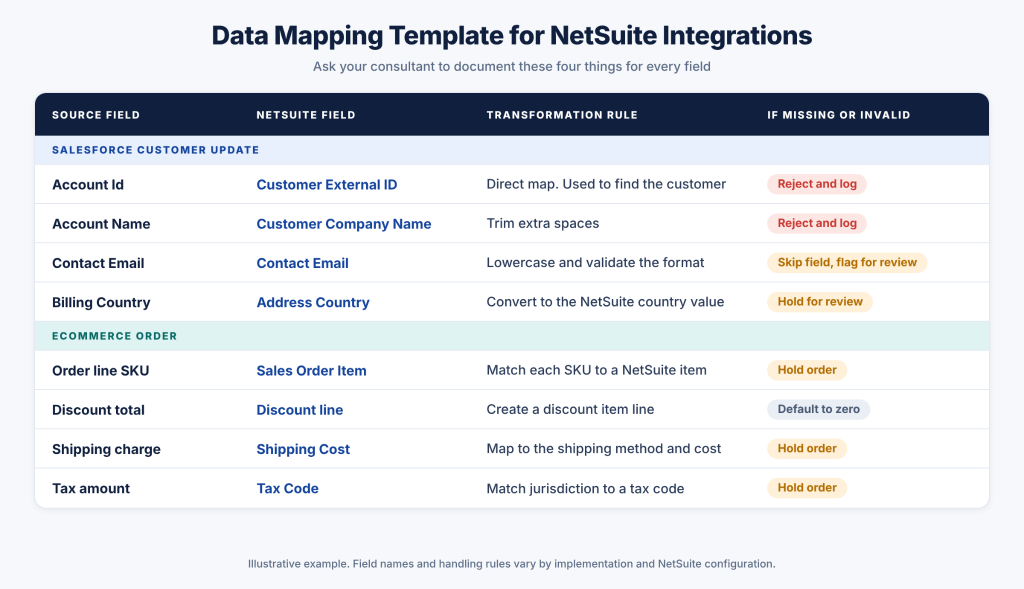
Your consultant needs to establish how these records correspond and what should happen when the source data does not match NetSuite’s requirements.
MuleSoft uses DataWeave to transform data between formats and structures. A consultant should know how to map fields, reshape payloads, apply conditional logic, and handle differences between systems without introducing inconsistent records.
For example, if Salesforce sends a customer update to NetSuite, the integration needs to identify the correct customer record and determine which system controls each field. Without clear ownership rules, updates from one application could overwrite information maintained in the other.
The same issue arises when your ecommerce platform sends orders containing discounts, shipping charges, taxes, and multiple line items. Your consultant must map these values correctly and account for the NetSuite configuration that governs how transactions are created.
Ask for documentation showing the source field, destination field, transformation rule, and handling for missing or invalid values. Your internal team should be able to understand these decisions without reverse-engineering the integration whenever a requirement changes.
4. Look for a Clear Error-Handling and Recovery Strategy
Even a well-designed integration will encounter failures. NetSuite might reject a transaction because a required field is missing, an API request might exceed a usage limit, or a connected application might become temporarily unavailable.
Your consultant should distinguish between errors that warrant a retry and those that require corrective action. Retrying a temporary connection failure could resolve the issue, but repeatedly submitting a transaction with invalid data will not fix the underlying problem.
Duplicate prevention is another important consideration. For example, NetSuite might create a sales order successfully, but the response never reaches your ecommerce platform. If MuleSoft resends the request without checking whether the original order exists, your business could end up with duplicate sales orders.
Your consultant should explain how the integration identifies transactions, manages retries, records failed requests, and supports reconciliation. They should also show how your team will investigate failures and determine whether a transaction needs correction or resubmission.
Ask how errors will be surfaced to the people responsible for resolving them. A failure that remains hidden in a technical log can disrupt order fulfillment or financial reporting before anyone notices it.
5. Make Security and Access Control Part of the Scope
Your NetSuite integration may exchange customer information, financial records, supplier details, and inventory data. Your consultant should explain how the integration will protect that information and restrict access throughout the workflow.
Start by reviewing the authentication method supported by the selected NetSuite API and MuleSoft connector. Your consultant should configure credentials securely and assign the integration identity only the permissions required for its tasks.
For instance, an integration that creates sales orders and retrieves inventory availability should not automatically receive unrestricted access to financial records or unrelated employee information. Access should reflect the responsibilities of each integration.
You should also discuss credential rotation, encryption in transit, API security policies, and logging practices that prevent sensitive information from appearing in diagnostic records. If your organization has specific compliance requirements, make sure these are included in the design and testing process.
Ask who will review permissions before deployment, how credentials will be maintained, and how access changes will be handled when your applications or business processes change.
6. Assess Their Testing, Deployment, and Support Process
An integration that works with a handful of test records is not necessarily ready for production. Your consultant should test the actual business scenarios your team encounters, including incomplete records, invalid references, high transaction volumes, and temporary service interruptions.
For an order-to-cash workflow, testing might cover order creation, item and customer validation, fulfillment updates, and the associated financial transactions. The exact scope depends on which applications you connect and how your NetSuite account is configured.
Your consultant should also prepare a deployment plan that covers environment-specific settings, version control, approvals, rollback procedures, and validation after release. Documentation and knowledge transfer should be included so your team can understand the integration after the project ends.
When evaluating your own project, ask the consultant to define acceptance criteria before development begins. You should know how success will be measured, which scenarios must pass, and who will approve the integration for production use.
7. Look for Business Understanding
Your MuleSoft NetSuite integration consultant should understand why you need an integration and what your team expects it to improve. Connecting two applications is only part of the job; the real objective is to support a business process reliably.
Suppose your warehouse team frequently finds that available inventory differs between NetSuite and the warehouse management system. Before proposing a real-time integration, your consultant should investigate how inventory updates occur, which system owns each quantity, whether transactions are delayed, and how adjustments are recorded.
This is the kind of discussion that distinguishes requirements-led consulting from development that starts before the problem is understood.
Our NetSuite consulting services cover implementation, configuration, customization, integration, assessments, and ongoing support.
A consultant with deep NetSuite functional knowledge helps clarify transaction requirements and business rules, while your MuleSoft developers translate those requirements into APIs, mappings, and integration flows. Your project needs these skills to work together.
8. Watch for Warning Signs Before You Sign
During your evaluation, pay attention to how prospective consultants answer practical questions about your project.
A consultant who discusses MuleSoft features but cannot explain how NetSuite transactions, permissions, and record dependencies affect the integration may overlook important ERP requirements.
Similarly, a proposal that describes successful data transfers without addressing failed transactions, duplicate prevention, and reconciliation leaves operational risks unresolved.
You should also question a design that introduces unnecessary API layers without explaining their value, or a proposal that excludes documentation, testing, and post-launch responsibilities. These omissions can increase maintenance costs and make your team dependent on the original developer.
Before signing, make sure the project scope identifies the applications and data flows involved, the expected deliverables, the testing and deployment process, and who will maintain the integration after launch. Ask for a clear explanation of any assumptions that could affect cost or delivery time.
9. Work With a Team That Understands Both MuleSoft and NetSuite
When your integration spans several applications, you need consultants who can account for both the technical requirements and the business processes those connections support.
Folio3 provides MuleSoft NetSuite integration services covering API-led development, custom connectors, DataWeave transformations, API governance, deployment, monitoring, and managed support. Its integration specialists work across NetSuite and other business applications to develop integrations around your data models and operational requirements.
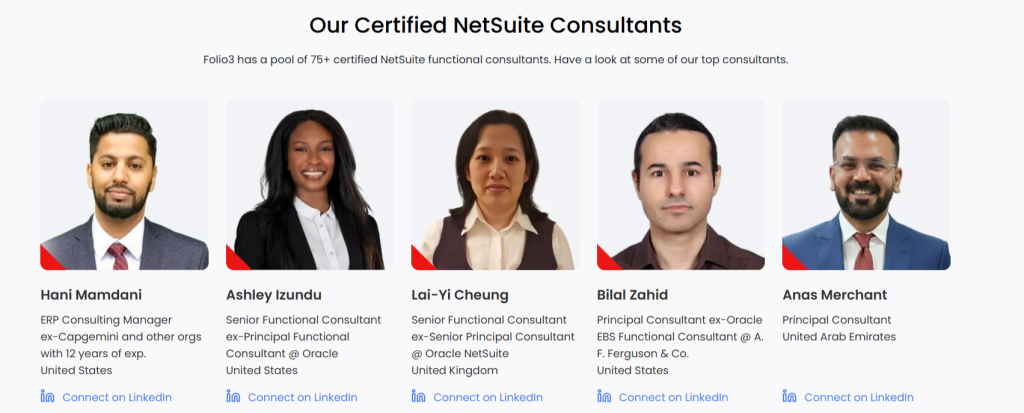
If you are planning a new integration or resolving problems with an existing one, you can contact Hani Mamdani, ERP Consulting Manager, or discuss your requirements with Folio3’s NetSuite and MuleSoft integration specialists.
Start with the applications you need to connect, the transactions you need to exchange, and the problems your current process creates. That gives your consulting team a concrete basis for recommending an integration design and defining the work required.
Frequently Asked Questions
What does a MuleSoft NetSuite integration consultant do?
A MuleSoft NetSuite integration consultant designs, develops, tests, and maintains integrations between NetSuite and other business applications. Responsibilities can include API development, data transformation, authentication, error handling, deployment, monitoring, and support.
What experience should a MuleSoft NetSuite consultant have?
Look for hands-on MuleSoft development experience, knowledge of DataWeave and API management, and a working understanding of NetSuite records, SuiteTalk APIs, permissions, and transaction dependencies. Experience with business processes similar to yours is also important.
Does every NetSuite integration require MuleSoft?
No. The appropriate solution depends on the applications you connect, the complexity of your business rules, and your integration requirements. Some ecommerce workflows can use a native connector, while integrations involving multiple applications, custom processing, or reusable APIs may justify MuleSoft or another integration platform.
What should a MuleSoft NetSuite integration project include?
Your project should cover requirements discovery, API design, data mapping, security, development, testing, deployment, documentation, and a defined support or handover plan. The exact scope depends on your systems and business processes.
