

Key Takeaways
- Boomi provides the integration layer, but success depends on a consultant who understands both integration architecture and NetSuite’s technical depth.
- Key skills to evaluate include hands-on Boomi experience, NetSuite knowledge, data mapping, system-of-record strategy, error handling, duplicate prevention, security, testing, monitoring, and post-go-live support.
- Early decisions about data ownership, mapping, error handling, and scalability affect reliability, maintenance, and future integration costs.
We’ve been part of 260+ NetSuite integration deployments, so trust us when we say that NetSuite never operates as a standalone business system. 100% of the time.
Yes, it serves as the central ERP for financials, order management, inventory, procurement, and other core processes. But the fact is that most organizations rely on a broader technology ecosystem around it.
A company might use Salesforce to manage customer relationships, Shopify or another ecommerce platform to process online orders, a warehouse management system to control fulfillment, or a 3PL to handle logistics.
Each of these systems has its own data structure, business rules, APIs, identifiers, and workflows. This is why connecting them to NetSuite is more complicated than simply moving data from one application to another.
NetSuite has its own data model, record relationships, authentication mechanisms, API considerations, customizations, subsidiaries, currencies, workflows, and governance requirements.
The systems being connected to it might represent the same business information in very different ways. For instance, a customer in CRM might not directly map to a NetSuite customer record.
Similarly, an order created in an ecommerce platform might require additional information, validation, transformation, or record creation before it can be processed correctly in NetSuite.
The integration also needs to decide which system owns each piece of data, when information should be synced, how changes should flow between systems, and what should happen when a transaction fails.
As the number of connected systems increases, managing these processes through isolated point-to-point connections becomes difficult.
This is where an integration platform like Boomi provides an important architectural layer. But the technology platform is only one part of the equation. Designing a reliable Boomi NetSuite connector requires an understanding of both the integration architecture and the business systems involved.
This is why choosing the right kind of Boomi consulting for NetSuite matters. But the question is what defines the “right” Boomi-NetSuite integration consulting. What should you look for when evaluating a Boomi-NetSuite integration consultant?
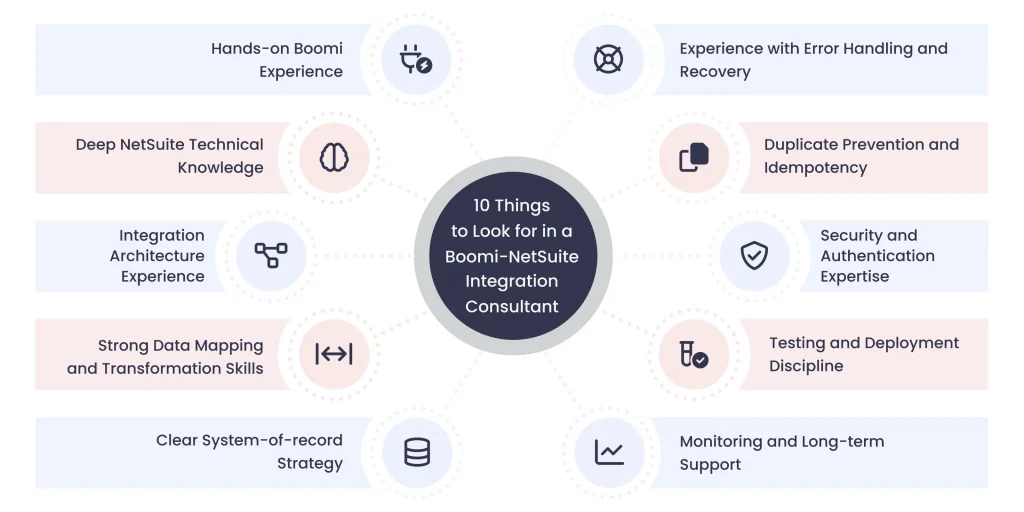
10 Things to Look for in a Boomi-NetSuite Integration Consultant
Choosing the right consultant to design and implement Boomi and NetSuite integration is highly important. The quality of the consultant matters because decisions made early, such as how data is mapped, which system owns each record, how errors are handled, and how the architecture will scale, affect the reliability, maintenance, and future integration costs.
Before selecting a consultant, here are 10 things you should look for in an evaluation to ensure Boomi and NetSuite integration success:
1. Hands-on Boomi Experience
The first and foremost thing you should look for is practical, hands-on experience with Boomi. Because nothing beats experience. A Boomi NetSuite integration consultant should understand how to design and develop Boomi processes.
Practical Boomi experience reflects expertise in Boomi application connectors, profiles, maps, data transformation, business rules, process properties, routing, scheduling, APIs, error handling, logging, deployment, environment management, and integration monitoring.
2. Deep NetSuite Technical Knowledge
Having deep domain knowledge of Boomi is only one side of the equation. So what about the other side? Well, the other side is about NetSuite expertise itself. The consultant should understand how NetSuite exposes and processes data.
Depending on the project, this might include SuiteTalk, REST Web Services, RESTlets, SuiteQL, saved searches, SuiteScript, customer records, custom fields, and NetSuite workflows.
They should also understand NetSuite’s data relationships. For instance, creating an order depends on an existing customer, item, location, subsidiary, currency, tax configuration, and other related records. The consultant needs to understand those dependencies when designing the integration.
3. Integration Architecture Experience
A consultant should be able to design the integration environment. This becomes increasingly important as the number of applications grows. An appropriate Boomi and NetSuite integration architecture should define the following:
- Which systems communicate with one another
- Which systems own each type of data
- Where transformations happen
- How data moves between systems
- How frequently data is synced
- How failures are handled
You should also look for a consultant who understands when simplicity is preferable, because not every company needs a complex enterprise integration architecture.
In fact, the right design depends on the number of systems, transaction volumes, business criticality, data complexity, and expected future growth.
Ask the consultant to explain why they recommend a particular architecture rather than simply presenting a prebuilt approach.
4. Strong Data Mapping and Transformation Skills
NetSuite and Boomi data mapping is one of the core components of the integration. But it’s also a fact that integration mapping is never a simple one-on-one exercise done on a visual, drag-and-drop interface.
For instance, a CRM might have Customer ID, Company Name, Contact Information, Industry, Account Owner, Billing Address, and Shipping Address.
On the other hand, NetSuite might need additional information related to Subsidiary, Currency, Terms, Sales Representative, Customer Category, etc.
This is why the integration needs transformation logic. Qualified Boomi-NetSuite integration consultants are comfortable with field mapping, conditional mapping, lookups, data validation, default values, reference data mapping, identifier transformation, business rules, nested data structures, and error handling.
They should be able to identify when the source system does not contain enough information to create a valid NetSuite record.
5. Clear System-of-record Strategy
One of the most important questions to ask in an integration project is which system owns the data. The answer varies by data type. For instance, a 3PL system would be the system of record for the shipment status. But for financial transactions, the system of record would be NetSuite.
You should look for a Boomi-NetSuite integration consultant who can define the system of record, data ownership, direction of sync, create/update authority, sync frequency, and record lifecycle.
6. Experience with Error Handling and Recovery
Production integrations encounter failures due to an unavailable API, a missing required field, a non-existent customer, an inactive item, a timed-out request, or failed authentication.
You should look for a Boomi-NetSuite integration expert who is able to explain what happens when a transaction fails.
And not just that, but they should be able to create a defined process for detecting failures, recording errors, alerting the appropriate users, separating failed transactions, correcting the underlying issue, reprocessing transactions, preventing data loss, and avoiding duplicate records.
7. Duplicate Prevention and Idempotency
Duplicate transactions are particularly dangerous in ERP integrations. Consider an order flowing from Shopify to NetSuite. The request reaches NetSuite, but the response times out. Boomi might interpret the timeout as a failure and retry the transaction. This would lead to the creation of the same order twice.
This is why you should look for a Boomi-NetSuite integration expert who has a clear approach to duplicate prevention and idempotency. This involves external IDs, unique business identifiers, duplicate checks, transaction state tracking, retry logic, and message tracking.
8. Security and Authentication Expertise
Boomi and NetSuite integrations involve financial information, customer information, order data, inventory data, and other sensitive business information. This is why you should look for a consultant who understands security throughout the integration lifecycle.
Make sure that they understand authentication mechanisms, OAuth, token-based authentication, role-based permissions, credential management, least-privilege access, secure data transmission, environment-specific credentials, and logging and audit requirements.
9. Testing and Deployment Discipline
The Boomi and NetSuite integration testing should cover both normal and exceptional scenarios. You should look for Boomi-NetSuite integration consultants who follow a comprehensive testing process, including the following:
- Functional testing
- Data testing
- Negative testing
- Error testing
- Duplicate testing
- Performance testing
- Regression testing
The consultant you consider should also have a controlled approach to moving integrations from development through testing and into production.
10. Monitoring and Long-term Support
The integration is not finished when it goes live because NetSuite configurations change, applications upgrade, APIs evolve, business processes change, transaction volumes increase, and new systems add up.
This is why the integration environment needs to evolve with them. And a qualified, reliable Boomi-NetSuite integration expert should be able to provide or establish integration monitoring, error monitoring, performance monitoring, alerting, log analysis, incident response, troubleshooting, documentation, change management, optimization, and ongoing enhancements.
Questions to Ask Before Hiring a Boomi-NetSuite Integration Consultant
When evaluating potential partners, avoid broad questions such as “Do you have Boomi experience?” Ask questions that reveal how they actually approach integration projects.
About Boomi
- How many Boomi-NetSuite integrations have you delivered?
- Which NetSuite-Boomi connectors and integration patterns do you use?
- How do you structure reusable Boomi processes?
- How do you manage development, testing, and production environments?
- How do you handle failed transactions?
- How do you monitor production integrations?
About NetSuite
- How much NetSuite integration experience does your team have?
- Which NetSuite APIs do you use?
- How do you handle custom records and custom fields?
- How do you manage NetSuite internal IDs and external IDs?
- How do you handle OneWorld and subsidiary requirements?
- How do NetSuite governance limits affect your integration design?
About Delivery
- What does your discovery process look like?
- Who will design the architecture?
- Who will build the integration?
- What documentation will we receive?
- How do you approach testing?
- How do you manage production deployments?
- What happens after go-live?
Choosing the Right Boomi-NetSuite Integration Consultant
A successful Boomi-NetSuite integration is about more than getting two applications to communicate.
It requires decisions about data ownership, business processes, APIs, record relationships, transformations, authentication, error handling, duplicate prevention, scalability, monitoring, and long-term maintenance.
That makes the choice of integration consultant important.
When evaluating Boomi NetSuite integration consultants, look beyond certifications and connector experience. Evaluate their understanding of NetSuite, their ability to design integration architecture, their approach to data and system ownership, their handling of failure scenarios, and their experience supporting integrations after they go live.
And, most importantly, choose a partner that starts by understanding what your business needs the systems to accomplish.
Frequently Asked Questions
What does a Boomi NetSuite integration consultant do?
A Boomi NetSuite integration consultant helps design, develop, implement, and maintain integrations between NetSuite and other business applications using Boomi. Their responsibilities include integration architecture, data mapping, API integration, error handling, testing, deployment, monitoring, and ongoing optimization.
Why do you need a consultant for Boomi NetSuite integration?
A Boomi-NetSuite integration involves more than connecting two applications. A consultant can help determine how data should move between systems, which application should be the system of record, how NetSuite records should be mapped, how errors and duplicates should be handled, and how the integration should scale as business requirements change.
What should you look for in a Boomi NetSuite integration consultant?
You should look for a consultant with hands-on Boomi experience, strong NetSuite technical knowledge, integration architecture expertise, data mapping and transformation skills, and experience with error handling, security, testing, monitoring, and post-go-live support. Experience with integrations similar to your business requirements is also important.
Why should I choose Folio3’s Boomi-NetSuite integration consultants for integration?
Folio3 combines NetSuite expertise with integration capabilities to help organizations design, implement, and optimize integrations between NetSuite and their broader application ecosystem. Its services can cover integration architecture, Boomi-NetSuite development, API integrations, data mapping, error handling, monitoring, and ongoing support.
