Key Takeaways
- ACS and partner managed services are not competing products. ACS handles platform health and Oracle-level guidance. A partner covers your specific configuration, custom scripts, integrations, and industry workflows. Many businesses need both.
- ACS works best when you know what you want and can direct the engagement. It struggles when you need someone to tell you what your system should be doing, not just respond to what you ask.
- ACS consultants are often more junior, with a few years of experience, and may lack business or financial acumen. Partner-managed services tend to provide senior consultants with deeper cross-industry knowledge.
- The revolving door problem is real. With ACS, every new request may go to a different consultant who starts from scratch. A named partner consultant builds knowledge of your system over time.
- A hybrid model works for many businesses. ACS handles foundational platform support. A partner handles optimization, customization, and strategic guidance. The two are not mutually exclusive.
- Folio3’s SmartCare program covers the gaps ACS leaves. Named consultants, SLA-backed response times, SuiteScript development, release management, and system optimization under one fixed monthly fee.
Here is something most businesses do not realize until they are already mid-contract with ACS: Oracle’s support program and a partner’s managed services program are not doing the same job.
Most companies start with ACS because it feels like the natural extension of the Oracle relationship. Then, a few months in, they realize that what they actually needed was someone who could get into their specific configuration and do the work. Not just advise on it. And by then, they are locked into an annual contract.
The businesses that make the right call from the start go in with a clear picture of what each option actually covers, where each one stops, and whether those limits match what they need.
This blog is that picture. What ACS covers. What it does not. What a partner covers. What it does not. And a decision framework you can actually use.
What Is NetSuite ACS?
NetSuite Advanced Customer Support (ACS) is Oracle’s proactive support subscription. It goes beyond standard break-fix support to provide ongoing guidance, system monitoring, and optimization advisory from Oracle’s own team.
ACS has four tiers: Advise, Monitor, Optimize, and Architec. Each tier increases cost and the depth of Oracle involvement.
What ACS covers:
- Customer Success Manager (CSM): A dedicated contact for account coordination and engagement direction
- Proactive system monitoring: Performance alerts and platform health checks
- Release guidance: Advisory ahead of NetSuite’s biannual upgrades
- Configuration and script review: Feedback on existing setups, scripts, and integrations
- ACS Playbooks: Best practice frameworks across common business processes
- Specialized solution architects: Available at higher tiers for complex advisory needs
What ACS does not cover:
- Your specific custom scripts and workflow logic: ACS can review these, but will not modify them
- SuiteScript development: No code changes are included in any ACS tier
- Third-party integration troubleshooting: ACS addresses the NetSuite side only
- Industry-specific configuration: ACS operates as a generalist program across all NetSuite customers
- User training on your specific processes: General platform guidance only
- Fixed-fee pricing with committed scope: ACS is a subscription, not a development engagement
To understand what each tier actually provides in practice, our blog on NetSuite Premium Support vs ACS covers each level with practical detail.
What are Partner Managed Services?
A NetSuite partner managed services program takes ongoing responsibility for the administration, customization, optimization, and evolution of your NetSuite environment after go-live.
Where ACS provides platform-level guidance from Oracle’s own team, a partner covers your specific configuration, your custom code, and your industry workflows. A partner is not bound by Oracle’s product scope. They can build what you need, fix what Oracle cannot touch, and approach your system from a business outcome perspective rather than a platform compliance perspective.
What a partner-managed services engagement covers:
- Named dedicated consultant: One person who learns your configuration and stays on your account
- SuiteScript development: Build, troubleshoot, and modify custom scripts as your needs change
- Release management: Full sandbox testing before every NetSuite update goes live in production
- Integration monitoring and troubleshooting: Across all connected platforms, not just the NetSuite side
- Industry-specific configuration: Vertical knowledge built from working across clients in your industry
- User training tailored to your processes: Not generic platform walkthroughs, but your actual workflows
- System health reviews: Monthly documentation of what is working, what is not, and what to address
- Fixed-fee pricing with written scope and SLA: No surprises on cost, no ambiguity on what is included
What a partner does not replace:
- Oracle’s direct product support: Platform-level bugs and outages go back to Oracle
- ACS for complex Oracle-level engagement: Where Oracle’s internal team adds value, a partner does not replace that
For a detailed breakdown of what partner managed services covers across all eight service categories, our blog on what services top NetSuite MSPs offer covers every category with operational detail.
Direct Comparison: ACS vs. Partner Managed Services
| Factor | NetSuite ACS | Partner Managed Services |
|---|---|---|
| Provided by | Oracle (product vendor) | Third-party certified partner |
| Scope focus | Platform health and Oracle product guidance | Your specific configuration, code, and workflows |
| Consultant model | Rotating team; new requests often get new consultants | Named consultant; builds knowledge of your system |
| Consultant experience level | Often junior; may lack business or financial acumen | Typically senior; cross-industry experience |
| SuiteScript development | Not included | Included |
| Custom workflow support | Guidance only; no code changes | Hands-on development and modification |
| Release management | Advisory and playbooks | Sandbox testing, conflict resolution, pre-deployment fixes |
| Integration troubleshooting | NetSuite side only | End-to-end across all connected systems |
| Industry expertise | Generalist across all NetSuite customers | Vertical-specific where partner specializes |
| Pricing model | Annual subscription, tiered | Fixed-fee or retainer, partner-defined |
| Contract flexibility | Annual commitment, limited exit options | Varies; many partners offer month-to-month |
| Upsell pressure | Can push Oracle modules as solutions | Platform-agnostic; can recommend non-NetSuite tools |
| Best for | Platform stability, Oracle-level guidance, OneWorld complexity | Configuration, development, optimization, industry needs |
See how partner-managed services compares to ACS in practice: NetSuite Managed Services vs ACS: What to Expect
Where ACS Falls Short in Practice
ACS delivers well for a specific type of business: one with a stable NetSuite environment, internal NetSuite expertise, and a clear technical roadmap to direct the engagement against. Take away any one of those three, and the experience is often different from what the marketing materials suggest.
The revolving door problem. When you work with NetSuite ACS, you often work with a different consultant each time you open a new request. That consultant starts from scratch. They do not know your configuration, your workarounds, or the decisions that got your system to where it is today. The call that should take 20 minutes turns into a 45-minute orientation session.
The experience gap. ACS consultants are typically a few years into their careers and may lack business or financial acumen. That matters when you are trying to solve a business problem, not just a platform configuration question.
The scope gap. ACS can review your SuiteScript. It cannot change it. ACS can advise on your workflow. It cannot rebuild it. For businesses that need actual development work done, this is a ceiling they hit quickly.
The upsell dynamic. Because Oracle’s internal team is incentivized to promote Oracle products, businesses sometimes receive recommendations for NetSuite modules when the real solution is a configuration change or a third-party tool. A managed services partner can take a platform-agnostic approach and introduce solutions outside of just NetSuite.
None of this means ACS is a poor product. It fits some businesses well and others poorly. The decision framework below helps you find out which category you are in.
Where Partner Managed Services Has Limitations
A partner managed services program covers more ground than ACS on customization and configuration. But it does not replace everything ACS provides. Knowing where a partner engagement has its own limits helps you make a more accurate comparison.
What a partner cannot do:
- Escalate directly to Oracle engineering: Partners escalate through Oracle support channels. There is an extra layer between your issue and the team that owns the codebase.
- Access Oracle’s internal product roadmap: ACS provides visibility into what Oracle is planning. A partner does not have that direct line.
- Guarantee platform-level SLAs: When Oracle’s platform has an outage or a product-level bug, that commitment comes from Oracle, not from your partner.
- Fix Oracle’s code: When the platform itself has a bug, only Oracle fixes it. A partner can document the issue, escalate it, and work around it. But they cannot resolve it.
Where the hybrid model fills both gaps. Many businesses find that combining NetSuite Advanced Customer Support with a third-party managed services partner gives them the best of both.
ACS handles foundational support, release management, system monitoring, and Oracle product issues. The partner handles workflow optimization, system enhancements, and roadmap execution. The two are complementary, not competing.
The Decision Framework: ACS, Partner, or Both
Work through each question in order. Stop at the first answer that fits your situation.
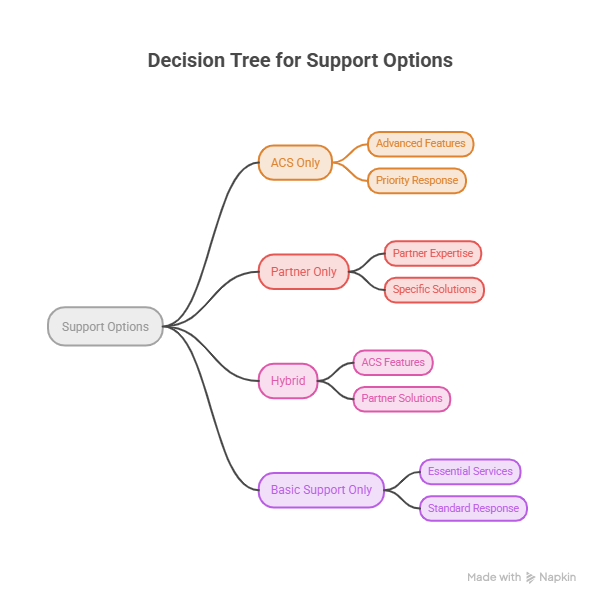
Question 1: Is your NetSuite environment complex?
Simple environment (standard modules, minimal customization): Standard or Premium Support covers most of what you need. ACS and managed services both add cost that may exceed the value delivered for a stable, lightly customized environment.
Complex environment (custom scripts, multiple integrations, heavy configuration): Continue to Question 2.
Question 2: Do you have internal NetSuite expertise to direct a support relationship?
Yes, you have a strong internal team: ACS can work. Your internal team provides direction. ACS provides Oracle-level execution and platform guidance. This is the scenario where ACS performs as advertised.
No, you have limited internal NetSuite knowledge: ACS will underperform. It assumes you know what you want from the engagement. Without internal expertise to direct it, calls become status updates rather than working sessions. A partner who starts with discovery and builds a support relationship around your actual needs is the better fit here.
Question 3: Do you need SuiteScript development, integration work, or industry-specific configuration?
Yes: These fall outside ACS scope. A partner managed services engagement is required for any of these, regardless of whether you also keep ACS.
No: ACS may be sufficient if the environment is stable and your needs are advisory and platform monitoring.
Question 4: Is budget predictability a constraint?
Yes: ACS is an annual subscription with defined tiers. The cost is predictable but locked to Oracle’s pricing structure. Partner managed services with fixed-fee pricing gives you equivalent or better predictability, often at lower cost for the same scope.
No hard constraint: Either model works from a budget perspective. Choose on the basis of coverage and fit.
Question 5: Do you run NetSuite OneWorld?
Yes: ACS is often specifically recommended for OneWorld because of the complexity around multi-subsidiary, multi-currency, and tax configurations. Consider keeping ACS alongside a partner if you also have significant customization.
No: The ACS recommendation is less compelling for single-entity environments. Partner-managed services typically cover what you need.
Decision Summary Table
| Your Situation | Recommended Model |
|---|---|
| Simple, stable environment, basic support needs | Oracle Basic or Premium Support only |
| Complex environment, strong internal team, platform guidance needed | ACS plus partner for customization and development |
| Complex environment, limited internal expertise | Partner managed services |
| Need SuiteScript development or integration support | Partner managed services required |
| NetSuite OneWorld with multi-entity complexity | ACS recommended; add partner for customization work |
| Want predictable fixed-fee support | Partner managed services (fixed-fee model) |
| Already on ACS, not getting value, mid-contract | Hybrid: keep ACS, add partner for optimization and development |
| Want one relationship to cover everything | Partner managed services with full-service scope |
The Hybrid Model: When ACS and a Partner Work Together
If you are mid-contract with ACS but still not getting what you need, you do not have to wait it out or walk away. Many businesses run a partner engagement alongside ACS without canceling anything. The two programs cover different things, and used together they fill the gaps neither covers alone.
This works well for businesses that:
- Are committed to ACS through a contract period but have specific development or optimization needs a partner can fill
- Want Oracle’s platform-level monitoring alongside a named partner consultant who knows their configuration
- Run complex OneWorld environments where Oracle-level engagement adds value, but partner-level customization support is also required
The practical role split looks like this:
| ACS Role in Hybrid | Partner Role in Hybrid |
|---|---|
| Platform health monitoring | Custom script development and maintenance |
| Release advisory | Sandbox testing and pre-release fixes |
| Oracle product issue escalation | Integration troubleshooting and monitoring |
| CSM coordination | Named consultant with system-specific knowledge |
| ACS Playbook guidance | Industry-specific configuration optimization |
For a direct comparison of what ACS and third-party support provide at each functional level, our blog on third-party NetSuite support vs Oracle covers the differences in detail.
Cost Comparison: ACS vs. Partner Managed Services
Neither option publishes a standard rate card. Here is what is known from market data.
| Model | Typical Annual Cost | Pricing Structure |
|---|---|---|
| ACS Advise | Lowest ACS tier | Annual subscription |
| ACS Monitor | Moderate | Annual subscription |
| ACS Optimize | $40,000 to $80,000/year (estimates) | Annual subscription |
| ACS Architect | $80,000 to $150,000+/year (estimates) | Annual subscription |
| Partner managed services (basic) | $36,000 to $60,000/year | Fixed-fee or retainer |
| Partner managed services (full-service) | $60,000 to $144,000/year | Fixed-fee or retainer |
The more telling comparison is not the number, but what you get at each cost level. ACS Optimize at $50,000 per year gives you Oracle advisory. A partner managed services engagement at $50,000 per year typically includes hands-on development, release management, integration monitoring, and optimization work. You are paying for guidance in one case, and execution in the other.
For a full breakdown of partner managed services pricing across different scope levels, our guide on NetSuite managed services cost and pricing covers what drives the monthly fee.
How Folio3 SmartCare Fits This Decision
Folio3’s SmartCare program covers the full scope of what a partner managed services engagement should provide, including the areas where ACS leaves gaps.
What SmartCare covers that ACS does not:
- Named dedicated consultant: One person with knowledge of your specific configuration from day one, not a rotating support team
- SuiteScript development: Build and troubleshoot custom scripts as your requirements change
- Sandbox release management: Every custom element tested before each NetSuite update goes live
- Integration monitoring and error resolution: End-to-end across all connected systems, not just the NetSuite side
- Industry-specific configuration: Automotive, apparel, food, manufacturing, and distribution, among others
- User training specific to your processes: Tailored to how your team actually works, not generic platform walkthroughs
- Monthly system health reviews: Documented improvement recommendations delivered on a regular cadence
- Fixed-fee pricing with written scope and SLA: No ambiguity on cost or coverage
Final Thoughts
ACS and partner managed services cover different parts of the NetSuite support picture. The businesses that end up disappointed are usually the ones that expected one to do the job of both.
Three questions determine which model is right for you. How complex is your environment? Do you have internal expertise to direct a support relationship? Do you need development and configuration work, or just advisory?
If the answer to the third question is yes, a partner is required regardless of what else you decide about ACS.
If you want to understand how Folio3’s SmartCare program fits your specific situation, reach out to the team for a straight answer on what fits and what does not.
Not sure which model fits your business? Book a 20-minute call.
FAQs
What is the difference between NetSuite ACS and partner managed services?
ACS is Oracle’s own subscription service covering platform health, advisory, and product-level guidance. Partner managed services covers your specific configuration, custom scripts, integrations, industry workflows, and development work. ACS operates at the platform level. A partner operates at the configuration level. Most businesses with complex environments need both for full coverage.
Should I use NetSuite ACS or a third-party managed services partner?
Use ACS if you have a complex NetSuite environment, strong internal expertise to direct the engagement, and need Oracle-level platform guidance. Use a partner if you need SuiteScript development, integration support, industry-specific configuration, or a named consultant with system-specific knowledge. Use both if you run OneWorld or need Oracle-level monitoring alongside hands-on development support.
Is NetSuite ACS worth the cost?
For businesses with complex multi-entity environments and a strong internal team to direct the engagement, yes. For businesses without internal NetSuite expertise, or those needing hands-on development and configuration work, the cost-to-value ratio often favors a partner managed services program. ACS struggles most when businesses expect it to function as a full managed services replacement.
Can I use both NetSuite ACS and a managed services partner?
Yes. The hybrid model is common and often the right choice. ACS handles platform-level support and Oracle product guidance. A partner handles your specific configuration, customization, and optimization. For businesses mid-contract with ACS that are not getting full value, adding a partner for the work ACS does not cover is a practical path without waiting for the ACS contract to end.
What does NetSuite ACS not cover?
ACS does not cover custom SuiteScript development, custom workflow modifications, third-party integration troubleshooting beyond the NetSuite side, industry-specific configuration, user training on your specific processes, or fixed-fee pricing with a committed development scope. These areas require a certified partner.
How do I switch from ACS to a partner?
You do not have to wait for your ACS contract to end. Many businesses run a partner engagement alongside ACS, using ACS for Oracle-level monitoring and the partner for everything ACS does not cover. If you want to fully transition, a good partner starts with a system audit and a structured knowledge transfer process. Our blog on how to select a NetSuite managed services partner covers the transition process in detail.